



Passover Seder Step #1: Kadeish = the reciting of the Kiddush blessing
Passover Seder Step #2: Urchatz = washing of the hands
Passover Seder Step #3: Karpas = the eating of a vegetable that is dipped in salt water
Passover Seder Step #4: Yachatz = the breaking of the middle matzah
Passover Seder Step #5: Maggid = telling the story of Passover by reciting from the Passover Haggadah
Passover Seder Step #6: Rochtza = washing one's hands for the Passover meal
Passover Seder Step #7: Motzee = making the Bracha of Hamotzi over the matzah
Passover Seder Step #8: Matzah = making the Bracha of Al Achilias Matzah over the matzah, and then eating the matzah
Passover Seder Step #9: Marror or Maror = eating the bitter herbs
Passover Seder Step #10: Koreich = eating the sandwich of matzah and the bitter herbs, known as 'Hillel's Sandwich'
Passover Seder Step #11: Shulchan Orech = eating of the Yom Tov meal
Passover Seder Step #12: Tzafun = eating of the Afikoman (also called: Afikomen)
Passover Seder Step #13: Bareich = saying the Benching (grace after meals)
Passover Seder Step #14: Hallel = reciting of Hallel, which are the Songs or Psalms of Praise
Passover Seder Step #15: Nirtzah = everyone at the Passover seder table asks G-d to accept our prayers
These 15 steps are the basic rituals and customs performed at the Passover meal, but the content of what one uses as vegetables and/or bitter herbs can vary with the country, region of a country, and/or city where Jews reside. One may ask: why are there 15 steps in the Passover seder? The answer may lie with where the number 15 appears in the Hebrew Bible. There were 15 steps leading up to the Temple in ancient Jerusalem, where the Levites, members of the priestly Hebrew Tribe of Levi, would sing 15 psalms from the Book of Psalms, where these 15 psalms were referred to collectively as the Song of Ascents. This was probably either referring to the fact that one 'ascended' to Jerusalem, since it sits atop hills, or to the fact that one 'ascended' to a House of G-d (Temple), or to an altar in the Temple. The connection between the 15 Passover steps and the 15 Song of Ascents lies with the holiness each step represents, leading up to communicating with G-d.
As one moves through the 15 steps of the Passover seder, there is a gradual transition from recalling past tragedies of slavery in the Passover story to discussing the future and the subjects of freedom and redemption. This is achieved by describing the food and wine rituals and the symbolisms they represent in recalling the past and in describing the future. This essentially means that from past sufferings can arise hope, happiness, freedom and justice for all in future times.
For the Passover seder, there are laws stipulating minimum quantities that must be used to fulfill each custom and ritual. For instance, the minimum amount of wine poured in cups, who pours the wine, when wine is drunk other than when one drinks wine during the Four Cups ritual, the amount of matzah eaten from a square piece of matzah, the amount of what position in a chair should one be in (reclining or not reclining) when one eats the koreich, maror, matzah, and the afikoman matzah (regular matzah and the afikoman matzah are not the same in terms of symbolism; they are separate from each other), at what time must one eat the afikoman (especially on the 1st Passover seder night), the amount of horseradish and matzah used in making the koreich, the positioning of a piece of afikoman matzah relative to other pieces of afikoman matzah on the table, when people can talk and when people are not permitted to talk as the 15 steps are performed, the amount of maror used depending on the type of maror used, and the amount of maror eaten per person. Now, with so many rules to follow before and after the Passover meal is served, you've just discovered the secret why us Jews like to eat!
There are 7 main symbolic foods on the Seder table that remind the Jewish people of their time of slavery in Egypt. This Seder plate shown below displays in Hebrew the names of each of the foods.
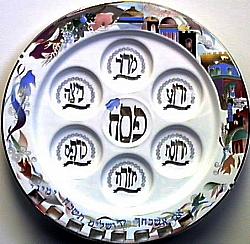
in no particular order:
Passover Symbolic Foods #2: Charoseth (also: Haroseth, Charoset, Haroset): A mixture of crushed nuts, apples, cinnamon, and honey, which symbolizes the mortar the Hebrew slaves in Egypt used in constructing buildings for the Pharaoh. The sweet taste of charoset is also supposed to take the sting out of the bitter taste of the maror, both literally and symbolically. Although the composition and mixture of charoset represents the bricks and mortar used by the Hebrews, the sweet taste of charoset represents the sweet taste of freedom that overtakes the bitter taste of maror, which represents slavery. The movement from slavery to freedom also refers to a transition from depending on other cultures to survive to depending on one's own self and one's own group to survive and self-govern.
Passover Symbolic Foods #3: Beitzah (also: Beitza, Baitzah, Baitza) - Roasted Hard Boiled Egg: A roasted hard-boiled egg is primarily used to symbolize the first Passover sacrifice of the lamb. This sacrifice was eventually performed in the first and second Temples in Jerusalem, but since the destruction of the second Temple in Jerusalem in 70 C.E. (or A.D.) by the Romans, the roasted hard-boiled egg was decreed by Rabbinical authorities to replace the Passover sacrifice of the lamb. The egg also symbolizes mourning for the destruction of the second Temple by the Romans in 70 C.E. Other symbolic meanings represented by the roasted hard boiled egg include Springtime - when the first Passover occurred, the never-ending cycle of life, fertility, and rebirth.
Passover Symbolic Foods #4: Salt Water: The egg is dipped in salt water which symbolizes both the tears of oppression as well as of joy in freedom. A small cup of salt water is set apart from the Passover seder plate.
Passover Symbolic Foods #5: Maror (also: Marror, Morror, Moror): This is very bitter horse-radish that symbolizes the hardships of slavery. It is very strong. I mean it. It makes my face red, my eyes tear and clears my sinuses!!!! Some communities place a second maror on the Passover seder plate called chazeret which is used for making Hillel's sandwich. The chazeret must not be the same type of bitter vegetable as the karpas.
Passover Symbolic Foods #6: Karpas: This is a mixture of boiled potatoes or radishes, and parsley which is dipped in salt water and symbolizes the undernourishment of the Hebrew slaves, as well as the new Spring season.
Passover Symbolic Foods #7: Z'roah (also: Zeroah, Zeroa): This piece of meat, sometimes represented as a shankbone, is not eaten but instead serves as a reminder and symbolizes the Paschal lamb and its sacrifice by the Hebrews. It also refers to G-d's rescuing of the Hebrews from Egyptian slavery.
The Passover seder not only symbolizes a Feast of Freedom from slavery, it also represents a reminder of gratitude for maintaining faith in one's beliefs. The leader of the seder sits at the head of the table, and then washes his/her hands to symbolize a new beginning or 'passing over' from slavery to freedom. The traditional Kiddush is recited by the leader of the seder, and involves the blessing over wine to G-d for having been taught the lesson of Passover, and its meaning of faith in one's beliefs. The matzah is broken into two pieces, not of the same size, and this splitting represents the parting of the Red Sea. The larger portion is called the Afikoman (also called: Afikomen) and is placed under a napkin and the smaller portion is put between the other matzot. This is followed by an announcement from the seder leader to people at the seder table to join around, and have a piece of the Matzah, also known as 'the bread of affliction'. Interestingly, the word 'afikoman' is of Greek origin, and means 'after-dish' or 'that which is coming', meaning 'dessert' in the Passover meal. Some have thought it to mean 'he who is coming', because in the Jewish tradition, the Messiah will arrive at Passover to bring redemption to the Jewish people, and that is why a place at the Passover seder table is kept for the Prophet Elijah, who is the forerunner of the Messiah according to the Book of Prophets.
The Four Questions
Traditionally given to the youngest person at the seder table (usually the youngest child) to read aloud, the Four Questions are a short but complete overview of the story of Passover as told in the Passover Haggadah, or Book of Passover, which is given to each person at the table. It illustrates the uniqueness of the Passover holiday, as compared to other times of the year. The famous question that opens the recitation of the Four Questions is: "Why is this night different from all other nights?" In Hebrew, this is translated as: "Ma Nishtana" (alternate spelling: "Mah Nishtanah"). The four questions are then recited by the youngest person at the Passover seder table. They include: 1. "On all other nights we eat bread or matzah, but on this night we eat only matzah. Why?"; 2. "On all other nights, we eat all kinds of herbs, but on this night we eat only maror. Why?"; 3. "On all other nights, we do not dip even once, but on this night, we dip twice. Why?"; and 4. "On all other nights, we eat either sitting or reclining, but on this night, we eat reclining. Why?". The answer for each question describes specific events in the Passover story and the symbolic meaning of each of these events in relation to the Passover holiday. The first two questions and their answers both symbolize and remind us of the burdens of slavery, and the second two questions and their answers both symbolize and remind us of the glory of freedom.
Answer to the first question: We eat only matzah because our ancestors could not wait for their breads to rise when they were fleeing slavery in Egypt, and so they took the breads out of their ovens while they were still flat, which was matzah.
Answer to the second question: We eat only Moror, a bitter herb, to remind us of the bitterness of slavery that our ancestors endured while in Egypt.
Answer to the third question: We dip twice - (1) green vegetables in salt water, and (2) Moror in Charoses, a sweet mixture of nuts and wine. The first dip, green vegetables in salt water, symbolizes the replacing of tears with gratefulness, and the second dip, Moror in Charoses, symbolizes sweetening the burden of bitterness and suffering to lessen its pain.
Answer to the fourth question: We recline at the seder table because in ancient times, a person who reclined at a meal symbolized a free person, free from slavery, and so we recline in our chairs at the Passover seder table to remind ourselves of the glory of freedom.
As you can see from the above-mentioned rituals and customs, Passover is full of symbolic representations and meaning, some that symbolize slavery, and some that symbolize freedom, and still others that describe the passage from slavery to freedom. My personal interpretations of these rituals and customs are that freedom in and of itself has little meaning unless it is contrasted with a situation in which one is not free. It is the passage from slavery to freedom which gives meaning and feeling to what the essence of freedom really is, be it being a slave under a harsh regime, or a slave to a problem one has in one's daily life. The main point here is to be aware, acknowledge, and feel grateful for whatever freedom one has in life, as opposed to what one might have otherwise been 'enslaved' in, and to use that freedom to enhance oneself, and in turn, both you and the world around you will also be enhanced in the process. From this awareness, acknowledgement, and gratitude for what one has comes the next step one can practice: meditating on feeling faith that one will receive answers that will help contribute to managing or solving one's personal challenges that can 'enslave' oneself. By feeling faith that beneficial and constructive answers for oneself will come when the time is right, one frees oneself from their preoccupation or 'enslavement' by being aware that they have chosen to be in control of their own destiny in the face of their personal challenges - be they vis-�-vis objects, situations, other individuals, or groups - rather than choosing to remain 'enslaved' by obstacles in their path. This is what I mean when I refer to how the ancient message of Passover helps individuals to help themselves enhance their 'freedom in faith': freedom in the knowledge that one will either manage or overcome challenges by having faith that the answers to those challenges will appear in one's mind in due time. In the Jewish religion, it is believed that all human beings are created in the image of G-d and that G-d loves, cares for, and will help his creation. From this knowledge, a Jewish person merely has to look inward to discover the unique answers for oneself that G-d gives when it comes to managing or solving a challenge, just as the Hebrews called for help from G-d to obtain their freedom from slavery in biblical times as told in the Passover story.
The Four Sons
The story of the Four Sons is also read at the Passover seder table. Each of the four sons symbolize a different type of Jewish person. One son is wise, another is simple and indifferent, still another is wicked, and the final one is very young in age and silent. The wise son inquires about why the Jews practise the customs of Passover. Those assembled at the passover seder table respond in unison, describing this son as wise, since he wants to know more about the Passover traditions of his people. The simple and indifferent son asks in more general terms what is all this he sees at the Passover seder table. Those at the Passover seder table respond by educating and reminding the simple and indifferent son about G-d's favors toward the Hebrews during the time of slavery in Egypt, and the importance of remembering them, and remembering with gratitude. The wicked son wants no part of the Passover traditions and asks why the Jewish people - other than him - practise the customs of Passover. Those at the Passover seder table respond by describing this son as wicked, since he thinks Passover customs are meant to be practised by other Jews, but not him. Finally, the young and silent son is simply told about the Passover story in accordance with the biblical command: "And thou shalt tell thy son in that day, saying: it is because of that which the Lord did for me when I came forth out of Egypt". The story of the Four Sons reflects different perspectives of Passover and teaches that no matter what view one has about the Passover holiday, the meaning of the Passover holiday is the same in response to each view: that one should remind oneself and feel grateful for the deeds done by G-d for the Hebrews so long ago.