Claudia Linsley For the Enquirer
They have cleaned and stocked the cupboards and refrigerator with only kosher foods. They
have marked favorite recipes in the "Jewish Holiday Kitchen" cookbook. And "The Family
Haggadah" is off the shelf and onto the table.
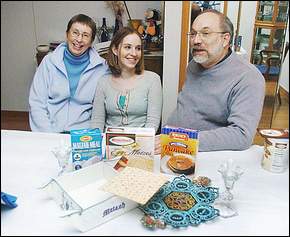
Cindy Wagner and her husband, Larry Kaiser, are ready for Passover, the Jewish holiday
beginning at sundown Monday and lasting until sundown April 10.
"Spiritually, it's uplifting for me. It's a time of unity and family ... and just thinking about the fact
that Jews around the world are sitting down to do the same thing ... that inspires me," said Kaiser,
57, of Battle Creek.
On Passover, they remember the divine deliverance of the Israelites from their captivity in Egypt.
Led by the shepherd Moses, Jews escaped the Pharaoh's rule, crossing the Red Sea to gain their
freedom.
The holiday is second in significance only to Yom Kipper, the Jewish day of atonement
observed this fall.
The Wagner-Kaisers said they've treasured the eight-day holiday with their children. Rachel, 18,
attends Vassar College in New York and Jeremy, 21, goes to the University of Michigan.
During Passover, Jews are supposed to toss out grains and yeast-based foods, such as bread and
crackers. Jews are forbidden to eat them, in memory of their enslaved ancestors, who didn't have
time to bake bread when they fled Egypt.
For Wagner, 49, the hardest part is going without breakfast cereal.
"It changes the way you live your life on a daily basis ... and that makes you mindful of Passover,"
she said.
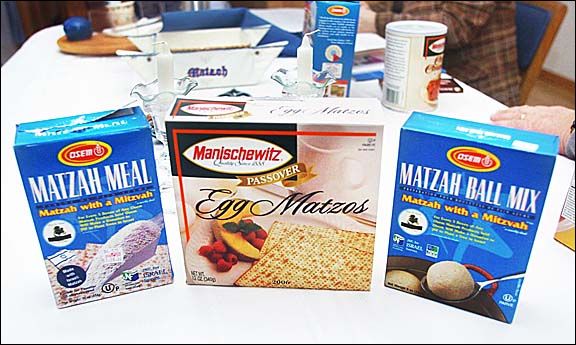
They usually shop for Passover in Ann Arbor, which has a large Jewish community. Candy, cola
and even chocolate bars are available in grocery kosher food aisles.
Wagner learned to be creative when preparing school lunches for her kids during Passover.
"You can't just put in peanut butter and jelly sandwiches," she said.
That meant lots of fruits and vegetables, and lots of matzah � unleavened crackers � for lunch,
Rachel Wagner-Kaiser said.
The Seder always has been a joyful event for the family. On the first night of Passover, they hold a Seder at home. They join on the second night with other members of Temple Beth El, Battle
Creek's Reform Jewish synagogue, for a community Seder.
Their home Seder is informal and casual, with as many as a dozen people, including non-Jewish
friends.
"It's great fun to hear the story and have the dinner," said Janet Chichester, a Christian who has
attended their Seders. "There are readings, songs and Psalms ... It's nice to have a ritual that goes
back that far."
The family's Seder often lasts more than 90 minutes, so "you don't plan anything else on those
nights," Kaiser said.
They've used elaborate and simple Haggadahs as Seder guidebooks.
"And some are quite traditional, while others have more current connections," such as readings
about women's rights, Kaiser said.
"Passover is a family holiday," he said. "Nothing has to be done at the temple."
Seder dinners include six foods representing the Passover story: a hard-boiled egg, horseradish,
bitter vegetable, parsley, a shank bone and charoset, a mix of apples, nuts and wine.
"And whatever else you bring to the table depends on where you came from," Larry Kaiser said.
Ashkenazi Jews with German and Eastern European ancestors choose different menus than
Sephartic Jews, whose roots are in Spain or Portugal.
The Wagner-Kaisers' favorites are turkey or roast chicken, gefilte fish, red potatoes, beef roast,
brisket, fresh asparagus, and desserts, such as a chocolate souffl�.
"We've just had fun with it, especially when the kids were small," Kaiser said.
"We just include whatever is happening. One time someone came to the door, and we included
them too."
He talked about the "silly traditions," such as hiding the afikoman � the half-matzah set aside early
in the Seder � so the children have to find it.
"I would always be the one who couldn't find it," Wagner-Kaiser said. "At the time it seemed so
unfair. But now it's kind of funny."
Sometimes adults rewarded the winner with cash or prizes.
When the family sings the repetitive songs near the Seder's end, they try to finish in one breath.
That really speeds things up, Wagner said. "Then, you end up singing them around the house
afterward, which is kind of nice."
Of course, the main part of a Seder is reading the Passover story, Kaiser said, and considering its
more sobering themes of affliction and redemption.
"Redemption and freedom from slavery are still possible today," Wagner said. "People are still
enslaved and oppressed."
Originally published April 1 , 2007