NYU-UN-FRTL-A5
|
NYU-UN-FRTL-A5 |
|
||
|
|
|
||
An Assessment of The Environmental Agenda of the UN in Light of the Rio Declaration
by
Finn Longinotto
New York University
For
Ambassador Ahmad Kamal
November 25, 2002
“An Assessment of the Environmental Agenda of the UN in light of the Rio Declaration”, Finn Longinotto
Table of Contents
| Page | |
| Introduction | 3 |
|
Chapter I Historical Background of the UN’s Environmental Agenda |
3 |
|
|
| Chapter II The 1992 Rio Declaration | 6 |
|
|
| Chapter III Evaluation of UN’s Environmental Agenda | 10 |
|
|
| Chapter IV Political Factors | 12 |
| Chapter V The Future | 14 |
|
|
| Conclusion | 15 |
| Appendices | 16 |
| Bibliography | 18 |
2
“An Assessment of the Environmental Agenda of the UN in light of the Rio Declaration”, Finn Longinotto
Ten years ago the United Nations Environmental Program’s (UNEP’s) Rio Declaration called for priority to be given ‘the most environmentally vulnerable developing countries’. This paper gauges the extent to which such priority has been granted and examines its future implementation.
Chapters I - II lay down the facts [1] surrounding the UN’s Environmental Agenda, while Chapters III - V attempt to provide a critical analysis of the relevance, success and failure of the agenda over the years, with a view to the health of the planet as a whole and, secondly, with reference to disparities between the developed and undeveloped world. The conclusion is that the record has been patchy but there is still hope for the most vulnerable countries.
Historical Background of the UN’s Environmental Agenda
Global Environmental Problems
Awareness of global environmental [2] problems has risen considerably among the peoples of the world, particularly over the past decade. These are problems common to the whole planet - what Ramphal [3] refers to as ‘the tragedy of the commons’ - such as pollution of the global atmosphere and the depletion of ocean fisheries, which stem from ‘the overuse of common environmental assets’. Environmental problems are myriad, but since this paper focuses on the landmark Rio Declaration of 1992, it is worth itemizing the six major areas brought up at the conference in Rio; they will be summarized in a later section:
Chlorofluorocarbons (CFC)
Carbon Emissions
Hazardous Waste (HW)
Endangered Species
Biodiversity
Desertification
_________________________________
[1] Main source: Ziring L. & Riggs, R, and Plano, J, (2000). The United Nations – International Organization and World Politics. Orlando: Harcourt College Publishers.3
“An Assessment of the Environmental Agenda of the UN in light of the Rio Declaration”, Finn Longinotto
Environmental problems of the developed world
As we have noted, by definition the global environmental problems indicated above are common to all countries, rich and poor. However, developed countries pay more regard - one might say they have the luxury to do so - to alleviating these problems than do developing countries. For example, air quality has improved in many large cities, such as Los Angeles, which used to be characterized by its heavy smog not so many years ago. Mexico City has improved somewhat, while Shanghai is getting worse. Even current smoking bans, which are scoffed at in many lesser developing countries, can be seen in this light. Along with a concern for clean air goes a concern for clean water, perceived as the first barrier against a host of communicable diseases. The UN’s focus has mirrored that of the developed world, where any environmental legislation has been ‘largely oriented around protecting people and their health ’.[4]
Environmental problems of the developing world
In their scramble to catch up with the industrialized world, developing countries tend to accord lower priority to environmental regulation, which itself may not be enforceable because of graft and corruption, lack of funds, or ignorance on the part of local authorities. As a result, buses in these countries often spew clouds of fumes, industrialized plants pour contaminated waste water into local rivers and the idea of recycling is a fantasy. Fast population growth exacerbates poverty, which in turn puts the most pressure on the environment in developing countries, as poor people over-exploit the forests to survive. A vicious circle is created, as they further undermine the very resource base - the forest - on which their well-being and survival depends.[5]
Impact of a borderless world
It has been said that in today’s world money is fungible. Investment will flow to where it can obtain the greatest return for a given level of risk. Similarly, in a world without national borders, corporations and, to a degree, governments, will dispose of waste where it is cheapest. Many environmental problems in the developing countries are brought on not by human practices of the native
_________________________________
[4] In the U.S. the Endangered Species Act, protecting nonhuman life was a rare exception. Dowie, Mark, (1995). Losing Ground – American Environmentalism at the Close of the Twentieth Century, Massachusetts Institute of Technology4
“An Assessment of the Environmental Agenda of the UN in light of the Rio Declaration”, Finn Longinotto
populations, but by outsiders. Strict environmental laws in developed countries prompt these countries to export toxic waste to poorer countries. The receiving countries need the money, as well as the employment opportunities, and are often unaware or reluctantly receptive of the negative impact on their own environment. In fact, were these countries left to their own devices and not used as cheap dumping grounds for the richer nations, their relatively simple way of life would leave little impact on their habitat.
Chronology of UN conferences and agreements on the environment
Although the UN was founded in 1945, the priorities dictated by the aftermath of World War II have led to the organization giving little heed to problems of the environment, which, in all fairness, were not so acute then as they are now.[6] The first environmental activists in the UN, if they can be so characterized, wrote a report in a small town outside Geneva, Founex, in 1970, stating that the environment should be put on the front of the UN agenda. This was followed, in 1972, by the Stockholm Conference. However, timing was poor and there was little follow-up. Nevertheless, one major outcome of the conference was the proposal to create a permanent UN agency, the United Nations Environment Program (UNEP), which came into being in 1973.[7]
With escalating population growth continuing worldwide, especially in the less developed countries, and the concomitant deterioration of the local and global environment, awareness of the problem grew too. It was not until 1985-86, then finally in 1987 with the report of the Brundtland Commission,[8] that the historic step was taken to link the environment with development, giving birth to the concept of sustainable development. The next big event was the Rio Conference in 1992, which will be examined in more detail. Timing was more fortuitous than for Stockholm. The break up of the USSR and the subsequent winding down of the Cold War led to a de-emphasis on Peace and Security, at least between the major power blocs, allowing the UN to pay more heed to the environment. A number of environmental bodies subsidiary or related to the UN came into being around this time.
_________________________________
[6] Thanks to the efforts of Eleanor Roosevelt, Human Rights received mention in the UN Charter, particularly in Article 13, paragraph 1.b., but not the Environment, though it falls within the sphere of Social and Economic Development, which lacked the priorities given to Peace and Security.5
“An Assessment of the Environmental Agenda of the UN in light of the Rio Declaration”, Finn Longinotto
Some, such as the UNFCCC,[9] were direct offspring of the 1992 Earth Summit in Rio de Janeiro. Others include the Ozone Secretariat, Secretariat of the Convention on Biological Diversity (CBD), Secretariat of the Convention on International Trade in Endangered Species of Wild Fauna and Flora (CITES), bodies on migratory species, hazardous waste, desertification, and wetlands. Details are to be found in the UN annual handbook.[10]
Concurrently, within the environmental movement itself, a realization has come about that humans and their communities are also part of the environment, and so worthy of protection along with wilderness and nature. Parallel, we have seen the concept of environmental justice mesh the distinction between human rights and the environment. Consequently, over the past 15 years there has been a shift in focus, allowing both these issues to be addressed in the UN, although the funds available have not risen accordingly.
Terms of the Rio Declaration
The Rio Declaration was the result of The United Nations Conference on Environment and Development (UNCED) held in Rio de Janeiro from June 3 to 14, 1992. The many chapters of Agenda 21, which set the goals of the conference, deal with aspects such as combating poverty, human health, government and a great many related topics which are not the subject of this paper. As the conference’s name, UNCED, implies, both environment and development were on the agenda together and are treated as such, always with regard to the impact on humans.[11] In fact, the first sentence of Principle 1 (from a total 27) of the Rio Declaration reads “Human beings are at the centre of concerns for sustainable development.” So as to limit the scope of this paper, only Principle 6 is being considered, in recognition that it cannot exist in isolation.
_________________________________
[9] Secretariat of the UN Framework Convention on Climate Change [10] United Nations Handbook, 2002, New Zealand Ministry of Foreign Affairs and Trade6
“An Assessment of the Environmental Agenda of the UN in light of the Rio Declaration”, Finn Longinotto
Principle 6 of the Rio Declaration
Definition
The text of Principle 6 reads as follows: “The special situation and needs of developing countries, particularly the least developed and those environmentally vulnerable, shall be given special priority”. It goes on to say that international actions should also address all countries. No clarification is made, here at least, of exactly what is meant by ‘special situation and needs’. My interpretation would be that it is intended in the same euphemistic way that ‘special education’ or ‘Special Olympics’ is meant, i.e. for the economically handicapped. Those ‘most environmentally vulnerable developing countries’ would seem to be those which are most threatened by environmental pressures, as well as those unable or unwilling to take the counteracting measures, envisaged in the spirit of the conference.[12]
Summarized briefly here are the six broad environmental concerns discussed in Rio, mentioned earlier. They are global in perspective, since they affect us all, but regional or national in implementation:
1. Chlorofluorocarbons (CFC), though banned from use internationally, are still used extensively in refrigerators and air-conditioning units in automobiles, as well as in spray cans as propellants.[13] Because of ready availability and, therefore, low cost, CFC’s use is so widespread, particularly in the less developed world, that the ban cannot be effectively enforced. Meanwhile, the CFC’s in our atmosphere continue to rise, pushing back the ozone layer which protects us from the more harmful rays of the sun, so leading to what have become known as ozone holes. These holes are especially evident in the southern hemisphere.
2. Carbon Emissions, in the form of carbon monoxide (CO1) and carbon dioxide (CO2), from the burning of fossil fuels such as coal and oil products in cars, have created a film around the earth. The creation of CO2 emissions far exceeds the ability of trees and other plants to absorb them.
_________________________________
[12] Excluded here are developed countries which may similarly be unable or unwilling to take measures for internal political reasons.7
“An Assessment of the Environmental Agenda of the UN in light of the Rio Declaration”, Finn Longinotto
As a result, we are experiencing what is commonly referred to as global warming. The resultant rise in temperature is accelerating the melting of icecaps, so raising the water level, and interfering with the planet’s weather and wildlife in devastating ways.
3. Hazardous Waste (HW), such as mercury from discarded batteries, seeps into the earth, gets into the water, becomes concentrated and can find its way into the food chain through fish. An awareness of this, and legislation against improper disposal of HW [14] in the developed world has has given birth to the traffic of HW from the developed to the developing countries. As a result of this trade, as well as the location of polluting industrial plants in poorer communities within the developed countries themselves, we are witnessing growing interest in the concept of Environmental Justice.
4. Endangered Species have been subject to some national and international regulation, as noted in footnote 4. Internationally such regulation has come about primarily when rare species are found to have been exported, which is forbidden by the UN’s Convention on International Trade in Endangered Species (CITIES or CITES). Unfortunately, this well-intentioned and largely successful convention is often circumvented by imaginative poachers. Oran Young puts the problem clearly, “it is not easy to imagine how to implement a regime requiring that individual members take effective steps to control the forces causing habitat destruction within their jurisdictions. Similar problems will undoubtedly afflict the ongoing effort to develop a workable regime to protect biological diversity.” The areas are simply too large geographically to control.
_________________________________
[14] The Basle Convention on the Control of Transboundary movements of Hazardous Wastes and their Disposal (The Basle Agreement), which stipulates proper disposal, is largely ignored, for example in China where old TV’s are imported from the West and disassembled for parts without regard for the mercury runoff.8
“An Assessment of the Environmental Agenda of the UN in light of the Rio Declaration”, Finn Longinotto
Perversely, CITES has also reduced the effectiveness of field research of rare fauna and flora in those countries too poor to have their own research facilities. This situation has arisen because of bureaucratic obstacles to exporting samples, as well as local extortion.
5. Biodiversity, meaning the richness of species, has long been recognized as important to preserve. Many of the earth’s remaining rainforests, threatened by logging, not only offer the best option for absorption of CO2 and tempering weather patterns, but contain more diverse species per square mile than any other habitat.
6. Desertification of once fertile areas is increasing as burgeoning human populations put pressure on the few remaining forests, and the cycle of unrestrained rain flows and subsequent soil erosion set in.
Implication
The implication of the focus on the most vulnerable countries, environmentally, for simplicity the poorest, was that without some assistance from other countries, through the mechanism of a world body such as the UN, these countries would undergo even more degradation. Spill over to the economic sphere would be inevitable and the countries could degenerate completely, becoming what is known as ‘failed states’.
Some countries targeted by Principle 6
Many of the countries that fit the description of Principle 6 are in Africa, particularly in Sub-Saharan Africa, such as Mali and the Sudan, but a few, such as Haiti are elsewhere. Some idea of the magnitude of the problem in Sub-Saharan Africa is gleaned from 1994 data of the World Bank, quoted by Dani Rodrik,[15] see Appendix A, which shows the per capita growth rates - often declines - of forty-three countries in the region from 1960 through 1994. They are, largely speaking, overpopulated resource poor countries which development has left behind. Abject poverty leads to even greater environmental damage. If anything, the disparity between rich and poor has increased, so they are worse off now, comparatively, than they were in 1992.
_________________________________
[15] Rodrik, Dani (1999). The New Global Economy and Developing Countries: Making Openness Work. Johns Hopkins University Press, Overseas Development Council, Washington, DC9
“An Assessment of the Environmental Agenda of the UN in light of the Rio Declaration”, Finn Longinotto
As Oran Young [16] points out, “the disparate circumstances of the advanced industrialized countries of the North and the developing countries of the South” is something that we have not been able to change. Young puts this down in part to the low bargaining strength of the less developed countries.
Evaluation of UN’s Environmental Agenda
Environmental Budget of the UN
The funds allocated to UNEP are allotted by the members of the UN. Over the twenty five year period from 1973 to 1998 UNEP’s annual budget grew from $20 million to $100 million. However, this amount still falls far short of the agency’s requirements, allowing for only about 200 total staff worldwide.
Before Rio Declaration
The reasons that developing countries, particularly the poorest, have lagged in tackling their environmental problems have been alluded to earlier. There is a lack of funds, accentuated by the lower priority accorded the environment because of more pressing needs. With a hand-to-mouth existence, citizens of these countries cannot identify with these less pressing concerns of the developed world. In this environment, and considering the bureaucratic nature of the organization and its pre-set priorities elsewhere, the UN’s record is not that poor. Even in the absence of tangible results, much of the credit for drawing attention to environment, as well as human rights abuses, goes to the UN.
The whole history of environmental thinking over the past 200 years has its roots in the (largely English speaking) nations of the developed world. Most progress, in terms of legislation has been in these countries and in Northern Europe, which has English as a second tongue. This is not to say that the practical applications of an environmental ethic have been disregarded elsewhere. In many instances, the opposite is true, and certain favorable environmental legislation has been put in place. Nevertheless, generally sound
_________________________________
[16] Young, O. (1994). International Governance: Protecting the Environment in a Stateless Society. New York: Cornell University Press.10
“An Assessment of the Environmental Agenda of the UN in light of the Rio Declaration”, Finn Longinotto
lifestyles, from an environmental perspective, have been disrupted by the onslaught of Western civilization, while environmental legislation has taken aback seat. Even developed and developing countries in Asia, with rich cultural traditions, have in earlier centuries lived with a more benign and respectful attitude toward their environs, long before any UN Agenda, because their civilizations relied less on unbridled consumerism.
After Rio Declaration
In the environment, as well as other areas, the hands of the UN, UNEP and subordinate organizations, have been held back by the underlying idea of sovereignty, and the right of states to do what they like within their own borders. As concern for the environment tends to go hand in hand with development, it should be possible to foresee how long it will take a country to reach a higher level of environmental awareness, as long as the country in question is on the path of development. Unfortunately, this caveat excludes some of the countries mentioned, which are far from being on this path, usually designating the little money they have to servicing debilitating debts to more developed countries and international organizations.
Donald Wells, [17] of West Georgia College, writes that the developing countries “place a high value on the use of resources for present consumption and a relatively low value on future conditions.” Thus the need to provide basic essentials was evidently a significant reason for “the posture of the Third World leadership on environmental questions . . .certainly given forceful articulation at the Rio Conference.” But this ‘forceful articulation’ does not appear to have been constructive, nor do the poorer countries appear to have improved their bargaining positions by jointly pushing all their points home. At the same time, the all important issue of money and how the ambitious agenda of the Rio Declaration was to be paid for was never mentioned.
_________________________________
[17] Wells, D., (1995). Environmental Policy: A Global Perspective for the Twenty First Century. Prentice-Hall, Inc, New Jersey. Both quotes from here. Efforts to quantify this pre-occupation with the present in the environmental policy area include Donald Wells’ Cultural Discount Rate (CDR)11
“An Assessment of the Environmental Agenda of the UN in light of the Rio Declaration”, Finn Longinotto
UNEP’s own assessment suggests that follow-up on the Rio Declaration fell short for these reasons:
Inadequate and fragmented institutional arrangements
Inadequate policy coordination
Inadequate mechanisms to translate the existing commitment into action
Inadequate resources -international organizations, multilateral financing, private, etc.
Without agreed-upon targets and budgets with which to reach them, the Rio Declaration lost momentum in its implementation. Ramphal put the problem for the future most succinctly when he said that there was “a lack of direction where to go next.” To quote more fully, “countries facing the most compelling threats to sustainability are generally those with the least capacity - institutional and financial - to deal wittth them. Implementation of Agenda 21 is therefore inextricably bound up with the issue of additional resources for development.” The same can be said for improving the environment, and bringing about the change in industrial practices and individual lifestyles which are needed.
Behind many poor countries’ week economic situation and dependence on developed countries lies the fact that they have little to offer of real economic value. These countries’ economies are based largely on the export of commodities, such as grains and ores, whose prices have fallen relentlessly over the years. There is no money to invest in plant, equipment and training for the more value-added products from these very commodities. As we have seen, this situation is further aggravated by high population growth, resultant malnutrition and low life expectancy. Simply put, the cycle cannot be broken without outside help.
Politically, often lacking solid democratic institutions, these countries fall prey to their own power-hungry strongmen. The authoritarian regimes, not representing those they govern, have no credibility and legitimacy. Being separated from the people, they resort to draconian and repressive means to govern. A governing elite is formed and the gap grows further between this elite and the population. Legitimate environmental concerns are swallowed along with other concerns by the greed of their own leaders, not to
12
“An Assessment of the Environmental Agenda of the UN in light of the Rio Declaration”, Finn Longinotto
mention the foreign corporations which sustain this elite. Only if the many developing countries act with one voice can they achieve bargaining power comparable to the West’s.
Global impact of failure to respect the spirit of Principle 6
The potential hazards to humankind of what has been called Macdonaldization of our planet, that is runaway consumerism, combined with the ever increasing gap between rich and poor nations, have been well documented. Of course, there will always be contrarians who believe the situation is not deteriorating that much, for example, that air and water pollution is not getting any worse. One such contrarian, is the Danish statistician (note, not environmentalist or scientist), Bjørn Lomborg, [18] who should be mentioned if only because he has drawn such attention.
Reasonable expectations for the future in light of:
Global environmental situation and creeping consumerism
One area in which Lomborg does appear to be on target is the distinction between perceived and real environmental problems. We know that some earlier alarmists, among them Malthus, [19] have so far been proved wrong on a global basis because of their inability to predict the huge technological advances that have increased food productivity beyond population growth. On a national level, countries without the means to acquire the technology still suffer, as we have seen. Meanwhile, most of us believe that non-renewable energy sources, which have not yet been replaced by other technologies are, by definition finite, not infinite.
The distinction between a community’s perception of its immediate environmental problems and the environmental problems of their country as a whole, and with those of the world, are best illustrated by Lomborg’s summary if a 1992 (Gallup) poll,[20] attached in Appendix B.
_________________________________
[18] Lomborg, Bjørn (2001). The Skeptical Environmentalist, Cambridge University Press, originally published in Danish in 1998 as ‘Verdens Sande Tilstand’, The World’s True Situation13
“An Assessment of the Environmental Agenda of the UN in light of the Rio Declaration”, Finn Longinotto
In 16 of the 24 countries surveyed, the environment was named as one of the three most important problems, and more than 50% of all respondents said they were concerned about environmental problems. Only 10% of Norwegians and Irish viewed their local community’s environmental problems as very or fairly bad (more than a coincidence that the former today still stays out of the European Community and the latter is reluctant to let others in).
In the large majority of the countries surveyed, the citizenship believed that the global environment was by far the biggest problem, followed by their country’s, while their immediate environment was in the best shape. Very few people, Nigerians and to a lesser degree Indians, thought their local environment was worse than the world’s as a whole. In addition to these two, only the recently emerging countries of the old Soviet Bloc, back in 1992, as well as South Korea, saw their country’s problems as worse than the world’s. Logically, those rich countries, which view their own problems as less serious than the world’s, should be channeling more funds in that direction, through the UN or some other mechanism. Norway does. A failure to address the problems of others as well as one’s own, can only lead to wider chasms between the environmentally most vulnerable and the more developed countries, at the same time aggravating those environmental problems which are truly global.
Global Compact
At the 1998 meeting of the World Economic Forum in Davos, where world leaders, corporate CEO’s and international organizations all came together, a challenge was made to the private sector. A set of nine principles were developed, in the areas of Human Rights, Environment and Labor, where the corporate world could have an impact. In fact, the companies do not have to do a great deal, simply say that they subscribe to the principles and state once a year what they have done to promote them. Some companies signed on in good faith, others to figuratively wrap themselves in the UN flag, ‘bluewash’ and others to appear to be environmentally sound, ‘greenwash’.
Curiously, although a large proportion of world corporate wealth is made up of American companies, only 20 of the 700 that have signed on today are American.
14
“An Assessment of the Environmental Agenda of the UN in light of the Rio Declaration”, Finn Longinotto
The good has been watered down by the bad, in part because the worst is suspected of an undisclosed membership. So far, then, the Global Compact has not lived up to expectations, and is unlikely to do so until membership is disclosed, American companies put aside their fear of litigation and join and, most importantly, it is made enforceable, something that is difficult to achieve for fear of offending the powerful corporations themselves.
The spiral which has led to the dismal situation of the world’s poorest countries is doing irreparable damage, not only to those countries, but to the planet. In the words of Klaus Töpfer, the Executive Director of UNEP, shortly before the Johannesburg Conference, “This current cycle of economic growth, which we call globalization, is bringing cascading declines in many critical ecosystems around the world.” The pull for ever greater consumerism, especially in those countries that are trying to catch up, combined with the push from a borderless corporate world will increase.
It is, nonetheless, possible for growing environmental awareness to lead to more money flowing to UNEP, which if not reversing the trend, could at least slow it down. If grassroots sentiments are allowed to surface in more democratic ways, both in the developed and developing countries, a national commitment to improving the environment can come about. The political mechanism would follow this commitment. Acting together as a body, ‘the most environmentally vulnerable developing countries’ can increase their overall bargaining positions and take measures to ensure that they are given the top priority intended. There would be a subsequent easing if not suspension of environmental deterioration and, possibly, even a amelioration of the situation for themselves and the world.
15
“An Assessment of the Environmental Agenda of the UN in light of the Rio Declaration”, Finn Longinotto
Per Capita GDP Growth Rates in Sub-Sahara Africa
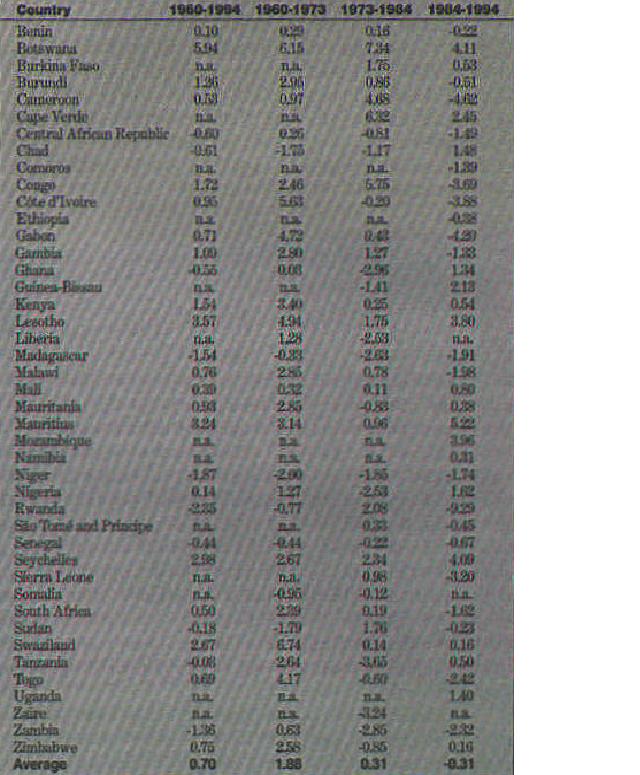
Source: World Bank data, D. Rodrik, Policy Essay No. 24
16
“An Assessment of the Environmental Agenda of the UN in light of the Rio Declaration”, Finn Longinotto
Percentage of respondents evaluating the environmental quality of their local community, nation and world as very or fairly bad
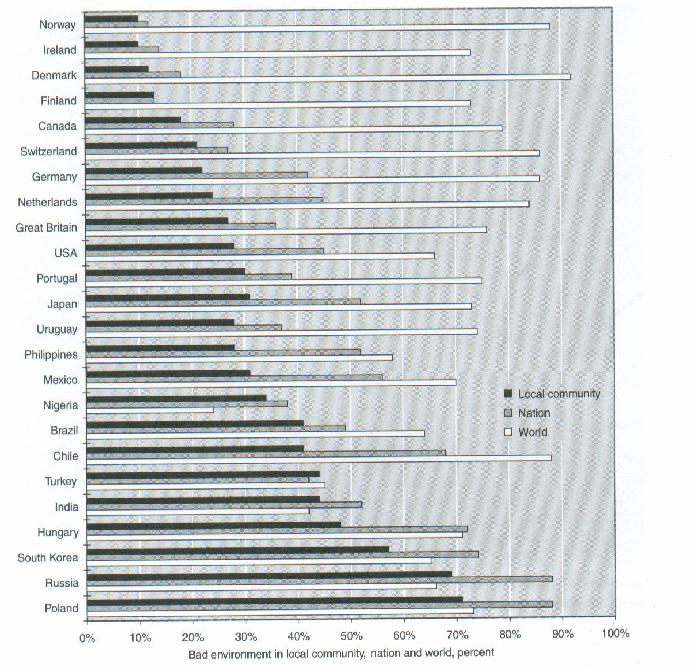
Source: Dunlap et al. 1993:12.
17
“An Assessment of the Environmental Agenda of the UN in light of the Rio Declaration”, Finn Longinotto
Ziring, L. & Riggs, R, & Plano, J, (2000). The United Nations - International Organization and World Politics. Orlando: Harcourt College Publishers.
Dowie, Mark, Losing Ground - American Environmentalism at the Close of the Twentieth Century (1995) Massachusetts Institute of Technology.
Ramphal, S, & Carlsson, I., (1995). Our Global Neighbouhood. New York: Oxford University Press.
Young, O., (1994). International Governance: Protecting the Environment in a Stateless Society. New York: Cornell University Press.
Rodrick, Dani, (1999). The New Global Economy and Developing Countries. Washington DC: Baltimore, MD: Overseas Development Council, distributed by Johns Hopkins University Press.
Wells, D., (1995). Environmental Policy: A Global Perspective for the Twenty First Century. Prentice-Hall, Inc, New Jersey.
Lomborg, Bjørn (2001). The Skeptical Environmentalist, Cambridge University Press

18