 |
|
|
|
|
|
|
|
|
|
|
|
Article Transcribed From
GQ Magazine: May 1982
Article Entitled "Meet Australia's New Leading Men", it featured LFG, Jack Thompson, Bryan Brown and Mel Gibson |
|
|
|
 |
|
|
|
Lewis Fitz-Gerald: Casting for Changes |
|
|
|
|
|
|
 |
|
|
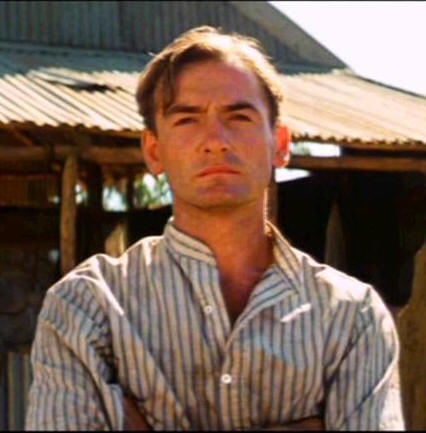
Through a series of lucky circumstances that so often surround a gifted life, Lewis Fitz-Gerald found himself with a principle lead in "Breaker Morant". After finishing high school, Fitz-Gerald was casting about for his role in life. "Initially, I wanted to be an architect until I discovered mathematics, so that was out of the question. Then I wanted to be a marine biologist until I discovered it required physics and chemistry." At the crossroads, a friend suggested that Fitz-Gerald apply to the National Institute of Dramatic Arts. A minor six-line part was available in "Breaker Morant", and director Bruce Beresford liked the young actor. During a series of re-writes, his six lines grew into the major role of George Witton, an idealistic young man with a misguided sense of glory and empire building whose death sentence is commuted to life imprisonment.
Cerebral in character, Fitz-Gerald approaches each role with the intensity of a scholar on sabbatical. Each line and every action must be understood on both an intellectual as well as an intuitive level before he goes before the camera. Above all, Fitz-Gerald acts because he loves it and this love brings a rare vitality to his every performance.
|
|
|
|
|
|
In his current project, Fitz-Gerald, 23, takes on the challenge of a contemporary role, the kind rarely available in Australian cinema. Called "Fighting Back", the film describes the life of an educator committed to the instruction of an emotionally disturbed child, much in the style of Annie Sullivan and Helen Keller. The relationship that develops between the two approaches the turbulence and passion required for breaking interpersonal barriers. The true story is based on a man who wouldn't desert his charges despite pressures from the authorities. As preparation, Fitz-Gerald has studied works by the past centuries great educators. "This is the hardest role. It's difficult to play somebody of your own time. To portray somebody who existed yesterday is almost to play somebody out of myth. You can paint the character with broader strokes. The audience will warm to that broad brush stroke."
Fitz-Gerald is quite proud of the direction Australian films are taking. Despite the distractions of fame, Fitz-Gerald, along with his colleagues, is concerned about forging a new cinema of importance not only to Australia, but to the world. "Our period films have been a necessary process. We've finally exorcised the old ghosts. Now we know what it is to be Australian. Because we're a small industry and not as diffuse as the Americans, we have a far greater number of multi-talented people working on our films. These people are called upon to give 110% of their effort. I think Americans can learn to enjoy the process of film making again. Why do we make these personal pictures? I don't know. I'm just glad we do." |
|