
From previous experiences in the South - West of India and on the Maledive islands they had learned how important it was to bring together the local spirit with the pure muslim faith in a way that did not hurt both. The scholars had studied the Holy Qur`an and the sayings of the noble Prophet Muhammad (s.a.s.) extensively and relating to their studies they all could agree on a special principle: That it was allowable in Islam to keep old customs and concepts as long as these were not directly in conflict with muslim ethics!
Obviously, the wide range of transgender and third gender roles found in many Indonesian societies was not seen as being in direct conflict with muslim ethics. Shafi `i scholars of Indonesia related them to the "mukhannath" and "khuntha" found in the ahadith and in the works of earlier muslim scholars and attributed to them the respect they saw in there.
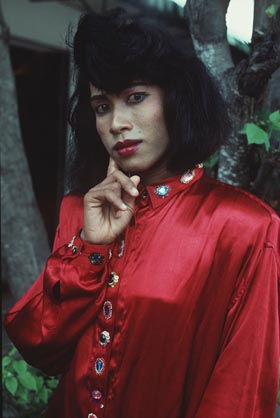
For centuries Indonesian third gender roles survived, they even lived on in the colonial times. The waria, a male to female transgender seen as "neither man nor woman", still exists in Javanese Muslim and Balinese Hindu society up to this day as an integral concept of local culture.
Farther east, among the Bugis of Sulawesi, we find a much more specified view of gender variants. The Bugis are known as strong believers in Islam, many of them can be seen at the Hajj in Makkah every year. Yet, allowed by traditional pre - Wahhabi Indonesian Shafi`i interpretation, they still keep a lot of customs and concepts in which Arab - Muslim and local -pre-Islamic influences mix in a way that is not in conflict with the ethical core of Islam.
Among these concepts we find the terms bissu, calalai and calabai.
The bissu could be roughly decribed as an intersexual ("khuntha") having a special ritual role in Bugis society`s folk- Islam. The calabai is a male born living a female life ("mukhannath"), the calalai a female born living a male life, both having a firm place in Bugis society.
I will outline their special characteristics in the following articles: