A Mythos Reinvented
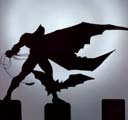
Dennis O'Neil, Neal Adams, and Dick Giordano are the acclaimed "gods" of the Batman world that brought about the neo-image of the Dark Knight Detective in the 1970s (Daniels, p.138). Gold said of O'Neil, "Dennis O'Neil is regarded as one of the (if not the) leading Batman writers of the post-television period, whose work did much to establish the 'darknight detective' characterization dominant for the past twenty years" (p.13). This team of three single-handedly created the Batman 'mythos', the idea of Batman as an urban myth. Frank Miller, working underneath these great men, wrote the two main graphic novels that set up the "mythos" and set the modern ground rules for the Dark Knight. These were Batman: The Dark Knight Returns (TDKR) and Batman: Year One. The idea of the "mythos" relates back to why Bruce Wayne chose to portray the symbol of the bat in the first place. Taking the words directly from Bob Kane, they had Bruce reason that "criminals are a cowardly, superstitious lot" (Daniels, p.1-2). He needed a persona that would strike fear into them at the mere mention of his name. In answer to his plight, a bat flew through a window in his study. O'Neil and his crew decided that the bat image would only be effective if he appeared at nighttime to make him a creature of the darkness, moving in and out of shadows to strike crime at it's core. Criminals who encounter the Bat meet him so briefly that they wouldn't sure if he was human or supernatural. Those citizens lucky enough not to meet him personally scoff at the idea that he even exists. Most shrug off the Bat-signal as a psychological ploy of the police department to frighten criminals from committing crimes. Still, the myth is obviously effective because most people don't go outdoors at night, for the night is ruled by Batman (Di Iorio). Batman himself comments on his success, "My unspoken message swiftly spreads through the streets: someone's watching, and he's angry" (Dini and Ross, p.47). The last of the rules is that the Batman doesn't kill. This is clearly illustrated in TDKR when the Joker goes on a massacre and Batman catches him and starts to break his neck, but stops. He cannot even bring himself to outrightly kill a murdering psychopath (Miller and Janson, Part. 3, p.46-47). As a part of the 'mythos', Batman is portrayed as a legend. A good example of this comes from Batman: No Man's Land Vol. 2 with a conversation between Police Commissioner Gordon and his daughter, Babs:
Gordon: No, not about this. He abandoned us all, Barb.
Babs: �They say he's back.
Gordon: And they also say that Superman is flying in medical supplies and the UN is lodging a formal protest about the US declaring Gotham NML [No Man's Land]. It's nothing.
Babs: No, Pop. It's hope. (Various et al, p.59)
Batman, as always, has something to say even of his own legend in I, Joker:
There comes a time when the oppressed and desperate must be defended. I have tried my best. I pray whoever else dons this hood will continue that quest. Shun meaningless vengeance, useless violence, and the glamour of your own legend. Fight for what's right. (Hall, p.39)
But the most intriguing aspect of the revamped Dark Knight is how there are times when Batman is considered as evil as the criminals themselves. In the Last Arkham, Batman is put into Arkham Asylum after accidentally killing a man. Dr. Arkham says:
"Point one, Batman: You won't be getting out until I say. And point two: You are the one who's insane. Or have you forgotten? The case of the Berserk Vigilante-the rage, however justified, that ended with a dead man?"
"There's been a terrible mistake."
"Indeed? Surprising how many of my patients claim that. Why don't you face facts, Batman? You walked too close to the edge for too long. One day you simply fell Over. THIS is your home now." (Grant, p. 19)
As usual, Batman has a few thoughts on his situation:
Batman's not afraid of anything. It's me. I'm afraid that the Joker may be right about me. Sometimes I question the rationality of my actions. And I'm afraid that when I walk through those asylum gates�when I walk into Arkham and the doors close behind me�it'll be just like coming home. (Morrison, p. 21)
What do you get when you put together darkness, nighttime, vigilantism, heroism, a little bit of insanity, and a bat? You get what makes the Batman the Dark Knight. Alan Moore sums it up nicely in "The Mark of the Bat", saying, "The importance of myth and legend as a subtext to the Dark Knight can't really be overstated..." (p.3).