


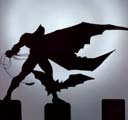
The longevity of the Batman can be attributed to three things: his pedigree, the medium in which he is presented, and his accessibility (Gold, p.12). Batman came about as a melding of classic heroes such as Zorro, Dick Tracy, the Shadow, and many others (Daniels, p.21-23). Though these characters have fallen by the wayside through the years, the Batman has survived by successfully combining the various elements that made his progenitors popular in their day and adding a few traits of his own to the mix. Then there is the comic book medium. Gold comments, "The vitality of The Batman lies in its primary story-telling medium: the graphic story, the so-called 'comic book'�unlike that other great American collaborative medium, movies, the comic book is a periodical: it renews itself each and every month" (p.12). Gold comes to his point saying, "The character did not merely change - he grew" (p.12). Gorfinkel, a writer for Batman comic books, expands on this idea, saying, "Batman naturally goes through an evolution every decade or so. He is one of the most popular continuing characters in fiction, and the way to keep him that way is to figure out what the future is" (Daniels, p. 197). Les Daniels, author of Batman: The Complete History, explains how this is possible, "Creators were afforded the opportunity to create variations on Batman more extreme than ever before, which paradoxically served to reinforce the character's power as an archetype" (p. 161). Dick Giordano, a Batman artist and editor, summarizes, "How many fictional heroes, comic book or otherwise, could survive and even prosper with that kind of tinkering? That Batman can exist comfortably in such circumstances speaks volumes for the strength and lasting appeal for the character" (p.11). Setting the issue of his appeal aside for the moment, Batman is a character that can withstand the test of time, but who exactly is this Dark Knight?