Lever
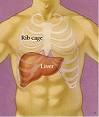
The liver is an organ present in vertebrates and some other animals. It plays a major role in
metabolism and has a number of functions in the body, including glycogen storage,
decomposition of red blood cells, plasma protein synthesis, and detoxification. This organ also
is the largest gland in the human body. It lies below the diaphragm in the thoracic region of
the abdomen. It produces bile, an alkaline compound which aids in digestion, via the
emulsification of lipids. It also performs and regulates a wide variety of high-volume
biochemical reactions requiring specialized tissues.
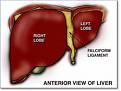
The adult human liver normally weighs between 1.4 - 1.6 kilograms 3.1 - 3.5 pounds,4 and it is
a soft, pinkish-brown boomerang shaped organ. It is the second largest organ the largest
organ being the skin and the largest gland within the human body. It is located on the right
side of the upper abdomen below the diaphragm. The liver lies to the right of the stomach and
overlies the gallbladder which stores bile.
\
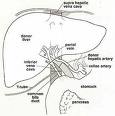
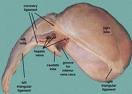
The splenic vein, joins the inferior mesenteric vein, which then together join with the superior
mesenteric vein to form the hepatic portal vein, bringing venous blood from the spleen,
pancreas, stomach, small intestine, and large intestine, so that the liver can process the
nutrients and byproducts of food digestion.The hepatic veins drain directly into the inferior
vena cava.The hepatic artery is generally a branch from the celiac trunk, although
occasionally some or all of the blood can be from other branches such as the superior
mesenteric artery.Approximately 60% to 80% of the blood flow to the liver is from the portal
venous system, and 1/4 is from the hepatic artery.
Bile
Bile or gall is a bitter, yellow or green alkaline fluid secreted by hepatocytes from the liver of
most vertebrates. In many species, it is stored in the gallbladder between meals and upon
eating is discharged into the duodenum where it excretes waste and aids the process of
digestion of lipids.
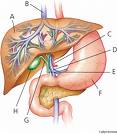
Bile is produced by hepatocytes in the liver, draining through the many bile ducts that
penetrate the liver. During this process, the epithelial cells add a watery solution that is rich in
bicarbonates that dilutes and increases alkalinity of the solution. Bile then flows into the
common hepatic duct, which joins with the cystic duct from the gallbladder to form the
common bile duct. The common bile duct in turn joins with the pancreatic duct to empty into
the duodenum. If the sphincter of Oddi is closed, bile is prevented from draining into the
intestine and instead flows into the gall bladder, where it is stored and concentrated to up to
five times its original potency between meals. This concentration occurs through the
absorption of water and small electrolytes, while retaining all the original organic molecules.
Cholesterol is also released with the bile, dissolved in the acids and fats found in the
concentrated solution. When food is released by the stomach into the duodenum in the form of
chyme, the gallbladder releases the concentrated bile to complete digestion.
The human liver can produce close to one litre of bile per day depending on body size. 95% of
the salts secreted in bile are reabsorbed in the terminal ileum and re-used. Blood from the
ileum flows directly to the hepatic portal vein and returns to the liver where the hepatocytes
resorb the salts and return them to the bile ducts to be re-used, sometimes two to three times
with each meal.

Physiological functions
Bile acts to some extent as a detergent, helping to emulsify fats increasing surface area to help
enzyme action, and thus aids in their absorption in the small intestine. The most important
compounds are the salts of taurocholic acid and deoxycholic acid. Bile salts combine with
phospholipids to break down fat globules in the process of emulsification by associating its
hydrophobic side with lipids and the hydrophilic side with water. Emulsified droplets then are
organized into many micelles which increases absorption.
Since bile increases the absorption of fats, it is an important part of the absorption of the
fat-soluble vitamins D, E, K and A. Besides its digestive function, bile serves as the route of
excretion for the hemoglobin breakdown product bilirubin created by the spleen which gives
bile its colour; it also neutralises any excess stomach acid before it enters the ileum, the final
section of the small intestine. Bile salts are also bacteriocidal to the invading microbes that
enter with food.
Bile from slaughtered animals can be mixed with soap. This mixture, applied to textiles a few
hours before washing, is a traditional and rather effective method for removing various kinds
of tough stains called bile soap.
Humorism
Humorism, or humoralism, was a theory of the makeup and workings of the human body
adopted by ancient Greek and Roman physicians and philosophers. From Hippocrates
onward, the humor theory was the most commonly-held view of the human body among
European physicians until the advent of modern medical research in the nineteenth century.
Essentially, this theory held that the human body was filled with four basic substances, called
four humours, or humors, which are in balance when a person is healthy. All diseases and
disabilities resulted from an excess or deficit of one of these four humors. The four humors
were identified as black bile, bile, phlegm, and blood. Greeks and Romans, and the later
Western-European medical establishments that adopted and adapted classical medical
philosophy, believed that each of these humors would wax and wane in the body, depending on
diet and activity. When a patient was suffering from a surplus or imbalance of one fluid, then
his or her personality and physical health, would be affected.
Theophrastus and others developed a set of characters based on the humors. Those with too
much blood were sanguine. Those with too much phlegm were phlegmatic. Those with too
much yellow bile were choleric, and those with too much black bile were melancholic. The
idea of human personality based on humors contributed to the character comedies of
Menander and, later, Plautus.
Through the neo-classical revival in Europe, the humor theory dominated medical practice,
and the theory of humoral types made periodic appearance in drama. Such typically eighteenth
century practices as bleeding a sick person, or applying hot cups to a person, were, in fact,
based on the humor theory of surpluses of fluids blood and bile in those cases. Ben Jonson
wrote humor plays, where types were based on their humoral complexion.Additionally,
because people believed that there were finite amounts of humors in the body, there were
folk/medical beliefs that the loss of fluids was a form of death.
History and the connection with Temperament theory
Although modern medical science has thoroughly discredited Humorism, this wrong-headed
theory dominated medical thinking... until at least the middle of the 20th century, and in
certain ways continues to influence modern-day diagnosis and therapy. The concept was
developed by ancient Greek thinkers around 400 BC and was directly linked with another
popular theory of the four elements earth, fire, water, and air Empedocles. Paired qualities
were associated with each humour and its season. The word humour derives from the Greek
??�??, chymos literally juice or sap, metaphorically flavor.
Hippocrates is the one credited for applying this idea to medicine. Humoralism or the doctrine
of the Four Temperaments as a medical theory retained its popularity for centuries largely
through the influence of the writings of Galen 131-201 AD and was decisively displaced only in
1858 by Rudolf Virchows newly-published theories of cellular pathology. While Galen thought
that humours were formed in the body, rather than ingested, he believed that different foods
had varying potential to be acted upon by the body to produce different humours. Warm foods,
for example, tended to produce yellow bile, while cold foods tended to produce phlegm.
Seasons of the year, periods of life, geographic regions and occupations also influenced the
nature of the humours formed.The imbalance of humours, or dyscrasia, was thought to be the
direct cause of all diseases. Health was associated with a balance of humours, or eucrasia.
The qualities of the humours, in turn, influenced the nature of the diseases they caused. Yellow
bile caused warm diseases and phlegm caused cold diseases.
In On the Temperaments Galen further emphasized the importance of the qualities. An ideal
temperament involved a balanced mixture of the four qualities. Galen identified four
temperaments in which one of the qualities, warm, cold, moist and dry, predominated and four
more in which a combination of two, warm and moist, warm and dry, cold and dry and cold
and moist, dominated. These last four, named for the humours with which they were
associated�that is, sanguine, choleric, melancholic and phlegmatic, eventually became better
known than the others. While the term temperament came to refer just to psychological
dispositions, Galen used it to refer to bodily dispositions, which determined a persons
susceptibility to particular diseases as well as behavioral and emotional inclinations.
Melancholia
Melancholia , in contemporary usage, is a mood disorder of non-specific depression,
characterized by low levels of enthusiasm and low levels of eagerness for activity. In a modern
context, melancholy applies only to the mental or emotional symptoms of depression or
despondency; historically, melancholia could be physical as well as mental, and melancholic
conditions were classified as such by their common cause rather than by their properties.
Similarly, melancholia in ancient usage also encompassed mental disorders which would later
be differentiated as schizophrenias or bipolar disorders.
The name melancholia comes from the old medical theory of the four humours: disease being
caused by an imbalance in one or other of the four basic bodily fluids, or humours. Personality
types were similarly determined by the dominant humour in a particular person. Melancholia
was caused by an excess of black bile; hence the name, which means black bile Ancient Greek
a person whose constitution tended to have a preponderance of black bile had a melancholic
disposition. See also: sanguine, phlegmatic, choleric
cribed as a distinct disease with particular mental and physical symptoms as early as the fifth
and fourth centuries BC. Hippocrates, in his Aphorisms, characterized all fears and
despondencies, if they last a long time as being symptomatic of melancholia.The most extended
treatment of melancholia comes from Robert Burton, whose The Anatomy of Melancholy
treats the subject from both a literary and a medical perspective.Burton wrote in the 16th
century that music and dance were critical in treating mental illness, especially melancholia. In
November 2006, Dr. Michael J. Crawford and his colleagues again found that music therapy
helped the outcomes of Schizophrenic patients.
A famous allegorical engraving by Albrecht D�rer is entitled Melencolia I. This engraving
portrays melancholia as the state of waiting for inspiration to strike, and not necessarily as a
depressive affliction. Amongst other allegorical symbols, the picture includes a magic square,
and a truncated rhombohedron . The image in turn inspired a passage in The City of Dreadful
Night by James Thomson B.V., and, a few years later, a sonnet by Edward Dowden.
Melancholy in Arab culture
The Arabic word found as uzn and azan in the Quran and h�z�n in modern Turkish refers to
the pain and sorrow over a loss, death of relatives in the case of the Quran. Two schools
further interpreted this feeling. The first sees it as a sign that one is too attached to the
material world, while Sufism took it to represent a feeling of personal insuffiency, that one
was not getting close enough to God and did not or could not do enough for God in this
world.The Turkish writer Orhan Pamuk in further elaborates on the added meaning h�z�n
has acquired in modern Turkish. It has come to denote a sense of failure in life, lack of
initiative and to retreat into oneself, symptoms quite similar to melancholia. According to
Pamuk it was a defining character of cultural works from Istanbul after the fall of the
Ottoman empire. One may see similarities with how melancholic romantic paintings in the
west sometimes used ruins from the age of the roman empire as a backdrop.
As a parallel with physicians of classical Greece, ancient Arabic physicians also categorized
uzn as a disease. Al-Kindi c. 801�873 CE links it with disease-like mental states like anger,
passion, hatred and depression, while Avicenna 980�1037 CE diagnosed uzn in a lovesick man
if his pulse increased drastically when the name of the girl he loved was spoken. oath,
intrigues, love, and food and treatments combining medicine and philosophy. Including
rational thought, morale, discipline, fasting and coming to terms with the catastrophe.
The various uses of uzn and h�z�n thus describe melancholy from a certain vantage point,
show similarities with Female hysteria in the case of Avicennas patient and in a religious
context it is not unlike sloth, which by Dante was defined as failure to love God with all ones
heart, all ones mind and all ones soul. Thomas Aquinas described sloth as an oppressive
sorrow, which, to wit, so weighs upon mans mind, that he wants to do nothing.
Bipolar disorder
Bipolar disorder is a psychiatric condition defined as recurrent episodes of significant
disturbance in mood. These disturbances can occur on a spectrum that ranges from
debilitating depression to unbridled mania. Individuals suffering from bipolar disorder
typically experience fluid states of mania, hypomania or what is referred to as a mixed state in
conjunction with depressive episodes. These clinical states typically alternate with a normal
range of mood. The disorder has been subdivided into bipolar I, bipolar II and cyclothymia,
with both bipolar I and bipolar II potentially presenting with rapid cycling.
Also called bipolar affective disorder until recently, the current name is of fairly recent origin
and refers to the cycling between high and low episodes; it has replaced the older term
manic-depressive illness coined by Emil Kraepelin 1856-1926 in the late nineteenth century.3
The new term is designed to be neutral, to avoid the stigma in the non-mental health
community that comes from con?ating manic and depression.
Onset of symptoms generally occurs in young adulthood. Diagnosis is based on the persons
self-reported experiences, as well as observed behavior. Episodes of illness are associated with
distress and disruption, and a relatively high risk of suicide.1 Studies suggest that genetics,
early environment, neurobiology, and psychological and social processes are important
contributory factors. Psychiatric research is focused on the role of neurobiology, but a clear
organic cause has not been found.
Bipolar disorder is usually treated with medications and/or therapy or counseling. The
mainstay of medication are a number of drugs termed mood stabilizers, in particular lithium
and sodium valproate ; these are a group of unrelated medications used to prevent relapses of
further episodes. Antipsychotic medications, sometimes called neuroleptics, in particular
olanzapine, are used in the treatment of manic episodes and in maintenance. The benefits of
using antidepressants in depressive episodes is unclear. In serious cases where there is risk to
self and others involuntary hospitalization may be necessary; these generally involve severe
manic episodes with dangerous behaviour or depressive episodes with suicidal ideation.
Hospital stays are less frequent and for shorter periods than they were in previous years.
Some studies have suggested a significant correlation between creativity and bipolar disorder.
However, the relationship between the disorder and creativity is still very unclear.234 One
study indicated increased striving for, and sometimes obtaining, goals and achievements.5
|