Where does life come from?
One of the theories about the origin of life says that life can develop out of lifeless material: Generatio spontane. The theory dates from the antiquity. Aristotle thought that all kinds of dead or lifeless materials had vital power resting in side them. When the circumstances were good, the vital powers got awake. These powers were able to catalyse a number of events, which ultimately resulted in ‘life’. Aristotle therefor thought that the vital powers within an egg were responsible for the development of the chick in the egg.
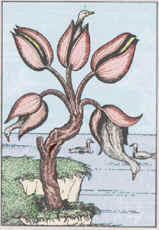
Supporters of the generatio spontane theory were convinced that from an individual of one species a total different species could develop. Plinius thought for instance that mussels grew on trees. Travellers of the Orient-express had seen trees that carried fruits with full-grown geese. The idea of the geese-tree survived till the 19th century.
There were even experiments that proved generatio spontan. The seventeenth-century scientist Van Helmont proved that wheat brought forth mice. In his experiment, Van Helmont filled a kettle with grains of wheat and covered it with a used shirt. When he removed the shirt after a few weeks, mice jumped out of the wheat. Van Helmont believed in the vital powers of the human sweat, which catalysed the development of mice out of the wheat.
Around 1650, Redi was the first who doubted the theory of generatio spontane:
It is my conviction that the earth, after on command of the almighty Creator the first plants and animals were created, in fact never produced any plant or any animal again.
This scientist from Florence conducted different experiments in relation to the development of maggots. In that time men believed that maggots spontaneously popped out of rotting meat. It was Redi’s opinion that the maggots were the result of sexual reproduction. He realised that life could only develop out of already existing life. This is called the theory of biogenesis. In his experiments Redi had put meat in three pots, the first pot was open, the was covered with paper and the third with a fine netting, which prevented that the flies could get near the meat, but they still would be able to smell the meat. The flies laid their eggs on the meat in the first pot, from which maggots developed. In the two other pots no maggots appeared spontaneously. The flies laid eggs of the netting of the third pot, which developed in to maggots. So, the maggots did not appear spontaneously in the meat but came out of the eggs.
By the discovery of micro-organisms by Van Leeuwenhoek in 1676, the discussion about the origin of live was stirred up again. It was assumed that micro-organisms were the result of generatio spontane, despite the fact that it does not occur in bigger organisms. In 1748 de English priest John Needham (1713-1781) published his experiments that confirmed generatio spontane. He had heated bouillon and poured it in flasks, which closed with a stop. As time passed by, the contents of the flasks became turbid and contained micro-organisms. He thought that the organic mater possessed the vital powers, which were necessary for the development of micro-organisms in the lifeless solution. A few years later the Italian priest Lazzaro Spallanzani (1729-1799) improved the experimental set-up of Needham. He had filled a number of glass flasks with a vegetable-extract en sealed them off. Then he boiled the content of the flasks for three-quarters of an hour. The flasks were put away and remained clear and free of micro-organisms. He suggested that the air contained germs, which caused the decay of the extract, or that the micro-organisms in the extract need air to duplicate. The supporters of generatio spontane sustained that by heating the air of hermetically closed flasks the vital powers of the air were destroyed.
The mystery of the origin of life was not solved until 1860. Louis Pasteur ended the saga of generatio spontane. He showed that micro-organisms are everywhere, in water, soil and air.
