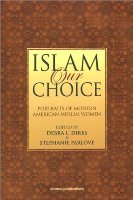
Stories Of New Muslim Taken From Islam Our Choice Book
Muhammad Asad (Austria) Muhammad Asad, Leopold Weiss, was born in Livow, Austria (later Poland) in 1900, and at the age of 22 made his visit to the Middle East.He later became an outstanding foreign correspondent for the Franfurtur Zeitung, and after his conversion to Islam travelled and worked throughout the Muslim world, from North Africa to as far East as Afghanistan.After years of devoted study he became one of the leading Muslim scholars of our age. After the establishment of Pakistan, he was appointed the Director of the Department of Islamic Reconstruction, West Punjab and later on became Pakistan's Alternate Representative at the United Nations. Muhammad Asad's two important books are: Islam at the Crossroads and Road to Mecca. He also produced a monthly journal Arafat. At present he is working upon an English translation of the Holy Qur'an. [Asad completed his translation and has passed away. -MSA-USC] In 1922 I left my native country, Austria, to travel through Africa and Asia as a Special Correspondent to some of the leading Continental newspapers, and spent from that year onward nearly the whole of my time in the Islamic East. My interest in the nations with which I came into contact was in the beginning that of an outsider only. I saw before me a social order and an outlook on life fundamentally different from the European; and from the very first there grew in me a sympathy for the more tranquil -- I should rather say: more mechanised mode of living in Europe. This sympathy gradually led me to an investigation of the reasons for such a difference, and I became interested in the religious teachings of the Muslims. At the time in question, that interest was not strong enough to draw me into the fold of Islam, but it opened to me a new vista of a progressive human society, of real brotherly feeling. The reality, however, of presentday Muslim life appeared to be very far from the ideal possibilities given in the religious teachings of Islam. Whatever, in Islam, had been progress and movement, had turned, among the Muslims, into indolence and stagnation; whatever there had been of generosity and readiness for self-sacrifice, had become, among the present-day Muslims, perverted into narrow-mindedness and love of an easy life. Prompted by this discovery and puzzled by the obvious incongruency between Once and Now, I tried to approach the problem before me from a more intimate point of view: that is, I tried to imagine myself as being within the circle of Islam. It was a purely intellectual experiment; and it revealed to me, within a very short time, the right solution. I realised that the one and only reason for the social and cultural decay of the Muslims consisted in the fact that they had gradually ceased to follow the teachings of Islam in spirit. Islam was still there; but it was a body without soul. The very element which once had stood for the strength of the Muslim world was now responsible for its weakness: Islamic society had been built,from the very outset, on religious foundations alone, and the weakening of the foundations has necessarily weakened the cultural structure -- and possibly might cause its ultimate disappearance. The more I understood how concrete and how immensely practical the teachings of Islam are, the more eager became my questioning as to why the Muslims had abandoned their full application to real life. I discussed this problem with many thinking Mulsims in almost all the countries between the Libyan Desert and the Pamirs, between the Bosphorus and the Arabian Sea. It almost became an obsession which ultimately overshadowed all my other intellectual interests in the world of Islam. The questioning steadily grew in emphasis -- until I, a non-Muslim, talked to Muslims as if I were to defend Islam from their negligence and indolence. The progress was imperceptible to me, until one day -- it was in autumn 1925, in the mountains of Afghanistan -- a young provincial Governor said to me: "But you are a Muslim, only you don't know it yourself. " I was struck by these words and remained silent. But when I came back to Europe once again, in 1926, I saw that the only logical consequence of my attitude was to embrace Islam. So much about the circumstances of my becoming a Muslim. Since then I was asked, time and again: "Why did you embrace Islam ? What was it that attracted you particularly ?" -- and I must confess: I don't know of any satisfactory answer. It was not any particular teaching that attracted me, but the whole wonderful, inexplicably coherent structure of moral teaching and practical life programme. I could not say, even now, which aspect of it appeals to me more than any other. Islam appears to me like a perfect work of architecture. All its parts are harmoniously conceived to complement and support each other: nothing is superfluous and nothing lacking, with the result of an absolute balance and solid composure. Probably this feeling that everything in the teachings and postulates of Islam is "in its proper place," has created the strongest impression on me. There might have been, along with it, other impressions also which today it is difficult for me to analyse. After all, it was a matter of love; and love is composed of many things; of our desires and our loneliness, of our high aims and our shortcomings, of our strength and our weakness. So it was in my case. Islam came over me like a robber who enters a house by night; but, unlike a robber, it entered to remain for good. Ever since then I endeavoured to learn as much as I could about Islam. I studied the Qur'an and the Traditions of the Prophet (peace and blessings be upon him); I studied the language of Islam and its history, and a good deal of what has been written about it and against it. I spent over five years in the Hijaz and Najd, mostly in al-Madinah, so that I might experience something of the original surroundings in which this religion was preached by the Arabian Prophet. As the Hijaz is the meeting centre of Muslims from many countries, I was able to compare most of the different religious and social views prevalent in the Islamic world in our days. Those studies and comparisons created in me the firm conviction that Islam, as a spiritual and social phenomenon, is still in spite of all the drawbacks caused by the deficiencies of the Muslims, by far the greatest driving force mankind has ever experienced; and all my interest became, since then, centred around the problem of its regeneration.
Ali Selman Benoist (France) As a Doctor of Medicine, and a descendant of a French Catholic family, the very choice of my profession has given me a solid scientific culture which had prepared me very little for a mystic life. Not that I did not believe in God, but that the dogmas and rites of Christianity in general and of Catholicism in particular never permitted me to feel His presence. Thus my unitary sentiment for God forbade my accepting the dogma of the Trinity, and consequently of the Divinity of Jesus Christ. Without yet knowing Islam, I was already believing in the first part of the Kalima, La ilah illa 'Allah (There is no deity but Allah), and in these verses of the Qur'an: "Say: He, the God, is One; God is an absolute unity; He never begot, nor was He begotten; and there is none equal to Him." (Al-Qur'an 112:1-4) So, it was first of all for metaphysical reasons that I adhered to Islam. Other reasons, too, prompted me to do that. For instance, my refusal to accept Catholic priests, who, more or less, claim to possess on behalf of God the power of forgiving the sins of men. Further, I could never admit the Catholic rite of Communion, by means of the host (or holy bread), representing the body of Jesus Christ, a rite which seems to me to belong to totemistic practices of primitive peoples, where the body of the ancestral totem, the taboo of the living ones, had to be consumed after his death, in order better to assimilate his personality. Another point which moved me away from Christianity was the absolute silence which it maintains regarding bodily cleanliness, particularly before prayers, which has always seemed to me to be an outrage against God. For if He has given us a soul, He has also given us a body, which we have no right to neglect. The same silence could be observed, and this time mixed with hostility with regard to the physiological life of the human being, whereas on this point Islam seemed to me to be the only religion in accord with human nature. The essential and definite element of my conversion to Islam was the Qur'an. I began to study it, before my conversion, with the critical spirit of a Western intellectual, and I owe much to the magnificent work of Mr. Malek Bennabi, entitled Le Phenomene Coranique, which convinced me of its being divinely revealed. There are certain verses of this book, the Qur'an, revealed more than thirteen centuries ago, which teach exactly the same notions as the most modern scientific researchers do. This definitely convinced me, and converted me to the second part of the Kalima, 'Muhammad Rasul 'Allah' (Muhammad is the Messenger of Allah). This was my reason for presenting myself on 20th February 1953 at the mosque in Paris, where I declared my faith in Islam and was registered there as a Muslim by the Mufti of the Paris Mosque, and was given the Islamic name of 'Ali Selman'. I am very happy in my new faith, and proclaim once again: "I bear witness that there is no deity but Allah, and I bear witness that Muhammad is Allah's servant and Messenger."
Sir Jalaluddin Lauder Brunton (England) Sir Jalaludding Lauder Brunton was educated at Oxford University. He was an English Baronet and a public man of wide repute. I am deeply grateful for this opportunity of saying a few words as to why I embraced Islam. I was reared under the influence of Christian parents. At an early age I became interested in theology. I associated myself with the Church of England, and took an interest in Mission work without an actual active part in it. Some years ago I gave my attention to the doctrine of "Eternal Torment" of all mankind except a few elect. It became so abhorrent to me that I almost became a sceptic. I reasoned that, a God that would use His power to create human beings whom he foreknew and predestinated should be Eternally Tormented, could be neither wise, just, nor loving. His standard would be lower than that of many men. I continued, however, to believe in the existence of God, but was not willing to accept the commonly understood teachings of God's revelation of Himself to men. I then turned my attention to the investigation of other religions, only to feel myself baffled. An earnest desire to worship and serve the True God grew in me. The creeds of Christianity claim to be founded on the Bible, but I found these to be conflicting. Is it possible that Bible and teaching of Jesus Christ had been misrepresented? So, I turned my attention again to the Bible and determined to make a careful study, and I felt that there was something wanting. I determined to strike out for myself ignoring the creeds of men. I began to teach that men possessed a "Soul", and an "Unseen Force" which was immortal, that sins were punished both in this world and in the next, that God in His Goodness and Mercy was ever ready to forgive our sins if we only were truly repentant. Realising the necessity of living up to the Truth and digging deep, so that I may find the "pearl of great price", I again devoted my time to the study of Islam. There was something in Islam which appealed to me at this time. In an obscure and almost unknown corner of the village Ichhra I was devoting my time and service to God's glory amongst the lowest classes of society with the earnest desire to uplift them to the knowledge of the True and only god, and to instil a feeling of brotherhood and cleanliness. It is not my intention to tell you as to how I laboured amongst these people, nor what were the sacrifices I had under-taken nor the extreme hardships I had undergone. I was simply going on with a singleness of purpose to benefit these classes both physically and morally. I eventually took up the study of the life of Prophet Muhammad. I knew very little of what he did, but I knew and felt that the Christians with one voice condemned the celebrated Prophet of Arabia. I was now determined to look into the matter without the spectacles of bigotry and malice. After a little time I found that it was impossible to doubt the earnestness of his search after Truth and God. I felt that it is wrong, in the extreme, to condemn this Holy Man after reading his great achievements for humanity. People who were wild idol-worshippers, living on crime, filth and nakedness, he taught them how to dress, filth was replaced by cleanliness, and they acquired personal dignity and self-respect, hospitality became a religious duty, their idols were destroyed and they worship the True and only one God. Islam became the most powerful Total Abstinence Association in the world. And many other good works were accomplished which are too numerous to be mentioned. In the face of all this and his own purity of mind, how sad to think that such a Holy Messenger of God should be run down by the Christians. I became deeply thoughtful, and during my moments of meditation an Indian gentleman named Mian Amiruddin came on a visit, and strangely enough it was he who fanned the fire of my life into a flame. I pondered over the matter a great deal; brought one argument after the other bearing upon the Christians' present day religion and I concluded in favour of Islam, feeling convinced of its truth, simplicity, toleration, sincerity and brotherhood. I have now but a little time to live upon this earth and I mean to devote my all to Islam
Mrs. Cecilia Mahmuda Cannolly (Australia) Why I embraced Islam ? First and foremost I would say it was because fundamentally I had always been a Muslim without being aware of it. Very early in my life I had lost faith in Christianity for many reasons, the major one being that whenever I questioned any Christian, whether it was a person belonging to the so called Holy Orders or a layman, regarding any point that puzzled me in regard to the Church teachings, I invariably received the monotonous answer : `You must not question the teachings of the Church; you must have faith.' I did not have the courage in those days to say : `I cannot have faith in something that I do not understand', and, from my experience, neither do most of the people who call themselves Christians. What I did do was to leave the Church (Roman Catholic) and its teaching and to place my faith in the one true god in whom it was much easier to believe, than in the three gods of the Church. By contrast with the mysteries and miracles of the Christian teaching, life took on a new and wider meaning, no longer cramped with dogma and ritual. Everywhere I looked I could see God's work. And although, in common with greater minds than my own, I could not understand the miracles that happened before my eyes, I could stand and marvel at the wonder of it all --- the trees, flowers, birds and animals. Even a new born babe became a beautiful miracle, not the same thing that the Church had taught me to believe at all. I remembered how, when a child, I gazed at newborn babies and thought, 'It's all covered in black sin', I no longer believed in ugliness; everything became beautiful. Then one day my daughter brought home a book about Islam. We became so interested in it that we followed it up with many other books on Islam. We soon realized that this was really what we believed. During the time I had believed in Christianity I had been led to believe that Islam was only something to joke about. Thus all that I then read was a revelation to me. After a while I looked up some Muslims and questioned them on some of the points that were not quite clear to me. Here again there was yet another revelation. My questions were all answered promptly and concisely, so different from the frustration I had experienced when questioning Christianity. After much reading and studying of the religion of Islam both my daughter and myself decided to become Muslims, taking the names of Rashida and Mahmuda respectively. If I were asked what impressed me most in the religion of Islam, I would probably say the prayers, because prayers in Christianity are used wholly in begging God (through Jesus Christ) to grant worldly favours, whereas in Islam they ar used to give praise and thanks to Almighty God for all His blessings since He knows what is necessary for our welfare and grants us what we need without our asking it.
Sir Jalaluddin Lauder Brunton (England) I am often asked when and why I became a Muslim. I can only reply that I do not know the precise moment when the truth of Islam dawned upon me. It seems that I have always been a Muslim. This is not so strange when one remembers that Islam is the natural religion that a child, left to itself, would develop. Indeed as a Western critic once described it. `Islam is the religion of common sense.' The more I read and the more I studied, the more convinced I became that Islam was the most practical religion, and the one most calculated to solve the world's many perplexing problems, and to bring to humanity peace and happiness. Since then I have never wavered in my belief that there is but one God; that Moses, Jesus, Muhammad and others before (peace be on all of them) were prophets, divinely inspired, that to every nation God has sent an apostle, that we are not born in sin, and that we do not need any redemption, that we do not need anyone to intercede between us and God, Whom we can approach at all times, and that no one can intercede for us, not even Muhammad or Jesus [unless God permits it -ed.], and that our salvation depends entirely on ourselves and on our actions. The word `Islam' means surrender to God. It also means peace. A Muslim is one who is `in harmony with the decrees of the author of this world', one who has made his peace with God and His creatures. Islam is based on two fundamental truths: (a) the Oneness of God and (b) the Brotherhood of Man, and is entirely free from any encumbrances of theological dogma. Above everything else it is a positive faith. The influence of the Hajj cannot be exaggerated. To be a member of that huge congregation gathered together from the four corners of the earth, on this sacred occasion and on the sacred spot, and to join with this mass of humanity, in all humility, in the glorification of God, is to have one's consciousness impressed by the full significance of the Islamic ideal, is to be privileged to participate in one of the most soul inspiring experiences that have ever been granted to human beings. To visit the birthplace of Islam, to tread the sacred ground of the prophet's struggle to call erring humanity back to God, is to re-live those hallowed by the memories of Muhammad's long toil and sufferings in glorious years of sacrifice martyrdom, is to have one's soul kindled by that celestial fire which lighted up the whole earth. But this is not all. The Hajj, above everything else, makes for unity among Moslems. If there is anything that unifies the scattered forces of Islam and imbues them with mutual sympathy it is the pilgrimage. It provides them with a central point to which they rally from all corners of the earth. It creates for them annually an occasion to meet and know one another, to exchange views and compare experiences and unite their various efforts to the common good. Distances are annihilated. Differences of sect are set aside. Divergences of race and colour cease to exist in this fraternity of faith that unites all Moslems in one great brotherhood and makes them conscious of the glorious heritage that is theirs.
Dr. Umar Rolf Baron Ehrenfels (Austria) Born as the only son of the late Baron Christian Ehrenfels, the founder of the modern structural (Gestalt) Psychology in Austria, Rolf Freiherr von Ehrenfels felt already as a child a deep attraction towards the East in general and towards the world of Islam in particular. His sister, the Austrian poetess Imma von Bodmershof, described this phase in her contribution to Islamic Literature, Lahore 1953. As a young man Ehrenfels travelled in the Balkan countries and Turkey, where he used to join prayers in mosques, (though a Christian) and was hospitably accepted by Turkish Albanian, Greek and Yogoslav Muslims. His interest in Islam increased by and by and Ehrenfels accepted Islam in 1927 and took on Umar as his Muslim name. He visitied Indo-Pakistan sub-continent in 1932 and took particular interest in the cultural-historical problems connected with the status and position of women. After his return to Austria, Baron Umar specialised in the study of anthropological problems of Matrilineal Civilizations in India. The Oxford University Press published his first anthropological book (Osmania University Series, Hyderabad, Deccan, 1941) on this subject. When Austria was overrun by the Nazis in 1938 Baron Umar again went to India, worked in Hyderabad at the invitation of the late Sir Akbar Hydari and carried on anthropological field-work in South India and with the support of Wenner-Gern Foundation, New York, in Assam. Since 1949 he has been Head of the Department of Anthropology at the University of Madras and was awarded the S.C.Roy Golden Medal for original contributions to social and cultural Anthropology by the Royal Asiatic Society of Bengal in 1949. His numerous scientific and Islamic publications also include an illustrated two-volume work on Indian and General Anthropology, "Ilm-ul-Aqwam" (Anjuman Taragqqi-i-Urdu, Delhi, 1941) and a tribal monograph on the "Kadar of Cochin" (Madras 1952). The essential features of Islam which impressed me most and attracted me to this great religion are as follows:- 1.The Islamic teaching of successive revelation implies in my opinion the following: The source from which all the great world religions sprang is one. The founders of these great paths, prepared for peace-seeking mankind, gave witness to one and the same basic divine teaching. Acceptance of one of these paths means search for Truth in Love; 2.Islam, in essence, means peace in submission to the Eternal Law. 3.Islam is, historically speaking, the last founded among the great world religions on this planet. 4.Prophet Muhammad is the messenger of Islam and is thus the last in the sequence of great religious world-prophets. 5.The acceptance of Islam and the path of the Muslims by a member of an older religion thus means as little rejection of his former religion, as for instance the acceptance of Buddha's teachings meant the rejection of Hinduism to the Indian co-nationals of Buddha. It was only later that schools of thought within Hinduism rejected the Buddhist way as heretical. The differences of religions are man-made. The unity is divine. The teachings of the Holy Qur'an stress this basic unity. To witness it, means acceptance of a spiritual fact which is common to all men and women. 6.The spirit of human brotherhood under the all-encompassing divine fatherhood is much stressed in Islam and not hampered by concepts of racialism or sectarianism, be it of linguistic, historic-traditionalistic, or even dogmatic nature. 7.This concept of divine fatherly love, however, includes also the motherly aspect of Divine love, as the two principal epithets of God indicate" Al-Rahman - Al-Rahim, both being derived from the Arabic root rhm. The symbolic meaning of this root equals Goethe's Das Ewing-Weibliche Zieht uns hinan, whilst its primary meaning is womb. In this spirit the Church of Hagia Sophia at Constantinople has been made the principal source from which the great Muslim architects in the Near East took their inspiration when building mosques like that of Sultan Ahmad or Muhammad Fatih at Istanbul
Dr. Abdul Karim Germanus (Hungary) Dr. Abdul Karim Germanus is a well known Orientalist of Hungary and is a scholar of world repute. He visited India between the wars and for sometime was also associated with Tagore's University Shanti Naketen. Later on he came to Jamia Millie Delhi. It was here that he embraced Islam. Dr. Germanus is a linguist and an authority on Turkish language and literature and it was through oriental studies that he came to Islam. At present Dr. Abdul Karim Germanus is working as Professor and Head of the Department of Oriental and Islamic Studies at the Budapest University, Hungary. It was on a rainy afternoon in my adolescence that I was perusing an old illustrated review. Current events mingled with fiction, and descriptions of far-off countries, varied in its pages. I turned the leaves indifferently for a while when suddenly a wood-cut arrested my eyes. The picture represented flat-roofed houses from among which here and there round cupolas rose gently into the dark sky enlivened by the crescent. The shadow of men squatting on the roof clad in fantastic robes stretched out in mysterious lines. The picture caught my imagination. It was so different from the usual European landscapes: it was an Oriental scene, somewhere in the Arabian East, where a story-teller told his gaudy tales to a burnoused audience. It was so realistic that I fancied I could hear his melodious voice as he entertained us, his Arab listeners on the roof and me, a sixteen-year-old student sitting in a soft arm-chair in Hungary. I felt an irresistible yearning to know that light which fought with the darkness in the picture. I began to learn Turkish. It soon dawned upon me that the literary Turkish language contains only a small amount of Turkish words. The poetry is enriched by Persian, the prose by Arabic elements. I sought to master all the three, in order to enter that spiritual world which spread such a brilliant light on humanity. During a summer vacation I was lucky to travel to Bosnia, the nearest Oriental country adjacent to ours. As soon as I settled in a hotel I dashed forth to see living Muslims, whose Turkish language had only beckoned to me through its intricate Arabic script from the pages of grammar books. It was night, and in the dimly-lit streets I soon discovered a humble cafe in which on low straw stools a couple of Bosnians enjoyed their kayf. They wore the traditional bulging trousers kept straight at the waist by a broad belt bristling with daggers. Their headgear and the unfamiliar costume lent them an air of truculence. It was with a throbbing heart that I entered the kahwekhame and timidly sat down in a distant corner. The, Bosnians looked with curious eyes upon me and I suddenly remembered all the bloodcurdling stories read in fanatical books about Muslim intolerance. I noticed that they were whispering among themselves and their topic was my unexpected presence. My childish imagination flared up in horror; they surely intended to draw their daggers on the intruding `infidel'. I wished I could safely get out of this threatening environment, but I dared not budge. In a few seconds the waiter brought me a cup of fragrant coffee and pointed to the frightening group of men. I turned a fearful face towards them when one made a gentle salaam towards me accompanied with a friendly smile. I hesitatingly forced a smile on my trembling lips. The imagined `foes' slowly rose and approached my little table. What now? ---- my throbbing heart inquired --- will they oust me? A second salaam followed and they sat around me. One of them offered me a cigarette and at its flickering light I noticed that their martial attire hid a hospitable soul. I gathered strength and addressed them in my primitive Turkish. Is acted like a magic wand. Their faces lit up in friendliness akin to affection --- instead of hostility they invited me to their homes; instead of the falsely anticipated daggers they showered benevolence upon me. This was my first personal meeting with Muslims. Years had come and passed in a rich variety of events, travels and study. Each opened new vistas before my curious eyes. I crossed all the countries of Europe, studied at the University of Constantinople, admired the historic beauties of Asia Minor and Syria. I had learnt Turkish, Persian and Arabic, and gained the chair of Islamic studies at the University of Budapest. All the dry and tangible knowledge that was hoarded up throught centuries, all the thousands pages of learned books I had read with eager eyes --- but my soul remained thirsty. I found Ariadne's thread in the books of learning, but I yearned for the evergreen garden of religious experience. My brain was satiated but my soul remained thirsty. I had to divest myself of much of that learning I had gathered, in order to regain it through inner experience, ennobled in the fire of suffering, as the crude iron which the pain of sudden cold tempers into elastic steel. One night Prophet Muhammad appeared before me. His long beard was reddened with henna, his robes were simple but very exquisite, and an agreeable scent emanated from them. His eyes glittered with a noble fire and he addressed me with a manly voice, "Why do you worry ? The straight path is before you, safely spread out like the face of the earth; walk on it with trusty treads, with the strength of Faith. "O Messenger of God", I exclaimed in my feverish dream in Arabic, "it is easy for you, who are beyond, who have conquered all foes when heavenly admonition has started you on your path and your efforts have been crowned with glory. But I have yet to suffer, and who knows when I shall find rest ?" He looked sternly at me and then sank into thought, but after a while he again spoke. His Arabic was so clear that every word rang like silver bells. This prophetic tongue which incorporated God's commands now weighed upon my breast with a crushing load; `A lam naj'all'l-Arda mihadan --- Have We not set the earth as a couch, and the mountains as stakes, and created you in pairs, and made your sleep for rest ... ! "I cannot sleep." I groaned with pain. "I cannot solve the mysteries which are covered by impenetrable veils. Help me, Muhammad, O Prophet of God! help me!" A fierce interrupted cry broke forth from my throat. I tossed chokingly under the burden of the nightmare --- I feared the wrath of the Prophet. Then I felt as if I had dropped into the deep --- and suddenly I awoke. The blood knocked in my temples, my body was bathed in sweat, my every limb ached. A deadly silence enveloped me, and I felt very sad and lonely. The next Friday witnessed a curious scene in the huge Juma' Masjid of Delhi. A fair-haired pale-faced stranger elbowed his way, accompanied by some elders, through the thronging crowd of believers. I wore an Indian dress, on my head a small Rampuri cap, I put on my breast the Turkish orders, presented to me by previous sultans. The believers gazed at me in astonishment and surprise. Our small party paced straight on to the pulpit, which had been surrounded by the learned, respectable elders, who received me kindly with a loud salaam. I sat down near the mimbar, (pulpit) and let my eyes gaze on the beautifully ornamented front of the mosque. In its middle arcade wild bees had built their nests and swarmed undisturbed around it. Suddenly, the adhan (call to prayers) was sounded and the mukabbirs, standing on different spots of the courtyard, forwarded the cry to the farthest nook of the mosque. Some four thousand men rose like soldiers at this heavenly command, rallied in close rows and said the prayer in deep devotion - I one among them. It was an exalting moment. After the Khutba (sermon) had been preached, `Abdul Hayy took me by my hand and conducted me to the mimbar, I had to walk warily so as not to step on someone squatting on the ground. The great event had arrived. I stood at the steps of the mimbar. The huge mass of men began to stir. Thousands of turbaned heads turned into a flowery meadow, curiously murmuring towards me. Grey-bearded `ulama (Savants) encircled me and stroked me with their encouraging looks. They inspired an unusual steadfastness into me, and without any fever or fear I slowly ascended to the seventh step of the mimbar. From above I surveyed the interminable crowd, which waved below me like a living sea. Those who stood after stretched their necks towards me, and this seemed to set the whole courtyard in motion. `Ma'sha Allah` exclaimed some nearby, and warm, affectionate looks radiated from their eyes'. "Ayyuh al-Saadaat al-Kiram", I started in Arabic --- `I came from a distant land to acquire knowledge which I could not gain at home. I came to you for inspiration and you responded to the call'. I then proceeded and spoke of the task Islam had played in the world's history, of the miracle God has wrought with His Prophet. I explained on the decline of present-day Muslims and of the means whereby they could gain ascendancy anew. It is a Muslim saying that all depends on God's will, but the Holy Qur'an says that `God betters not the condition of people unless they improve themselves'. I built my speech on this Qur'anic sentence and wound up with the praise of pious life, and the fight against wickedness. Then I sat down. I was aroused from the magnetic trance of my speech by a loud `Allahu Akbar', shouted from every nook and corner of the place. The thrill was overwhelming, and I hardly remember anything but that Aslam called me from the mimbar, took me by the arm and dragged me out of the mosque. "Why this hurry ?" I asked. Men stood before me and embraced me. Many a poor suffering fellow looked with imploring eyes on me. They asked for my blessing and wanted to kiss my head. "O God!" I exclaimed, "Don't allow innocent souls to lift me above them! I am a worm from among the worms of the earth, a wanderer towards the light, just as powerless as the other miserable creatures. The sighs and hopes of those innocent people ashamed me as if I had stolen or cheated. What a terrible burden it must be for a statesman, in whom people confide, from whom they hope for assistance and whom they consider to be better than themselves!" Aslam liberated me from the embraces of my new brethern, put me in a tonga and drove me home. The next day and the following ones people flocked to congratulate me and I gathered so much warmth and spirit from their affection as will suffice me for a lifetime.
Sir Abdullah Archibald Hamilton (England) Sir Abdullah Archibald Hamilton Bart, formerly Sir Charles Edward Archibald Watkins Hamilton, embraced Islam on 20th December 1923. A well-known English statesman, fifth baronet of the first (1770) and third baronet of the second creation (1819) Sir Abdullah was born on 10th December 1876. He was a Lieutinent in the Royal Defence Corp. and was also the President of the Selsy Conservative Association. Since arriving at an age of discretion, the beauty and the simple purity of Islam have always appealed to me. I could never, though born and brought up as a Christian, believe in the dogmatic aspect of the Church, and have always placed reason and commonsense above blind faith. As the time progressed, I wished to be at peace with my Creator, and I found that both the Church of Rome and the Church of England were of no real use to me. In becoming a Muslim I have merely obeyed the dictates of my conscience, and have since felt a better and a truer man. There is no religion that is so maligned by the ignorant and the biased as is Islam; yet if people only knew, it is the religion of strong for the weak, the rich for the poor. Humanity is divided into three classes. First, those on whom God has, out of His bounty, bestowed possessions and wealth; secondly, those who have to work to earn their living; and lastly, the great army of the unemployed, or those who have fallen by the wayside through no fault of their own. Again Islam recognizes genius and individuality. It is constructive and not destructive. For example, if a landowner who is rich and is not in need of cultivating his land refrains from doing so for some time, his property ipso facto becomes public property, and according to Islam Law, passes into the hands of the first person who cultivates it. Islam strictly forbids its adherents to gamble or to indulge in any games of chance. It prohibits all alcoholic drinks and interdicts usury, which alone has caused enough sorrow and suffering to mankind. Thus, in Islam, none can take a mean advantage of another who is less fortunate. We neither believe in fatalism nor in predestination, but only in pre-measurement; that is to say the fixity of the laws and the intelligence to follow them. To us, Faith without Action is a dead-letter; for in itself it is insufficient unless we live up to it. We believe in our own personal accountability for our actions in this life and the Hereafter. We must carry our own cross and none can atone for another's sin. Islam teaches the inherent sinlessness of man. It teaches that man and woman come from the same essence, possess the same soul, and have been equipped with equal capabilities for intellectual, spiritual and moral attainment. I do not think I need say much about the Universal Brotherhood of man in Islam. It is a recognized fact. Lord and vassal, rich and poor, are all like. I have always found that my brother Muslims have been the soul of honour and that I could believe their word. They have always treated me justly, as a man and a brother, and have extended to me the greatest hospitality, and I have always felt at home with them. In conclusion, I would like to say that whereas Islam guides humanity in the daily workaday life, the present-day so-called Christianity, indirectly in theory and invariably in practice, teaches its followers, it would seem, to pray to God on Sundays and to prey on His creatures for the rest of the week
Muhammad Aman Hobohm (Germany) Why Do Westerners Embrace Islam? There are various reasons for it. In the first place, truth always has its force. The basic tenets of Islam are so rational, so natural and so appealing that an honest truth-seeker cannot help being impressed by them. To take, for example, the belief in monotheism. How it raises the dignity of man and how it frees us from the grip of superstition! How naturally it leads to the equality of men, for all have been created by the same God and all are the servants of the same Lord. For the Germans, in particular, the belief in God is a source of inspiration, a source of fearless courage and a source of the feeling of security. Then the idea of life after death turns the tables. Life in this world remains no more the main objective, and [a] great part of human energy is devoted to the betterment of the Hereafter. The faith in the Day of Judgement automatically spurs a man to give up misdeeds, for good deeds alone can ensure eternal salvation, although the wrong deeds may prosper here for a limited period. The belief that none can escape the consequences of the judgement of a Just, Impartial and Omniscient Lord makes one think twice before one does anything wrong and surely this internal check is more effective than the most efficient police in the world. Another thing that attracts foreigners to Islam is its emphasis on tolerance. Then the daily prayers teach one punctuality and the one month of fasting enables one to exercise self-control over oneself and without doubt punctuality and self-discipline are two of the most important attributes of a good man and a great man. Now comes the real achievement of Islam. It is the only ideology which has succeeded in instilling in its followers the spirit of observing the ethical and moral limitations without external compulsion. For a Muslim knows that, wherever he is, he is being observed by God. This belief keeps him away from sin. As man is naturally inclined towards goodness, Islam also offers peace of mind and heart --- and this is what is totally absent from the Western society of today. I have lived under different systems of life and have had the opportunity of studying various ideologies, but have come to the conclusion that none is as perfect as Islam. Communism has its attractions, so have secular democracy and Nazism. But none has got a complete code of a noble life. Only Islam has it, and that is why good men embrace it. Islam is not theoretical; it is practical. Islam is not a departmental affair; it means complete submission to the will of God.
Thomas Irving (Canada) In approaching an account of my conversion to Islam, it would be as well to relate my personal experience, both before and after coming into contact with its ideals. This is not so much to tell a story in itself as to show how the thought of thousands of other young Canadians and Americans is evolving and the opportunity that awaits an effective Islamic propaganda. I can remember thrilling, as a very small child, to the Christian interpretation of Jesus's life, but yet I cannot say that I was ever truly Christian of my own conviction. Instead of absorbing the pretty Biblical tales, I began wondering why so many in the world were `heathen', why Jews and Christians differed on the same Bible, why the unbelievers were damned when the fault was not theirs, and also why they could practice goodness as well as the self-called "higher nations". I remember especially a missionary returned from India stating how the `Mohometans' were so obdurate in adhering to their religion; that was my first encounter with Islam, and it roused an unconscious admiration in me for their steadfastness to their faith and a desire to know more about these "wicked" people. In my first year course in Oriental literature, I had learned of the progression of human thought in its attempt to perfect its conception of God. Jesus had culminated the teaching of a Loving God. This idea had been lost in a cloud of liturgical doggerel and atavistic paganism; a beneficent, merciful deity had been obscured by an implacable overlord who could only be reached through an intercessor. Someone was needed to lead men back to the fountain of truth with its limpid mainstream of the One God. Europe was still in the semi-barbarism induced by the folk-wanderings and the extinction of classic culture by a narrow ecclesiasticism. The East was the logical centre of inspiration, and here Muhammad (God's blessings be on him) arose seven centuries after Jesus, when Christo-paganism was firmly entrenched in Europe and rational study, let alone inspiration, still nine centuries distant. At last I was able to accept Muhammad as an apostle of God; firstly, he was needed; secondly, my own conclusions had been independent and still coincided; and thirdly, apart from both the former, the realization of the divine quality of the Holy Qur'an and the Prophet's teachings flooded upon me clearly. At the same time, I received and bought more and more literature upon Islam. An Indian philanthropist from Bombay, the late Mr. Q. A. Jairazbhoy, had sent me What is Islam! by H. W. Lovegrove (this is perhaps the most practical exposition that I have read, and merits wide distribution). Later he sent me [...an...] annotated edition of the Holy Qur'an, and various other books and tracts. At Montreal, I was able to procure considerable French literature on Islam, both for and against, and this helped broaden my vision.
Mavis B. Jolly (England) I was born in a Christian environment, baptised in the Church of England, and attended a Church school where at a tender age I learned the story of Jesus as contained in the Gospels. It made a great emotional impression on me, as also did frequent visits to the church, the high altar with candles burning, the incense, the robed priests and the mysterious intoning of prayers... I suppose for those few years I was a fervent Christian. Then with the increase of schooling, and being in constant contact with the Bible and everything Christian I had the opportunity to think over what I had read and observed, practised and believed. Soon I began to be dissatisfied with many things. By the time I left school I was a complete atheist. Then I began to study the other main religions in the world. I began with Buddhism. I studied with interest the eightfold path, and felt that it contained good aims but was lacking in direction and details. In Hinduism I was faced not with three, but with hundreds of gods, the stories of which were too fantastic and revolting to me to be accepted. I read a little of Judaism, but I had already seen enough of the Old Testament to realize that it did not stand my tests of what a religion must be. A friend of mine persuaded me to study spiritualism and to sit for the purpose of being controlled by the discarnate spirits. I did not continue this practice very long as I was quite convinced that, in my case anyway, it was purely a matter of self-hypnosis, and would be dangerous to experiment further. The war ended. I took work in a London office, but my mind never strayed far from the religious quest. A letter appeared in the local paper to which I wrote a reply contradicting the divinity of Christ from the Biblical point of view. This brought me in contact with a number of people, one of whom was a Muslim. I started discussing Islam with this new acquaintance. On every point my desire to resist Islam fell down. Though I had thought it impossible, I had to acknowledge that perfect revelation had come through an ordinary human being, since the best of twentieth century governments could not improve upon that revelation, and were themselves continually borrowing from the Islamic system. At this time I met a number of other Muslims and some of the English girl converts endeavored to help me, with no little success, since, coming from the same background, they understood better some of my difficulties. I read a number of books, including The religion of Islam, Muhammad and Christ and The source of Christianity, the latter showing the amazing similarities between Christianity and the old pagan myths, impressed me greatly. Above all I read the Holy Qur'an. At first it seemed mainly repetition. I was never quite sure if I was taking it in or not, but the Qur'an, I found, works silently on the spirit. Night after night I could not put it down. Yet I often wondered how perfect guidance for man could come through imperfect human channels at all. Muslims made no claim for Muhammad that he was superhuman. I learned that in Islam prophets are men who have remained sinless, and that revelation was no new thing. The Jewish prophets of old received it. Jesus, too, was a prophet. Still it puzzled me why it did not happen any more in the twentieth century. I was asked to look at what the Qur'an said: "Muhammad is the Messenger of God and the last of the Prophets." And of course it was perfectly reasonable, too. How could there be other prophets to come if the Holy Qur'an was the book ... explaining all things and verifying that which is with you and if it was to remain uncorrupted in the world, as is guaranteed in the Qur'an, and perfectly kept so far? "Surely We have revealed the Reminder (i.e. the Qur'an) and surely We are its Guardian." In that case there could be no need of further prophets or books. Still I pondered. I read that the Qur'an is a guide to those who ponder (XVI: 65) and that doubters were asked to try and produce a chapter like it (II: 23). Surely, I thought, it must be possible to produce a better living plan in 1954, than this which dates back to a man born in the year 570 C.E.? I set to work, but everywhere I failed. No doubt, influenced by the usual condemnation of Islam from Christian pulpits on the subject, I picked on polygamy. At last I thought I had something; obviously Western monogamy was an improvement on this old system. I talked of it to my Muslim friend. He illustrated with the aid of newspaper articles how much true monogamy there was in England, and convinced me that a limited polygamy was the answer to the secret unions that are becoming so distressingly common in the West. My own common sense could see that, particularly after a war, when women of a certain age group far outnumber men, a percentage of them are destined to remain spinsters. Did God give them life for that? I recollect that on the radio programme known as `Dear Sir' an unmarried English girl had called for lawful polygamy, saying she would prefer a shared married life rather than the loneliness to which she seemed to be destined. In Islam no one is forced into a polygamous marriage, but in a perfect religion, the opportunity must be there to meet those cases where it is necessary. Then about ritual prayers I thought I had a point. Surely prayers repeated five times a day must become just a meaningless habit? My friend had a quick and illuminating answer. `What about your music practice, he asked, where you do scales for half an hour every day whether you feel like it or not? Of course, it is not good if it becomes a dead habit --- to be thinking of what is being done will give greater benefit --- but even scales done without thinking will be better than not doing them at all, and so it is with prayers.' Any music student will see the point of this, particularly if he bears in mind that in Islam prayers are not said for the benefit of God, Who is above needing them, but for our own benefit as a spiritual exercise, besides other uses. Thus gradually I became convinced of the truth in the teachings of Islam, and formally accepted the faith. I did this with great satisfaction, as I could fully realize that it was no emotional craze of the moment, but a long process of reasoning, lasting nearly two years, through which I went despite my emotions that pulled me so strongly the other way.
Miss Fatima Kazue (Japan) Ever since the Second World War I have been watching with restlessness that our faith in our religion was fast becoming weak. We had begun to accept the American mode of living and I deeply felt as if something was missing. At first I could not understand what it was that was missing. It was the cry of my soul to find an answer to this restlessness. I was fortunate to be acquainted with one Muslim who had been staying in Tokyo for sometime. His behaviour and his way of worship made me curious and I asked many questions. His answers were very gratifying and afforded me much peace of mind and soul. He taught me how one should lead his life as God desires us to live. I had never imagined before that the entire outlook of life can change so suddenly, as did mine by living as a Muslim and feeling a sort of unison with the Creator Himself. Look at the salutation of a Muslim. You say "Assalamo-'Alaikum Wa-Rahamatullah Wa-barakatoho": `May you have peace from God and be happy ever. This is very unlike `good morning' and `good afternoon' which simply means your morning be good and your afternoon be good. It sounds all materialistic. There is no eternal wish, no prayer to invoke God's blessings. Through that Muslim friend of mine I have learnt many things which a Muslim believes in and practises. I like the Muslim way of life which is pure, simple and essentially peaceful. I am convinced that Islam alone can bring peace in an individual's life as well as in the collective life of man. Islam alone can give real peace to mankind - a peace which humanity is eager to have. I am happy to have acquired this peace and could like to spread Islam as much as possible for me amongst my people. [A better translation of "Assalamo-'Alaikum Wa-Rahamatullah Wa-barakatoho" would be "May Allah's peace, mercy, and blessings be extended on you". -ed.]
Professor Haroon Mustapha Leon (England) The Late Professor Haroon Mustapha Leon, M.A., Ph.D., LL.D., F.S.P., accepted Islam in 1882. He was a Fellow and Honorary Member of many learned societies in Europe and America. He was an able Philologist, and was at that time contributing a series of articles on the "Etymology of the Man's Language" to the 'Isle of Man Examiner'. His services to this important branch of science had frequently been recognised by learned bodies. The Potomac University (U.S.A.) conferred upon him the degree of M.A. Dr. Leon was also an earnest geologist. He frequently lectured on scientific and literary subjects before learned and other societies. He occupied the important position of Secretaire-General of "La Societe Internationale de Philologie, Sciences et Beaux-Arts" (founded 1875) and was the Editor of "The Philomathe" a scientific magazine, published from London. Dr. Leon received many decorations from Sultan Abdul Hamid Khan, the late Shah, and the Emperor of Austria. One of the glories of Islam is that it is founded upon reason, and that it never demands from its followers an abnegation of that important mental faculty. Unlike certain other faiths, which insist upon their votaries implicitly accepting certain dogmas without independent inquiry, but simply on the authority of "The Church", Islam courts inquiry and counsels its disciples to study, search and investigate prior to acceptation. The Holy Prophet, of ever-blessed memory, said: "Allah hath not created anything better than reason, the benefits which Allah giveth are on its account, and understanding is begotten of it." On another occasion he said: "Verily, I tell you, a man may have performed prayers, fasts, charity, pilgrimage and all other good works, but he will not be rewarded but by the manner in which he hath used and applied his reason." The parable of the 'Talents' narrated by Saiyiddena 'Issa', i.e. Jesus (on whom be peace) is in strict accordance with Islamic doctrine, as also is the maxim: 'Prove all things; hold fast to that which is good.' The similitude of those who follow blindly and who neglect to use the intelligence which the Divine Giver, of all good, hath bestowed upon them, is declared in the imperishable pages of Al-Qur'an ( Sura 52: Al-Jumm'a - 'The Assembly') to be that of 'an ass laden with books.' The noble and learned Caliph, Hazrat Ali (on whom be peace) said: "The world is darkness; knowledge is light; but knowledge without truth is a mere shadow." Muslims believe that Islam is a term synonymous with truth, and that under the glorious and ever-brilliant sun of Islam, by the light of reason and knowledge, truth can be obtained but in order to obtain that knowledge, and thus attain that truth, man must use his reasoning faculties. A most poignant pronouncement on this question was given by our Holy Prophet only a few days prior to his decease. There he lay, the last and greatest of the grand chain of mighty men whom Allah, in His everlasting mercy and compassion, had sent to the world as inspired messenger of truth and of righteousness, his saintly head pillowed upon Hazrat 'Ayesha's loving knee. The true believers of Medina, old and young, men and women -- nay, even the children -- had gathered, in loving sympathy there around the mat whereon lay Mustapha Al-amin, the chosen, the faithful, ar-Rasul-Allah. Tears glistened in their eyes, and coursed down the cheeks of even the most grizzled and valiant of the veteran warriors of Islam. Their leader, their friend, their beloved pastor, and, above all, their Prophet, he who had led them from the darkness of ignorance and superstition into the radiant brightness of the truth, had brought them into Islam, the habitation of peace, was about to pass from them. No wonder, then, that their eyes became fountain of tears, and their hearts were heavy and oppressed. In the agony of distress, almost of despair, one exclaimed: "O Prophet of Allah, thou art ill, thou mayest die, then what is to become of us?" "You have Al-Qur'an" said Allah's Messenger. "Oh, yes, Rasul-Allah, but even with that enlightening book and unerring guide before us, we have had at times to ask from you advice, counsel, and instruction, and if you are taken from us, O Prophet who is there to be our guide?" said the companions. "Do as I did and as I have said," was the reply. "But, O Prophet, after you have gone fresh circumstances may arise which could not have arisen during thy blessed lifetime; what are we to do then? And what are they to do who follow us?" The Prophet slowly raised his illustrious and saintly head, and with the lurid light of prophecy and inspiration shining radiantly from his noble eyes exclaimed: "Allah hath given to every man as a personal monitor, a conscience and as a guide, his reason; then, use them in respect of all things and Allah's blessing will ever guide you aright."
Dr. Hamid Marcus (Germany) Dr. Hamid Marcus was also the editor of Moslemische Revue, Berlin. As a child I had felt an inner urge to learn all I could about Islam, and I had carefully studied an old Qur'an translation which I had found in the library of my home town and which dated back to 1750. It was the edition from which Goethe also drew his knowledge of Islam. At that time I had been deeply struck by the absolutely rationalistic and at the same time imposing composition of the Islamic teachings. I had also been very much impressed by the gigantic spiritual revolution which they evoked in the Islamic nations of that time. Later, in Berlin, I had the opportunity of working together with Muslims and listening to the enthusiastic and inspiring commentaries which the founder of the first German Muslim Mission at Berlin and builder of the Berlin Mosque, gave on the Holy Qur'an. After years of active co-operation with this outstanding personality and his spiritual exertions, I embraced Islam. Islam supplemented my own ideas by some of the most ingenious conceptions of mankind ever thought of. The belief in God is something sacred to the religion of Islam. But it does not proclaim dogmas which are incompatible with modern science. Therefore there are no conflicts between belief on the one hand and science on the other. This fact is naturally a unique and enormous advantage for a man who participated to the best of his ability in scientific research. The second advantage is that the religion of Islam is not an idealistic teaching which runs along blindly beside life as it is, but that it preaches a system which actually influences the life of a human being .... the laws of Islam are not compulsory regulations which restrict personal freedom, but directions and guides which enable a well-contrived freedom. Throughout the years I have noticed time and again with deepest satisfaction that Islam holds the golden mean between individualism and socialism, between which it forms a connecting link. As it is unbiased and tolerant, it always appreciates the good, wherever it may happen to come across it.
Mr. R. L. Mellema (Holland) Dr. R. L. Mellema is the Head of the Islamic Section of the Tropical Museum, Amsterdam, and is the author of Wayang Puppets, Grondwet van Pakistan, Een Interprtatie van de Islam, etc. What is for me the Beauty of Islam? What hs Attracted me to this faith? I began with my study of eastern languages at the University of Leiden in 1919 and attended the lectures of Prof. C. Snouck Hurgronje, the well-known Arabist. I learned Arabic, read and translated al-Baidawi's commentary on the Qur'an and al-Ghazali's reflexions on the Law. I studied the history and institutions of Islam from European handbooks as was usual in that time. In 1921 I stayed in Cairo for one month and visited the Al-Azhar. Besides Arabic I studied other languages such as Sanskrit, Malay and Javanese. In 1927 I left for the then Netherlands Indies to teach Javanese language and Indian cultural history at a special secondary school for advanced studies in Jogyakarta. For 15 years I specialised myself in Javanese language and culture (modern and old) and had little contact with Islam and no contact at all with Arabic. After a difficult period which I spent as a japanese prisoner of war, I went back to the Netherlands in 1946 and found a new task at the Royal Tropical Institute in Amsterdam. Here I had the opportunity to take up again my study of Islam, being instructed to write a short guide on Islam in Java. I started to study the new Islamic State of Pakistan which was culminated in a journey to Pakistan in the winter of 1954/55. Having come to know Islam till now from European writers only, in Lahore I was confronted with quite another aspect of Islam. I asked my Muslim friends to be allowed to take part with them in the Friday prayers in the mosques and from now on I began to discover the great values of Islam. I have felt myself a Muslim from the moment that I had to address the people in one of the Lahore mosques and had to shake hands with the innumerable new friends and brothers. I wrote about this event in an article, published in Pakistan Quarterly, Vol. V. no. 4, 1955, the following lines: We were now to visit a much smaller mosque, where the sermon was delivered by a scholar who spoke English fluently and had a position of eminence at the University of the Punjab. He informed the congregation that he had deliberately interspersed more English words than usual in his sermon, as he thought that their brother who had come from a far country, the Netherlands, would then understand the Urdu discourse more easily. The sermon was followed by the usual recitation of two rak'ahs under the leadership of the Imam. This done a few more rak'ahs were performed in silence by those who felt the need to do so. I was about to leave when Allamah Sahib, turning to me, observed that the assembly expected me to say a few words. He himself would translate them into Urdu. I went and stood before the microphone and quietly started to speak. I said how I had come from a far away country where only a few Muslims live, whose greetings I conveyed to the brothers present in the Mosque, who for the last seven years were so fortunate as to have their own Muslim State. In these few years the new State had succeeded in consolidating its position. After a difficult beginning they could undoubtedly look forward to a prosperous future. I promised them that, back in my country, I should bear witness to the great kindness and hospitality it had been my privilege to receive from all sections of the Muslim population in Pakistan. These words having been translated into Urdu had a wonderful effect, for, to my intense surprise, without even realizing at first what was happening, I saw hundreds of worshippers hasten forward to press my hands and to congratulate me. Old hands and young clasped mine with the most affectionate cordiality. But what struck and touched me most was the great warmth all these eyes radiated. At that moment I felt myself taken up in the great Brotherhood of Islam which extends throughout the world, and I was indescribably happy. So the people of Pakistan made me understand that Islam was more than just acquaintance with many details of the Law, that belief in the moral values of Islam had to come first and that knowledge should be conditional to reaching faith. What is now for me the beauty of Islam and what in particular has attracted me to this faith! I will try to give a short answer to these questions in 6 points. 1.The acknowledgement of One Supreme Being, uncomplicated and easy to accept by every reasonable thinking creature: Allah, He on Whom all depend. He begets not, nor is He begotten and none is like Him. He represents the highest wisdom, the highest strength and the highest beauty. His Charity and Mercy are boundless. 2.The relation between the Creator of the Universe and His creatures, of whom man has been entrusted with the supreme direction, is a direct one. The believer does not need any mediation; Islam does not need priesthood. In Islam contact with God depends on man himself. Man has to prepare himself in this life for the next. He is responsible for his deeds, which cannot be compensated by a substituting sacrifice of an innocent person. No soul shall be burdened beyond its capacity. 3.The doctrine of tolerance of Islam, so clearly manifested in the well-known words: There is no compulsion in religion. A Muslim is recommended to search for the truth where he may find it; also he is enjoined to estimate the good properties of other religions. 4.The doctrine of brotherhood of Islam, which extends to all human beings, no matter what colour, race or creed. Islam is the only religion which has been able to realise this doctrine in practice. Muslims wherever on the world they are, will recognise each other as brothers. The equality of the whole mankind before God is symbolised significantly in the Ihram dress during the Hajj. 5.The fact that Islam accepts matter and mind both as existing values. The mental growth of man is connected inseparable with the needs of the body, whereas man has to behave in such a way that mind prevails over matter and matter is controlled by mind. 6.The prohibition of alcoholic drinks and narcotic drugs. This is in particular a point in respect of which it may be said that Islam is far ahead of its time.
Umar Mita (Japan) By the Grace of Allah I am leading a happy Muslim life for the last 3 years. The righteous way of life as taught by Islam, was shown to me by our Pakistani Tablighi brethren (Missionaries), who visited my country and to whom I am deeply grateful. The majority of our people are Buddhist, but they are Buddhists in name only. They are not practising Buddhists and actually they are almost unmindful of their religious knowledge. The main reason for this apathetic attitude may be due to the fact that Buddhism presents a high sounding and complicated philosophy and gives nothing practical. It is thus beyond the reach of an average person who remains busy with the problems of this worldly life. He cannot understand it nor can he implement it. It is not so with Islam. The teachings of Islam are simple, straight-forward and quite practical. It governs all the departments of human life. It moulds the thinking of man and when once the thinking becomes pure, pure actions will follow spontaneously. The teachings of Islam are so simple, easy and practical that every one can understand it. It is not the monopoly of the priests as is the case in other religions. There is great future for Islam in Japan. Some difficulties may be there but the same are not insurmountable. Firstly, an organised steady and vigorous effort should be made to acquaint people with the teachings of Islam. Our people are becoming materialistic day by day but they are unhappy. They have to be told that the real peace and contentment lie in Islam which is a complete code for life and gives guidance for all walks of life. Secondly such people are required to do this work whose own lives set an example before others. Unfortunately the type of Muslim students who come to Japan from different Muslim countries are no example for us to follow and we cannot gain any advice or guidance from them. Most of them have adopted the Western way of life and they know nothing about Islam due to their being educated in the European established institutions, mostly convents. If Islam is to succeed in Japan, as I am quite sure that one day it will, all Islam-loving people should think over the problem and make sincere and concentrated efforts in this behalf. Such of the Muslims who are true believers and whose lives can be an example to others, should visit Japan and teach the people here. Our people are thirsty for peace, truth, honesty, sincerity, virtue and all that is good in life, and I am confident that Islam and Islam alone can quench their thirst. We need absolute Faith in Him to do the job and we pray to Him to grant Faith to us. Islam means `peace' and no other people than the Japanese require peace more. Real peace can come to us by accepting the religion of peace. Peace with all men and peace with God. The brotherhood in Islam is a unique principle and in it truly lies salvation for the mankind. [MSA-USC Editor's Note: "Islam" actually means "submission (to God)", however a *completely secondary* meaning is "peace". Submission to God is the way to achieve *inner* peace but it may entail an *outer* state of physical struggle - for example, a war to stand up for justice.]