| Welcome to Angela's website. Let me tell you a bit about how she came to us. After a difficult pregnancy that included 22 weeks of bedrest, placental ubruption and a subchorionic bleed, Angela was born at 36 weeks gestation by emergency c-section. Angela weighed a whopping 4 lbs 4 oz at birth, and was 17 inches long. She was a peanut for sure, and she is still often called "Peanut". Angela spent 4 weeks in NICU where she was supposed to be learning how to eat. During that time she was also diagnosed with direct hyperbillirubinemia (direct jaundice) of unknown origin. The problem with Direct Billi elevations is they indicate a problem with the liver. Phototherapy isn't an option. Angela's gallbladder was also "missing" and she had repeated ultrasounds to try and find it. Finally, on the day exploratory surgery was to be performed it showed up! Small and shriveled, but it was there. Angela never did learn to eat in the hospital so came home with an n-g feeding tube instead. Thankfully it only took her a few days at home to get the hang of things. Somewhere between 2-3 months Angela had a "neurological event" that affected the use of her left side. ON CT scan she had a large spot on her brain stem. On MRI she had a narrowing of the right corotid artery, indicative of a disease called Moya Moya. Neurologists at Mayo Clinic and our children's hospital are unsure if she has Moya Moya or not. Basically, if she has a stroke we'll know. Angela had severe Gastro-Esophageal reflux disease, and at 11 months had a nissen fundoplycation and gtube done. The surgery was a huge success. She ended up keeping the tube for 2 years because she started aspirating liquids. She didn't learn to drink liquids safely until the age of 36 months. She finally got rid of the tube all together in Sept. 1999!! Somewhere along the way Angela was also diagnosed with an as-yet unnamed connective tissue disorder. It became aparent when the scar from her first nissen surgery herniated. It had originally had nice healthy scar tissue which basically disintigrated and disappeared. She has had that scar and several other abdominal and umbilical herias repaired seral times each. The third time the nissen scar was repaired gortex mesh was "installed" to help the scar tissue hold together. It was only partially successful. Angela has been through too much in her short 4 year life. But one would never know by looking at her! She is an active, vibrant little girl who clearly loves life to the fullest! Oh Yeah...Angela also happens to have Down Syndrome. Sometimes we forget that part! |
 |
 |
 |
 |
|
|
|
| The Queen's Chambers |
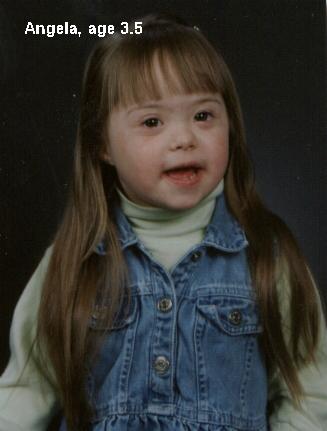 |
| Angela age 3.5 (Nov. 1999) |
| More about ME! |
| Update April 2004 |

|
| UPDATE May 2005: In September 2004, Angela and I had a minor bike accident, causing the gortex mesh in her abdomen to tear away from the scar tissue it was supposed to be holding together. After nursing the injury and newly developed hernia, she has surgery on Nov. 9th 2004 to replace the mesh. Unfortunately she developed a serious reaction to the material, along with an infection, and the incision never closed properly. In January 2005 she had another surgery to remove all the foreign material and give her lymph system a chance to get back to normal. Sometime after that surgery it became evident that Angela was refluxing again. In mid May, 2005, tests confirmed that Angela's nissen has slipped, and she again has severe GERD. This has become a very serious issue for Angela. Her esophagus is at risk for deterioration and developing Barretts Esophagus. We have started her on Prevacid to decrease the acid production, and Erythramycin to act as a motility drug. This would, in theory, speed up her system so her stomach empties faster, leaving less food in her stomach to be refluxed back up. So far she is not tolerating the the Erythramycin very well, and is having trouble with GI upset because of it. At this time Angela is in need of prayer to avoid having to have her Nissen re-done. Surgery is something people always hope to avoid, but in Angela's case it really is a worry because of her difficulty with wound healing and infections. There is also concern about her ability to eat orally (by mouth) if the nissen has to be done tighter. |
   |
|
|