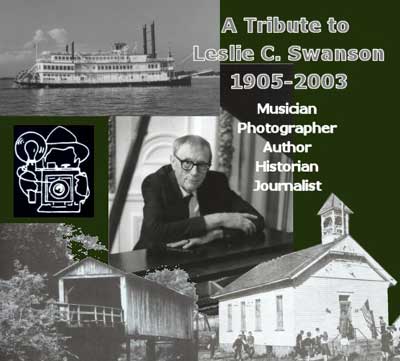
| Covered bridge enthusiasts throughout
the world lost a friend and advocate in April 2003 when Les Swanson,
author of Covered Bridges in Illinois, Iowa & Wisconsin,
succumbed following a brief illness at age 97 in Moline,
Illinois.
Swanson was known as a photographer, historian,
author, jazz musician, and magazine and newspaper writer. Beginning
in the 1960’s, he was a frequent contributor to "Covered Bridge
Topics" the newsletter published by the NATIONAL SOCIETY FOR THE
PRESERVATION OF COVERED BRIDGES.
His interest in covered bridges was launched in 1946
when he unexpectedly came across an old bridge at dusk in Knox
County, Illinois. The beauty of that scene never left him and he
began to seek out other old bridges and their histories. In the
1960’s he self-published his book about them and became a Midwest
authority on the subject.
Swanson was instrumental in helping several
communities plan festivals and raise funds to preserve their
bridges, including the well-known Madison County Bridge Festival in
Iowa. In his home state, he worked with Illinois legislators who
developed and unanimously passed a bill to protect the historic
structures.
In addition to his book about covered bridges, he
penned several more on Americana topics, including Old Mills in
the Mid-West, Canals of Mid-America, Rural One-Room
Schools, and Steamboat Calliopes. Swanson’s first two
booklets written while in his thirties about the care and training
of racing homing pigeons, Racing Homer Facts and Secrets and
Racing Homer Topics, are still distributed and considered
classics in the sport worldwide.
While in his eighties, Swanson wrote a book called
Riverboat Gambling. This book coincided with the introduction
of gambling boats in the Quad-City metropolitan area of Illinois and
Iowa. He called it the "thrill of a lifetime" when he played
calliope and was interviewed on national television (ABC network,
Good Morning America) during the 1991 inaugural voyage of the
Diamond Lady gambling boat in Bettendorf.
Mr. Swanson had remained independent and active
despite his years. He continued to golf and do freelance writing. As
a jazz musician, his last performance was in March 2003 at the
100th Anniversary of the former jazz great, Bix
Beiderbecke. Swanson played two piano solos in tribute to Bix who
had been a friend and contemporary in the 1920’s.
|
|
Swanson's career in the music business
continued for about 70 years, with his first job as organist
for silent movies at the Strand Theater in East Moline, while
still in high school. He also appeared on riverboats, playing
piano, calliope, or both, on ten different steamers, covering
the entire length of the Ohio and Mississippi rivers.
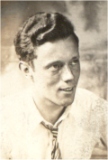
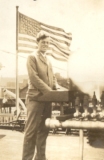
Photos: Left, Swanson in the late 1920's
and right, at the calliope of the Steamer Washington in May,
1928 |
|
In business, Swanson spent several years in the
editorial department of the former Daily Times in Davenport, IA. He
later owned and operated a commercial photography business in Rock
Island, Illinois, specializing in wedding candids and children's
portraits. Some of his photographs of babies attracted national
attention, appearing in two press syndications and papers across the
entire country.
Retiring from the photo studio in 1965, Swanson
turned his attention to writing. He never forgot his love of the
written word from his days in newspaper journalism. An extremely
prolific writer, he contributed stories and photos to the Sunday
sections of the Des Moines Register, the Travel section of the
Chicago Tribune and the Quad-City Times and countless other
publications throughout his lifetime. Many of these articles
centered about covered bridges, old mills, old canals and other
historical lore.
With his sharp memory of details and history, he was
regarded as a prominent local historian in multiple fields. Many of
his life experiences were noteworthy. As a grade school kid, he had
witnessed performances of nationally known figures. In 1914 he saw
Buffalo Bill and Annie Oakley in the Wild West circus playing in
Moline. In 1918, he accompanied his father to Chicago to see Babe
Ruth go hitless against the White Sox. Swanson became acquainted
with several prominent people in his lifetime, including Ronald
Reagan, Duke Ellington, the Andrew Sisters, Bix, and several more
jazz greats, including Louis Armstrong, Jack Teagarden, Louis
Bellson, Earl "Fatha" Hines, and PeeWee Hunt. Most of these
experiences were put into writing and featured in newspapers.
In the late 1990's, Swanson contributed two long
articles to the Quad-City Times on two phases of the life of
cornetist, Bix Beiderbecke. One told of his experiences on two
Streckfus riverboats, from which Bix was yanked by the musicians'
union because of his youth and inability to read music. The second
portrayed, the cornetist's life from 1920 to 1930 as a strange
parallel to the turbulent "Roaring Twenties, as Bix's career came
crashing down about the same time of that memorable stock market
collapse in 1929. Swanson is quoted in several books and
publications about Beiderbecke. A French author doing research came
to Moline in September 2002 to interview him for the first book
about the jazz musician to be published in the French language.
Swanson was a 50-year gold card member of the
American Federation of Musicians. Other memberships included First
Lutheran Church in Moline, honorary membership in the historic
Clover Chapel near Woodhull, Illinois, a charter member of the
Catfish Jazz Society, and former memberships in the National Society
for Preservation of Covered Bridges, Society for the Preservation of
Old Mills, and the American Canal Society. Swanson was heavily
involved with Winterset, IA Covered Bridge Festival. He took part in
the annual event until he retired from it in 1983 and donated his
extensive displays to the festivals.
He is listed in Who's Who in the Midwest and Who's
Who in Entertainment. He was one of the last few survivors of the
1923 graduating class of Moline High School and the 1928 graduates
of Augustana College.
Follow this LINK for
a list of books written by
Swanson. |