 |
Le Cafe Singe Bleu Serving generous portions of history and mystery from our monthly menu |
| |
Le Cafe Singe Bleu Serving generous portions of history and mystery from our monthly menu |
|
Was There A Murder or Wasn't There?:
Part One of a Two Part appreciation of the classic mystery spoof Murder By Death. Part Two will appear in our March issue.
Part One: The World's Five Greatest Detectives
Neil Simon, born in 1927 in the Bronx, was a writer for the comedy shows Your Show of Shows, The Phil Silvers Show (Sgt. Bilko) and The Garry Moore Show before moving on to plays and screenplays.
By 1976 he had produced ten plays (Come Blow Your Horn (1963), Barefoot in the Park (1967), The Odd Couple (1968), Sweet Charity (1969), Plaza Suite (1971), Last of the Red Hot Lovers (1972), The Prisoner of Second Avenue (1975), and The Sunshine Boys (1975)). He also had written three screenplays (After The Fox starring Peter Sellers, The Out of Towners, and The Heartbreak Kid.
Simon's first wife died of cancer when she was 40 and he 46. He married again, actress Marsha Mason, and she, Simon and his two children by his first wife moved to Los Angeles. During his first fourteen months there he worked on three projects simultaneously: ''the script of the play California Suite, the new version of The Goodbye Girl movie, and another original screenplay that I had been working on while still living in New York, Murder By Death.''
Simon writes in his memoir:

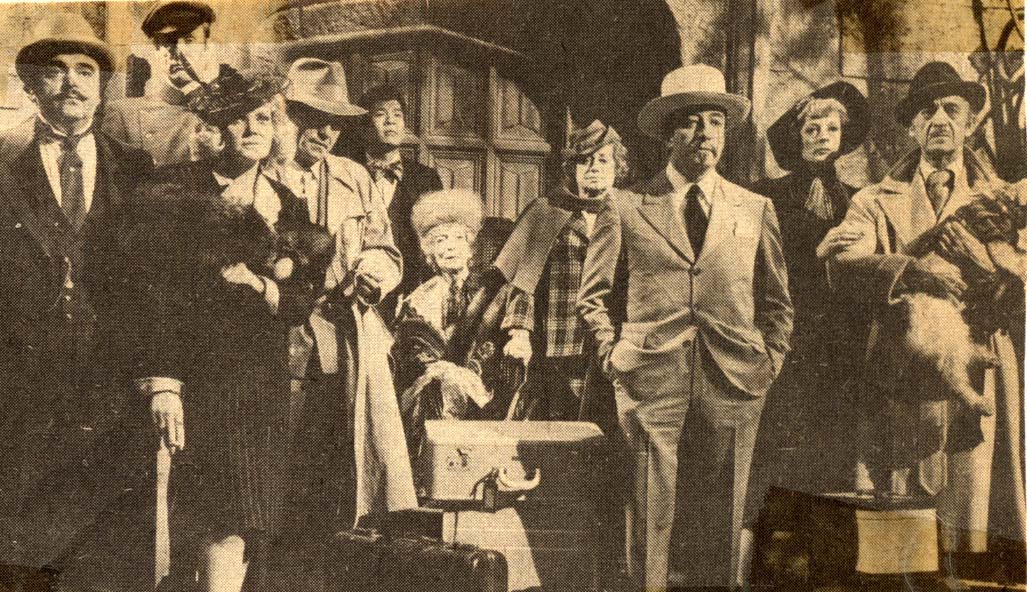
The opening credits of Murder By Death feature gloved hands opening up a small wooden chest, and up pops a diorama (drawn by Charles Addams of The Addams Family fame) of the exterior of a Gothic-windowed mansion, with ten people gathered in a group about a naked, face down, knife-in-the-back body on the floor. As the music rolls, the camera pans to each face, their name is given, and their eyes dart from left to right, or up and down, depending on the location of the next cast member (the cast is listed 'in diabolical order). We then enter the study of Lionel Twain, with thunder and lightning outside the arched, stained glass window, small lamps battling against the darkness and flames dancing about in the fireplace. The camera looks over the back of an individual seated at a desk, gloved hands signing an invitation:
''Do you think they'll come, sir?'' Truman Capote's voice answers him. ''Oh, they'll come, they'll come all right. Here, stamp these and mail them.'' And he hands the butler a dish filled with stamps. Closeup of Guinness licking each stamp, arm movement of him putting it down, presumable on an envelope, and banging it with his clenched fist to ensure it stays stuck. Then the camera pans down to show he's stuck the stamps to the desk. Not a very funny bit of business, but while there are a few misfires of questionable taste, most of the set-pieces that follow are hilarious. The opening of Murder By Death is devoted to introducing us to the characters as they drive towards the Lionel Twain mansion. We get a chance to meet each of them (except Jessica Marbles and her nurse, Miss Withers) and learn their character quirks. It's a dark, foggy night. A car is stopped at the side of the road. A thin, distinguished gentlemen, holding a glass of liquor, is making a call from a public call box fortunately affixed to one of the many trees in the area. (This is the late 1940s and its before cell phones and before, even, telephones in cars). ''Darling, will you walk Myron the other way? My leg tends to look like a tree in this fog.'' Yes, its Dickie and Dora Charleston, as played by David Niven and Maggie Smith. And their dog, Myron. They are each exquisitely dressed, cool, calm and sophisticated, with a glass of liquor always to hand.
The phone rings in the Twain mansion. Gloved hands snip the wire. ''That's funny,'' says Dickie Charleston...''The phone went dead. It sounded as if someone snipped the wires.'' ''Really? What did it sound like?'' says Maggie Smith in her characteristic drawl. ''Snip.'' Meanwhile, Sidney Wang and his adopted number three son, Willie are attempting to make their way through the fog as well. ''Some fog, eh, pop?'' ''Conversation like television on honeymoon. Unneccessary.'' Young Japanese actor Richard Narita makes his film debut as Wang's dim but loving (and loved) adopted son, and Sidney Wang is played by Peter Sellers.
''Where are we going anyway, pop?'' ''Questions like athlete's foot. After while, very irritating.'' Wang hears the sound of a dog barking and tells his son to stop the car. Soon Charleston appears framed in the window. He's lookig for Myron, but recognizes Wang immediately. Wang introduces his adopted Japanese number 3 son, Willie. (''Mrs. Wang and I could never have children). Wang reveals that he too is heading for the house of Lionel Twain. Charleston warns him to take care. ''These roads are treacherous.'' ''Treacherous road like fresh mushroom, must always...'' Willie Chan accelerates and Wang turns to him furiously. ''Idiot! Did not finish mushroom story! You idiot!''
Parisian cafe music, and we are in the car of Belgian detective Milo Perrier and his chauffer/secretary Marcel. Perrier is devouring chocolate. Perrier is played by James Coco, and Marcel by James Cromwell, in his movie debut role.
''Nuts!'' says Milo Perrier.
''Something is not right in all of this,'' Marcel continues. ''I can feel it in my bones.'' Since he's speaking with a French accent, it comes out as 'buns'.
Jazz music introduces us to Sam Diamond and his secretary, Tess Skeffington. Diamond is played by Peter Falk and he wears a white dinner jacket which reminds one of Humphrey Bogart as Rick inCasablanca. His secretary is dressed in 'a cheap number.' ''If you ask me, Sam, this is a wild goosechase.'' ''No one's asking you, sweetheart.'' Skeffington is a typical 1940s noir dame, but she doesn't take that lying down. ''Yes they did. You asked me, back there...'' ''That was then, this is now,'' Diamond counters. ''You worry me sometimes, Sam.'' Skeffington replies. Peter Falk does an excellent imitation of Humphrey Bogart as Sam Spade. Few audience members today would remember Lee Patrick as Spade's secretary, Effie Perrine, so Eileen Brennan can create her own character as Teff Skeffington. It is now that we learn who Lionel Twain is: ''What do you got on this Twain guy?'' Miss Skeffington reads from her notebook. ''He was born in 1906...his mother was a Roman Catholic, his father was an Orthodox Jew, they separated two hours after the marriage.'' ''Any children.'' ''Just one, a daughter named Rita.'' She gives him more information which underlines Lionel Twain's eccentricities, and then, ''Lionel Twain has no pinkies.'' ''You mean Lionel Twain has only eight fingers?'' ''No, he has ten. He just doens't have any pinkies.'' ''You did good, Angel. Where'd you dig all that stuff up?'' ''Oh, I wrote to Twain and asked him.'' ''Smart thinking.'' They run out of gas. ''I saw a gas station about five miles back, Sam.'' says Tess Skeffington. Sam Diamond hands her the gas can. ''I want you to know I'm going to be waiting for you, baby.'' Tess smiles at him wanly and gets out of the car.
Sidney Wang and son arrive at a rickety bridge, and distrusts its ability to bear up under the weight of two men anda car. ''Why do I have to drive across?'' ''Because I smart enough to get out first.'' Willie drives across successfully. ''Now come back and get adopted father,'' calls Wang. The scene continues with Wang, as they drive up to 22 Twain's house. They ascend the steps, but Wang realizes ''Something wrong here. Do not move. When I tell you to jump, you jump.'' He counts to three, gloved hands send a gargoyle hurtling towards them, and they jump out of the way. ''Holy shanghai!'' cries Willie Wang bewilderingly (to shanghai someone is to kidnap them, not try to kill them, and what is Willie Wang doing imitating Robin the Boy Wonder anyway?) ''How'd you know, Pop?'' asks Willie, and his father points out the footsteps chalked on the step. ''Even had correct shoe size.'' ''Ring door, please,'' says Wang. ''Are you nuts? Someone's trying to kill us!'' ''Yes,'' says Wang insouciantly, ''should make for exciting weekend.''
''An electronic device,'' the butler explains (thus giving us the information that Lionel Twain is an electronic genius). ''Mr. Twain, as you will soon discover, prefers his atmosphere...murky.'' He leads them up the stairs, explaining that Twain is not there for the dinner. ''Mr. Twain prefers to eat out.'' Quick shot of gloved hands redrawing footsteps and sweeping away the debris from the first gargoyle. This is a clue. The butler can't be in on it alone. Or can he?
The butler hears the scream of a woman and goes down to answer the door, while Sidney Wang and Willie deal with the fire he has lit in the center of their bed in the impression that he was lighting the fireplace.
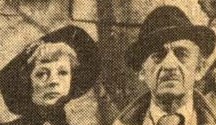
BENSON:.... Not many people come to the manor these days. It's nice to hear guests again.
Benson escorts them to their room - which used to be the room of the late Mrs. Twain. It hasn't been touched since the night she murdered herself, nine years ago. ''Murdered herself?'' asks Dickie. ''Don't you mean suicide?'' ''No, it was murder. Mrs. Twain hated herself.''
Benson opens the door and we see dust and cobwebs everywhere. Dora sees a mouse and screams. Dickie prevents Benson from going downstairs to answer the door. Dora declares that she will not sleep in such a filthy room, so Benson says he'll attend to it during dinner.
Benson goes downstairs, while Dickie discovers that the dust is baking flour and the cobwebs spun sugar. ''This has all been put here recently to frighten us.'' he comforts his wife.
''Stop the car,'' says Perrier as his car sweeps up to the door and stops. ''We are here.''
Marcel points out that Perrier has chocolate all over his face. Marcel spits on his handkerchief and cleans it off as one would do for a little child. ''Sloppy,'' says Marcel.
Benson has gone to the kitchen, and simultaneouly hears a woman scream and a knock on the door. He opens it, but cannot see the little French-uniformed cook standing there. It is Nancy Walker. She displays a message which says her name is Yetta. She can't speak or hear. She pulls out another message which says she can't understand English. ''This message was written for me.'' However, Benson bumps into her, realizes she's a woman and deduces she must be the new cook. He gives her instructions on how to cook the courses for the dinner.
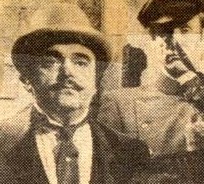
''Oh, leave me alone,'' says Marcel. Perrier steps over him, delivering his final shot. ''Sloppy.'' He goes to the telephone and tries to make a phone call. ''Allo. Allo? Operator? I am saying allo, allo?''
Benson comes on the scene. It's dead, sir.''
Benson heads up the staircases with their bags. ''I don't trust this butler,'' hisses Perrier at Marcel. ''Notice how his eyes never look at you!'' ''He's blind, messieur!'' Perrier follows Benson into his room, and delays him for a second, performing a few facial contortions to which Benson does not react. Perrier dismisses him. ''He's blind, alright! Those were my funniest faces!'' Sam Diamond pulls up in front of the Twain mansion. Tess moans. ''My feet are killing me! Why didn't you tell me we needed oil when I went back for the gas?'' Considering how long it would take for someone to walk ten miles round-trip, twice, this is not a very logical set-piece. But he had to be able to give Diamond the following lines: ''Because I gave you a fifty dollar bill and the gas was only five bucks. Maybe you'd come back, maybe you wouldn't. I couldn't take that chance, Angel.'' ''Don't you trust me, Sam?'' ''Trust you? The last time I trusted a dame was in Paris, 1940. She said she was going out for a bottle of wine. Two hours later the Nazis marched into Paris.'' They get out of the car and prepare to go up the steps. ''First, kiss me, Sam.'' ''I don't kiss.'' ''Just this once.'' ''I don't like kissing. Now leave me alone.'' This is a constant refrain throughout the movie. What is one to infer? Interior of house, as Benson heads towards the front door and hears a scream. He opens the door to Miss Skeffington standing there and the rubble of a gargoyle on the steps. ''My God! He's been crushed to death! Sam Diamond, the man I work for is lying out there! He's dead! I'm going to faint! You catch me!'' Benson extends his arms, but she falls between them. ''Madam. Where are you?'' Diamond strides through the doorway, his snow white tuxedo unmarked. Gun drawn, he accosts Benson. ''Freeze, Winkie. I got your little invitation to dinner, I didn't realize I was going to be the main course.'' Sam Diamond/Falk has a splendid scene here as he bullies the butler, whom he calls Jeeves and Shakespeare among other Diamondisms. At last Tess Skeffington persuades him to calm down, and Benson leads the way up the staircase to their room. ''He has a dreadful temper, hasn't he?'' comments Benson. Hands take off gloves and put them in a drawer. A clock strikes nine. Benson goes into the kitchen. ''Nine o'clock. Time for dinner.'' The cook is sitting at the table, looking bored. ''I don't smell anything. Very light on the seasoning, are you?'' On the second floor, Dick and Dora Charleston exit their room. ''You haven't told me how I look, Dickie.'' They both see a full length mirror in the hallway and turn to look at themselves. ''Do you love me and adore me?'' This is a scene that gives Dora Charleston some dialog, but its an annoying scene nevertheless. It's rather depressing for a beautiful woman to need the constant reassurance from her husband that she's beautiful, that he loves and adores her. They are lines that Nora Charles would never have said. Wang and son come out of their room and have a bit of dialog with the Charlestons, and then Perrier and the chauffer emerge from Perrier's room. ''Ah, East meets West in a most bizarre setting,'' comments Perrier. It is here that Dick Charleston is given the opportunity to do some deducing - more like Sherlock Holmes than Nick Charles. ''Recovered from your accident, Marcel?'' By the way he bends, Dickie has deduced that Marcel's left side was smashed in by car, ''a Citroen I imagine.'' Not to be outdone in the deducing department, Wang comments that Charleston must not have liked Mrs. Charleston dying her hair blonde, for there is a blonde hair on his shoulder...he catches himself but too late. It gives an insight into Dickie Charleston - either he's not above cheating on his rich and beautiful wife, or, more charitably, women still find him attractive and attempt to seduce him with their womanly wiles, but he would spurn them because he's so much in love with his wife. They enter the study, and Wang wonders where others are. ''Others? Are? What others?'' asks Mrs. Charleston. ''Invitation to dinner and murder finally clear to Wang, with appearance of Messieur Perrier.''
Perrier takes up the thread. ''It is obvious. Only the world's greatest detectives are on the guest list.''
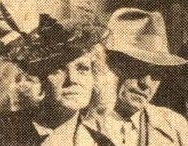
''Please forgive Sam,''says Tess. ''He was shot in the head last week. He shouldn't even be out of the hospital.'' ''Well, if yo uask me the fellow's pretty damned honest,'' comments Dickie Charleston equably. Dora reproves him for his language. At this point, Benson introduces Miss Jessica Marbles of England and her nurse, Miss Withers.
Sam reenters the room. ''Who's the old geezer?'' ''Sam!'' cries Miss Marbles. ''Jessie, baby!'' They hug, and Dora notices that Sam has a bullet hole in the back of his tuxedo. ''You should see the other guy.''
A groaning sound is heard by all. ''My god, it's the face,'' Dora Charleston realizes. ''It's coming from the face.'' ''What does it mean?'' wonders Dickie Charleston. ''It means dinner, sir. We have no gong.'' announces the butler. The guests file into the dining room for the dinner part of the evening. Or is to be the murder part?
Part Two of ''Was There A Murder Or Wasn't There?'' will appear next month.
The Play Goes On: A Memoir, Neil Simon, Simon and Schuster, 1999 |
 |
Thank you so much |
