 |
Le Cafe Singe Bleu Serving generous portions of history and mystery from our monthly menu Volume 1, Issue 2, February 2003
|
| |
Le Cafe Singe Bleu Serving generous portions of history and mystery from our monthly menu Volume 1, Issue 2, February 2003
|
Charlie Chan appears in six books written by Earl Derr Biggers. Of these, only two take place in Hawaii - the first, The House Without A Key, (1925) and the fourth, The Black Camel (1929). A cruise ship makes a brief stop at Honolulu in Charlie Chan Carries On , but this doesn't really count. By Edogawa Ranpo |
| Astronomer Percival Lowall, most famous for his theory that life might exist on Mars, coined the term 'Boston Brahmin.' It refers to a whole social cast in New England, men and women who were descended from the original Puritan settlers and who were the 'aristocracy' of Boston.
|
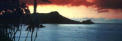
Biggers sets the scene of the 'semi-barbaric beauty of a Pacific island' as he follows the thoughts of Miss Minerva: 'It was the hour she liked Waikiki best, the hour just preceding dinner and the quick tropic darkness. The shadows cast by the tall cocoanut palms lengthened and deepened, the light of the falling sun flamed on Diamond Head and tinted with gold the rollers sweeping in from the coral reef. A few late swimmers, reluctant to depart, dotted those waters whose touch is like the caress of a lover.
A few pages later Biggers gives the reader even more background on this exotic location, which few people in 1925 had ever visited: 'Dan's great rambling house of many rooms was set in beauty almost too great to be borne. She stood, drinking it all in again, the poinciana trees like big crimson umbrellas, the stately golden glow, the gigantic banyans casting purple shadows, her favorite hau tree, seemingly old as time itself, covered with a profusion of yellow blossoms. Loveliest of all were the flowering vines, the bougainvillea burying everything it touched in brick-red splendor.

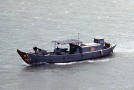
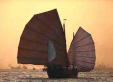
Yet more Hawaiian beauty follows: 'So brief, this tropic dusk, so quick the coming of the soft alluring night. ...On top of that extinct volcano called Diamond Head a yellow eye was winking, as though to hint there still might be fire beneath. Three miles down, the harbor lights began to twinkle, and out toward the reef the lanterns of Japanese sampans glowed intermittently. Beyond, in the roadstead, loomed the battered hulk of an old brig slowly moving toward the channel entrance. ....Ships of all sorts, the spic and span liner and the rakish tramp, ships from Melbourne and Seattle, New York and Yokohama. Tahaiti and Rio, any port of the seven seas. For this was Honolulu, the Crossroads of the Pacific - the glamorous crossroads where, they said, in time all paths crossed again.
 ..
..
Boston
Minerva is walking on the beach with her cousin Amos. Of Amos, Biggers states: 'he was the New England conscience personified, the New England conscience in a white duck suit.' How did he get to Hawaii? ''It's a strain in the Winterslips,'' he said, ''supposed to be Puritans but always yearning for the lazy latitudes.''
Minerva leaves the company of Amos for that of Dan, the Winterslip who restored his father's fortune (lost by his father when his fleet of ships had been destroyed, trapped and crushed by Arctic ice) by blackbirding - transporting slaves, in the 1880s. Amos is poor and Dan is rich. ''Yes, that's the way it often goes in this world. But there's a world to come, and over there I reckon Dan's going to get his.''
Dan keeps two servants, a Japanese butler, Haku, and a pure Hawaiian housekeeper, Kamaikui.
A little while later Haku brings in a tray of cocktails.
Dan is proud of his wealth, but he yearns for the past.
| In 1778,
British explorer Captain James Cook discovered an island chain which he named the Sandwich Islands after Britian's Earl of Sandwich. Originally, he got along well with the native inhabitants, but in 1779 he was killed in a dispute at Kealakekua Bay, near Kona. The first Chinese arrived in 1789 after jumping off a trading ship. The islands weren't peaceful, there were wars among the native inhabitants until 1810, when King Kamehameha the Great unites all the Hawaiian islands into one kingdom. Spain introduced the first pineapple plants to Hawaii in 1813. In 1816 the first Hawaiian flag is sewn and in 1817 coffee is first planted. King Kamehameha the Great died in 1819. Prince Liholiho ascended the throne as Kamehameha II (1819-1824). He abandoned the ancient taboo of eating with women. It was in 1820 that the first American Protestant missonaries arrived aboard the brig Thaddeus from New England, bringing religion and all-concealing clothing to the natives. The reign of King Kamehameha III was from 1825 - 1854, with the first Hawaii constitution of the kingdom established in 1840, and in 1848 The Great Mahele was signed by King Kamehameha III which allows commoners and haoles to own land outright or in "fee simple," a concept that continued to present day. On August 31, 1850, King Kamehameha III declared Honolulu a city. 1874 - 1891 marked the reign of King David Kalakaua. In 1882, America's only royal residence, Iolani Palace wass built on Oahu. In 1883 the Mutual Telephone Company was started. In 1885, the first contract laborers from Japan arrive to work on the sugar cane plantations. In 1892 macadamia nut trees were first planted. With the death of Kalakaua, Queen Liliuokalani ascended the throne. American businessmen saw their chance, and applied pressure. In 1893 Queen Liliuokalani was forced to surrender the kingdom to the United States under protest and in 1895 she abdicated her throne. In 1898, Hawaii was annexed to the United States, and it became a territory in 1900. Prince Jonah Kalanianaole Kuhio, the last powerful member of the royal Hawaiian family died in 1922.
 The Royal Hawaiian Band, circa 1880. Founded by David Kalakaua, the King of Hawaii from 1836 to 1891.
|
John Quincy Winterslip, the young man who is the real protagonist of the book, is described by his Aunt Minerva:
| Hawaii receives the benefits of 'trade winds' - the benificent winds which, save at rare, uncomfortable intervals, blow across the Islands out of the cool northeast. When the trade winds die, it becomes Kona weather. Kona - the sick wind. Wind that comes out of the south. Jack London mentions 'the sick wind' in 'Chun Ah Chun', one of his short stories in The House of Pride and Other Tales of Hawaii (1912). Out of copyright, our beloved patrons may read it online at this external website. [Later! After you've completed this article!] |
Continue to Page Two of Charlie Chan's Hawaii.
 |
We have a complete selection of Charlie Chan books and videos. Go to the Charlie Chan Store. The books by Earl Derr Biggers are out of print (except for a hard-back facscimile version of The House Without Key), you can locate used books at www.abe.com. |
 |
Thank you, so much |
