|
Reviewed by Dot Emm
The Winterslips
Miss Minerva Winterslip
Dan Winterslip
Amos Winterslip
John Quincy Winterslip
Barbara Winterslip
Interested Parties
Arlene Compton, 'The Widow of Waikiki'
Harry Jennison - a friend of Dan Winterslip's, he has his eye on Barbara
Carlota Egan - daugher of Peter Egan, she does her best to run the hotel during his imprisonment
Peter Egan - the owner of the Reef and Palm Hotel; and feared by Dan Winterslip, but for what reason?
Thomas Cope - an old flame of Miss Minerva's
Thomas McBrade - son of the captain of the Maid of Shiloh
The Police
Inspector Hallett
Sergeant Charlie Chan
| Opening Lines
Miss Minerva Winterslip was a Bostonian in good standing, and long past the romantic age. Yet beauty thrilled her still, even the semi-barbaric beauty of a Pacific island. As she walked slowly along the beach she felt the little catch in her throat that sometimes she had known in Symphony Hall, Boston, when her favorite orchestra rose to some new and unexpected height of loveliness.
It was the hour at which she liked Waikiki best, the hour just preceding dinner and the quick tropic drkness. The shadows cast by the tall cocoanut palms lengthened and deepened, the light of the falling sun flamed on Diamond Head and tinted with gold the rollers sweeping in from the coral reef. A few late swimmers, reluctant to depart, dotted those waters whose touch is like the caress of a lover. On the springboard of the nearest float a skim brown girl poised for one delectable instant. What a figure! Miss minerva, well over fifty herself, felt a mild twinge of envy - youth, youth like an arrow, straight and sure and flying. Like an arrow the slender figure rose, then fell; the perfect dive, silent and clean.
Miss Minerva glanced at the face of the man who walked beside her. But Amos Winterslip was oblivious to beauty, he had made that the first rule of his life. Born in the Islands, he had never known the mainland beyond san Francisco. Yet there could be no doubt about it, he was the New England conscience personified - the New England conscience in a white duck suit.
|
There have always been two kinds of Winterslips. The Puritan, stay-at-home kind - those who live in Boston, go to Harvard, become stockbrokers, marry the right kind of women and live the sedate life. Then there are those with a gypsy strain, those who �yearn towards the lazy latitudes.� One such Winterslip sailed out of Boston Harbor as a whaler, amassed a huge fortune, and became one of the richest men in Hawaii. In 1880 he lost his fortune, which caused one of his two sons, Dan, to take ship to search for his own fortune...as a blackbirder. It took him only one trip to do it�for the captain of his ship died, and Dan Winterslip took the man�s treasure chest for his own, returning to Hawaii a very wealthy man.
In 1925, Dan Winterslip is still a wealthy man. But he has his problems. His brother Amos, though born in Hawaii, is a Puritan through and through, and hates his more adventurous, and more wealthy, brother with a passion. The woman he loves is called The Widow of Waikiki, for it is believed by most that she drove her previous husband to his death. And he has, rather foolishly, kept the box, with the initials of the late Captain of the Maid of Shiloh, from which he had taken his fortune. It�s in the house he maintains in San Francisco, to be sure, but of a sudden it must be destroyed, and quickly.
Meanwhile, Puritan Winterslip John Quincy has been sent, all protesting, to Hawaii, in order to bring back his aunt, Miss Minerva Winterslip, who ten months ago had gone out there for six weeks. He travels by train from Boston to San Francisco, where he is met by cousin Roger, and delegated with the task of taking the box from Dan�s house and tossing it overboard once he gets out to sea. Unfortunately, he is attacked in the darkness by a shadow figure and the box stolen. The next day, he sets sail for Hawaii, accompanied by his beautiful cousin Barbara, who has just graduated from college on the mainland, and her very good friend, and Dan Winterslip�s lawyer, Harry Jennison. On the journey, John Quincy finds out more about the unsavory past of Dan Winterslip than he wants to know�but it is still a shock to find out that, while the boat lay off shore, waiting to dock the next morning, Dan Winterslip had been murdered, stabbed through the heart. John Quincy, at first prodded by Minerva, and later by his own sense of duty, decides to help with the police investigation.
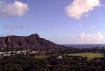
Diamond Head
The first sight of Hawaii from on board ship
The police officer in charge of the case is a Chinese, Charlie Chan, �the best detective on the force,� according to Amos Winterslip. Chan �was very fat indeed, yet he walked with the light dainty step of a woman. His cheeks were as chubby as a baby�s, his skin ivory tinted, his black hair close-cropped, his amber eyes slanting.�
Although the snobbish (but not offensive with it) Winterslip is startled to find a Chinese detective, he quickly learns that Charlie Chan is extremely intelligent and capable in his job. For his part, Chan has no objection to Winterslip helping out in the case, accepting his aid and discoveries, though he never shares with John Quincy his own deductions.
| ''You know,'' remarked John Quincy, ''I'd like to work with you on this case, if you'll let me.''
''I have only delight,'' Chan answered. ''You arrive from Boston, a city most cultivated, where much more English words are put to employment than are accustomed here. I thrill when you speak. Greatest privelege for me, I would say.''
''Have you formed any theory about the crime?'' John Quincy asked.
Chan shook his head. ''Too early now.''
''You have no fingerprints to go on, you said.''
Chan shrugged his shoulders. ''Does not matter. Fingerprints and other mechanics good in books, in real life not so much so. My experience tell me to think deep about humsn people. Human passions. Back of murder what, always? Hate, revenge, need to make silent the slain one. Greed for money, maybe. Study human people at all times.''
''Sounds reasonable,'' admitted John Quincy.
''''Mostly so,'' averred Chan. ''Enumerate with me the clues we must consider. A guest book devoid of one page. A glove button. A message on the cable. The story of Egan, partly told. Fragment of Corsican cigarette. This newspaper ripped maybe in anger. Watch on living wrist, numeral 2 indistinct.''
''Quite a little collection,'' commented John Quincy.
|
The House Without A Key marks the debut performance of Chinese detective Charlie Chan. Although he is, even here, a memorable character, with his Oriental politeness, stilted speech of a second language, sense of humor and pride, the story is very much the story of John Quincy Winterslip (told from his point of view) and how he matures and grows in the course of the case. The Hawaii of 1925 is vividly invoked, the class and caste structures of the American aristocracy of the rich is brought to life. The title refers to the fact that life is so safe (in the wealthier neighborhoods, anyway) that there are no need for keys, for the doors of Dan Winterslip�s house are never locked.
It is by no means a fair-play novel, although verbal clues to the killer�s identity are sprinkled sparingly through the book�John Quincy does not act as Chan�s Watson (or vice versa). Many of Chan�s clues that he possesses, and the deductions he made from them, are not told to Winterslip, or us, until the denouement. Yet John Quincy does solve the murder on his own, getting to the same conclusion by a roundabout and more violent route. The ending is bittersweet. Indeed the book itself, with its evocation of a lost time and lost culture, is bittersweet and memorable.
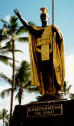
Statue of King Kamehameha
Dated Death
|
Selected timeline of Hawaiian history: (See external site Hawaii School Reports):
300-700 - Polynesian settlers arrive from the Marquesas.
1627 - Spanish sailors visit Hawaii, describe volcanic eruption in ship's log.
1758 - Paiea, later known as Kamehameha the Great, the 'lonely one', born in Kohala on the Island of Hawaii.
1778 - European 'discovery' of Hawaii by English Captain James Cook, who names them the Sandwich Islands.
1779 - Captain Cook killed in dispute with Hawaiians at Kealakekua, Island of Hawaii.
1782 - Kamehameha inherits power in the northern part of the Island of Hawaii and later begins conquest of the other Hawaiian Islands.
1791 - Kamehameha controls the entire island of Hawaii.
1794 - Hawaii is placed under the protectorate of Great Britain by Vancouver.
1795 - Kamehameha defeats the army of the King of Oahu at the battle of Nu`uanu. He now controls Hawaii, Maui, Lanai, Molokai and Oahu. Only Kauai and Niihau elude him.
1796 - Kamehameha's fleet readying to attack Kauai is turned back by weather.
1797 - Kamehameha puts down a revolt on the Island of Hawaii in a battle near Hilo.
1804 - Another planned invasion of Kauai is postponed because of a plague.
1810 - First theatrical performance staged in Hawaii.
1810 - Kamehameha unifies all the Hawaiian Islands into one kingdom through a treaty with the King of Kauai.
1813 - Don Francisco de Paula y Marin, a Spanish advisor to King Kamehameha, introduces coffee and pineapple to Hawaii.
1815 - Russian soldiers fail attempt to build a fort in Hawaii.
1816 - Volcano House opens for tourists on the Island of Hawaii, $1 per person for lodging.
1819 - King Kamehameha dies, Prince Liholiho ascends the throne as Kamehameha II (1819-1824).
1819 - Kamehameha II abandons kapu (taboo) system, including the prohibition on men eating with women.
1820 - First Protestant missionaries arrive from New England.
1824 - Kamehameha II dies in London.
1825 - Kauikeaouli ascends to the throne as Kamehameha III.
1826 - James Honnewell establishes C. Brewer & Co. Ltd. trade and service organization.
1826 - U.S. enters into treaty of friendship, commerce and navigation with the Kingdom of Hawaii.
1829 - H.N. Greenwell plants first coffee in Kona on the Island of Hawaii.
1834 - Honolulu Police Department is founded by King Kamehameha III.
1835 - First successful sugar plantation started in Koloa on Kauai.
1836 - Organization of the Royal Hawaiian Band.
1838 - Ground is broken for the building of the Kawaiahao Church.
1839 - France enters into treaty of friendship, commerce and navigation with the Kingdom of Hawaii.
1839 - Kamehameha III promulgates the Declaration of Rights and the Edict of Toleration (freedom of religion).
1840 - Kamehameha III promulgates the first Constitution of the Kingdom of Hawaii.
1842 - First House of Representatives is called to order.
1842 - First class begins at Punahou, the new private school.
1843 - Lord George Paulet seizes Hawaii in the name of England for 5 months. Admiral Thomas is dispatched to the islands to return the throne to Kamehameha III.
1843 - Great Britain and France agree to consider the Sandwich Islands an independent State and further that neither will take possession of the islands.
1846 - France and Great Britain enter into treaties of friendship, commerce and navigation with the Kingdom of Hawaii.
1846 - Construction of Washington Place (now governor's residence) is completed.
1848 - Kamehameha III divides land between the King, the alii (nobility), and the maka`ainana (commoners). This Mahele (division) allowed private land ownership for the first time.
1849 - French admiral Legoarant de Tromelin fails in attempted invasion.
1850 - United States and the Kingdom of Hawaii ratify a treat of friendship, commerce and navigation.
1852 - First steam-propelled ship used in inter-island service
1852 - First Chinese contract workers arrive.
1852 - Kamehameha III promulgates a new Constitution.
1853 - Smallpox epidemic takes the lives of over 5,000 Hawaiians.
1854 - Kamehameha III dies, and Alexander Liholiho takes the throne as Kamehameha IV.
1858 - C. R. Bishop and W. A. Aldrich begin Bishop Bank, now First Hawaiian Bank.
1859 - Honolulu Gas Company is established.
1860 - The Queen's Hospital's cornerstone laid.
1863 - Kamehameha IV dies, Prince Lot Kapuaiwa ascends the throne as Kamehameha V.
1864 - Kamehameha V promulgates a new Constitution.
1866 - Samuel Clemens (Mark Twain) sails into Honolulu Harbor.
1868 - First Japanese contract workers arrive in Hawaii.
1872 - Kamehameha V dies.
1873 - William C. Lunalilo elected King.
1874 - King Lunalilo dies, David Kalakaua becomes King.
1874 - Supreme Court of Hawaii moves into Ali`iolani Hale (where it remains today).
1875 - Victoria Ka`iulani Kalaninuiahilapalapa Kaw�kiui Lunalilo (Crown Princess) born in Honolulu.
1875 - United States and Kingdom of Hawaii enter into Reciprocity Treaty that allowed sugar and other products into the U.S. without customs duties.
1878 - Lydia Kamaka`eha (later Queen Liliuokalani) writes "Aloha Oe."
1878 - First telephone is in operation, two years after Alexander Graham Bell's patent.
1878 - First Portuguese arrive from the Azores.
1879 - First locomotive on Maui.
1881 - William H. Purvis introduces macadamia nuts to Hawaii.
1882 - The King and Queen move into Iolani Palace.
1882 - Planter's Labor and Supply Company founded (renamed the Hawaii Sugar Planter's Association in 1895).
1883 - Kamehameha Statue is unveiled in Honolulu.
1883 - Mutual Telephone Company founded in Hawaii (later Hawaiian Telephone, GTE Hawaiian Tel., and Verizon).
1883 - Princess Bernice Pauahi Bishop, the last direct descendant of Kamehameha I, executes her will which contains a trust to erect maintain a school for boys and girls to be called Kamehameha Schools.
1884 - United States and Kingdom of Hawaii extend the 1875 Reciprocity Treaty for seven years in return for the U.S. getting the exclusive right to use Pearl Harbor as a naval base.
1886 - Electricity arrives as five arc lamps are strung around Iolani Palace.
1886 - Great Chinatown Fire; losses exceeded $1,455,000.
1887 - Kamehameha School for Boys opens.
1887 - King David Kalakaua promulgates the 'bayonet' Constitution.
1889 - Father Damien dies at Kalaupapa Leper Colony on Molokai.
1889 - Robert Louis Stevenson, famous author, arrives in Hawaii.
1889 - Revolt against 'bayonet' Constitution put down.
1889 - First artesian well drilled in Ewa plain, allows commercial sugar and pineapple planting.
1891 - King Kalakaua dies in San Francisco. Lydia Kamaka`eha becomes Queen Lili`uokalani.
1893 - Hawaiian Monarchy overthrown by government ministers, planters and businessmen with the assistance of the U.S. Consul. U.S. Marines and sailors sent ashore to maintain order and protect Americans.
1893 - Sanford B. Dole and his provisional government request annexation of the Hawaii by the United States.
1893 - President Grover Cleveland withdraws the treaty of annexation from Senate consideration saying "a feeble but friendly state [was] robbed of its independence and its sovereignty by a misuse of the name and power of the United States."
1894 - July 4th, Republic of Hawaii established with Sanford B. Dole as President.
1894 - Kamehameha School for Girls opens.
1895 - Revolt against Republic of Hawaii put down, Queen Lili`uokalani forced to formally abdicate the throne.
1896 - Moana Hotel ("Grand Old Lady" of Waikiki/now the Sheraton Moana Surfrider) started.
1897 - William McKinley becomes President of the United States.
1898 - Spanish-American War, U.S. liberates Cuba and acquires Puerto Rico, Guam and the Philippines.
1898 - Congress passes the Newlands Resolution which annexes Hawaii as a territory. Sanford B. Dole appointed first Territorial Governor.
1900 - Congress passes an Organic Act for Hawaii which establishes the framework of the territorial government.
1900 - Great Chinatown fire, 7,000 made homeless.
1900 - First workers arrive from Puerto Rico and Okinawa.
1901 - James "Jim" Drummond Dole plants his first pineapples near Wahiawa and founds the Hawaiian Pineapple Company.
1901 - Honolulu Rapid Transit inaugural run of electric streetcars.
1902 - First Korean workers arrive.
1903 - Joint Tourism Committee is created to promote the Territory to the world (now the Hawaii Visitors and Convention Bureau).
1905 - First workers from the Philippines arrive.
1906 - California and Hawaiian Sugar Company (C&H) founded.
1907 - University of Hawaii at Manoa founded as a land grant college called the College of Agriculture and Mechanic Arts.
1907 - Dole opens a new pineapple cannery in Iwilei.
1905 - Only 80 automobiles are registered on the island of Oahu.
1909 - Japanese workers strike sugar plantations.
1910 - First airplane flight in Hawaii.
1912 - Duke Kahanamoku participates at the Olympics in Stockholm.
1912 - "The Outdoor Circle" founded to keep Hawaii clean, green and beautiful.
1916 - The brothel "Iwilei Stockade" is shut down.
1917 - Charlie Chaplin visits Hawaii and speaks at the Honolulu Ad Club's luncheon.
1920 - Edward, Prince of Wales, visits the Islands.
1920 - Hawaii National Park on the islands of Hawaii (now Volcanoes National Park) and Maui (now Haleakala) established by an Act of Congress.
1921 - Congress passes the Hawaiian Homes Commission Act introduced by Delegate Jonah Kuhio Kalaniana`ole (R-Haw.).
1923 - Hawaiian Dredging Co. begins dredging of the Ala Wai Canal.
1924 - Work begins on Aloha Tower.
1924 - Labor riots at Hanapepe, Kauai. 16 workers and 4 police killed.
|
|
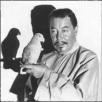
Warner Oland as Chan in Charlie Chan's Courage (1934)
An adaption of The Chinese ParrotEarl Derr Bigger's novel The Chinese Parrot will be reviewed in our next issue. |
This review uploaded December 24, 2002.
|