| An early two-legged, winged dragon from the book of snakes by Conrad Gesner (Zürich, 1589). |
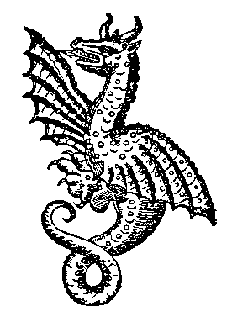 |
| An early two-legged, winged dragon from the book of snakes by Conrad Gesner (Zürich, 1589). |
|
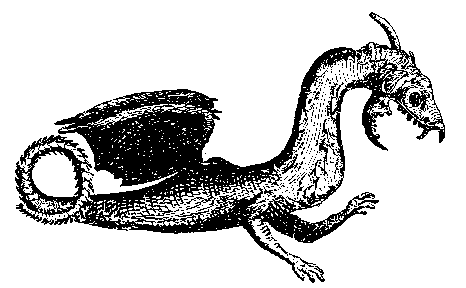 |
During the 17th and 18th century the first "museums" (or better: collections of curiosities) were established. They often contained "dragons", compiled from all sorts of animals. You might think that the curators have been fooled. Wrong ! They were quite aware that these "animals" were man-made. But scientists considered it possible that dragons might live somewhere in a remote place. And so they collected those artefacts as examples of yet unknown but perhaps real creatures. |
| Another dragon (or rather a flying serpent) from the book of snakes by Conrad Gesner (Zürich, 1589). | 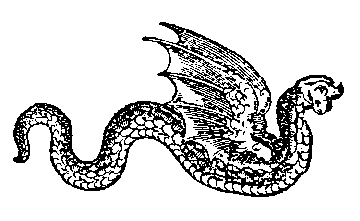 |

Der Drachenstich zu
Furth im Wald
The historic play "Drachenstich" (= slaying of the
dragon) is the oldest folk play in Germany.
D.R.A.G.O.N.S.
Draconic Research Alliance for Gainful Observations also
Non-lucrative Society.
Biological description and physiology of dragons.
The
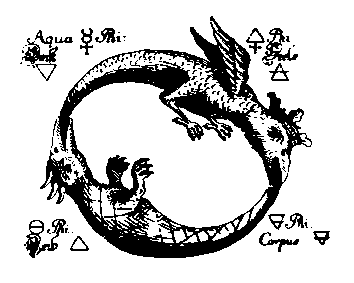
ouroboros
A serpent biting its tail - symbol of eternity.
Mediaeval
Culture as Evidenced by Gargoyles
The first model for gargoyles was a dragon´s head !
(follow the link "Student" or "Mediaeval
Culture" - or just have a look on the gargoyles !)
