The Kingdom of Tyllis
Celts or
Gaels arrived in Greece unexpectedly. According to Greek
historians, they lived in western Europe from pre-historic years.
As an Indo-European tribe, they first appeared on the northern
borders of Balkans and then, in 6th century B.C, they started to
roam eastward and southward. They settled in Spain, meanwhile
they also invaded North Italy, Switzerland, south Germany and
Hungary which was their starting point for the entry into the
northern Greece in 4th century BC[1]
In 335 B.C,
during Alexander the Great s campaign to Istros, Celt ambassadors
met with him and signed a peace treaty, which later, in 323 B.C,
was revised by a second Celtic embassy in Babylon. After
Alexander's death, new Celtic tribes charged the northern
Balkans. Having defeated by Romans in 284 B.C, Celts looked for a
better life by moving to the east. It was to the Celts advantage
that Lysimachus the ruler of Macedonia was occupied by a war in
Minor Asia and could not protect the northern borders of his
country from these superior warriors. Celts seemed to know the
situation and preferred not to attack the south, where Pyrrus
Kingdom of Eperus resided, but rather they attacked eastward into
Thrace.
| After the death
of Lysimachus and Seleucus, civil wars erupted in central
Greece between Sparta, Aitolea and Antigonus, Pyrrus went
to Italy, and a large number of Celtic tribes invaded
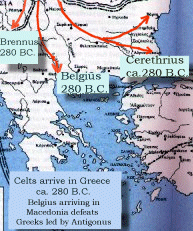
Greece. One army, led by Cerethrius, attacked in the east
against the Trivallians and Thracians, while another one,
led by Brennus and Ackihorius charged Pannonia. A third
army, led by Belgius, attacked Macedonia and Illyria.
Macedonian forces were completely defeated in 280 BC and
Ptolemeaus the "Thunder", their ruler, died in
the battle. After this conquest by Belgius, quick
reformations begun in Macedonia.Meleagrus, Ptolemeaus
brother, crowned himself King but, being powerless, he
was dethroned by Macedonians, which declared Antipatrus,
a Lysimachus nephew, the new King who, in his turn,
proved to be also weak and lost his crown after a few
days. Then, Sosthenes, a general, took control and after
a struggle, succeeded in pushing Celts to Pannonia and
Thrace. |
 |
 |
During the spring
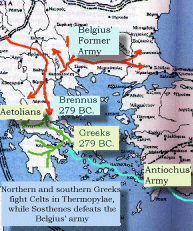
of 279 BC, Brennus with his army noticed this situation
and led his army to Macedonia. His army consisted of
200,000 people according to writers of that era, though
today this sounds fictional. When they crossed into
Thessaly, south of Macedonia, an alliance against Celts
was built by former enemies in southern Greece. There,
most of the cities were still autonomous while Antigonus
Gonatas controlled mainly cities in Peloponessus, and few
north of the Isthmus of Corinthus. The alliance comprised
of the rest free cities of central Greece, and also
included Aetoleia, Beaoteia, Locreia, Fokeia, Megara and
Athens, which led the alliance. Antigonus sent a force of
500 men, same number as the men sent by Antiohus, the
King of Syria. Kallipus, the Athenian general, being in
charge of this army, could not fortify the Sperhius River
pass and he prepared to defend Thermopylae. |
Brennus, responded with a
strategic action: he sent a power to Aetoleia, thus making 7,000
Aetolians to abandon the allied army in order to return and
protect their homes. Then, he led his army through a pass and
attacked from the side, using the same route Persians did 200
years before. Once again, this road was defended by Fokaies who
were surrounded and were saved only by escaping to the nearby
navy and so they returned to their home.
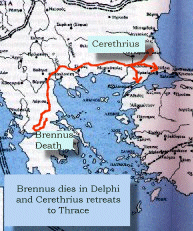
| Brennus, marching
into southern Greece now, came to Delphi where the Celts
fell upon very cold weather and having considerable
losses they also lost Brennus. Upon Brennus s death,
Comondorius took the control and Celts, being in a
hostile country, outnumbered and suffering from cold and
skirmishing, begun to move back to the north crossing
Thessaly, Macedonia and finally they settled down in
Thrace. Meanwhile there, the other Celtic tribes, led by
Belgius and Cerethrius, had already migrated this place. |
 |
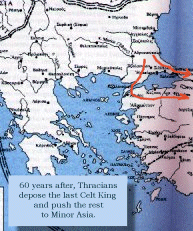 |
Unified now, the
Celts, formed a Kingdom, the "Kingdom of
Tyllis" as it was named, which became so powerful
that controlled even the city and the port of Byzantium.
That Kingdom stayed in Celtic rule for almost 60 years,
when Thracians deposed Canarus, the last Celt King in
Thrace thus pushing them to Minor Asia. After this
period, we have not historical record about any Celtic
existence in Thrace. |
Footnotes:
[1]. Obviously, we cannot
be sure of the exact Celtic origins. Ploutarchus (Camil.15)
alleges that the first origin of the Celts the Ripea mountains,
but we don't know where these mountains were located. Some
historians suggest they are part of Caucasus, while others say
that they may be Carpathia, or even Altaeia mountains in central
Asia.
[2]. Brennus in ancient Celtic language meant General and is a
name or perhaps a nickname of every Celt leader of that time.
