 An Clarsach
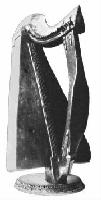
Laomannach (The Lamont Harp)
An Clarsach
Laomannach (The Lamont Harp)
The
Lamont Harp, now in an Edinburgh museum, is the oldest
surviving Celtic harp. The harp was the traditional
musical instrument of the Celts, long before the adoption
of the bagpipe in the 16th century. The harp was the
instrument of the bards, those individuals whose gift of
oral recitation made them 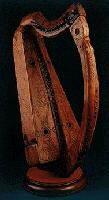 invaluable to the early
clan chiefs.
invaluable to the early
clan chiefs.
The Lamont harp dates from at the latest, the mid 1400s. It was in the possession of Lillias, a daughter of Duncan Lamont, when in 1464 she married Charles Robertson of Lude. The harp stayed at Lude, near Blair Atholl, until 1914, then was purchased by the National Museum of Antiquities for 850 guineas. It is now one of the prized historical objects of Scotland
The Celtic harp is, beyond a doubt, an ancient instrument, predating even the bagpipes in Irish and Scottish Tradition. As far back as the 12th century, chronicles speak of the harp playing the troops into battle, as accompaniment for the songs and stories of the Bards who moved from place to place, passing on the stories and events of the times, as well as lulling the laird and his household to sleep at the end of a busy day. Also described are the complexity of the music and the dexterity and artistry of the ones who played it. Even at the late date of 1687 the harp was the most ancient and revered of Irish musical instruments. Its history stretched far back before the year 1000. There are references to the Irish harpers accompanying the Crusaders across Europe to the Middle East in the 1200s and 1300s.
The Irish harp was the country's national instrument. It was of ancient design and constructed of just two woods, either oak or willow (sallow). For some unknown reason these woods had mythological significance and no harp builder would ever vary them.The harp had a long and important tradition for the Celts, who in the years before the Normans arrived, used it in a sacred or magical manner.
It was never hard to pick out a harper. His hands gave him away. His nails, long and slender, were a badge of high status in medieval society. These same nails placed him in the upper echelon of the Gaelic ruling class. No harper would have ever considered cutting his nails. The strings of this instrument were never struck with the balls of the fingertips. Because their fingernails were so long, harpers did no menial work. Their nails were their tools and they would not damage them.The harper's long nails plucked the strings and the instrument would resonate with a bell-like tone which reverberated through the high-ceilinged halls of the castles of the hereditary chieftains of the country.
Most harpers, in the years before 1600, were aligned with a chieftain and served him and his family. Others found a position at the manor house of a wealthy Anglo-Irish or Norman-Irish family. These "new" Irish were descendants of the original Norman invaders, and they took to Irish ways with enthusiasm. They had assimilated the Irish language and customs as their own and in the years preceding Henry VIII they were said to have became "more Irish than the Irish themselves".
Harp music in Ireland then, unlike today, was music for the nobles, not music of the common folk, and it was never considered a folk instrument, but was the primary musical instrument heard by the high ranking Irish aristocracy. The music that flowed from its strings was courtly and dignified. It was not primarily a dance instrument. As such, it remained socially segregated from the music of other musical instruments during its heyday, and stayed that way until its final fading notes were sounded early in the nineteenth century. The landless peasant, scratching out an existence, sheltered from the elements in a windowless thatched hovel, may never have heard the sound of the harp.
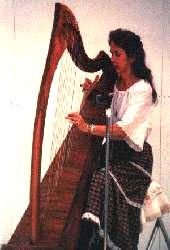 music had almost died
out in Scotland by the mid-18th century, and not long
after, in Ireland also. Harpists of today have needed to
reconstruct the music as best they can.
music had almost died
out in Scotland by the mid-18th century, and not long
after, in Ireland also. Harpists of today have needed to
reconstruct the music as best they can. 