The
The
Druids
Long before the Romans invaded Normandy, Britain and Ireland, the Celts lived in communal, tribal groups, their lives entwined with the all-pervading presence of elemental forces, and of nature itself.
Among their number were an elite group of wise elders whose job it was to memorize in verse all of the knowledge and history of their tribe and pass the wisdom on by word of mouth. Often the keeping of this hidden knowledge was the traditional responsibility of certain clans or families. In this way, the family and societal histories were kept alive within the oral tradition.
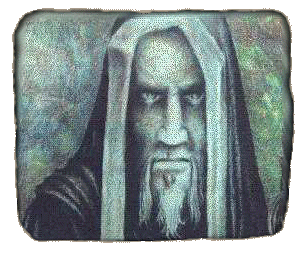
These wise elders were known as the Druids, Ovates and Bards. Among their ranks were the educated leaders of the Celtic people... the historians, astronomers, philosophers, judges, royal advisors, doctors and musicians, shamans and diviners.
With their concentrated system of learning which was known in Ireland as the Brehon Law, they grew in power and stature until they were as or more powerful than the Kings and Queens they served. Celtic Bards and Druids were allowed to pass unhindered between different warring tribes even though they were, at a later time, formally prohibited from carrying arms or using any physical weapon. But such was their position that they were capable of using words alone to vanquish their enemies when the need arose.
The Druids had a very special relationship with nature. They saw that human life was but a small fragment of a much larger pattern, and that the shape of life rhythms could be worked out by the careful observation of, and the strict adherence to, an annual cycle.
The Druids used a complex system of time-keeping based on their awareness of solar and lunar cycles. According to the Coligny Calendar, they measured the passage of time by observing the lunar orbit around the Earth (a lunar month.)
A Druid Cycle of five years was known as a 'Lustre'. At the end of six Lustres, or one month of years (30), a Druidic Cycle was complete. A period of 21 months of years corresponded to a Druidic Era. Eras dated from the Second Battle of Mag Tuireadh in Ireland, at which the Tuatha Dé Danann vanquished the Fomorians.
Greek was originally known and used by the Ancient Druids until the arrival of Christianity when Latin was adopted as the new religious and scientific language.
However the Druids also used a secretive hieratic alphabet as a special means of communicating with each other. It was known as the Ogham, or Beth-Luis-Nuin alphabet. It was limited to mnemonic learning by question and answer, and embodied special symbolic uses that are lost to us.
