 |
|
 |
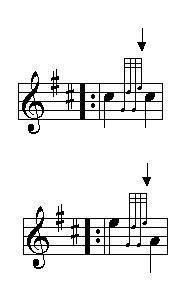
| Throw on D, Grip, Taorluath The following doublings (the throw on D, grip, and taorluath) vary from the basic doublings not only in complexity of the fingering, but in beat placement as well. Whereas in the basic doublings the beat falls on (or near) the very beginning of the doubling, these three have the beat falling in the middle or end of the doubling. I feel it worth stressing this because beat placement here can considerably affect the way your tune will sound, and it seems fairly well agreed upon where the beat falls in these doublings, so we may as well be practicing them that way. Throw on D There are two types of throws on D that pipers can play, deemed �light� or �heavy� based primarily on how much Low G they incorporate. Generally, both are considered acceptable, and which one you choose is little more than preference, based on ease, sound, or both. Some pipers may claim that they can play either interchangeably. This is possible, but I don�t think as common as people often want us to believe. I do find myself changing between them occasionally, but, as a rule, I can�t do this at will and I have noticed a fairly common trend in which I tend to play the light throws in slow-airs and some marches, while the heavy throws come more naturally for me in faster tunes. I teach new students the light throw because I find it both easier to break down and teach and easier to learn; however, I find that many people end up making a natural jump to the heavy throw after a year or two of piping (probably due to their teacher and/or Piper Major constantly reminding them to put more Low G in their throws). |
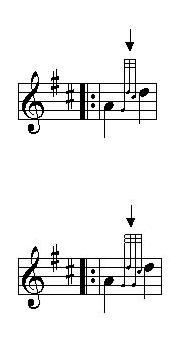
| Leumluaths: a.k.a. Grips The grip (I will refer to if by its more common name) is actually quite peculiar because the beat here does not actually fall on the doubling at all, but on the melody note following the doubling. The grip itself actually falls slightly ahead of the beat. I�ve heard a number of pipers play grips with the beat in every conceivable place, and this is one of the doublings in which consistency is crucial and can truly make or break the �togetherness� sound of a pipeband. Whether you put the beat on the first Low G, or on the final melody note makes an amazing difference in the sound of the tune. All I can say is this: most pipers are going to play it this way, so you would probably be well-advised to practice it this way as well. Here�s the breakdown: |
| Beyond beat considerations, there are a couple of things that people should keep in mind when practicing their throws. I personally prefer the heavy throw, but there is one main concern to watch out for when playing that one. Perhaps a year ago or so, I realized that my heavy throws on D were often little more than grips to D. In other words, I was frequently leaving out that C-gracenote, and I think that is actually a very common practice, though it comes so quickly that often we cannot actually hear it. If you decide to go with the heavy throw, keep that in mind, and watch for your C-gracenote. For the light throw, many people cut short or leave out entirely the Low G- and/or C-gracenotes. For the Low G, I can only say, be sure you hit a solid Low G (get all those fingers closed completely!) and hang onto it for a bit. For the C, I teach students to play a D-gracenote to C, and actually overtly exaggerate the length of the C (when practicing) in order to lessen the chance that you�ll just leave it out when you play it evenly, up to speed. |
| Light throw on D |
| Heavy throw on D |
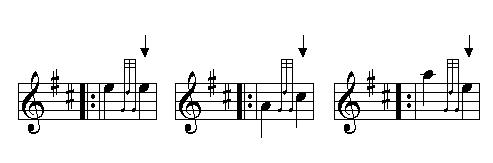 |
| Grip: E to E Grip: Low A to C Grip: High A to E |
| Notice that the beat is the same whether you play the grip breaking up two of the same melody notes or in transition from one note to another. It is fundamental to practice this consistently, in both circumstances. For the sake of space, I�ve only listed three examples, but I hope it is clear that all grips are timed the same. (Note: It has recently come to my attention that some people call a grip that transitions from one note to another, especially from Low A to C it seems, a �throw.� This appears to be an older term, and, while still acceptable, it seems that many, if not most, pipers have switched over to calling them all grips, and you may well never hear the term. However, in the hopes that you may avoid the confusion that I faced, I am pointing out that variant term here.) |
| Taorluaths: Taorluaths are played and timed fundamentally the same as grips. The only difference between the two is the addition of the E-gracenote at the end of the doubling. |
| Naturally, a taorluath cannot end on a top-hand note (E, F, High G, High A), but any of the bottom-hand notes are fair game. As I said above, the timing is basically the same as in a grip, except that you are placing the beat on the final E-gracenote to whatever melody note you end on. Technically, this is no different than the grip, but that�s only because you should be opening to the final melody note at the same time that you are playing the E-gracenote. If you wait to place the beat after the E-gracenote, there will be a noticeable lag between you and pipers who are playing it on the E-gracenote. As with all of the doublings, practice these slowly and deliberately. Remember: don�t cheat yourself. |
| Taorluath from C to C |
| Taorluath from E to Low A |