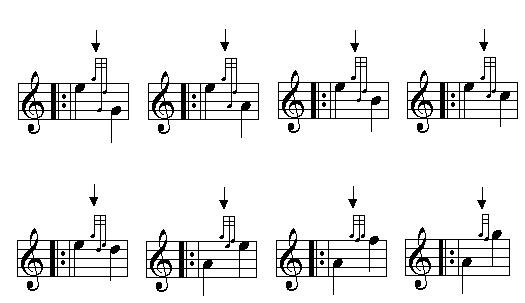
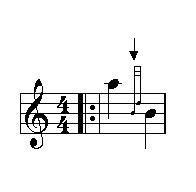
| When practicing anything (tunes or exercises) to improve my fingering once I�ve become fairly familiar with whatever it is I�m working on, I like to start off playing it agonizingly slow several times, until I�m comfortable with it (this creates that initial control�I can�t tell you how many times I heard, �if you can�t play it slow, you can�t play it fast� when I was beginning, and if you want to be a decent piper in the end, that old maxim really is pretty true), then I gradually pick up the tempo a few beats per minute (BPM). I repeat this over and over again until I�m playing at a tempo that is just slightly, but not too far, beyond what I can do with any semblance of control. I then return to a middle tempo (or the target tempo if I�m working with a tune) and practice there for a while. On an exercise like these basic doublings on the scale, I would start around 50 BPM, give or take a little, and may work my way up in excess of 160 BPM, moving in 10 BPM increments (give or take a little, depending on my comfort with the exercise). This helps build that control at various speeds I keep harping on, and playing slightly beyond your comfort level makes it seem a little less daunting when you return to the target tempo. The key here is that you never move up to the next tempo before you�re comfortable playing at the one you�re on. Also, be sure that you are varying the timing of the actual doubling, not just the space between melody notes�play slower, more open doublings at the lower tempos and tighter, brisker ones at the higher tempos (just be sure you are including all the notes when you speed up). If you ignore those two details (comfort and doubling tempo), you�ll be wasting your time. This technique is not the only technique available, but I like it because it is applicable to virtually anything you want to practice (with the arguable exception of slow-airs), and will clean up your fingering, if done properly, and improve your speed. Certainly there are less time-consuming exercises out there, but I think that if you do this occasionally (once a week or so) on a few things you are struggling with, you�ll begin to see some marked improvements. |