
In 1999 I published the book „An Essay on a Finite Ontology”, which contains the firsts articles of a ampler work, "The Finite Universe”. In this book contains following chapters:
In these articles I made the principial presumption of a finite Universe (not infinite!). I considerated as fundamental gauges the meter, the kilogram and the Newton (dynamic gauge), and not the time (static gauge). As primary elements I considered the v type qquantas, which are inert at a temperature of T = 00K and become mobile when their absolute temperature T > 00K (existant) - we'll call them w type qquantas.
We shall denote the set of qquants of type v – {v}, and the set of qquants of type w with {w}. We get the following axioms:
Axiom
I.1: {v} È {w} º
U (the finite Universe);
Axiom
I.2: {v} Ç
{w} º Æ
(inexistent set);
Axiom II: {w} / {v} = k (constant) {w} < {v}.
According to the properties of w type qquantas we can classify them following a certain criteria. Because {w} is finite, their classification will be made also according to the finitude of the criteria.
We'll denote the w type classes as {ci}, where i represents the ordinal number of the classes. Because {w} type classes are finite, there will be a final class {cM} where M is identical to i.
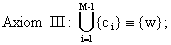
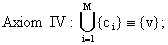
Let's take two finite rows {ci} and {ci, }. If there are two incompatible, contrar, hostile elements in the two sets cp and cp, , how will the two sets {ci} and {ci, } behave when reunited?
The PhF principle - Panheautofteirizsis comes from παν
- everything;
ξαντο
-
reflexive;
φυιριρ
-
to neutralize, to destroy. If we'll denote F1 the row {ci}
except the incompatible element cp and F2 the row {ci,
} except the incompatible element cp, and Δ
the difference between them {ci} and {ci,
}, then:

To Main Page Next: A Finite Cosmology