If we take into account that we admit a finite ontology, namely the multitude of elements must not include the notions of great “infinity” or small “infinity”, then with an adequate geometry there cannot be mentioned any “straight line” or a “plane”, as they are both ab initio infinite. More than that, phrases like pseudo-notions of “limited straight line”, “limited plane” and, if possible, “limited space” leads to a finitude of the “infinity”.
In
our work An essay about a finite ontology,
we have shown that the Universe is finite, and hence there is no “infinite
straight line” or “plane”. Thus, the wonderful edifices of D. Hilbert or
G. D. Birhoff’s are left without a subject. G. J. Darboux had the same
expressions, a bit more hidden, for integrability of some functions and A. L.
Vauchy for convergence of rows, as well as many other great mathematicians.
On
the point of view of a finite ontology, a primordial element is the “point”,
an adimensional element. A pair of two distinct points, is undetermined and
undeterminatory, because through them very many circles and ellipses can be
drawn.
The
second primordial element, that cannot be defined, is the “circle”. Three
distinct points delimit a circle. I have not used the expression “not situated
on the same imaginary line” because there is no such an expression. The
largest circle is the one that includes the whole (finite) Universe, and the
narrowest circle is the one that includes a v qquant.
Instead
of a circle there can also be arc of a circle or arcs of circles.
Let us assume that we have in front of us an ordinary coordinates system (rectangular). In this case we shall be able to represent in Mathematics the equation of the circles.
(1) (x-a)2 + (y-b)2 = R2 or x2 + y2 + 2px + 2qy + c = 0, where a= -p and b= -q are coordinates of the centre of the circle, R = the ray of the circle and

The sphere.
(2) (x-a)2 + (y-b)2 +(z-c)2 = R2 or x2 + y2 + z2 + Mx + Ny + Pz + Q
The ellipsis.
(3) Ax2 + xy + 2Bxy + Cy2 + 2Dx + 2Ey + F =0
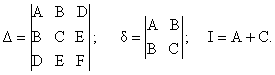
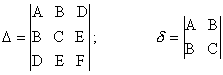
(3) is an ellipsis if D·I < O; d < 0
The ellipsoid.
(4) a11x2 + 2a12xy + a22y2 + 2a13xz + 2a23yz + a33z2 + 2a14x + 2a24y + 2a34z + a44 = 0
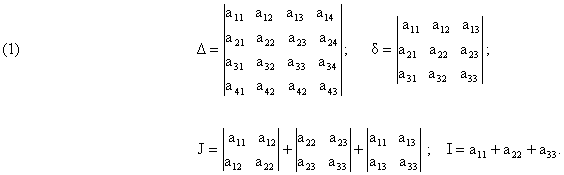
The secular equation is the following one: S2 + IS2 + JS + Δ/δ.
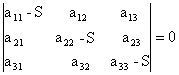
The conditions for this equation to be an ellipsoid are:
D¹0; d¹0; S1X2 + S2Y2
+ S3Z2 + Δ/δ
= 0, where
S1, S2 and S3 are solutions to secondary equation, all of them
are positive and
Δ/δ
< 0.
What
is left now is displaying the axioms. It may happen that some of them be
redundant, others to lack something or to have a thing more than it is
necessary, but all these shortcomings will not impede on the essence of what I
shall next say.
The point.
The point, unlike what was
told of it by me or by others until now, is something abstract, without contents
or dimensions. I shall consider the point as dimensional and substantial entity,
as the v type qquantor (written with two qs)x
may be. In order to make you have an idea about the small dimensions of a v
qquantor, I must reveal you that the whole Universe has 10134 v
qquantors. But this number is so enormously big – Skewes’s number – , that
Hardy discovered in Mathematicsxx.
Axiom 1. Any three distinct points (we did not say
linear because the straight line does not exist) delimit one and only circle.
Axiom 2. Any four distinct points delimit one and
only sphere.
Axiom 3. All real (existent) points are in a
continuous movement.
Axiom 4. We consider any of the points that determine
a circle or a different figure as points connected to the circle or to a
different figure, because they have given up the movements of the other points.
The circle.
First of all we
must introduce some new notions. The fact that allows this to us is that the
straight line and the plane are not conceivable to us, as they are infinite and
infinity is not a number, as analysts would believe. Beside the point, there are
the circle, the sphere, the ellipsis and the ellipsoid which are the only finite
elements that we shall use.
Since
there are and cannot be infinite elements, elements that are left remain
measurable, they need to establish a definite scale of values and a gauge for
their dimensions. To those which have already been measured, there will continue
to exist for the meter (m), the kilogram (kg), as well as the force (N) – the
newton with its multiples and submultiples. Thus, in drawings (Technique) it is
recommended that the helping elements for circle, sphere, ellipsis or ellipsoid
be used with one or two degree of gauges, without reducing its gauge or of using
an analogous comparison.
Definition 1. Being given two
circles c1 and c2,
c1<c2
( c1 is lesser than c2),
c1£c2
(c1 is lesser or at the most equal to c2),
c1>c2
(c1 is more than c2).
c1³c2
(c1 is more or at least equal to c2)
c1£c2
Ç
c1>c2 É
ci = c2
Definition 2. Being given
three points A-B-C we shall be able to define distances as it follows. (We shall
measure dimensions according to the proportion 1:100 – that is measuring at
the second degree of gauge, where curving reduces).
VA,B,C d(A-B-C)>0
(1:100)
VA,B,C d(A-B-C) =
d(C-B-A)
(1:100) and
VA,B,C,D,E d(A-C-E) =
d(A-B-C) + d(C-D-E)
Axiom 5. Inside every circle
there is a point called the centre of
the circle. Distances from the centre to the circle (the periphery of the
circle), called radiuses, are equal.
The opening between two radiuses of a circle is
called an angle. The opening between two circle radiuses splits the interior
of the circle into two angles. When radiuses are overposed then the angle is
said to be of 0º (degrees); when the openings of the radiuses are half the
interior, the angle is supposed to be of 180º, and when the opening has gone
over the whole interior, the angle is supposed to have 360º. It is in the same
way that arcs (parts of the periphery) are noted. To 0, 180 and 360 degrees
correspond 0, p
and 2p radians.
Definition 3. VA,B,O,C,E
= m("ABODE)
³ 0 , where O-B-A and O-D-E are radiuses.
Definition 4. VA,B,O,D,E,F,G
= m("ABODE)
+ m("EDOFG)
= m("ABOFG).
Circles
and points
Axiom 6. Between two circles there the following situations may occur: exterior circles, with a common point, that is tangents (extern or intern), with two points in common, that are secant, they may be interior and concentric, namely parallel.
Axiom 7.
Every circle has its own individuality, distinct from other circles. Two
circles, with two points in common allow each other to take part at their own
individuality.
Three
circles may be connected in triangles or connected in chain. For the reason that
in the triangle connection there are six points in common and in the chain
connection there are only four points, the triangle connection may preferred. It
is in the same way that circle agglomerations behave towards (finite) circle
chains. Constructions of various circle combinations can be found, for example
chain circles alternatively with agglomeration circles.
Axiom 8.
If upon a sphere or upon a calotte of a sufficiently big ray was drawn a
rectangular system of coordinates, then biunivoquely with a square function with
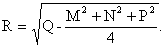
f(x,y) = x2 + y2 + 2Mx + 2Ny + P a circle of coordinates
–M and –N and of a radius:  .
.
The sphere. As a basic notion, the sphere cannot be defined. Intuitively, the sphere is
born when a semicircle rotates (the periphery half of a circle) in a complete
rotation 2p around the diameter of the circle (2R). A
sphere is determined by four distinct points.
Axiom 9.
The intersection of two spheres is done on a circle.
Several
spheres may intersect either as a conglomerate, or as a chain.
Spheres
as conglomerates are more numerous than chain ones. With conglomerates they may
reach a number of 4R and with chains they may reach 2R of circles. In fact,
multiple and multiform combinations of spheres can be done.
Spherical triangles.
We have the following postulates:
P.1.
A spherical triangle is modelled upon a spherical calotte.
P.2. In a spherical triangle, a random side is smaller than the sum of the other
two sides and is bigger than their difference.
P.3.
The sum of sides of a spherical triangle is less than four straight angles (2p).
P.4. Two spherical triangles are equal when each of them has an equal side
situated between two respectively equal angles and placed in the same order.
P.5. Two spherical triangles are
equal when each of them has an equal angle situated between two respectively
equal sides and positioned in the same order.
P.6. Two spherical triangles are equal when they have three sides respectively
equal and situated in the same order.
P.7. Two spherical triangles are equal when they have the three angles
respectively equal and situated in the same order.
P.8.
If in a spherical triangle two sides are equal, then the angles opposite them
are equal, too.
P.9. If in a spherical triangle two angles are equal, then the sides opposite
them are equal, too.
P.10.
The sum of the three angles of a spherical triangle is situated between 2p
and 3p.
P.11. In a spherical triangle, the sum of two angles is less than the third angle with p3.
Theorem: The
shortest path between two points on a sphere is on the largest arc that passes
through the two points.
The demonstration is simple, if “its smaller
part”xxx will be added.
Solving
spherical triangles.
Elements to work with:the angles
A, B, C and their corresponding arcs, namely the sides a, b, c.
1. All the three sides – a, b, c – are known:
cosA = (cosa-cosb·cosc)/sinb·sinc; cosB = (cosb-cosc·cosa)/sina·sinc;
cosA = (cosc-cosa·cosb)/sina·sinb.
2. Two sides and the angle situated between them are known: a, b, C.
cosc = cosa·cosb+sina·sinb·cosC; ctgA=ctga·sinb/sinC;
ctgB = ctgb·sina/sinC-cosa·ctgc.
3. Two angles and the side situated between them are known: a, B, C.
ctgb = ctga·cosB+sinC·ctgB/sina; ctgc = ctga·cosB+sinB·ctgC/sinA;
cosA
= -sinB·sinC·cosa-cosB·cosC.
4. The three angles A, B, C are known.
cosa = (cosA+cosB·cosC)/sinb·sinC; cosb = (cosB+cosC·cosA)/sinA·sinC;
cosC = (cosC+cosA·cosB)/sinA·sinB.
5. Two sides and the angle of one of them are known: a, b, A.
sinB = sinA·sinb/sina.
knowing B, namely sinB.
cosb·cosc+sinb·cosA·sinc = cosA.
the unknown element being cosc or sinc, we shall denote as
cosc = (1-tg2t/2)/(1+tg2t/2) and sinc = (2·tg2t/2)/(1+tg2t/2), then we obtain the equation: cosb·(1-tg2c/2)+sinb·cosa·(2·tg(c/2)) = cosa·(1+tg2c/2).
It may be noticed that an easy to solve 2nd degree equation was
obtained, of a tg(c/2) variable
.
6. One side and two angles, one of which is opposite to the side: a, A, B. .
sinb = sina·sinB/sinA; sinc = sina·sinC/sinA;
cosA = sinb·sinc·cosa-cosB·cosC.
The ellipse.
The ellipse is not definable. One property of the ellipse is that it is the
geometrical place of any points starting from which the distance to two fixed
points, called focuses, is always constant. An ellipse has four vertexes, two of
them are acute and two are obtuse. On the construction point of view, the ellipse
has a symmetry centre, two symmetry axes, the big axe, 2a and the small axe, 2b.
The big and small axes may be oblique or rectangular. One ellipse may be
determined by five distinct points.
The equation of a conic ellipse is:
Ax2+2Bxy+Cy2+2Dx+2Ey+F = 0
I = A+C.
In order to represent an
ellipse, the equation has
to: D·I
< 0 and
d
> 0 .
The
focuses F and F’ of the ellipse are obtained if from the edge of the small axis
B we fix the big semiaxe a on the big axe on one side and the other of the small
axe. Starting from the centre of
the ellipse O, on the big axe, there are the focuses, on a distance equal to OF
= OF’.
OF2 = BF2 – OB2
or OF2 = OA2
– OB2; OF=c; c2
= a2 – b2
If the centre of the ellipsis moves to the origin of
coordinates O and its axes coincides with coordinate axis, then the equation
becomes
x2/a2+y2/b2-1 = 0
.
We
hereby reproduce two theorems (without demonstrations) upon a few properties of
ellipses.
The
geometric place of the vertex of a straight angle, the sides of which stay
tangent to an ellipse, is a circle – the orthoptic circle. (Gaspar Monge).
Tangents
drawn from a (exterior) point to an ellipse are inclined on the focal radiuses
MF and MF’ of the point M. (Jean Victor Poncelet).
Ellipses
have co-chain properties, but, due to their formal way of being and of
manifesting, chain relationship prevails upon conglomerates. But this default is
chased by a great privilege, namely the richness of elements such as a centre,
two focuses and the absence of the boring roundness of the circle.
Two
ellipses or one circle and one ellipsis can be exterior to each other, can
intersect in two points or in four points, and as lines of border there are arcs
of ellipsis or/and arcs of circle and of ellipsis.
The ellipsoid cannot
be defined. On the formal-geometrical point of view, the ellipsoid is a quadrix.
The ellipsoid has three reference axes and 6 main focuses. It is therefore a
body very rich in elements. It needs nine distinct points and determinations
between invariants D, d,
J, I, which will become coefficients of the secular equation. The calculus of
invariants is to be exposed in the following page.
When
ellipsoids intersect one another or intersect spheres, ellipses will appear.
The
same as with ellipses, ellipsoids have the tendency to form chains and/or to
conglomerate in what regards its elements. As we have already shown, the same as
with ellipses, with ellipsoids there is a preference for chains, meaning not
arborescent forms of chains. In order to avoid this shortcoming, especially in
information theory – namely with theory of transmitting information – a
symbiosis was adopted between the sphere and the ellipsoid. This way, chains
would alternate with conglomerates.
For
the time being, there are few known data upon the way ellipsoid’s elements
behave.
The title of this article A Project of Geometric Axiomatic into a Finite Ontology may seem a bit awkward. I must admit too, it seemed somewhat false, if not paradox-like. How should I admit a finite ontology along with geometry which has as basic elements the point (the tiny, immaterial infinity), the straight line (infinite), and the plane (infinite)? However, I used a categorical discrepancy in order to elude the presented incompatibility. The axioms of Euclid, Hilbert, Birkhoff and many more started from their studies upon the infinite plane, the infinite straight line and the tiny infinite point and they represent axioms of inexistence. It sounds like a logical paradox.
In my work I have admitted point as something material, a v qquantor. How otherwise understand the notion of absolute void? Instead of a straight line (infinite) I considered the circle and the ellipsis, and I considered the periphery of the (finite) Universe as the largest element. I used the sphere and the ellipsoid as bodies. The greatest (finite) body is the Universe or the Existence.
x Leon Birnbaum An Essay About a Finite Ontology, Ed. ALETHEIA, Bistrita, 1999, p.16.
xx Simon Shing The Great Theorem of Fermat, Ed. HUMANITAS, Bucuresti, 1998, p.158.
xxx by Arno Kahane, Complements of Mathematics, Ed. Tehnica, Bucuresti, 1958, p.129.