|
|
|
 |
 |
- none-official-version-
For the FCI-Standard No. 145
pls. go to the official club-websites
or the FCI-Website www.fci.be
The Leonberger belongs to the FCI-Group II - molossian type dogs -
The standard for a FCI-recognized breed is made by the country of origin,
for the Leonberger Germany, given to FCI , and must be considered by all
FCI-member-countries to provide an equal judgement on all shows !
|
|
|
|
|
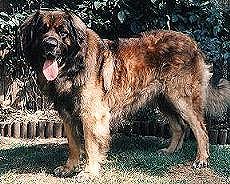
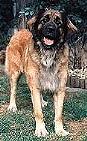
The Leonberger dog is a dog of a tall, strong,
muscular yet elegant body,
well proportioned and of selfconfident
character but enjoyable temperament.
Male/dog: about 72 - 80 cm
ht/withers about 50 - 75 kg bw
Female/bitch: about 65 - 75 cm ht/withers
about 45 - 60 kg bw
The coat should be
medium to good lenght,
not curly, slight waves are allowed;
Colours:
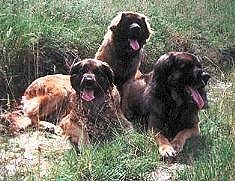
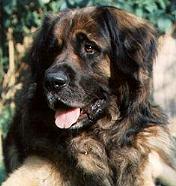
lion-coloured to red-brown (with black tips)
and black mask !
Some white on toe(s) and chest is tolerated.
Paws and nose must be black, brown excludes from breeding.
Bone-structure,
head and body proportional in good relation
to each other .
Character and habits
The breed is well-known as a so-called family dog, since decades
breed for especially this habit.
The Leonberger loves and adores his family, his is very well
known for being especially fond of children and being very patient with them.
One of the habits is the souvereignity of the
breed by being alert at the same time.
The Leonberger does not
bark without a serious reason.
The temperament of the breed is shown in awaiting of good things,
playing around with his family, going for a walk, getting some
favorit food etc. Than the dog is waving its tail, barking,
jumping.
At that time you should put your precious crystal and other
things of worth you may own out of the reach of your dog - he's
far too excited to take care of your other goods.
Aggression is very rarely shown by a Leonberger - against human's - but the dog has to be socialized very well as it is
necessary for a family dog.
Very temperamentful and dominant
males might sometimes show some aggression / dominance reaction
against other males - try to avoid that by education and
sozialisation very early, start with the puppy, let it play with
adult dogs of good character and it will learn how to behave well
against other dogs.
The Leonberger needs most of all a very close contact to it's family, it is a
giant breed but still a baby - even as an adult
dog. The Leonberger loves his family and wants to stay with his
family in almost every situation.
The breed is - as any giant
breed - slowly growing out psychically, and a very long time
juvenil and fond of playing around.
Some Leonberger show these
habits the whole life long.
Because of belonging to the giants, the dog must have a
consequente but sensitive guidance, one has to be patient and
sensitive to bring up a Leonberger dog. The dog itselfs is very
strong but easy to handle - if the owner has found the right
way
to guide the dog.
Agility could be done with the Leonberger - but always think of
the fact: it is a giant dog, not as fast as other breeds due to
that fact. Training on the bike could be done - but please start
slowly and not too large distances; about 3 miles will do for the
beginning.
Due to the fact that the dog is growing until about 2 years age
(a male needs sometimes about 3 years and maybe more)
don't start to early with
activities.
(The right time would be about 18 - 20 months in the
average - education / obedience has to be done from the very beginning, start
with 10 minutes a day).
Due to the growing period one can do harm to the bones and tendons when starting too early and
allow too much activities.
The
Leonberger prefers to walk around and play around with it's
family.
|
|
This breed needs the every-days-contact |
This information was partly picked up at the book
Der Leonberger
(H. Schmitt, G. Zerle)
Verlag Paul Parey, Hamburg/Berlin
ISBN 3-490-39012-1
- only in German -
(there are other books available in English)
and supplemented with some information by the author.
There are Clubs in Germany, Belgium, France, Netherlands, Switzerland, Austria,Great-Braintain,
Sweden, Norway, Finland
& some other European countries, and as well in USA.& Canada.
The author is also willing to help you with additional
information.


© by E. Steffen