Lord Sebastian Blacke and the SCA
Bottom


Lord Sebastian Blacke was born in 1166 in the French city of Auxerre
in the Abbey of St. Etienne. His father's name is Sir Henri Blacke
and his mother's name is Ingebjorn. His family's ancestral seat of power
is the manor house of Blackwheel and is eight miles northwest of Auxerre.
Sebastian is the 6th son and the 9th child of Henri.
Sebastian's mother Ingebjorn is Henri's second wife.
Sebastian was given over to the abbey as an oblate to be educated and
raised to one day become a monk when he was fourteen. It was in the abbey
that he learned to read and write Latin and at his father's request,
French. However, in 1178, Ingebjorn's father, two brothers, and all of
her nephews were killed by fires and flooding during a violent storm
that smashed the North Sea coastlines and her family's homeports in Ribe,
Denmark and Nidaros, Norway. As the only surviving male of Ingebjorn's
line, even one by marriage, Henri Blacke inherited all of their lands and
property -- including two surviving merchant cargo ships.
Henri moved his wife and children to Ribe for a short time to
familiarize himself with the business and his men and servants in Denmark, then traveled to the small port town of Scardeburg in the
English Danelaw, where Ingebjorn's father had purchased property only a
few months earlier. Scardeburg remains the primary residence of Henri.
Sebastian and his brothers, Roger, Stephen, and Dominic spent the next
seven years sailing the North Atlantic and the Baltic Sea aboard the
family's ships, learning the business, training with weapons to help
defend the ships against piracy, and generally being dissolute younger
sons.
Then in 1185, after he and his three closest brothers went to give
confession in Lincoln Cathedral while drunk and then lied about their sins, an earthquake struck north-central England. Most of the
cathedral was destroyed but enough remained intact for Sebastian, his brothers,
a few priests and parishioners, and the cathedral's prized green ducks
to survive. Terrified, they gave true confessions to the priests.
In penance, they were to make a pilgrimage to Jerusalem.
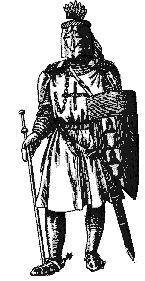
Henri gave Sebastian and his brothers horses, crossbows, and enough money
for the trip. They sailed aboard a family ship to Arles, France, where they
visited their older brother Gilbert, who had become a clark in the service
of the archbishop of Arles. They had to take passage aboard a non-family
ship for the rest of the trip to Tripoli in the Kingdom of Jerusalem.
On the trip, a storm struck the ship off the coast of Malta and the
youngest brother, Dominic was washed overboard and lost.
After they arrived in Palestine, life was rather good. The entered into
the service of Sir Humphrey of Chester, who himself was vassal to Count Raymond
of Tripoli. Sir Humphrey had two fiefs, a manor-farm near Tripoli, and a
house in the southern coastal town of Ascalon. It was in Ascalon that the
brothers spent the majority of their time. Their ability to read and write
Latin and French and their experience with numbers and a business that made
them valuable vassals. Sir Humphrey bought a merchant ship of his own, the
Lincolnshire Maiden, and charged them to operate it throughout the eastern
Mediterranean. Sometimes they were at the disposal of Count Raymond. It was
during this time that they began to learn Arabic and Greek in their dealing
with other Islamic and Byzantine merchants.
All went relatively well for almost two years until the summer of 1187.
There had been no serious threats of warfare from the array of fragmented
and squabbling Muslim states around the lands of the Latin Kingdom
of Jerusalem and its Frankish allies of Edessa and Antioch since the
ill-fated Second Crusade over twenty years before. Trade and the lucrative
pilgrimage routes kept the local economies running smoothly and the Crusading
Orders of the Hospitallers and the Templars fore-stalled anything above the
level of determined raiding on the part of the neighboring Muslims. But then
a series of events plunged the Franks, and Sebastian his brothers, into
full-scaled warfare: the rise of Saladin, the political ineptitude of King
Guy de Lusignan of Jerusalem, and the cruel depredations of Baron Reynald
de Chatillon of Kerak.
It culminated into the Battle of the Horns of Hattin
on July 4, 1187. In that battle was lost the future of the European states
in the Middle East. The twenty-thousand man strong army of the Kingdom of Jerusalem, led by King Guy was essentially wiped out. Only a few hundred men
survived. Their patron, Sir Humphrey, was killed but by staying close to
Count Raymond, Sebastian and his brothers, serving as mounted crossbowmen
serjeants, were able to follow him and his men through a breakout in the
shrinking Saracen perimeter.
The brothers entered into a loose vassalage under Count Raymond during
the bloody and chaotic months that followed. The survived the fall of
Ascalon on September 4th to Saladin and the fall of Jerusalem
on Jerusalem on October 2nd. Before he died from illness in
November, Count Raymond purchased back from Saladin the brother's ship,
which had been captured when Ascalon was captured.
By this point, the brothers were generally clear of any feudal bonds and
re-established themselves as a small merchant house. They had a tenuous link
with Balin of Ibelin, under whom they fought in the Siege of Jerusalem,
and it was to him that they paid a percentage tax of their business in order
to operate under the umbrella of his name. While the news of the disaster
of Hattin and the Fall of Jerusalem dismayed and outraged western
Christendom, and thus Sebastian's family back in England, Denmark, and
France, for the brothers things fell into a general routine of trading
between ten different port cities along the broad sweep of coastline
from Egypt to Asia Minor: Alexandria, Ascalon, Jaffa, Acre, Tyre, Tripoli,
Lattakieh, Tarsus, Seleucia, and Famagusta (in Cyprus). Having had enough troubles
against the armies of Saladin, the brothers dropped any arrogance they
still carried for Muslims and Greeks and settled down to become prosperous.
They kept learning Arabic and Greek and duly paid tariffs and bribes at
every port of call and soon found acceptance among their fellow traders
and at every market they called upon. Several times they ventured into the Aegean
Sea and stopped at Rhodes, Crete, and even Constantinople. By the
autumn of 1189 they had earned enough to purchase another, albeit a
smaller boat, the Danish Dragon, and a house in the merchants quarter
of Famagusta.
But the political events of the rest of the world, which is how they viewed
the burgeoning Third Crusade, eventually caught up with them. In September
1189, a flotilla of ships from Denmark and Flanders at Sicily to help with the
preparations and supplying of the massive armies gathering together in Northern
Europe.
 Some of those ships made their way into the Aegean and coastal cities of
Greece and Anatolia, where the brothers met up with friends and colleagues from
back home. Some of those ships were going to return to Denmark and took messages
with them for their father, Henri. Overall though, the Danish ships that had
arrived at Sicily took part in the Christian naval blockade of Acre and were soon
joined by more and more ships arriving from southern France and the Italian cities.
The brothers managed to not become attached to the blockade and served as a ferry
for crusader knight and lords involved in the landward siege of the city.
When a major battle at Acre took place on October 4th, Sebastian was with
Stephen in northern Syria selling food and bow wood to the Syrian merchants supplying
Saladin's army.
Some of those ships made their way into the Aegean and coastal cities of
Greece and Anatolia, where the brothers met up with friends and colleagues from
back home. Some of those ships were going to return to Denmark and took messages
with them for their father, Henri. Overall though, the Danish ships that had
arrived at Sicily took part in the Christian naval blockade of Acre and were soon
joined by more and more ships arriving from southern France and the Italian cities.
The brothers managed to not become attached to the blockade and served as a ferry
for crusader knight and lords involved in the landward siege of the city.
When a major battle at Acre took place on October 4th, Sebastian was with
Stephen in northern Syria selling food and bow wood to the Syrian merchants supplying
Saladin's army.
More and more crusaders arrived to swell the ranks of the army besieging Acre,
as well as the rest of the Kingdom of Jerusalem (still called thus despite the fact
that Saladin still held the city). These newcomers had ahead of the armies being
gathered in England by King Richard, in France by King Philip, and in the
German states by the Holy Roman Emperor Frederick Barbarossa. They all needed
to be fed and supplied and the brothers grew richer selling to them openly while
secretly maintaining their partnerships with various Muslim merchants. This proved
to be invaluable to the brothers when on October 31st, an Islamic fleet
of fifty ships from Egypt and Syria broke the blockade of Acre briefly and on
December 26th an even larger armada broke the blockade and scattered
the European fleet. The crusaders had lost control of the sea but the brothers
continued to trade and ferry messengers undisturbed. The landward siege lines
began to suffer from disease and hunger -- that is, among the common soldiers.
In general, the wealthier nobles managed to do just fine thanks to sporadic
supplies from the brothers and a few other well-favored merchant vessels.
This situation held for a few months until a rebuilt Crusader fleet drove
off the Muslims on March 5th, 1190. After a resupply run from
Tyre on May 4th, the brothers decided to stay out of southern
Syria for a while.
However, this decision was reversed when on June 8th, 1190, the Holy Roman Emperor,
Frederick Barbarossa, led his army down through Asia Minor towards Seleucia.
Sebastian and his brother Stephen happened to be in port after delivering a cargo
of cloth and cedar wood from Lattakieh when the city fathers learned that
Barbarossa would soon enter Seleucia. Sebastian agreed to take aboard a trio of
messengers from the city to Tripoli, where they would thence depart. It was the
purpose of the messengers to warn Saladin of Barbarossa's imminent arrival at
the Mediterranean coast. Before the Danish Dragon left with the evening
tide on June 10th, word reached the city that Barbarossa had drowned
that day attempting to ford the Calycadnus River.
From that point on, thing became bloody and chaotic for the brothers again.
They still took the city messengers to Tripoli, but they also took aboard several
wealthy Syrian merchants and their families with them. Despite being leaderless,
the arrival of the German army frightened a great many northern Syrian Muslims.
The depredations of the First Crusades was remembered throughout the Islamic
world. Over the next two months the brothers generally focused on helping Muslim
merchants with whom they had had close dealings escape from Asia Minor to the
safety of Syria. This role was discovered by a Pisan ship and incurred the
anger of King Tancred of Sicily, who demanded that they choose one side or the
Aware of their dangerous situation should the crusader armies defeat Saladin,
declared their solidarity as Christians. The brothers returned to Famagusta
and tried to stay uninvolved, never leaving Cypriot waters and confining
themselves to intermittent coastal jaunts. Occasionaly they entertained and
quarted fellow merchants, Danish crusaders, and vassals of thier distant
patron, Balin of Ibelin. This situation suited them well for the next year
until King Richard Coeur-de-Lion finally arrived.
The Chronicle of Sebastian Blacke
Top

You can dispatch a swift messenger to me at [email protected]
 Home
Home
Life
Scandinavian Studies