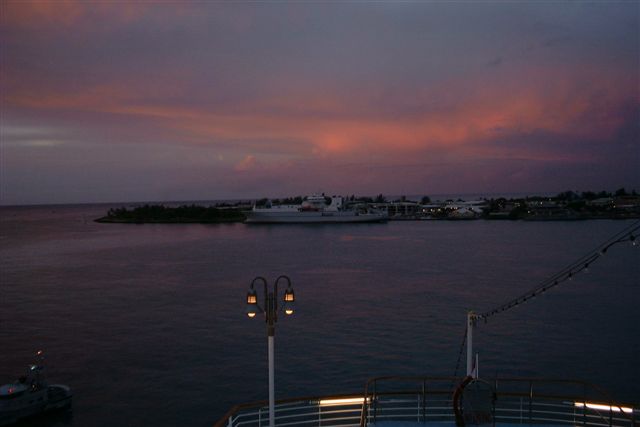
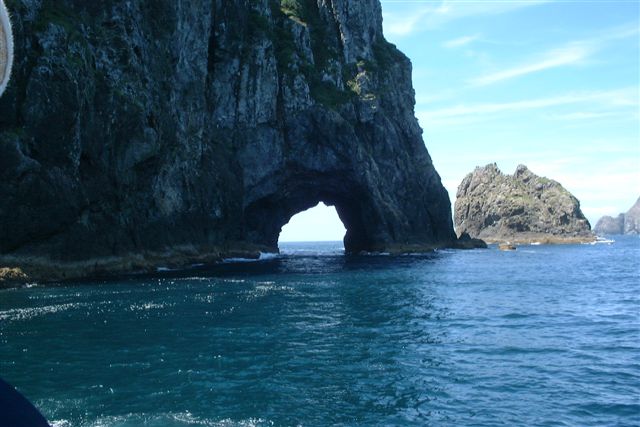
After our 3 hour boat ride among the islands we visited the town
of Russell, had lunch purchased some wine and returned to the boat. We
leave at 6 pm for Auckland, NZ a city of 1.5 million where we will
arrive at 7 am tomorrow.
We arrived in Auckland, NZ 8 am today. The Auckland metro is home
to one in three of the 4 million Kiwis (NZ). We immediately boarded a
tour bus and traveled until 530 pm. We were greeted with a life jacket
life boat drill upon arrival back on the ship. For our tour we traveled
3 hours to Waitomo Glow worm caves. We had a guided tour of the
limestone cave followed by a boat ride through the darkness of the
Glowworm Grotto to view the thousands of glowworm lights. Caves form
along cracks in the limestone where rainwater has begun to flow
downward. Rainwater mixes with small amount of carbon dioxide in
the air forming a weak acid. The acid strengthens as more carbon
dioxide is absorbed from the soil. As it seeps through cracks in
the rock the acidic water dissolves the limestone and enlarges any
cracks and joints. Eventually streams flow through the enlarged cracks
helping to created the caves. The caves were 40 meters deep and
followed the river for long way. The stalactites and stalagmites were
spectecular.
We stopped for lunch at a working cattle (800) ranch. The home was
an English garden house with beautiful gardens. In the background was a
nearby mountain. Then we stopped at the Kiwi House-Native Bird Park and
saw many birds including the nearly extinct Kiwi which is the symbol of
New Zealand. It was a great day.
We arrive 7 am in Lyttelton, NZ., the neighboring port to
Christchurch the largest city (360,000) on South Island. The city was
started with the concept of harmoniously blending church and
state. With the backing of two Archbishops, seven Bishops,
fourteen Peers, four Baronets and sixteen members of
Parliament money was raised and settlers found for this
new little corner of England. The migrants were hand selected. To
qualify for assisted passage to the new colony, a migrant had to
furnish a certificate from his vicar vouching for his character,
sobriety,, industriousness, honesty and respectability. The
"Canterbury Pilgrims" arrived on four ships in the port of Lyttleton in
1850. Today in the center of town surrounded by a grid of
rectangular streets, you will find Cathedral Square presided over by
the neo-gothic Church of England Cathedral. The City is called the
"garden city". It has an unusual number of parks, the 5th ranked in the
world Botanical Gardens and flowers everywhere.
We started the day with a 3 hour train trip to the mountains west
toward the other coast (Tasman Sea). When we arrived at the summit we
boarded 4 buses to travel to our lunch site. It was in the
middle of the mountains where a big tent had been assembled. The lunch
and wine was outstanding. The scenery was awesome. Our return trip on
the bus was to the Christchurch where we viewed key sites. To me the
key feature of the city is the Avon River that winds thru the
city. The parks and the Botanical Gardens all weave into the river. The
train ride to mountains was breathtaking.
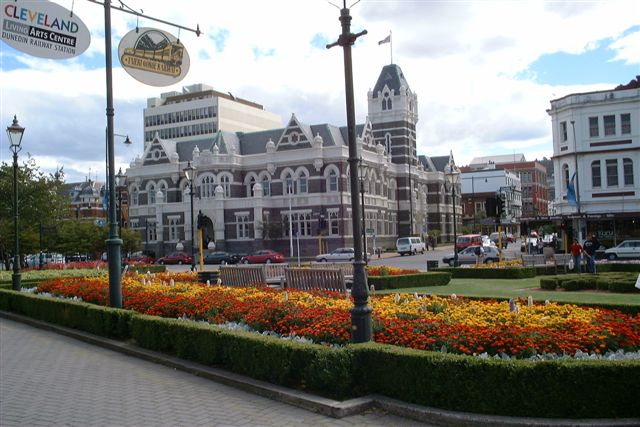
We are in Port Chalmers (Dunedin) located on the Otago Peninsula
on the South Island of New Zealand. Founded by Scottish settlers
in 1848, it was the second city on the South Island and boast the first
university, the University of Otago. In 1861, the discovery of
gold brought a rush of Australian settlers and a large amount of
wealth. This allowed the city to grow to become a grand Victorian
city in the South Pacific. The Victorian architecture still stands
today with only a little intrusion of the modern. The decline of
the economy drove many of the settlers away, leaving behind a
beautifully preserved city. Dunedin is the capital of the Otago
Peninsula, which is also home to some of the world's rarest wildlife.
We took a tour bus ride from 8 am to 430 pm. First we went to a
colony of yellow-eyed penguin, the world's rarest penguin. There
are 30 some varieties of penguins. One day a sheep farmer
discovered a small flock living amongst his livestock. He established a
conservation reserve to assist the penguins. He uses the profits from
the tourists site to finance his colony. He continues to farm sheep. He
has built a nest that helps protect the birds from predators. He has
tunnel like walk ways for tourist to view the birds. The colony is on
shore of the ocean. We also saw a 900 lb. sea lion.
Next we visited the Royal Albatross Colony, a wildlife reserve
managed by the Department of Conservation . A colony of Royal Albatross
mate at this site. The live to be over 60 years and mate for life.
There wing span is 10 ft. They cannot take flight until there is a 15
knot wind to assist them. They can fly at 60 mph and may stay
aloof for 2 or 3 days without landing.
We next visited an underground disappearing gun. The gun was built
in England and shipped to NZ to protect them from a feared Russian
invasion in 1880s. The gun shuts a 100 lb. shell 5 miles. It disappears
underground after each shot. One shell may be launched every minute.
Nine men operated the gun. There were numerous tunnels to protect the
soldiers. The gun site is at the tip of the Otago Peninsula.
Next we visited a mansion built in 1871 for a fabulous lunch. The
restaurant has 30 acres of woodland gardens with walking tracks
throughout.
The we drove thru city of Dunedin viewing its beautiful homes
and buildings. No functional old structure is torn down. They are
all restored.
We are at sea today. We are coastal cruising on the west side of
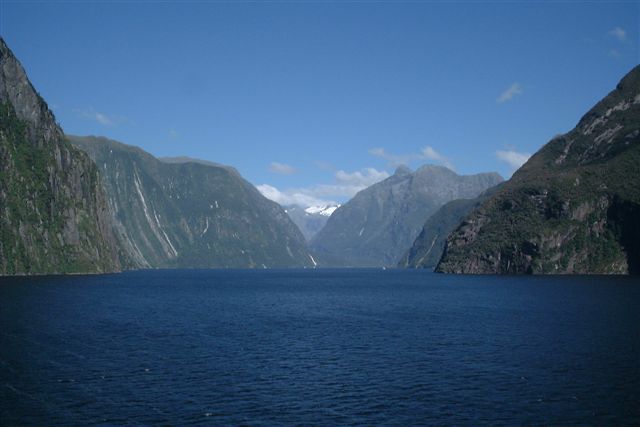
New Zealand. We are cruising through 3 glacially-carved fiords. Fiords
are like a river. Comparing them imagine a river as v shaped and a
fiord as u shaped. The river meanders like a s curve. A fiord is u
shape because it was carved thru the mountains by the tremendous
pressure and power of glaciers during successive ice ages then later
flooded by the sea the ice melts and sea levels rise. The fiords we see
today are Dusky Sound, Doubtful Sound and Milford Sound. These fiords
are part of the Fiordland National Park the largest park in NZ. The
Park receives 20 ft of rainfall a year. There is an almost constant
mist in the air in the fiords. Magnificent waterfalls cascade down the
mountains into the fiords. The fiords go miles into the mountains. The
mountains are tree covered and have snow on them. The sight is
fantastic. Earthquakes are common in this area. The most recent
was aprx a month ago and registered 7.l, the same magnitude that killed
thousands in Japan recently.
Mona and I are celebrating our 4 anniversary today.
We spent the day in Tasmania, Australia, but the high lite of the
trip occurred this evening aboard our ship. We saw Carol Channing
perform. Ms Channing performed Hello Dolly over 5000 times on Broadway.
She is now 86 and she is an inspiration. I hope I am as alive an active
as she is at her age. The audience gave her two standing ovations for a
long long time. She was outstanding.
We got off the ship this morning at 630 am on to a tender (small
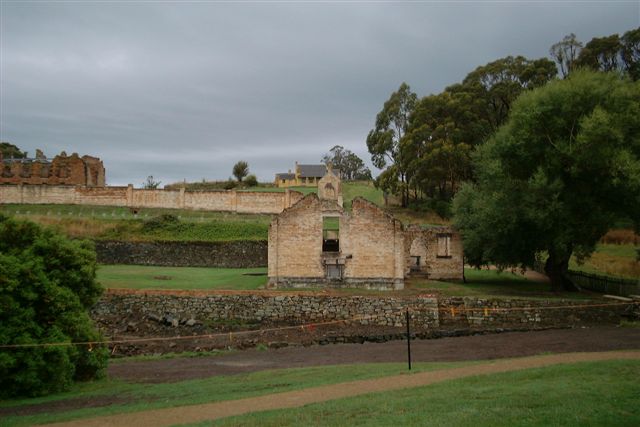
boat) and went ashore to Port Arthur, Tasmania, Australia. This is the
site of the infamous penal colony where more then 10,000 prisoners were
sentenced between 1830-1850. The highest number at one time was 2000;
there were only 70 when the prison was closed in 1870. The place is now
a national park and historical site.
We then were bused to a wild life park where we saw the Australian
birds and animals. One usual animal was the Tasmania Devil unique to
the island. It is size of a small dog but has jaws with 2 ton pressure.
They eat everything of dead animals. We watched them being fed. Sure
was glad I was not in their pen. We went to another wild life park in
the afternoon and visited another village Richmond. It has
Georgian style buildings, many of them from the last century (1800),
were all constructed from the fine local sandstone. The oldest bridge
in the country spans the Coal River. Across the bridge, among a thicket
of English trees is Australia's oldest Catholic Church built in
1836 and still active. The countryside always has a range of
mountains in the background and the island is lush with trees,
hedges, flowers etc everywhere.
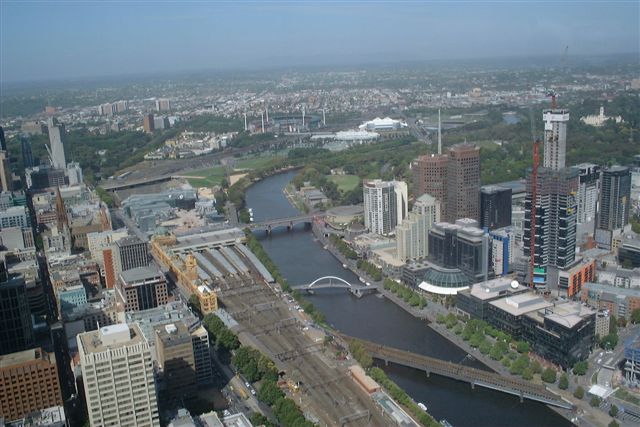
I know why Melbourne is rated the most livable city in the world.
It has many beautiful gardens and parks within the city. It has several
sites for cultural events. The performing arts auditorium if awesome.
Yesterday was a 8 hour day of touring. In the morning we were on our
own and boarded electric trolley (their tram) and went from the dock to
the other end of the city over an hour each way. We went on a tour in
the afternoon on a bus viewing the city sites. We went to the cultural
sites for guided tours and then went to the 55 floor of a building
where we could view in 360 degrees the whole city. Then we boarded a
1900 street car all fancied up and were served champagne and high tea
British style while we again toured the city. Still we did not get our
fill of Melbourne it is the top of list for a repeat visit.
Today is a day at sea tomorrow Sydney. We are nearing 12,000 mile mark.
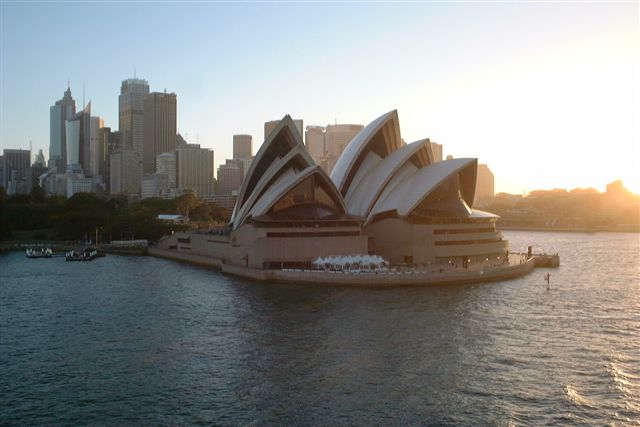
I love Sydney. A very cosmopolitan city of 4 million people.
Australia has 20 million people. Nearly every nationality is
represented in Sydney. Sydney harbor is spectacular resembling San
Francisco. The international cruise ships have two choices to dock one
by the Opera House and the other where we docked called Darling
Harbor Eleven ships arrived here in 1788, bringing the first
Europeans numbering 1000 convicts.
We took the shuttle bus into downtown area where we had coffee at
Starbucks. We wondered around the area until noon returned to the ship
for lunch and a nap.
We went to the Opera House that night and saw the opera Merry
Widow. The facility and performers are first rate. It was an
experience we will never forget.
The next day we took a tour to the Blue Mountains. They are 3500 ft
high. We first took a bus tour of the downtown area boarded a cat boat
(twin hull) and toured the harbor and 20 miles up a river. We reboarded
our bus for the trip to the mountains. We stopped at the Olympic
Village site of the summer 2000 games. All of the facilities are used
today. We continued our climb to the mountains and viewed what
the Ausies call their Grand Canyon. The view
was great but was no Grand Canyon. We took a train ride down the
mountain side 55 degree angle and walked a short distance thru woods
and viewed an old cold mining site. Then we took a cable car
ride back to the top of the mountain. We had a buffet lunch in a
mountain resort that made the two hour nap trip to the ship
easier. Between doses we watched a video of the animals and
birds found only in Australia. When we returned to the ship
Mona stayed aboard and I looked for the video. I got lost and
just made it back before the ship sailed.
We awoke at 530 am for our tour to the Great Barrier Reef. The
ship stopped for a few minutes while the tour operators brought their
catamaran along side and 100 or so of us got aboard. We have 550
passengers aboard. We traveled for aprx 15 minutes to the site
where a large pontoon was anchored. The pontoon had a viewing area we
could see hundreds of fish and some coral reef. We boarded at our
choice for the next couple hours a semi submersibles boats that toured
around the reef area where we saw thousands of colorful fish and many
coral formations. The Great Barrier Reef covers over a 1000 mile area
and is visible from the moon. Mona and I snorkeled for a half an hour
among the reefs. The catamaran remained at the pontoon site and we
could go back and forth at our leisure. After aprx 3 hours we all
boarded the catamaran for a 2 hour plus trip to catch up
with our ship that had anchored in Hamilton Harbour. We had brunch and
Australian beer and wine plus coffee etc. aboard the catamaran.
Hamilton Island is one of 74 Whitsunday Islands probably best
known of the Queensland Islands. (Queensland is a State) The group was
named by Captain Cook who sailed through on July 3, 1770 on Whitsunday
or Pentecost Sunday. There are 7 islands that are developed with
resorts the rest are uninhabited.
Upon our return to the ship we boarded a tender to go ashore in
the community at Hamilton Island. We toured the shops bought a
newspaper and returned to the ship and took a nap.
Feb 25 (day 35)
Yesterday we spent the day in Cairns, capital of the State of
Queenlands. It is a tropic vacation site for Tourists being the No. 1
industry followed by sugar cane. It was founded in the 1870's as a
government customs collection point, it grew in the late 19th century
as the result of gold discoveries along the two rivers. Tin was
also in abundance. The community location was selected because of its
great harbor.
Our tour took us up the mountain to a Rainforestation where
boarded a WW II Army Duck amphibious vehicle. The locals say they have
two rainy seasons, one last 4 days a week and the other 3 days.
We got quite wet but it was warm. We didn't dry out until we were back
on the ship. During our "Duck" ride we saw many lizards, and many ferns
and trees only found in Australia. We then visited a Wildlife
Sanctuary and saw wallabies, freshwater crocodiles, koalas and
kangaroos.
We then boarded the Scenic Railway, built one hundred years ago
for a 2 hour trip down the mountain. The spectacular journey was
through majestic scenery, tropical rain forest and past the picturesque
Barron and Stoney Creek Falls. We had an informative guide commentary
with several glasses of champagne and "nibbles". The trip through
the gorge was the most spectacular so far of our trip. We reboarded our
bus and returned to Cairns where we went shopping until we walked to
the ship.
We have new dinner companions. One couple is from New Jersey.
He is an attorney who worked in real estate for Prudential Ins.
Co. He knows Martin Bucksbaum of Des Moines. The other couple is from
New Zealand. During the Kennedy years he was the Ambassador from NZ to
US. He is giving a series of lectures on the ship. He was also the
Secretary of Defense for NZ. He met his wife in Argentina.
HAPPY BIRTHDAY BETTY!!
Feb 27
This is our third day at sea. Tomorrow we will arrive in Darwin the last
stop in Australia. Our next stop is Komodo, Indonesia, part of southeast
Asia. Australia is as large as US. We have touched less than half of the
coastline and we have been here for two weeks.
We had a special treat this afternoon  a classical concert. The
entertainment has been outstanding and today's performance by the Black Tie
was exceptional. This unique act consists of vocalist brothers, Con and Yuri
Mavridis and their wives, cellist, Susan and concert pianist, Valerie.  Each
member is a soloist in their own right. Con and Yuri have outstanding
bass-baritone voices that blend together perfectly in duets, creating a
unique sound. They performed arias from several operas.
We have left the Great Barrier Reef located in the Coral Sea off the
northeast coast of Australia.  Though its name suggest that it is a large
single reef, it is actually a series of thousands of individual reefs and
hundreds of small coral islands formed along the edge of the Queensland
continental shelf. The Great Barrier Reef stretches more than 1250 miles and
is the largest organic feature on the earth. Coral reefs are formed by small
animals that secrete a calcium carbonate skeleton.  Millions of skeletons
eventually form a reef.  Unlike reefs that form around oceanic islands due
to subsidence, The GBR was caused by rising sea levels after the last Ice
Age.  Because the corals contain algae in their tissue that require
sunlight, the reef grows upward in response to rising sea levels.  Corals
also require warm seawater to thrive, preferably near 77F. The GBR is
ideally located in a region where the warm South Pacific Equatorial Current
feeds into the East Australian Current.  Although coral reefs appear to be
rocky and indestructible, they are complex and fragile ecosystems.
Feb 28 (day 39)
We arrived in Darwin at 6 am today. On our tour bus we visited the
Australian Aviation Heritage Centre which displays both civil and military
aircraft-from the early pioneers through WWII including a B 52. Darwin still
is a refueling site for the B 52. We visited Botanical Gardens that
contained more than 400 species of tropical and subtropical plants and
trees. Then we visited the Museum of Arts and Natural Sciences. There was an
excellent collection of Aboriginal,, SE Asian and Oceanic Art. There was a
large collection of sailing vessels used in this area dating hundreds of
years in the past. We toured the city and spent several hours shopping and
having lunch.

Darwin is the capital of the Northern Territory. It is not a state. Darwin
has 70,000 people. It was settled in 1869, gold was discovered in 1871 but
soon petered out. It remained a small community until WWII. The Japanese
attacked Darwin with a greater number of aircraft then what attacked Pearl
Harbor. The first attack was Feb 19, 1942. Darwin was attacked 64 times and
at least 243 people lost their lives and most of the city was destroyed. It
was only place in Australia to suffer prolonged attack although there always
was the threat of attack in Australia. Christmas Day 1974 Cyclone Tracy
nearly again wiped out the city.

The Northern Territory has 200,000 people with 30 % being Aboriginal. The
Aboriginals own more then half the land in the territory. In addition to the
Aboriginals there are 50 ethic groups in Darwin. Darwin has the largest
harbor in Australia and recently the last railroad link was completed. Since
Darwin is the nearest place to Asia it is expected to enlarge greatly in the
future. Darwin has a tropical climate and is a beautiful city.
Mar 1 (day 41)
We arrived today in Komodo Island, Indonesia. Komodo is one of 13,000 island
making up Indonesia. It has a population of 220 million people scattered
over 3000 miles of the Pacific. Komodo is west of Flores Island. Four
hundred people live in the only village on the Island. The rest of the
island is a
National Park and is a World Heritage Site. The island's volcanic slopes are
generally hot and barren, though briefly during the annual monsoon season
they turn green. They were green today and we also had a brief monsoon rain.
Tall lontar palm trees grow on the hill slopes and tropical evergreens also
grow on the island.
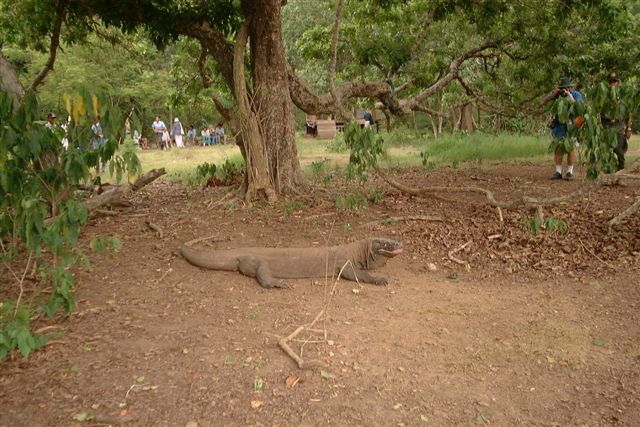
The island is one of the few remaining areas inhabited by the Komodo dragon,
which is protected in Indonesia. Komodo dragons are giant monitor lizards
that roam wild over the island. They measure up to 10 feet long and weigh up
to 300 lbs and can live up to 100 years. Park officials regularly supply pig
and goat carcasses to attract the lizards to viewing areas for tourist.
Komodo dragons are carnivores and don't eat any of the vegetation. There are
254 plant species from Asian and Australian origin. The main prey of the
Komodo dragon are deer and wild boar who feed on various leaves, fruit,
flowers, roots and grasses found in the park. The park covers 200 square
miles.
The temperature was in the 90s, humidity 86 %; we walked for 2 hours to view
the dragons. We saw five dragons and a wild boar. Viewing the dragons was
worth the effort.
Mar 2 (day 42)
We arrived today in a small island in Southern Indonesia. Java is to the
west and Lombok to the east. Bali is 90 miles long and 50 miles wide.
Economically and culturally, Bali is one of the most important islands of
Indonesia.  Rice is grown on the irrigated, terraced hillsides; other crops
include sugarcane, coffee, copra, tobacco, fruits and vegetables.  Cattle
and hogs are also raised.  The Balinese are skilled artisans, particularly
in wood carving, and in fashioning object of tortoiseshell and of gold,
silver, and other metals.  The women of Bali are noted for their traditional
dancing and for their skills in weaving cloth of gold and silver threads, as
well as for embroidering silk and cotton clothing.  The principal religion
on the island of Bali is a variation of Hinduism that incorporates
Polynesian religious rites.  Bail was first visited by the Dutch in 1597,
but Dutch rule was not firmly established until 1908.  In 1946, after the
Japanese occupation of the island during WWII, Bali was included in the
newly formed state of East Indonesia, becoming part of the United States of
Indonesia in 1948.  In 1950, Bali became part of the Unified Republic of
Indonesia.  The word Bali has come to mean paradise to many people, even the
Balinese do not have a word for "paradise" in their language! The lush
tropical vegetation, extravagant flowers, and mountainous landscape all
combine to give Bali a very dramatic look.  The island is still volcanically
active and extremely fertile. The drive through the countryside reveals the
complex and amazingly beautiful patchwork of rice terraces.
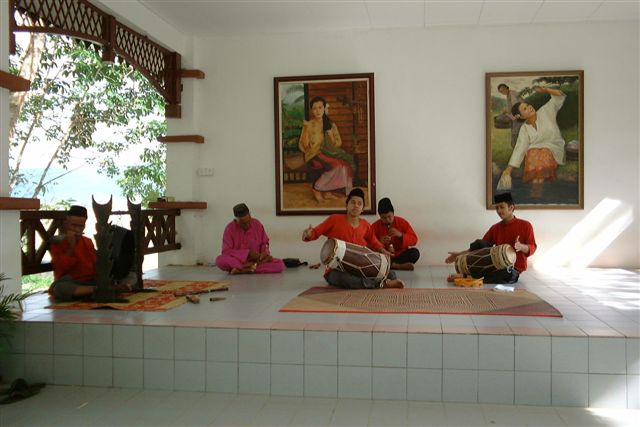
We will go onto the island this evening to see a Balinese Dance performance.
Tomorrow we will motor to a mountain village then we will go to a water
palace.
Mar 3
Last night we attended a program held at a local hotel viewing a Balinese
Dance. It is known as the Kecak or monkey dance. It is a ritual dance taken
from the tale of Ramayana, whose musical accompaniment is supplied by
chanting men sitting in concentric circles rhythmically swaying as the
costumed dancers weave among them. Then we saw a fire dance by a young man
walking barefoot over glowing coals.

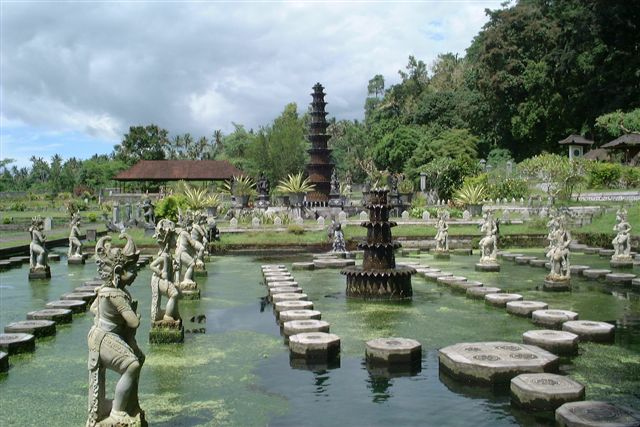
This morning we went on a tour bus for 4 and half hour ride up a mountain
where we visited three villages including the Puri Agung Karangasem
Palace-more commonly known as the Water Palace-it is an imposing reminder of
the time Karangasem was a kingdom.  This palace was built around 1947 by
Amlapurs's water-loving king, and is a place of beauty and solitude.  The
palace contains a network of pools and a swimming pool fed by a natural
spring, surrounded by the most beautiful rice terraces. On the way down the
mountain we went thru Selat, a mountain pass where we saw a magnificent view
of the island's terraced rice fields.

One thing is very evident; we are in a different part of the world. The
people are a copper color a most beautiful skin. Remarkedly a fat person is
very rare. The beautiful women are more prevalent then average appearing
women. The country side is lush beyond anything we have seen previously. The
temperature is in the high 80 with the same amount of humidity. Hugh crowds
pressed us at every stop to buy their goods. It seems everyone is an expert
seamstress, artist, wood carver or stone mason. In every mile there are at
least 2 or 3 temples varying in size. Some temples are very large and very
ornate. Ninety four per cent of the people are Hindu with Bali worship of
many gods mingled in the religion of the island.
Mar 6 (day 46)
We are in Sabah (Malaysian State) which together with the State of Sarawak
and the federal territory of Labuan, make up East Malaysia.  Prior to 1962,
Sabah was the British Crown Colony of North Borneo.  Occupying the
northernmost part of the island of Borneo, it is bounded on the northwest
and north by the South China Sea, on the northeast by the Sulu Sea, on the
southeast by Celebes Sea, on the south by Borneo and on the west by Sarawak.
It covers an area of 28,425 sq mi with a coastline of about 900 miles.
Sabah is extremely mountainous; the only lowlands of importance are confined
to the coastal region. Mount Kinabalu rises 13,455 ft and is the highest
summit on the island. The island is heavily forested with numerous streams
and 3 navigable rivers going inland for 200 miles. There are several large
bays and natural harbors. Tropical climatic conditions prevail throughout
Sabah. Average annual rainfall is 80 inches and it rained several times
during our day here for aprx 10 minutes.

The population is composed of indigenous peoples, Chinese, Malays,
Eurasians, Europeans and others. There are 70 native dialects. There is one
native universal language and English is mandatory in school with science
and math only taught in English. School is mandatory.
Malaysia is an Islamic nation with Sunni sect in the majority. Islamic law
has crept into government but the civil law remains paramount. There are
periodic extremist calls to adopt Islamic law altogether but so far it has
not happened.

The region came under British control in 1877. It was occupied by the
Japanese during 1942-1945. On September 16, 1963, the region became a part
of the Federation of Malaysia was renamed Sabah.
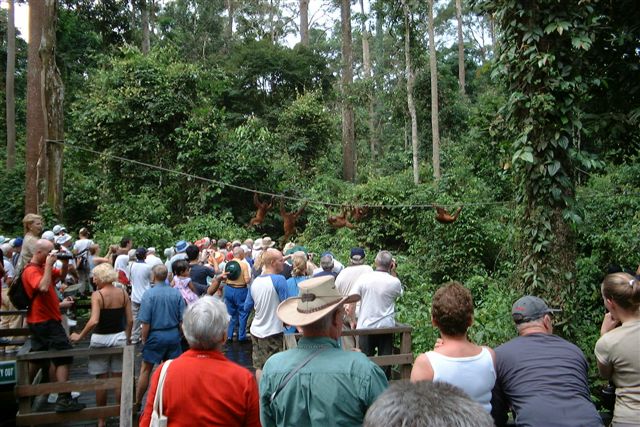
For our tour today we motored for an hour to Sepilok Orangutan
Rehabilitation Center and walk on a wooded elevated walkway thru the jungle
to a viewing platform where we watched 2 adults and 8 young Orangutans eat
bananas and drink coconut milk. Several monkeys joined the feast.
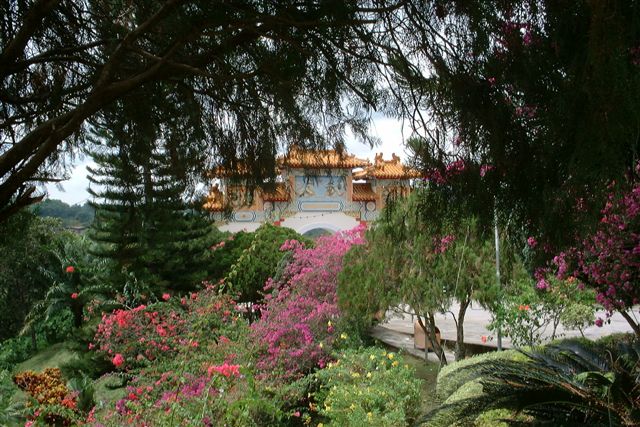
We then went to a Chinese Buddhist Temple named Puh Jih Syh which in
addition to its beauty had a panoramic view of the Sandakan Bay a 1000 feet
below. The original temple built in 1880s was destroyed during WWII, the
current ornate temple was built in 1987.
Mar 8 (day 48)
We are in Manila, Philippines, a city of 9 million, home to 12 % of the
nation's population. Metro
Manila is a conglomeration of 17 cities and municipalities unified by
presidential decree in 1976. The city was founded by Muslims in the early
16th century, and at various times has been taken over by Spain (300 yrs),
the United Kingdom (2 yrs) United States (46 yrs) and Japan (3 yrs). Eighty
five per cent of the people are Roman Catholic, 10 % Muslim and 5 the rest.
Nearby Mt Pinatubo erupted in early summer 1991 and is still rumbling. Our
guide said he has been in two 7 plus earthquakes. He said no building can be
more than 55 stories but several are that height. He said building codes
require buildings to be built to withstand an earthquake of 8. The current
President is a woman the second in history and a third potential is 45 and
rising. The nation consists of 7,107 islands. Most of Manila was destroyed
in WWII. To reclaim the city the Allies fought building to building in the
city.

Manila is a vibrant and very modern city. There are areas of poverty but
overall it lives up to its name as "The Pearl of the Orient".
Our tour today was escorted by two policeman on motorcycles who moved the
traffic out of our way. The traffic was extremely heavy. Of particular note
was the Jeepney. Originally the WWII Jeeps were given extended floors and
serve as licensed buses on assigned routes. Today the Jeeps are factory
built with extended floors. If you want off you hiss at the driver or yell
you want off or pound on the roof. When you get on you hand your money
person to person until it reaches the driver. He is looking with one eye in
the mirror to see who pays and one eye on the road. He has one hand on the
wheel and the other is reaching for the money. It costs 8 cents (US) to
ride.

There is a lot of cultural activities in Manila with museums, operas,
orchestras, ballets etc. I would return to Manila in a New York minute.
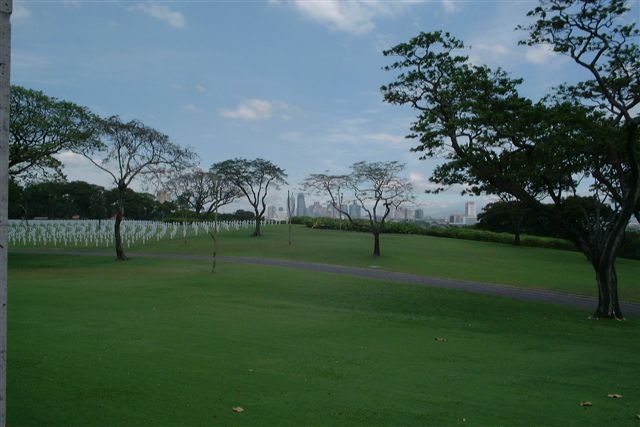
Our last stop was at the Manila American Cemetery and Memorial. There are
17,206 of our military dead are buried here. There are 1000 Star of David
markers and the rest are crosses. The headstones are arranged in circular
rows around the high point on which the memorial stands. The burial area is
divided into eleven plots. The Memorial is faced with travertine limestone
quarried near Tivoli, a few miles east of Rome, Italy. I am glad I am not
buried here but if I were I would be proud. It is a very fitting tribute to
those who died for our country.
Mar 11 (day 50)
We are in Hong Kong. Words are inadequate to describe Hong Kong. Pictures do
not, do it justice. HK is a place that must be visited to grasp its
excitement. The blend of the Oriental and Western Cultures is phenominal. I
love it, I love it, I love it.

HK consists of the mainland portion and about 235 islands. It has 7 million
people and its total land area is small only 422 sq mi. The surrounding
waters cover 707 sq mi. Most of the people live in the skyscrapers and there
are hundreds of them. Many house businesses of every kind but many are homes
to millions. Our guide said that Mainland China has a one child government
policy. HK doesn't have that policy by decree but the apartments have only
500-600 sq feet and it cuts down the number of children. Much of the housing
is subsidized public housing costing only $300 per month. English is
mandatory in elementary school and school is free thru high school. Chinese
language has many dialects but they can't verbally communicate with each
other although the written language is universal. HK has the Cantonese
dialect and Mandarin is the official universal language. Learning Mandarin
is mandatory in elementary school.

We took our usual tour for 4 hours visiting many sites in the city including
a ride in a sampan (junk boat) .In the past thousands live on the sampans
but we saw at least in the area we visited a limited number living on the
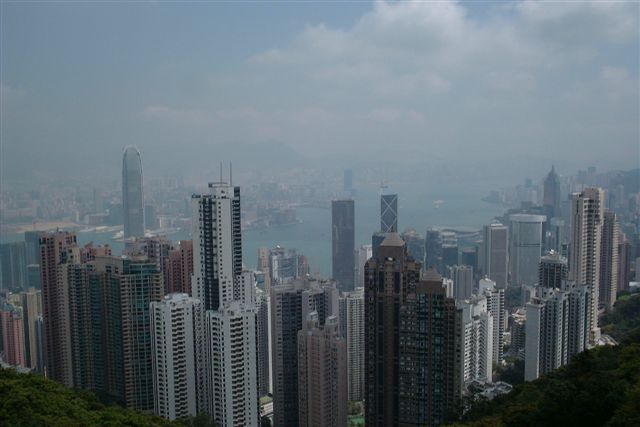
sampans. We took at tram up the 1800 ft to Victoria Peak for a breathtaking
view of the Harbour. We shopped the afternoon and went to dinner with
friends at the Intercontinental Hotel. The hotel has all glass facing the
river and the skyscrapers on the other side of the river. Each building has
a colorful sign identifying the building. At last many of the skyscrapers
have colorful displays of rotating lights. At 8 pm for 20 minutes this
fantastic display is augmented by a laser light battle. I have never seen a
lighting display to equal this display.

We have two more days here. I don't know if I have the capacity to absorb it
all.
Mar 17
Whereas, Hong Kong a prosperous and sophisticated city seems to have become
so due to its unique blend of Oriental and Western Cultures; Bangkok and
Thailand have done the same thing with their own culture. Today in visiting
Bangkok I saw very little evidence of Western Culture. Bangkok looks the
least like the West then any other place we have visited on this World Tour.
After the ship docked our tour bus took 2 hours to reach Bangkok. All along
the way were many rice fields and many other agricultural products in the
fields. The land is lush. Upon entering the city of 10 million people we
were impressed by its cleanliness.  We took a boat ride for one and half
hours around the city along the river and canals. Bangkok has been compared
to Venice in that so much of the intra city traffic is on the waterways.
Every where we viewed ornate palaces and temples. There are over 400 temples
in Bangkok. Ninety per cent of the people are Buddhist. Along the waterways
we saw canal grocery stores, houses on stilts and the Royal Barge dockyard.
Everywhere we traveled we saw only happy faces and friendly waving people.
We had a fantastic lunch at the Oriental Hotel restaurant and continued a
drive thru the Chinatown commercial district and walked thru  a flower
market. We stopped at the Marble Temple one of Bangkok's best known
landmarks. We stopped at Jim Thompson's Jewelry Store the largest in the
World. Fortunately we have another day to explore this wonderful country.
Mar 20
We are in our second day at sea, will be in Singapore tomorrow 7 am. During
our at sea days we attend
lectures. This morning we had a lecture about Singapore, another one on 20
years of Paramount movies done by Bill Harris who for 20 years had a TV
program in Los Angles interviewing movie stars. This afternoon the lecture
is by a physiologist on Longevity and Attitude. We will then nap go to
Crow's Nest that is all glass the width of the boat at the bow on the 12th
floor and view the sunset and listen to piano music for an hour then go to dinner.
Following dinner we will attend Variety Show with first act a Dance program,
then a comedian then a musical performance.

We have other options, too. There is the casino, aerobic, Tai Chi,
Watercolor Class, Daily Quiz, Board games, Sports-shuffleboard, golf, 3
person BB, team trivia, dance class today Viennese Waltz, Blackjack
tournament, duplicate and party Bridge, Cooking Demonstration with Executive
Chef, Arts & Crafts, Frisbee throw, Arctic Circle Visitors Get Together,
Gifts of Yarn, etc etc On our second day in Thailand we went to the resort
town of Pattaya a 30 minute bus ride. We shopped and had
lunch at the Marriott Hotel.
Mar 22 (day 62)
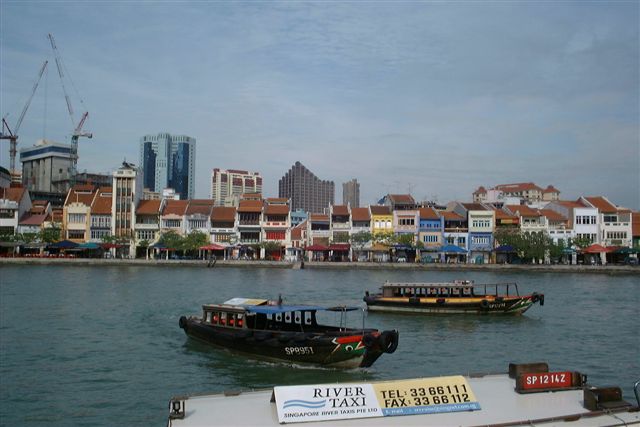
Yesterday we were in Singapore. It is an independent city-state in southeast
Asia, comprising one main island and fifty adjacent islands off the southern
tip of the Malay Peninsula. Singapore has 4 million people about
three-fourths of them are Chinese but there are significant Malay and Indian
minorities. When Singapore became part of the British Empire in 1820 it was
a few fishing settlements and a small trading post. Since becoming an
independent republic in 1965 it has maintained political stability and high
economic growth. Its people now have one of the highest standards of living
in the world.
Like Hong Kong, Singapore is a mixture of oriental and western cultures. It
is the cleanest city I have ever visited whereas Hong Kong is organized
chaos; Singapore is organized period. It would take at least two weeks to
see the spectacular sites.
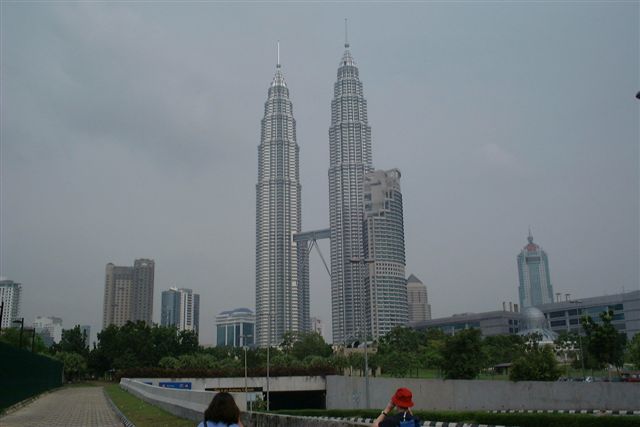
Today we arrived in Port Klang, Malaysia. We took a tour bus to Kuala
Lumpur, 60 miles away. KL the capital and largest city of Malaysia, blends a
colonial past with the modern era. We viewed the twin towers the tallest
buildings in the world if you include their antennas. We stopped at the
Jamek Mosque, the oldest mosque in the city. It is located at the confluence
of two rivers, the site from which Kuala Lumpur developed into the present
city. Independence Square, surrounded by grand old buildings including the
Royal Selangor Club with its Tudor style elegance and the Sultan Abdul Samad
Building were fascinating. The National Monument designed by the man who
designed the Iwo Jima Memorial, was built in memory of those who had fallen
in the defense of their country. It was inspiring. We visited a Craft
Cultural Complex, which displays and sells works of local craftspeople.
After lunch we visited the Royal Selangor Pewter, established in 1885. This
is the largest pewter factory in the world and was worth making the trip
just to visit the factory.
Tonight a perfect day was sealed by a 45 minute sunset display of a
kaleidoscope of spectacular colors.
Mar 23 (day 63)
We are in Langkawi, Malaysia. You may recall that we were in Malaysia just
before we stopped at Manila. Malaysia has two parts, part of the Island of
Borneo. The Malaysia states of Sarawak and Sabah are on Malaysian Borneo.
The other part of Malaysia is called Peninsular Malaysia and it is the long
finger of land extending south from Asia pointing towards Indonesia and
Australia. Much of the peninsula is covered in dense jungle. On the western
side of the peninsula there is a long, fertile plain running down to the
sea, while on the eastern side, the mountains descend more steeply and the
coast is fringed with sand beaches. Langkawi is located off the coast of the
northern end of Peninsular Malaysia near the Thailand border. There are
50,000 people on this island. There are a total of 105 islands with 6 of
them underwater during high tide. Most of the islands are not inhabited.
Today on our tour we went to a batik a handicraft center and various
fabrics. Next we visited a rubber plantation where we watched workers tap a
rubber trip to allow the latex to flow into a small bucket. We visited Eagle
Square that has a large sculptured eagle the symbol of the island. Finally
we visited a shopping mall. The scenery was beautiful with mountains always in
the background. We saw many rice patties. We saw one monkey but they are
numerous on the island.  We also saw many water buffalo used in rice
farming. They used to mine marble but decided the beauty of their island was
more important then the money from marble mining.
Mar 25 (day 65)
We are in Yangon (Rangoon) Myanmar (Burma). Myanmar a nation of 58 million
people 80 per cent are Buddhist. The elected President Aung San Suu Kyi has
been under house arrest since she was elected in 1990, by the military
dictator. She won the Nobel Peace Prize in 1991. One million men and boys
are monks. Most of the novices do not remain in the monkhood.  All men are
expected to spend some time as a monk. Women have a role in the spiritual
life. Women are revered but society is male dominated. Dress is traditional.
Both sexes wear a sarong-like garment called longyi. The upper body is
covered with a blouse and sandals protect the feet. Britain occupied Burma
beginning in 1852 until independence was obtained in 1947. Japan occupied
the country 1942-1945. They killed 300,000 civilians and 70,000 soldiers.

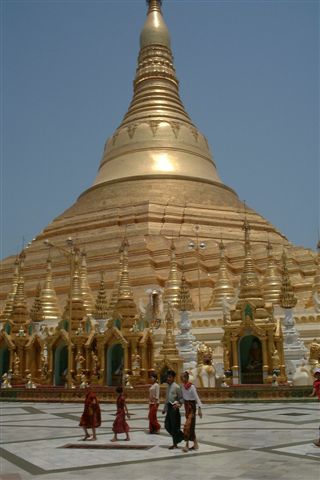
Our tour took us thru the country side for a one hour drive to Yangon. We
visited the Shwedagon Pagoda. It is 316 feet tall with a circumference at
the base of 1420 feet. All around the principal stupa is a cluster of
smaller stupas, temples, shrines, prayer halls, pavilions, religious images
and statues. We then visited the Scott Market-a sprawling market dating back
70 years. It was under roof and had hundreds of stalls with Burmese
handicrafts, lacquerware, gems and jewelry etc. There are overnight trips to
Mandalay and a several day trip to Nepal and the Taj Mahal. We will leave
tomorrow.
Mar 26
One of the unexpected benefits of the World Cruise is the lecturers.
Presently we have a retired foreign service officer who had postings in
this area of the world who is giving four one hour lectures. Also a
University of Chicago PHD student who is on a Fulbright Scholarship in India for a
year is also giving 3 one hour lectures on India. Next year he will be finished
with his studies and will be writing his thesis on India. His father is
Indian his mother American and they live in Portland, Oregon. His wife's
father is also Indian and her mother American and they live in Chicago. They are
one of two couples at our dinner table. The last three table changes have
ended with us getting one of the lecturers at our table. The other couple at
our table are honeymooners who are from Mexico. His father owned a large
building in Mexico. A tragedy killed his brother and his father grieved
to the point the building set empty. He and his brother finally stepped in
and started a private hospital in the building. Now they have 3 hospitals
in different communities. He says that the quality of the government
hospitals encourages the development of private hospitals. They are the best
looking couple on the ship. The third lecturer was the CEO of Pepsi Cola and
also Apple Computer. He is fantastic. He is informing us on the global economy
and what the future holds in store for us financially. He also is telling us
about future technological innovations.
Mar 30 (day 70)
We are in Cochin (Kochi) India, a city of 1.36 million and we saw them all
today. It is a city of several islands and the peninsula. Ferries run
constantly on the waterways. We saw the oldest church in India, winding
streets with mosques and 500 year old Portuguese houses, cantilevered
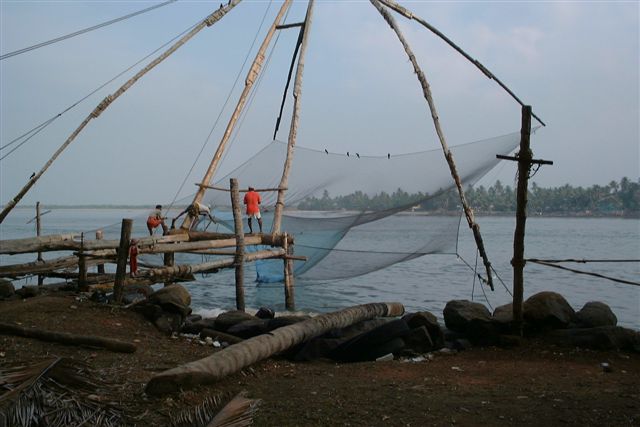
Chinese fishing nets, a Jewish community with ancient roots, a 16th century
synagogue, and a palace built by the Portuguese and given to the raja of
Cochin.
The nets hang over the harbor and operate by a system of weights and levers.
The nets, on wooden frames, are raised periodically to check the catch.
The Pardesi Synagogue-a tiny but delightful structure built in 1568. Its
décor includes a floor paved with hand-painted blue and white Cantonese
porcelain tiles, no two alike, and a glass, oil-burning chandelier from
Belgium. The surrounding area is called Jew Town and is a fascinating mix of
antique shops, warehouses, and spice auctions rooms.
The Jewish community started 2000 years ago when Jews fled Palestine. Today
in the synagogue are a number of copper plates bearing an ancient
inscription granting a early village and its revenue to a Jewish merchant
Joseph Rabban by King Bhaskara Ravi Varman I (962-1020). Migration to Israel
has reduced the community to just four families and fourteen people by the
end of 2002.  In spite of the low numbers the community remains active.
There has been no rabbi within living memory but the elders are qualified to
perform religious ceremonies and marriages.
I bought my favorite travel book Lonely Planet-India and left my Visa card.
Fortunately the proprietor called the ship and I took a taxi and retrieved
my Visa. It was like no other taxi ride I have ever had. I thought we were
going to kill about a hundred people on motorcycles and bicycles but
fortunately we killed none.
April 1 (day 72)
We are in Mumbai (Bombay) today and tomorrow. Tomorrow we are taking a bus
tour. Today we took a taxi into the city and viewed the sights and shopped.
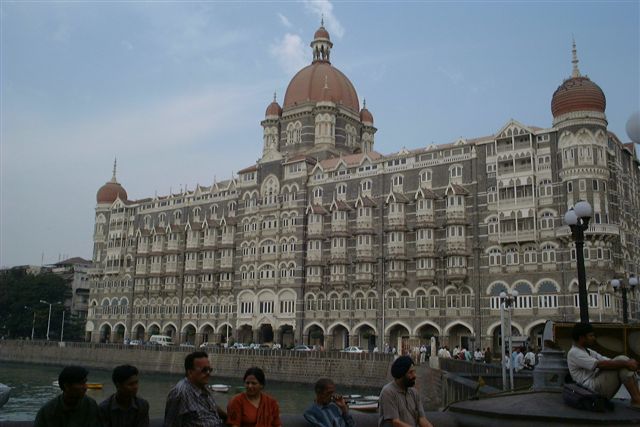
We had lunch at the Taj Mahal Hotel a 5 star hotel, then we returned to the ship.
Mumbai know as Bombay until 1995 is a city of 16 million people. It is the
premier port of India. Mumbai proper occupies a low-lying area that once
consisted of seven islands separated from each other only during high tide.
Dredging and reclamation projects, as well as the construction of
breakwaters and causeways, have linked the islands into a contiguous stretch
of land known as Bombay Island. The city is surrounded on the east by the
mountains, on the north by Salsette Island and on the south and west by the
Arabian Sea.  Mumbai is a fascinating city with many colors, exotic foods,
beautiful architecture (Victorian and Gothic) silks and brocades with few
rich and many very poor side by side but all appear happy and are very
hospitable. The men wear western style clothes but the women wear the verym colorful
India is only about one-third the size of Europe, yet its population is one
billion people. Hinduism is the main faith, but there are also Zoroastrians,
Moslems, Jains, Buddhists, Sikhs, Jews, and Christians to list a few. India
is comprised of 22 states, based mostly on linguistic patterns. There are eight
major cities, each with a population of more than two million people.
Hindi is India's national language, there are 18 official languages and more then
1000 dialects. English is widely spoken.
April 2
On our second day in Mumbai, India, we took a bus tour of the city. We
viewed the Gateway of India-an Indo-Saracenic-style archway built in 1911 to
commemorate the visit of King George V and Queen Mary. When the British left
Bombay they exited to their ships thru this gateway. We drove along Marine
Drive along the ocean and its graceful curve is a favorite promenade in the
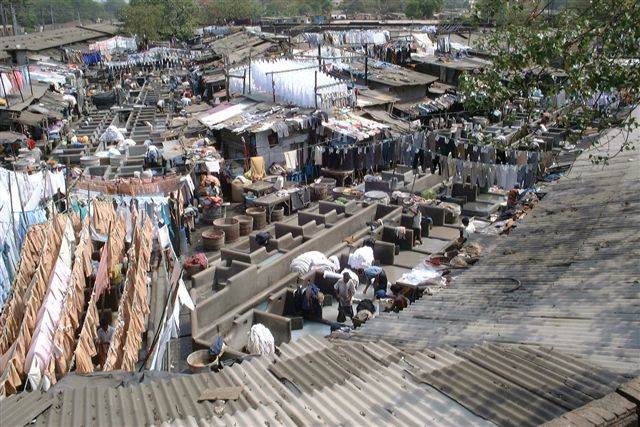
evening among the locals. We stopped at the Dhobi Ghat riverside where local
people wash their laundry. We went to the highest point in the area 150 ft
above sea level to the Hanging Gardens. Situated at the top of Malabar Hill,
the gardens were laid out in 1881 and feature an assortment of hedges
trimmed into animal shapes. The gardens also offer a superb view of the
bustling city center in the distance. Under the gardens is a water reservoir
that supplies much of the city's water. The water is pumped in from distant
water sources. Adjacent to the gardens are the Parsee community's seven
Dokhmas (Towers of Silence) in which cadavers are hung for vultures to
devour in accord with Parsee tradition. We also visited  a Jain temple which
offers a polished marble image of Adinath enshrined in its central chamber.
The walls leading to the approach of the central chamber are covered with
mirrors and colorful paintings. Finally we passed the main railway terminus
of Mumbai-Victoria Terminus. Built during Queen Victoria's Golden Jubilee
year this is an example of Victorian Gothic architecture. It looks more like
a lavishly decorated palace or cathedral than a train depot. Carvings of
peacocks, gargoyles, monkeys and lions are mixed up among the buttresses,
domes, turrets, spires and stained glass windows. It is the most magnificent
building I have seen on the trip.
April 5 (day 76)
Last night was special. We and 10 others spent 3 hours in the Captain's
private quarters having cocktails and dinner with he and his wife. They were
most entertaining. He is doing these small group dinners with all world
cruise passengers. He is from Norway and she is from Australia and they live
in Norway in his 300 year old home. They have been married 6 years and have
a 4 year old daughter. Lisa, the wife is much younger than the captain. It
is their first marriages. She had additions placed on the house to make it
more modern. He entertained us with stories of his life at sea. It was an
evening we won't forget. All other cruise captains have their dinner in the
big dinning room and spend 10 minutes at the table.

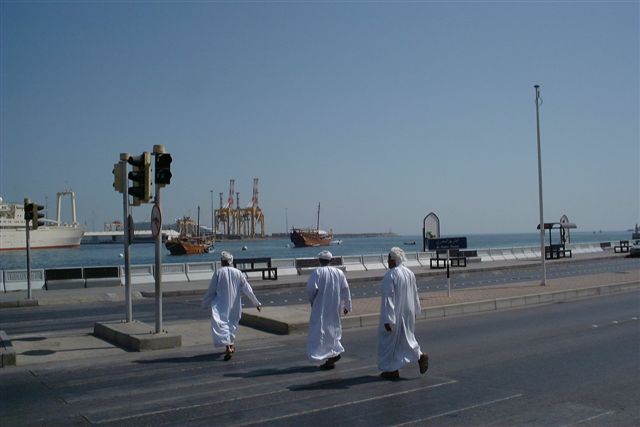
We are in Muscat, Oman. The country proves what a benevolent dictator can
do. The current Sultan overthrew his father in 1970, and sent him into exile
in London. Father had been very religious, very conservative and
isolationist. Oman has a lot of oil and the Sultan has used the income to
further the living conditions for his people. His primary emphasis has been
on education. All citizens over 21 have the right to vote. Sixty per cent of
the university students are women. Education is mandatory thru high school.
I observed no poverty during our tour today. We visited the Zawawi Mosque.
We drove along the coastal road thru a fishing village of Sidab. Then we
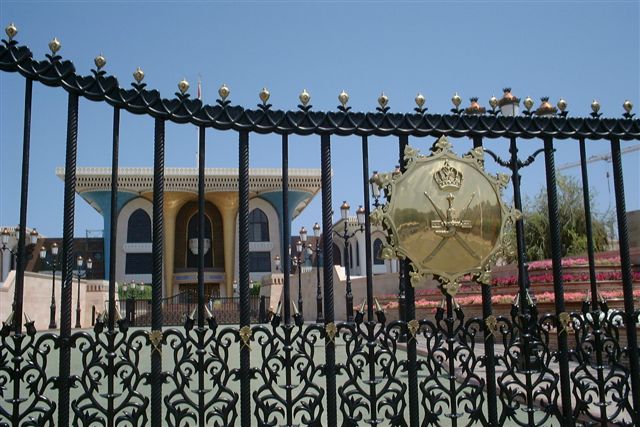
visited the old part of the city and viewed the Al Alam Palace-the official
residence of the Sultan-built upon the same site of the old palace in 1970.
The architecture is a blend of oriental and occidental styles in rich hues
of gold and blue. The palace is strategically positioned between the two
medieval fortresses of Jalali and Mirani, built by the Portuguese at the end
of the 16th Century. We visited a private museum that houses traditional
Omani heritage items. The exhibits include collections of Omani weaponry,
jewelry, clothing, household items, books, photographs, paintings and maps.
Oman's history is more than 5000 years old. Finally we stopped at the
colorful Mutttrah Souk (market). There were hundreds of small shops
featuring exotic Arabian perfumes and spices, Omani Khanjars (daggers),
antiques, traditional silver jewelry, handicrafts in copper, camel bone,
wood, leather and hand made Omani costumes.
Oman is definitely a place I want to visit again.
We are at sea for the next eight days. After transversing the Suez Canal our
next stop will be Istanbul, Turkey, on April 14. I plan to at least send an
email every other day.
April 7
I am fascinated with Oman. Beginning in 563 BC it was a part of the Persian
empire. The people of Oman converted to Islam in 750 AD one of the earliest
people to do so. Beginning in aprx 1000 AD Oman became the major naval
influence in the area. Its control extended to southern Africa and its ships
also sailed east to India and China.
The contrast to the vast desert wasteland of Saudi Arabia or the tiny
city-states of the Gulf, Oman is a land of dramatic mountains and long
unspoiled beaches. In 1970, there were 10 Km of surfaced roads, 3 primary
school, no secondary schools and one hospital run by a US mission. Today it
is a beautiful example for the world.

I have a set of National Geographic magazines from the beginning (1880) to
the present on CDs. They are available on Amazon.Com etc for aprx $70.00. An
article in the July 82 magazine is concerned with Sinbad the Sailor. In 1979
Tim Severin went to Muscat, Oman with his idea to duplicate Sinbad's voyage
from Oman to China. He thought to give credence to the story of the voyage,
he wanted a exact replica of the vessel of that time. Unplanned he ended
receiving the Sultan's full payment of all expenses for the project. He
obtained 140 tons of aini a wood similar to teak. They hand hewed the keel
from a 52 ft log. They hand drilled 20,000 holes and made 400 miles of coir
(rope) of coconut fiber to lash the timbers to the keel. They packed the
holes with a waterproof mix of lime and tree gum. The rope was preserved by
mopping it with vegetable oil. The boat was 87 ft long had 2 settee sails
and a jib. The main mast was 75 ft tall. Not a single nail was used. The
voyage Oman to Canton was 6000 miles and took 7 1/2 difficult months. They
left November 1980 the 10th anniversary of the Sultan's reign. Mr. Severin
wrote a book called The Sindbad Voyage published by GP Putnum & Sons, New
York.
April 9
We are on the Red Sea, 1000 miles remaining to Suez Canal. The Red Sea is a
beautiful blue. It is 1200 miles long, maximum width 220 miles and max.
depth is 9,970 ft. It was formed 20 million years ago when the Arabian
peninsula was torn from Africa. As I was walking this morning I observed a
mountain off the port side and 3 tankers and 3 fishing boats pass by.
Additional information regaining Sinbad the Sailor. According to the story,
a poor, hard-working porter rested in the shade of a grand palace in Baghdad
and wondered enviously why the owner deserved such luxury. The owner, Sinbad
the Sailor, invited the porter to be his guest and answered the question by
recounting his seven difficult voyages. During the reign of Harun ar-Rashid
(AD 786-809), Sinbad worked as a merchant and through his trade became an
unwitting explorer of India, Ceylon and other frontiers, suffering severe
hardships during his travels.  With his narrative, Sinbad demonstrated to
the porter that his wealth was earned over a long period of risk-taking and
hard work. The porter apologized to Sinbad, and Sinbad shared some of his
wealth with the porter. The two became lifelong friends.
Apr 13
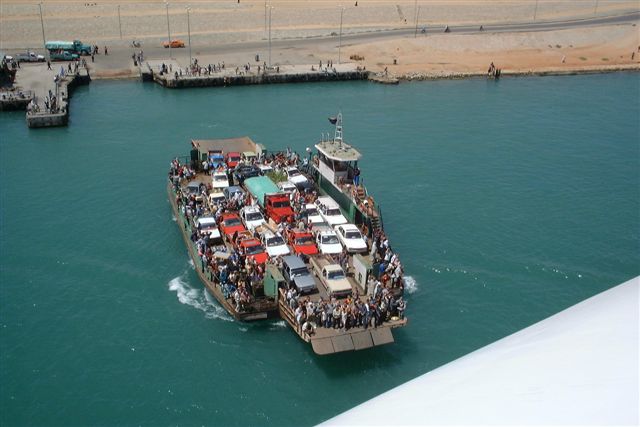
We had a very interesting passage yesterday thru the Suez Canal. Seasoned
world cruise passengers were amazed at the progress the Egyptian people have
made in their development of the area. On the west side of the canal there
was a lot of irrigated farming. Also a number of communities have been
developed. On the Sinai side the beginnings of development are happening.
Many of us remarked yesterday was one of our best days on this cruise.

The Canal is 121 miles long. The minimum bottom width of the channel is 197
ft and ships of 53 ft draft can make the transit.  The canal can accommodate
ships as large as 150,000 dead weight tons fully loaded.  The canal has no
locks, because the Mediterranean Sea and the Gulf of Suez have roughly the
same water level.  The canal utilizes three bodies of water-Lake Manzilah,
Lake Timsah and the Bitter Lakes and is not the shortest distance across the
isthmus.  Most of the canal is limited to a single lane of traffic, but
several passing bays exist, and two lane by passes are located in the Bitter
Lakes and between Al Qantarayh and Ismilia.  A railroad on the west bank
runs parallel to the canal for its entire distance.
The first canal between the Nile River delta and the Red Sea was excavated
about the 13th century BC, probably under the reign of either Seti I or
Ramses II. During the next 1000 years the canal was neglected, but several
rulers at various times had it re-excavated or modified.  Efforts to
maintain it in good condition were finally abandoned in the 8th century AD.
Thereafter various proposals to dig a canal across the Isthmus of Suez were
proposed, but no action was taken.  In 1854, the French diplomat and
engineer Vicomte Ferdinand Marie de Lesseps succeeded in enlisting the
interest of the Egyptian viceroy Said Pasha in the project.  In 1858 the
Canal Corporation was formed to cut the canal and to operate it for 99
years, after which ownership would return to the Egyptian government.
Excavation of the canal was begun on April 25, 1859 , and the canal was
opened to navigation on November 17, 1869. The cost of the construction
totaled about 100 million. About three times that sum was spent on later
repairs and improvements.
Our ship paid $120,000 today to cruise thru the canal.
April 14 (day 85)
We arrived in Istanbul, Turkey, at 3 pm today. Mona and I left this ship and
walked for 1 and half hours. The street we selected was dedicated to
hardware. There must have been millions of pieces of every imaginable
household hardware in couple hundred small shops that also spread out on to
the sidewalk. Walking back the pattern was different on a different street,
this one had cameras, TV, restaurants etc. Tomorrow we have an all day tour
of the city.

Istanbul is a vibrant, exciting city where Asia meets Europe in a bustling
and chaotic setting.  Formerly Constantinople, Istanbul is the only city in
the world that sits astride two continents-Europe and Asia. Istanbul was
founded in the 7th century BC as Byzantium. In the 4th century AD it was
renamed Constantinople by Roman emperor Constantine the Great and served as
the capital of the Byzantine Empire until it was captured by the Ottomans in
the 15th Century.  The Ottomans called the city Istanbul, but it was not
until 1930, seven years after Turkey gained independence, that Istanbul
became its official name.  The population of Turkey is ninety-eight per cent
Muslim
and this reflected in the daily life of the citizens of Istanbul.  At dawn,
you will hear the sound of the call to prayer as it echoes from the ancient
minarets.  You will see countless devoted Muslims kneeling on their prayer
rugs facing Mecca.  All of this will be in contrast to a modern city where
old traditions in some cases are giving way to the new. Transportation
ranges from donkey carts to modern automobiles fighting for space on the
narrow crowded streets.  The Golden Horn, an inlet flowing off Bosphorus
Strait and spanned by three distinct bridges, separates Old Istanbul from
the New Town on the European side. The central point to view the seven hills
of the city is the modern drawbridge which was built to replace the historic
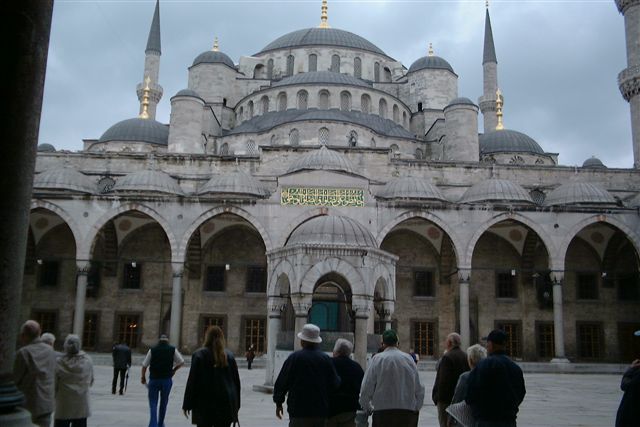
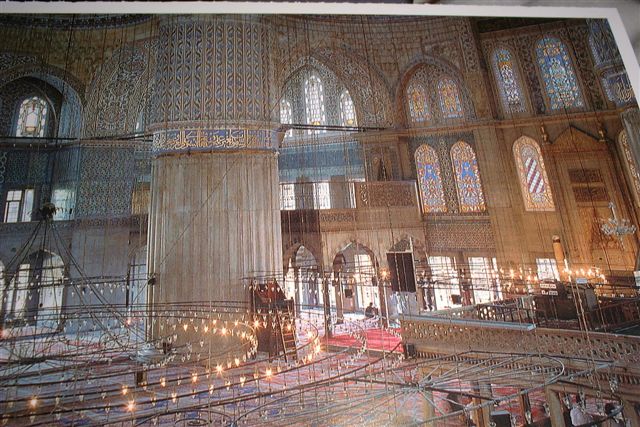
Galata Bridge. Dominating the skyline is the Blue Mosque, otherwise known as
the Sultan Ahmet Camii. This fantastic building contains 260 stained glass
windows and six minarets.  Metmet Aga, also known as Sedefkas (Worker of
Mother of Pearl) built the mosque in eight years beginning in 1609.
Florence Nightingale tended the sick and wounded in the Crimean War.
Istanbul
has 9 million people central and 15 million metro.
The Bosphorus Strait is the sole marine gateway to the Black Sea. Largely
because of this feature, but also because Asia Minor lies directly in the
path of the best land routes between Europe and the Far East, 12 major
civilizations have ruled.  All have imprinted upon the architecture and
culture, leaving antiquity and rich tradition. Ancient ruins tell the
stories of the Greek, Roman, Persian, Ottoman, and Byzantine Empires.
April 15
This was our best day of the cruise in spite of the first all day rain of
the trip. We saw many incredible sights had the best luncheon and the most
wonderful guide.

First we visited the Mosque of Sultan Hamlet (Blue Mosque) so called because
are 21,403 azure colored tiles lining its massive walls. The 16 balconies on
its six minarets honor the 16 sultans of the empire. Sultan Hamlet was only
14 years old when he ordered the construction. It took 7 years to complete
in 1616. Surrounded on three sides by courtyards with five portals, the
portico is covered by 30 cupolas supported by 26 marble columns with
stalactite capitals.  In the centre of the main courtyard is a hexagonal
fountain. The central dome is supported by four marble piers with four
arches sprung between.  The dome is flanked on all four sides by a semi-dome
with cupolas at the corners. The extraordinary height of the dome allowed
for 260 windows which provide the interior with a warm, overall light which
illuminates the rich tiling and tracery. SPECTACULAR.

Next we visited the Church of Chora Museum-best known for its collection of
frescoes and mosaics depicting scenes from the Bible. It was built at the
order of Constantine I in the 4th century BC. It was damaged by an
earthquake in 558 AD and restored by Justinian during his reign 527-565 AD.
It remained a Christian Church until late 1400s when it was converted to a
mosque. Today it is preserved as a historical monument, owing to the mosaics
and frescos.

Next we visited the Museum of St Sophia. This splendid Church of Divine
Wisdom was originally built by Constantine in 325 AD. It was burnt down 404
AD by an angry populace protesting against the banishment of the bishop of
Constantinople. It was burnt down a second time. Justinan ordered the church
rebuilt again and it opened its doors in 537 AD. Justinan in great
excitement shouted "Solomon, I have surpassed you". The construction took
five years, 1000 master craftsmen and 10,000 laborers. For a 1000 years it
was the largest church in the world. In 1453, it was converted into a
mosque. In 1934, Ataturk, father of modern Turkey declared it a national
monument and museum.

Next we visited Topkapi Palace-official residence of the Ottoman Sultans.
The palace consists of courts, pavilions, fountains and a beautiful treasury
section where the Spoonmaker's 86-carat diamond is housed. It was built in
1472-1478. The Ottoman Empire spanned three continents and absorbed the best
of several wealthy empires.  The mass of riches at Topkapi is beyond belief.

THESE SITES WERE THE MOST SPECTACULAR OF OUR WORLD CRUISE.
April 16 (day 87)
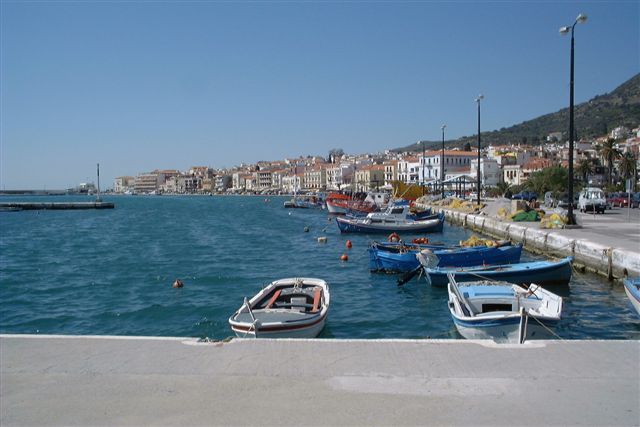
We anchored off of Samos Island, Greece. We tendered to Pythagorion the
tourist resort of the island. We took a motorcoach to the capital city of
the island, Vathi. We visited the town's Archaeological Museum. We visited
the village of Kokkari. We drove past sandy beaches of Tsmadou and Lemakia
and entered the Valley of the Nightingales. We stoped at a local taverna
where we had Samos wine and local meze (appetizers).

Samos has a population of 40,000. We drove for aprx 3 hours over the
mountain to the opposite side of the island. We never saw any poverty. The
island is beautiful and tranquil, very clean and the people are friendly.
Most of the signs were in both Greek and English. Two miles of ocean
separate this island from a part of Turkey. We saw a lot of farming,
vineyards, olive trees, citrus trees etc. Samos modern history begins in
aprx 3000 BC. A great deal of excavation has been done on the island with
many artifacts available for viewing. Excavation continues today. All of
Greece use the Euro currency as Greece is part of the European Union.

It would take a minimum of two weeks to see all this beautiful island has to
offer.
April 17 (day 88)
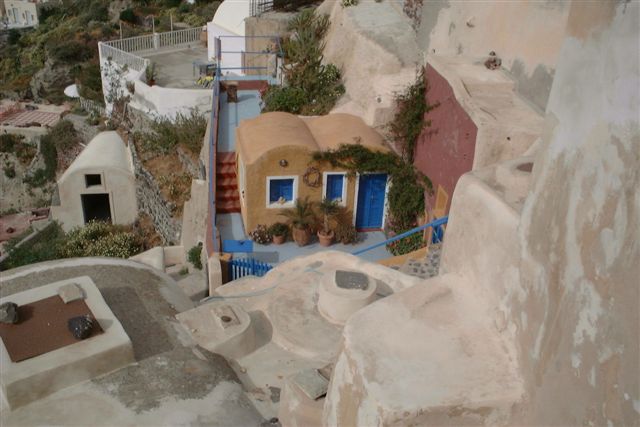
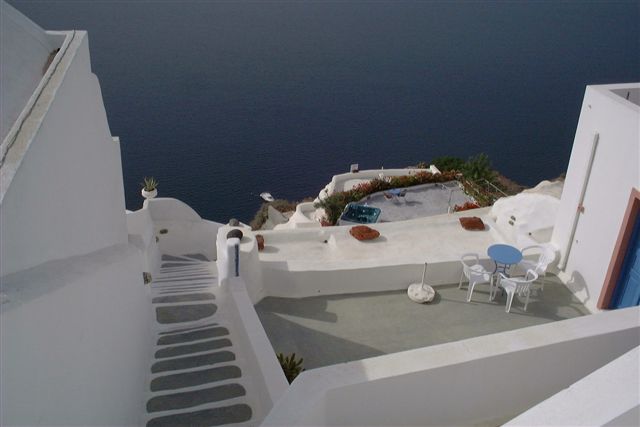
I give up. I have no more adjectives in my vocabulary to describe Santorini,
Greece. Santorini's cliff-faced crescent isle is on the tourist brochures
and posters all over the world. This place meets and exceeds all picture
postcard expectations. Santorini encloses the pure blue waters of its
caldera, the core of an ancient volcano. Its two principal towns, Fira and
Ia, are perched atop the summit of the caldera, where their whitewashed
houses resemble a dusting of new snow on the mountain top. Today's Santorini
was created by an eruption that blew out the center of this once circular
island some 3,600 years ago (1450 BC), buried the cosmopolitan city of
Akrotiri under tons of ash, and sent tidal waves and nearly wiped out the
people on the island of Crete. Today 5% of Akrotiri has been excavated and
funds are being solicited to continue the work. Ancient Thira, another of
Santorini's archaeological wonders, is spectacularly situated atop a high
promontory.
Our motorcoach tour today took us to the top of the rim nearly a mile up
from the ocean. There is a zigzag road but the cliff is nearly straight up
and down from the ocean. There is a plateau where the soil is very fertile.
The climate is perfect for crops unfortunately they don't have adequate
water. Rain is limited and the wells are not very productive. Rain is
collected in cystrains and water is shipped in. We visited a winery and
tasted their excellent white wine. They have a red wine used for blending
and after dinner. Because of the summer heat and lack of rain the vines are
formed into a basket close to the ground instead of the usual trellis. They
grow cherry tomatoes and cucumbers, barley, and olives.
April 20 (day 90)
Yesterday we arrived in Venice, Italy. In late afternoon we took a motor
launch to the new Holland America ship Westerdam. It is the greatest ship I
have ever seen. It is enormous with the latest technology in theatre, movie,
sound and internet. Everything is the state of the art, seemingly without a
concern for cost. It is elegant. We are soon going on it wherever it is
going. We met the CEO of Holland America, he was impressive. This ship was
built here in Venice as has the last 10 Holland American ships. We had
cocktails and dinner aboard. We saw the best stage performance I have ever
seen on a ship.
Today we took a motor launch into main Venice. We were joined by excellent
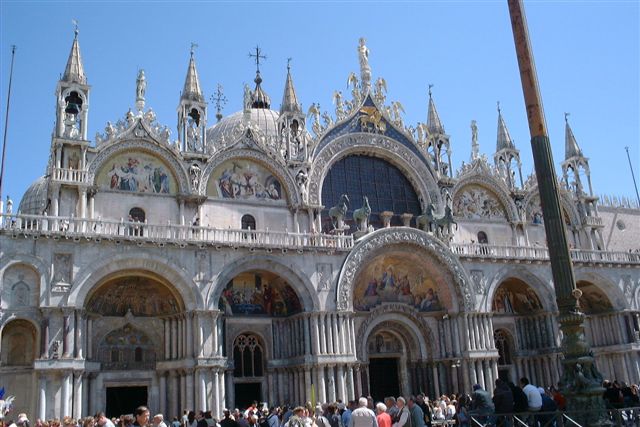
professional guide. We visited St Mark's Square (Piazza San Marco). It is
surrounded by St Mark's Cathedral and Doge's Palace. It looks like a million
people could fit into the square it is so large.
The Cathedral was originally constructed in the 9th Century AD to shelter
the bones of St Mark the patron Saint of Venice. Only traces of the original
structure remain, as the present building dates from the end of the 11
century. The exterior's domes, pinnacles and bronze horses, contrast with a
glowing interior of gold mosaics, elaborate carvings and beautiful statues.
We toured the exquisite Doge's Palace, the former residence of the Duke of
Venice, and seat of the Venetian government from the 9th century until 1797.
We viewed enormous paintings of Tintoretto and Veronese that decorated all
the walls. We viewed the senate chambers, the Grand Council chambers for
1000 deputies, and several other Halls, each with magnificent paintings,
gold inlaid walls and ceiling and marble floors.
We visited a glass factory and saw glass blown into many shapes. We ate
lunch on our own and continued to view this magnificent city and returned to
our ship via a motor launch.

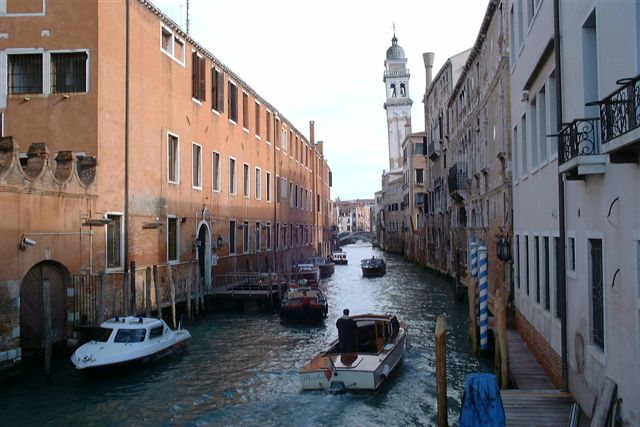
Venice is situated on 120 islands formed by 177 canals in the lagoon between
the mouths of the Po and Pave rivers, at the northern extremity of Adriatic
Sea.  Because of its historic role as a naval power and commercial center,
the city is known as the "Queen of the Adriatic". Long sand bars, or barrier
beaches, on the outer side of the lagoon serve as protection against the
sea.  The islands on which the city is built are connected by about 400
bridges. The Grand Canal winds through Venice, dividing the city into two
nearly equal portions. The Giudecca Canal separates Giudecca Island, on the
extreme south, from Venice proper. No motor vehicles are permitted on the
narrow, winding lanes and streets that penetrate the old city, and the
bridges are for pedestrians only. For centuries the most common method of
transportation was by gondola, a flat bottomed boat propelled by a single
oar. Although there are some motorized boats on the canals it appeared that
by far most of the boats were gondolas.

We were fortunate that today was sunny and pleasant because we were able to
see the snow capped Alps to the north.

On a personal note, my daughter Diana presented husband Dave and her
daughter Claudia a new member of the family an eight pound seven ounce baby boy.
All four are doing well and mother is expected home today. WOW
April 22
We are at sea. We will arrive Sat in Gibraltar. Our next stop will be
Madeira, Funchal, islands 650 miles SW of Gibraltar. Today we have 3
lectures including one by a tablemate Hubrecht Duiijker, on wine tasting. He
has written over 75 books on wine selling more than 3 million copies
worldwide in many different languages.  He was awarded the Julia Child Award
for the best wine book of the year.
The second lecturer Tom Logdson is a rocket scientist involved in the Apollo
project as well as Skylab capsule, various Mars missions and the GPS
navigation satellites.
The third lecturer Ambassador William Sherman will speak on the "New Order".
Yesterday we heard a port talk on Gibraltar and the second of Carl
Bernstein's talks. Last night Hal Linden of Barney Miller TV fame gave a
fantastic performance. Life is going to be dull when we arrive home in less
than 2 weeks.
April 24 (day 95)
We arrived in Gibraltar at 4 pm four hours late. The problem was one of the
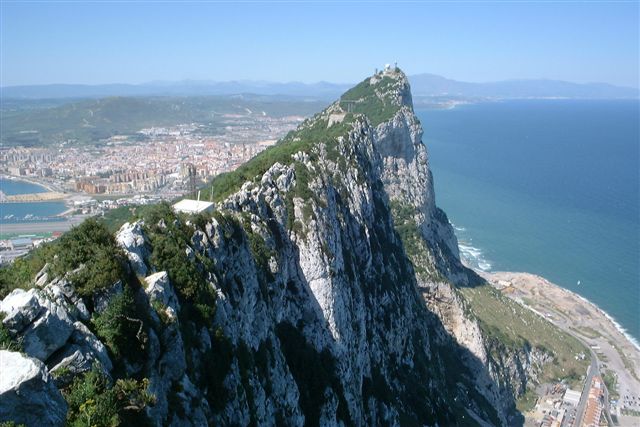
four engines developed a problem. It is repaired now. Our tour bus took us
to the cable car that took us to the top of the rock. The panorama opening
is breathtaking. We also looked down the east side to a huge catchments area
that no longer provides the water for the area. Now desalination of the
ocean water provides the water for the community. We viewed Catalan Bay an
area for long time residents from Italy. We then went to St Michael's Cave.
With its magnificent stalactites and stalagmites, some looking like giant
sticks of barley sugar, all beautifully illuminated. Today, the cave, with
its wonderful acoustics, is occasionally used for concerts, orchestral
shows, etc. Seating for 500 is set up.
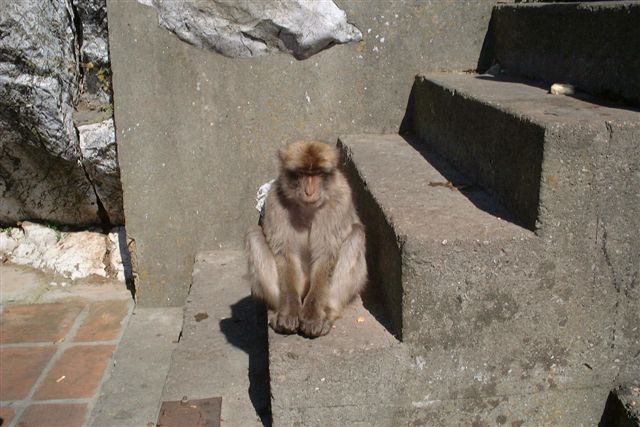
We viewed the 30 famous tailless monkeys who are roaming free. They are
thieves and one of them jumped from a tree on to the back of a lady and
tried to remove a necklace. She wasn't hurt but was frighten. We moved on to
the Great Siege Tunnels built during the 4 years siege in the 1700s. Today
this less then 2 square mile piece of rock is the most fortified land in the
world with more than 30 miles of underground tunnels with fortifications.
The Gibraltarians are celebrating 300 years of English rule (1704-2004). The
Phoenicians were the first to visit the Rock in 950 BC. Then followed the
Greeks, Roman, Moorish, Spanish and British periods in Gibraltar's history.
Today they have domestic independence for executive and legislative matters.
The local judiciary handles the trial phase but appellate judges come in
from Great Britain. GB also provides military support.
The dictator Franco closed the border between Gibraltar and Spain from
1969-1985. It is opened today but Spain wants the area returned to it, so
harassment occurs in that border crossing into Spain can be several hours of
delay. The residents voted overwhelmingly against Spain control last
November. Next stop on Monday is Funchal, Madeira, an island 650 miles SW
from here.
April 24 (day 97)
Today was our last port city. The next 7 days we will be closely following
Columbus' voyage across the Atlantic.
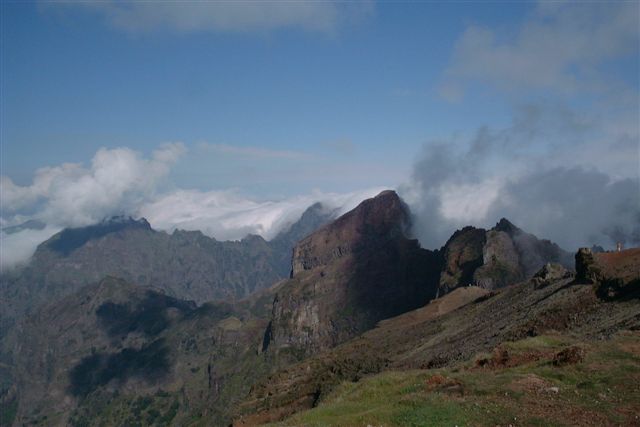
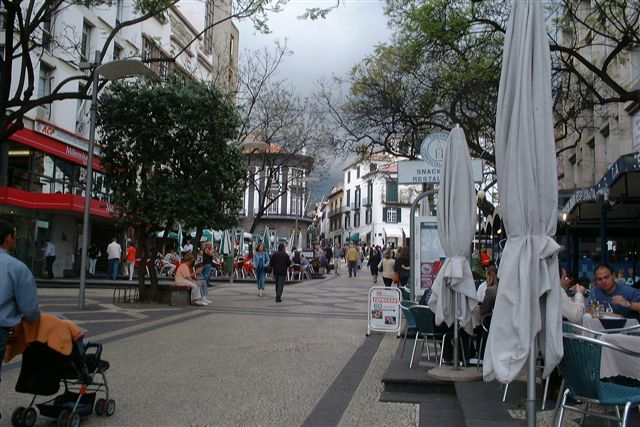
Today we took our usual motorcoach tour of Funchal, Madeira. Winding through
the streets of Funchal, then out into the countryside, the route took us
through the village of Monte, through an eucalyptus forest and up to an
elevation of 5,937 feet. From the summit of Pico do Arieiro we could look
down over the countryside of the island and out to the ocean. We stopped at
a hotel for tea and pound cake. We passed through the resort town of Machico
and stopped at a wine lodge in Funchal where we tasted and bought local
wine. We joined our new tablemates for lunch at a local restaurant where we
sat outside upstairs over the street where we could people watch. Lisa is
the person in charge of luggage shipment. Ted is Director of Security
Operations for Boeing in the Middle East and Africa based in Riyadh, Saudi,
Arabia. We have really enjoyed our latest tablemates.
Funchal, the capital city of the Madeira Islands, is located on the southern
shore of Madeira, the region's largest island on Funchal Bay. It is 35 miles
long and 14 miles wide, it has 100 miles of coastline. The population of the
island is 260,000, with half of it in Funchal. The volcanic soil produces a
plethora of flora ranging from bougainvillea and orchids to prickly pear,
poinsettias, frangipani, wisteria and cassas.  Custard apples, avocados,
mangos and bananas grow in profusion.  The steeply terraced vineyards are
famous for the local wine named for the island. Maderia wine, also known as
Malmsey by the English, is fortified with brandy during fermentation and
aged in baking rooms, called estufas, for several months.  This accelerated
aging process was adopted after the discovery that wines benefited from the
prolonged heat of storage that they underwent on long tropical sea voyages.
Although the island has been Portuguese since its discovery in 1419 by Joao
Gancalves Zarco, the port city of Funchal displays an unmistakable air of
British Colonialism which dates from the 1650's and the marriage of the
Portuguese Princess Catherine of Braganca to England's King Charles II. We
truly enjoyed this beautiful island paradise.
May 4
We are passing southern Abaco as I write. This completes our
circumnavigation. We arrive at 8 am tomorrow in Ft Lauderdale. We will then
drive to Palatka, Fl where Snug is.   The following summary is in our Daily
Program paper today and expresses my feeling exactly:

"Oh what memories! From the lush tropical beauty of Hawii to the unspoiled
natural splendor of New Zealand. Australia beckoned us with its unique
wildlife, coral reefs, and one of the most spectacular harbors in the
world,, Sydney. The mysterious dragons, myths, and magic of Indonesia gave
way to the friendliness and warmth of the Filipino people, and before we
knew it, Hong Kong and the allure of Asia loomed on the horizon. Exotic
India revealed her serene Taj Mahal, while the ancient lands of the Middle
East mesmerized us. The multi-domed skyline is always a traveler's delight
and in Greece we glimpsed a civilization that gave us stunning architecture,
literature, and art. Venice was a special treat, for we saw both the past
and the future. The glory of Italy in all her Renaissance splendor still
lives in Venice, and the future of Holland America was born in front of our
very eyes as we explored the beautiful Westerdam.  The  The rugged
coastlines of Gibraltar and Madeira were our final glimpse of land as we set
sail for Ft Lauderdale and a fond farewell to our 2004 Grand World Voyage.
More than the ports of call, we have shared fine food, good drink, and an
amazing variety of entertainment."

We hope some of you join us on our future cruise both on a cruise ship and
on Snug