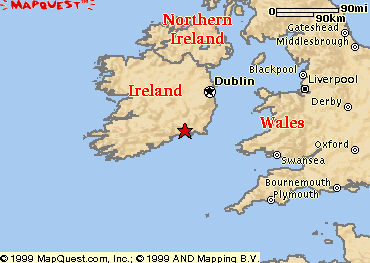
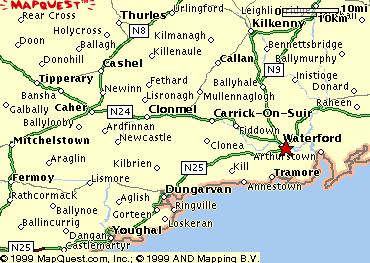
These maps show the basic neighborhood we're talking about. OK, the N-25 didn't run through the heart of the kingdom 1600 years ago! (Though some byway probably did...) But to give an idea of the geography the O Faolains ruled, the towns shown here (by the folks at mapquest.com) that would fall into the boundaries of The Decies probably include modern Tramore, Annestown, Dungarvan, Ringville, Loskeran, Gorteen, Aglish, Kilbrien, Lismore, Clonea, Fiddown, Carrick, possibly as far north as Clonmel, Newcastle, Ardfinnan, Caher, Ballylooby, Newinn, Lisronagh, and such. Not Waterford City; that was a Viking town. But basically nearly all of Co. Waterford and some attached areas of Counties Cork to the west, Tipperary to the north, and Kilkenny to the northeast.
I'm not sure Mitchelstown technically fell into the Decies, but I'm glad they show it, because right near there is one of three Irish placenames incorporating our name: Kilphelan, County Cork (not shown). 'It's in the neighborhood...!'
Gaelic-rooted surnames we're talking about from this area at the time of the Invasion included O'Phelan/Whelan and variants, O'Brick, O'Keane, O'Brien (a later branch of the famous ones), O'Lomasney, O'Luby, O'Donorly, O'Crotty, O'Trehy or Troy, Ormonde or Roe, O'Merry, a MacGrath, an O'Neill, and possibly an O'Mulcahy and O'Quirke. It would appear that these people were/are "the Decies of Munster." (There's also a Cork family called Deasy said to be from here originally.)
Up north, just above Dublin, is the Decies of Meath (or Breaga), right near Tara Hill, ancient capital of Ireland. The legends say this is the birthplace of the Decies people or race/tribe/clan. Some stayed up there while others moved south (us) and west...
...Straight west of Dublin and a little south is Thomond (North Munster), to where some other Decies folk migrated from Tara, to become, it is said, the Dalcassian "race," including the really famous O'Briens, Brian Boru, etc. They shared the Kingship of Munster Province with the folks just west of the Decies of Munster, the MacCarthy's of Desmond (South Munster). The MacCarthy's have a Munster map that suggests how things might have looked politically before the invasion.
And east of the star on this map (which by the way represents Waterford City), in South Wales, is where some of the Munster Decies raided and colonized Celtic Britain, a couple centuries before the Angles, Saxons, and Jutes arrived in eastern Britain from the continent. Buckingham Palace is not amused...!
I'm working on a more detailed history page...but basically what the legends say happened was that the Decies derive from the descendants of a fellow named Fiacha Suighdhe, brother of High King Conn of the Hundred Battles in the late 100s and early 200s of the Common Era, descendants of maybe half of Ireland's previous High Kings. His descendants got in a fight with Conn's grandson, High King Cormac Mac Art, and were kicked out of the capital neighborhood of Tara Hill, some moving south, some west, and some eventually over to Wales.
All the Kings of the Decies of Munster supposedly descend from Fiacha's son Eoghan (Owen or Eugene), and in the 1100s this family assumed the surname O Faolain, meaning Descendant of Faolan, possibly after a forebear Faolan Mac Cormaic who was King of Decies in the 900s. They didn't hand down the Crown directly from father to son, but under a quasi-elective system called tanistry, different branches of the O Faolains shared the leadership of their own sept (clan), and since they were the leading family of the "tribe," their Chief was ex officio King of the Decies as well. In theory every adult male could qualify to be Chief and King, and the family chose the sucessor--the tanist or Tanaiste in Irish--during the life of the Chief/King.
The Decies Kingdom was part of the Provincial Kingdom of Munster, one of ultimately five largely independent Provincial Kingdoms in Ireland. It may have had some relationship with the powerful major regional Kingdom of Desmond or South Munster to the west, perhaps a very influential relationship, but details are sketchy, and in any case, the Decies functioned quite autonomously or semi-independently on its own.
When the Anglo-Normans were brought in by the neighboring King of Leinster Province beginning in A.D. 1169, the Decies bore part of the brunt of the initial offensive, and suffered heavy losses. King John of England granted Desmond and most of the Decies to a branch of the Norman Fitzgeralds, while the rest of the Decies went to the Norman family De La Poer or Power--now the most common surname in Co. Waterford.
After the Invasion, King Donnell O'Faelain died in 1205. In 1207 another (unnamed in my source) O'Faelain, presumably Donnell's successor, killed the Anglo-Norman bishop of Waterford. (I'm not sure why.) As late as the 1400s or 1500s an active O Faolain Chief was still recorded in official documents. From then until 1957 I have no information about Clan/Sept affairs. But the sept spread northward, so that derivatives of the name O Faolain are common not only in Waterford, but also Cork, Kilkenny, Wexford, Laois, Carlow, Offaly, Westmeath, as well as Dublin. And in 1957 there was a published report of a claimant heir to the Chieftainship of the O Faolains, a Whelan I have not been able to get more information on yet.
To this day most of Co. Waterford and vicinity (outside the City of Waterford) is still called The Decies. Also the British established two minor baronial seats in western Co. Waterford, Decies Within Drum and Decies Without Drum; I don't know what "Drum" is. And back up north in the 'homeland' of what is now County Meath they established the baronies of Upper and Lower Deece.