Carl Marx

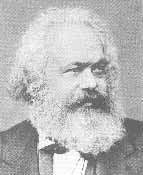
Karl Marx was born on May 5, 1818 , in the city of Trier in
Rheinish Prussia. His family was Jewish, but converted to Protestanism in 1824.
The family was petty-bourgeois; his father was a lawyer. After graduating from a
Gymnasium (High School) in Trier, Marx entered the university, first at Bonn and
later in Berlin, where he read law, majoring in history and philosophy. He
concluded his university course in 1841, submitting a doctoral thesis on the
philosophy of Epicurus. At the time Marx was a Hegelian idealist in his views.
In Berlin, he belonged to the circle of "Left Hegelians" (with Bruno Bauer and
others) who sought to draw atheistic and revolutionary conclusions from Hegel's
philosophy. Ludwig Feuerbach began to criticize theology, particularly after
1836, and he began his turn to materialism, which in 1841 gained ascendancy in
his philosophy (The Essence of Christianity).
After graduating from university, Marx moved to Bonn, hoping to become a
professor. However, the reactionary policy of the government made Marx abandon
the idea of an academic career, after Ludwig Feuerbach had been deprived of his
chair in 1832 (and who was not allowed to return to the university in 1836); and
in 1841 the government had forbade the young Professor Bruno Bauer to lecture at
Bonn.
At the begining on 1842, some radical bourgeois in the Rhineland (Cologne), who
were in touch with the Left Hegelians, founded a paper in opposition to the
Prussian government, called the Rheinische Zeitung. Marx and Bruno Bauer were
invited to be the chief contributors, and in October 1842 Marx became
editor-in-chief and moved from Bonn to Cologne.
The newspaper's revolutionary-democratic trend became more and more pronounced
under Marx's editorship, and the government first imposed double and triple
censorship on the paper, and then on January 1 1843 suppressed it. Marx was
forced to resign the editorship before that date, but his resignation did not
save the paper, which suspended publication in March 1843. Of the major articles
Marx contributed to Rheinische Zeitung, Engels notes, an article on the
condition of peasant winegrowers in the Moselle Valley. Marx's journalistic
activities convinced him that he was insufficiently acquainted with political
economy, and he zealously set out to study it. (See: Marx's articles for the
Rheinische Zeitung)
In 1843, Marx married, at Kreuznach, a childhood friend he had become engaged to
while still a student. His wife came from a bourgeois family of the Prussian
nobility, her elder brother being Prussia's Minister of the Interior during an
extremely reactionary period — 1850-58.
In the autumn of 1843, Marx went to Paris in order to publish a radical journal
abroad, together with Arnold Ruge (1802-1880). Only one issue of this journal,
Deutsch-Französische Jahrbücher, appeared. Publication was discontinued owing to
the difficulty of secretly distributing it in Germany, and to disagreement with
Ruge. Marx's articles in this journal showed that he was already a revolutionary
who advocated "merciless criticism of everything existing", and in particular
the "criticism by weapon", and appealed to the masses and to the proletariat.
Also in 1843, Feuerbach wrote his famous Principles of the Philosophy of the
Future. "One must have experienced for oneself the liberating effect" of these
books, Engels subsequently wrote. "We [i.e., the Left Hegelians] all became at
once Feuerbachians."
In September 1844, Frederick Engels came to Paris for a few days, and from that
time on became Marx's closest friend. Shortly after meeting, Marx and Engels
worked together to produce the first mature work of Marxism — The German
Ideology. In this work, largely produced in response to Feuerbach's materialism,
Marx and Engels set down the foundations of Marxism with the materialistic
conception of history, and broke from Left Hegelian idealism with a critique
against Bruno Bauer and Max Stirner. "The philosophers have only interpreted the
world in various ways;" Marx wrote in an outline for the begining of the book, "
the point is to change it."
In the mid to late-1840s both Marx and Engels took a most active part in the
then seething life of the revolutionary groups in Paris (of particular
importance at the time was Proudhon's doctrine), which Marx broke into pieces in
his Poverty of Philosophy, (1847).
At the insistent request of the Prussian government, Marx was banished from
Paris in 1845, considered by both governments a dangerous revolutionary. Marx
then moved to Brussels. In the spring of 1847 Marx and Engels joined a secret
propaganda society called the Communist League. Marx and Engels took a prominent
part in the League's Second Congress (London, November 1847), at whose request
they drew up the Communist Manifesto, which appeared in February 1848. With
outstanding clarity, this work outlines a new world-conception based on
materialism. This document analysises the realm of social life; the theory of
the class struggle; the tasks of the Communists; and the revolutionary role of
the proletariat — the creators of a new, communist society.
On the outbreak of the Revolution of February 1848, Marx was banished from
Belgium. He returned to Paris, whence, after the March Revolution, he went to
Cologne, Germany, where Neue Rheinische Zeitung was published from June 1 1848
to May 19 1849, with Marx as editor-in-chief. The victorious counter-revolution
first instigated court proceedings against Marx (he was acquitted on February 9,
1849), and then banished him from Germany (May 16, 1849). First Marx went to
Paris, where he was again banished after the demonstration of June 13, 1849, and
then went to London, where he lived until his death.
Marx's life as a political exile was an extremely difficult one, as the
correspondence between Marx and Engels clearly reveals. Poverty weighed heavily
on Marx and his family; had it not been for Engels' constant and selfless
financial aid, Marx would not only have been unable to complete Capital but
would have inevitably have been crushed by hunger and malnutrition.
The revival of the democratic movements in the late fifties and in the sixties
thrusted Marx back into political work. In 1864 (September 28) the International
Working Men's Association — the First International — was founded in London.
Marx was the heart and soul of this organization, and author of its first
address and of a host of resolutions, declaration and manifestos. In uniting the
labor movement of various forms of non-proletarian socialism (Mazzini, Proudhon,
Bakunin, liberal trade-unionism in Britain, Lassallean deviations to the right,
etc.), and in combating the theories of all these sects and schools, Marx here
hammered out uniform tactics for the proletarian struggle of the working in the
various countries. (See Marx's writings for the First International)
Following the downfall of the Paris Commune (1871) — of which Marx gave a
clear-cut materialistic analysis of these events in The Civil War In France,
1871 — and the Bakunin cleavage in the International (See: Marx's conflict with
Bakunin), the organization could no longer exist in Europe. After the Hague
Congress of the International (1872), the General Council of the International
had played its historical part, and now made way for a period of a far greater
development of the labor movement in all countries in the world, a period in
which the movement grew in scope, and mass socialist working-class parties in
individual national states were formed.
Marx's health became undermined by his strenuous work in the International and
his still more strenuous writings and organising. He continued work on the
refashioning of political economy and on the completion of Capital, for which he
collected a mass of new material and studied a number of languages (Russian, for
instance; Marx was fully fluent in German, French, and English). However,
ill-health prevented him from completing the last two volumes of Capital (which
Engels subsequently put together from Marx's notes).
Marx's wife died on December 2, 1881, and on March 14, 1883, Marx passed away
peacefully in his armchair. He lies buried next to his wife at Highgate Cemetery
in London.