V.I. Lenin

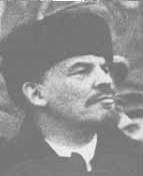
Lenin, Vladimir Ilyich (1870-1924)
One of the leaders of the Bolshevik party since its formation in 1903. Led the
Soviets to power in October, 1917. Elected to the head of the Soviet government
until 1922, when he retired due to ill health.
Lenin, born in 1870, was committed to revolutionary struggle from an early age -
his elder brother was hanged for the attempted assassination of Czar Alexander
III. In 1891 Lenin past his Law exam with high honors, whereupon he took to
representing the poorest peasantry in Samara. After moving to St. Petersburg in
1893, Lenin's experience with the oppression of the peasantry in Russia, coupled
with the revolutionary teachings of G V Plekhanov, guided Lenin to meet with
revolutionary groups. In April 1895, his comrades helped send Lenin abroad to
get up to speed with the revolutionary movement in Europe, and in particular, to
meet the Emancipation of Labour Group, of which Plekhanov head. After five
months abroad, traveling from Switzerland to France to Germany, working at
libraries and newspapers to make his way, Lenin returned to Russia, carrying a
brief case with a false bottom, full of Marxist literature.
On returning to Russia, Lenin and Martov created the League for the Struggle for
the Emancipation of the Working Class, uniting the Marxist circles in Petrograd
at the time. The group supported strikes and union activity, distributed Marxist
literature, and taught in workers education groups. In St. Petersburg Lenin
begins a relationship with Nadezhda Krupskaya. In the night of December 8, 1895,
Lenin and the members of the party are arrested; Lenin sentenced to 15 months in
prison. By 1897, when the prison sentance expired, the autocracy appended an
additional three year sentance, due to Lenin's continual writing and organising
while in prison. Lenin is exiled to the village of Shushenskoye, in Siberia,
where he becomes a leading member of the peasant community. Krupskaya is soon
also sent into exile for revolutionary activities, and together they work on
party organising, the monumental work: The Development of Capitalism in Russia,
and the translating of Sidney and Beatrice Webb's Industrial Democracy.
After his term of exile ends, Lenin emigrates to Münich, and is soon joined by
Krupskaya. Lenin creates Iskra, in efforts to bring together the Russian Social
Democratic Labour Party, which had been scattered after the police persecution
of the first congress of the party in 1898.
[...]
After leading the October Revolution, Lenin served as the first and only
chairman of the R.S.F.S.R.. In 1919 Lenin founded the Communist International.
In 1921 Lenin instituted the NEP. During 1922 Lenin suffered a series of storkes
that prevented active work in government. While in his final year — late 1922 to
1923 — Lenin wrote his last articles where he outlined a programme to fight
against the bureaucratization of the Commmunist Party and the Soviet state.
Lenin died on January 24, 1924.