LTHL NW Indiana Times story
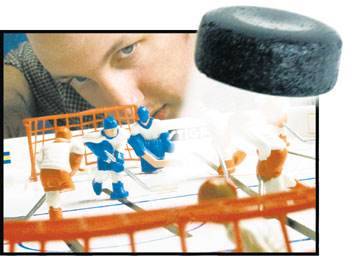
NW Times photo illustration. Table of dreams Decades-old hockey game plays on with boomers BY JAMES HAMBROCK Times Correspondent The puck is dropped and play begins. As the miniature players move up and down the ice while spinning like tops, their human controllers furiously move the control rods back and forth to keep up with the action. Sweat dripping from their foreheads and table rocking, the controllers are focused on the little disc until finally one makes a quick move and scores.
Such is the scene in garages, basements and bars across America and parts of the world as table hockey, the game many baby boomers played as kids, is re- emerging as a popular way for people of all ages to compete without having to lace up the skates themselves.
"It's a thing most people have done since they were kids," said Gary Leverence of Chicago, who received his first set as a 5-year-old for Christmas. "We would spend hours playing."
Being a big Blackhawks fan, he found a connection between what he saw on the ice and what he played at home.
The 54-year-old Leverence said table hockey was part of a larger ritual of hockey for him and his friends. "Chicago used to be a Mecca for hockey," he said, adding that after a long day of playing ice hockey outside, he and his friends would come in and pick up the action on the tables.
As time went on, competition became more intense. They began recording statistics and developed a play schedule.
Eventually, a league formed out of it, which today is known as the Chicago Table Hockey League.
"The NHL was a league, and now we had ours," said Leverence, who has been retired from active play for 18 years. "We got a kick out of it."
Leverence's league, for which he is the commissioner, is one of many across America and parts of the world. Playing during the winter months on restored tables from the early 1970s in the basement of Harry's Tap in Chicago, the league boasts more than 30 players, including six world-class players.
"It's fun, yet very intense," he said. "They play it like the Chinese play table tennis."
The league offers both seasonal play and special tournaments for those who can't make a regular commitment. Once the season is over, the top 16 teams make the playoffs while those left, the "also-rans," play in another tournament.
"I feel the whole league is a competitive group," Leverence said.
Once the players are done for the winter, they can pick up play in Lemont, Ill., at the home of Jerry Pytlewski, whose league has been around since 2002. Pytlewski, 55, also was raised on table hockey, and although he went on a hiatus in his middle years, he came back to the game and since has been traveling with his son to play in tournaments, including several in Montreal, Canada.
Though he said he is not as sharp as he used to be, he still enjoys playing.
"If I take a pounding, I don't mind," he said.
Pytlewski formed his league after he found a group of guys in his area who wanted to play. He attributes most of his recruitment success to the Internet, which with a quick search will bring up leagues from California to Sweden.
The league, which meets on Saturday nights, often goes until the late-night hours as players continue to enjoy the competition despite sore arms, bruised fingers and battered egos.
"The guys don't want to leave," Pytlewski said. "It's nonstop here."
Though most of the players in Pytlewski's league are middle-aged men, he said the occasional twenty-something guy will stop by.
"We're glad to get them," he said. "It gets them off of those video games."
Leverence said the greatest aspect of the leagues is the camaraderie.
"Everyone enjoys it and I can't get away from it," he said, adding that although his position is like another full-time job, he looks forward to the next season.
"It's like anything else. You get what you put into it," he said.
As for the future, Leverence said he doesn't see enthusiasm for the game decreasing, even as players retire.
"We have regenerated every year and we take pride in that," he said. "We encourage anyone to try it."
Pytlewski would agree.
"If (people) have the itch to play, we're here," he said.