Yes, something indeed is, as everyone knows. Of the many regrettable consequences that come to mind there are two I believe to be the most pernicious. With overemphasis on drills and standardized multiple-choice tests students (and teachers) develop a perception that
To Err is Wrong
This is despite the overwhelming evidence that mistakes often serve as stepping stones for correct answers, while failures of expectation form a most basic element of the learning process. When test after test after test, we are conditioned to provide (or select) just one possible answer, the idea that
There Is Only One Right Answer
becomes deeply ingrained in our process of thinking. It's almost obvious that, in Mathematics, if the sought answer is to prove something then in most cases it is impossible to expect a single correct one. Thus with the current education system Mathematics is being emptied of its most basic and characteristic element - deduction. The system violates two fundamental principles of creativity and learning methodology:
Do not be afraid of failure.
Do not be satisfied with a single answer.
As a complement to the above I began collecting quotations from various sources:
Hugo Steinhaus, One Hundred Problems in Elementary Mathematics, Dover Pubns, 1979
This small book is a response to the deplorable state of mathematical education of high school students sensed by college educators after the WW2.
Edmund Landau, Foundations of Analysis, Chelsea Pub Co, 1960
Please forget whatever you've been studying at school; for you have not learned it.
Martin Gardner, Mathematical Carnival, Vintage, 1965.
A teacher of mathematics, no matter how much he loves his subject and how strong his desire to communicate, is perpetually faced with one overwhelming difficulty: How can he keep his students awake?
G.Polya, How To Solve It?, Princeton University Press, 1973
Thus, a teacher of mathematics has a great opportunity. If he fills his allotted time with drilling his students in routine operations he kills their interest, hampers their intellectual development, and misuses his opportunity. But if he challenges the curiosity of his students by setting them problems proportionate to their knowledge, and helps them to solve their problems with stimulating questions, he may give them a taste for, and some means of, independent thinking.
A.K.Dewdney, 200% of Nothing, John Wiley & Sons, 1993
A faltering education system is colliding head-on with the world-wide emergence of a competitive technological economy in which mathematics, more than an single science, will be the main determinant of excellence.
National Research Council. Mathematical Sciences Education Board. Everybody Counts. Washington, D.C., National Academy Press, 1989
(The traditional mathematics curriculum is described as) "a long dimly lit journey through a mountain of meaningless manipulations, with the reward of power and understanding available only to those who complete the journey."
J.A.Paulos, A Mathematician Reads The Newspaper, Anchor Books, 1995
Furthermore, because of the mind-numbing way in which mathematics is generally taught, many people have serious misconceptions about the subject and fail to appreciate its wide applicability.
Failure to conclude has been an outstanding characteristic of philosophy throughout its history.
Philosophers of the past have repeatedly stressed the essential role of failure in philosophy. Jose Ortega y Gasset used to describe philosophy as "a constant shipwreck." However, fear of failure did not stop him or any other philosopher from doing philosophy.
M.Guillen, Five Equations that Changed the World, Hyperion, 1995.
A.Einstein: "It is, in fact nothing short of miracle that the modern methods of instruction have not yet entirely strangled the holy curiosity of inquiry; for this delicate little plant... stands mainly in need of freedom; without this it goes to wrack and ruin without fail."
S.K.Stein, Strength in Numbers, John Wiley & Sonse, 1996
If you browse through The Mathematics Teacher, the main journal devoted to instruction in mathematics you will find constant lamentation, going back to its first volume in 1908, where one teacher wrote, "One of the most obvious facts about mathematics in our schools is a general dissatisfaction." The tone in 1911 was even less cheery, "Our conference is charged with gloom. I have attended funerals, but I do not remember a more mournful occasion than this. We are failures and our students are not getting anything worthwhile."
Year after year, the complaints in The Mathematics Teacher persist. I will skip ahead to 1958, when we read, "The traditional curriculum is meaningless, and by heading for abstract mathematics the modernists are moving further from reality." This was an early warning about the group developing what came to be called "the New Math." More about that reform later. Still, in 1994, the University of Chicago School Mathematics Project complained, "The student today still encounters a variant of the elementary school curriculum designed for the pupil of a hundred years ago."
Is There Always One Right Answer?
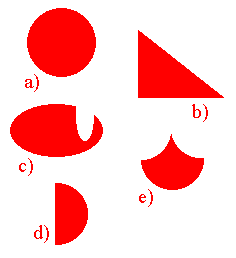
Let's see. Try selecting a figure from the five shown on the right that is different from all the others at least in one respect. Do select a shape before you proceed further.
If you chose figure b), congratulations! You've picked the right answer. Figure b) is the only one that has all straight lines. Give yourself a pat on the back!
Some of you, however, may have chosen figure c), thinking that c) is unique because it's the only one that is asymmetrical. And you are also right! c) is the right answer. A case can also be made for figure a): it's the only one with no points. Therefore, a) is the right answer. What about d)? It is the only one that has both a straight line and a curved line. So, d) is the right answer too. And e)? Among other things, e) is the only one that looks like a projection of a non-Euclidean triangle into Euclidean space. It is also the right answer. In other words, they are all right depending on your point of view.
Reference
R. von Oech, A Whack on the Side of the Head, Warner Books, 1990
Free vs. Pedantic Thinking
The following piece by Alexander Calandra appeared
first in The Saturday Review (December 21, 1968, p 60)
I have discovered it in a collection More Random Walks in Science
by R.L.Weber, The Institute of Physics, 1982.
Some time ago I received a call from a colleague who asked if I would be the referee on the grading of an examination question. He was about to give a student a zero for his answer to a physics question, while the student claimed he should receive a perfect score and would if the system were not set up against the student. The instructor and the student agreed to an impartial arbiter, and I was selected.
I went to my colleague's office and read the examination question: 'Show how it is possible to determine the height of a tall building with the aid of a barometer.'
The student had answered: 'Take the barometer to the top of the building, attach a long rope to it, lower the barometer to the street, and then bring it up, measuring the length of rope. The length of the rope is the height of the building.'
I pointed out that the student really had a strong case for full credit, since he had answered the question completely and correctly. On the other hand, if full credit were given, it could well contribute to a high grade for the student in his physics course. A high grade is supposed to certify competence in physics, but the answer did not confirm this. I suggested that the student have another try at answering the question. I was not surprised that my colleague agreed, but I was surprised that the student did.
I gave the student six minutes to answer the question, with the warning that his answer should show some knowledge of physics. At the end of five minutes, he had not written anything. I asked if he wished to give up, but he said no. He had many answers to the problem; he was just thinking of the best one. I excused myself for interrupting him, and asked him to please go on. In the next minute he dashed off his answer which read:
'Take the barometer to the top of the building and lean over the edge of the roof. Drop the barometer, timing its fall with a stopwatch. Then, using the formula S = at2/2, calculate the height of the building.'
At this point, I asked my colleague if he would give up. He conceded, and I gave the student almost full credit.
On leaving my colleague's office, I recalled that the student had said he had other answers to the problem so I asked him what they were. 'Oh, yes' said the student. 'There are many ways of getting the height of a tall building with the aid of a barometer. For example, you could take the barometer out on a sunny day and measure the height of the barometer, the length of its shadow, and the length of the shadow of the building, and by the use of simple proportion, determine the height of the building.'
'Fine' I said. 'And the others?'
'Yes' said the student. 'There is a very basic measurement method that you will like. In this method, you take the barometer and begin to walk up the stairs. As you climb the stairs, you mark off the length of the barometer along the wall. You then count the number of marks, and this will give the height of the building in barometer units. A very direct method.
'Of course, if you want a more sophisticated method, you can tie the barometer to the end of a string, swing it as a pendulum, and determine the value of 'g' at the street level and at the top of the building. From the difference between the two values of 'g', the height of the building can, in principle, be calculated.
'Finally,' he concluded 'there are many other ways of solving the problem. Probably the best' he said 'is to take the barometer to the basement and knock on the superintendent's door. When the superintendent answers, you speak to him as follows: "Mr Superintendent, here I have a fine barometer. If you will tell me the height of this building, I will give you this barometer."'
At this point, I asked the student if he really did not know the conventional answer to this question. He admitted that he did, but said that he was fed up with high school and college instructors trying to teach him how to think, to use the 'scientific method', and to explore the deep inner logic of the subject in a pedantic way, as is often done in the new mathematics, rather than teaching him the structure of the subject. With this in mind, he decided to revive scholasticism as an academic lark to challenge the Sputnik-panicked classrooms of America.
Can I Do Anything?
Yes, of course you can. The problem of improving the educational system is enormous. It's unlikely to be solved in the next few years. On the other hand, if we wait until a global solution is found, implemented, and, what's more important, is proven to work, we are going to miss the action.
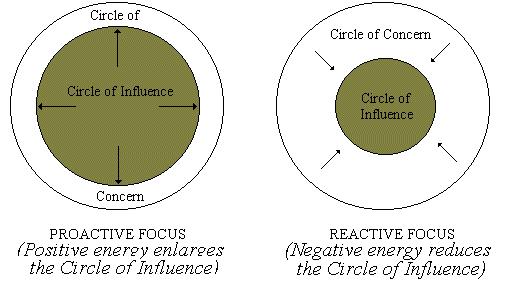
Some time ago I fell under the charm of Stephen Covey's book The 7 Habits of Highly Effective People. As several other very readable books on thinking, learning, self-improvement, the book is very graphical. I am especially fond of the following diagram
Covey writes,
We each have a wide range of concern - our health, our children, problems at work, the national debt, nuclear war. We could separate those from things in which we have no particular mental or emotional involvement by creating a "Circle of Concern."
As we look at those things within our Circle of Concern, it becomes apparent that there are some things over which we have no real control and others that we can do something about. We could identify those concerns in the latter group by circumscribing them within a smaller Circle of Influence.
By determining which of these two circles is the focus of most of our time and energy, we can discover much about the degree of our proactivity.
Proactive people focus their efforts in the Circle of Influence. They work on the things they can do something about. The nature of their energy is positive, enlarging and magnifying, causing their Circle of Influence to increase.
Reactive people, on the other hand, focus their efforts in the Circle of Concern. They focus on the weakness of other people, the problems in the environment, and circumstances over which they have no control. Their focus results in blaming and accusing attitudes, reactive language, and increased feelings of victimization. The negative energy generated by that focus, combined with neglect in areas they could do something about, causes their Circle of Influence to shrink.
I think the best most of us can do is to take personal responsibility to contribute and to get more involved. In most cases this may mean doing something unusual, something one is unaccustomed to, something creative. Whatever you do - whether prevailing over your habits and education or going against peer pressure and accepted standards, you are following in footsteps of other creative people whose attitude to confronting problems is well expressed as
Cut the Knot
A story is told that Gordius, in Greek mythology, king of Phrygia, had the pole of his wagon fastened to the yoke with a knot that defied efforts to untie it. An oracle stated that he who untied this Gordian knot would rule Asia. According to legend, Alexander The Great simply cut the knot with his sword. Which was a non-trivial and quite an unexpected solution. Sure enough, he has conquered a good deal of Asia eventually reaching as far East as Northern India.
Being an Alexander and living at 1 Alexander Road, one can imagine how often I have been asked if it is a coincidence. The association has not been lost on me. Not having global ambitions of Alexander The Great, I often reflected of how the Gordian knot might have looked like.
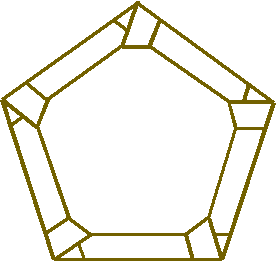
The design I came up with could not have been used by the king Gordius to fasten a yoke. However, it would certainly take Alexander's ingenuity to untie it.
Fold a narrow band of paper into a regular knot without crumpling it unnecessarily. Straighten all the wrinkles if you accidentally did. The knot should actually form a right pentagon. It then follows that if the piece of paper is sufficiently long and one ties knots at equal distances from each other then after the fifth knot the two ends of paper will overlap. Now gluing them together will create a shape that I use as my logo.
It is actually easy to provide a rigorous proof that the design is feasible. What it takes is to demonstrate that the knot indeed shapes itself into the regular pentagon.
One additional remark: the logo proves to be a one-sided surface, akin to the M�bius band.
Math was the most difficult subject I ever�
I strongly believe that there is no two opinions on this account. Generation after generation we grow up disliking and misunderstanding math and not feeling the worse for it. Still, lest these pages be mistaken for a pioneering effort, I wish to give credit to those who raised the issue on other occasions.
A.K.Dewdney, 200% of Nothing, John Wiley & Sons, 1993
People also stereotype themselves in order to avoid math. Women who roll their eyes at the mention of math may be unconsciously taking refuge in the dumb blond stereotype. "I was never any good at math." It may as well be Barbie speaking. ... They may laugh if you called them innumerate but would become incensed if you ever called them illiterate. (p 136)
Barbie's voice chip by Mattel (from A.K.Dewdney, 200% of Nothing)
Math class is tough.
P.J.Davis and R.Hersh, The Mathematical Experience, Houghton Mifflin Company, Boston, 1981
The difficulties of communication emerged vividly when the ideal mathematician received a visit from a public information officer of the University.
P.I.O.: I appreciate your taking time to talk to me. Mathematics was always my worst subject.
P.F.Kanter, HELPING YOUR CHILD LEARN MATH, U.S. DEPARTMENT OF EDUCATION, OFFICE OF EDUCATIONAL RESEARCH AND IMPROVEMENT, January 1994. (Available at gopher://gopher.ed.gov/00/publications/full_text/parents/math.dos)
The United States is the only advanced industrial nation where people are quick to admit that "I am not good in math."
S.Dehaene, The Number Sense, Oxford University Press, 1997
Calculation errors are so widespread that far from stigmatizing ignorance, they attract sympathy when they are admitted publicly ("I've always been hopeless at math!"). Many of us can almost identify with Alice's plight as she attempts to calculate while travelling through Wonderland: "Let me see: four times five is twelve, and four times six is thirteen, and four times seven is - oh dear! I shall never get to twenty at that rate!"
S.K.Stein, Strength in Numbers, John Wiley & Sons, 1996
Consider the message a child gets when reading these exchanges in the daily comics. The first is from Peanuts
"Say we cut an apple in half. We now have two halves."
"That's fractions!! You're trying to teach me fractions! I'll never understand fractions! I'll go crazy!"
Isn't that a fine way to prepare a child for the study of fractions? Now how about this in Calvin and Hobbes?
"I have a question about this math lesson."
"Yes?"
"Given that sooner or later we're all just going to die, what's the point of learning about integers?"
I admit that I found that amusing. However, why didn't the strip ask, "What's the point of learning to read or write or studying history?"
C.C.Clawson, Mathematical Mysteries, Plenum Press, 1996
Most adults admit to an ignorance and a deeply rooted annoyance of mathematics.
Bill Cosby, a stand-up show, February 7, 1998, New Brunswick State Theater
Calculus is one course you can come with to your parents and say, I am dropping it. And they'll understand.
Huckleberry Finn:
I have been to school ... and could say the multiplication table up to 6�7 = 35, and I don't reckon I could ever get any further than that if I was to live forever. I don't take no stock in mathematics, anyway.
From Mathematica Fallacies, Flaws and Flimflam by Edward J. Barbeau (MAA, 2000, p. 1):
The column Money angles: where else to invest? by Andrew Tobias in the May 17, 1993, issue of Time offers this advice for improving your financial worth:
Buy staples in bulk when they're on sale Consider a family that buys one bottle of wine each week. With the 10% discount many stores offer on wine by the case, they would be saving 10% every twelve weeks-more than 40% a year, tax free and largely risk free.
One can in fact do better; increase consumption to one case per month and save 120% over a year, thus qualifying for a 20% payback from the merchant.
Submitted by Larry Zeitel of Loras College in Dubuque, IA.
And another one from the same book (p 15):
The April 3, 1994 ussie of the Washington Post recounted how a sports celebrity failed to answer the following questions on a high school equivalency test:
If the equation for a circle is x2 + y2 = 34, what is the radius of the circle?
If 6 - 50 = x + 20, what is x?
If 2x plus 3x plus 5x = 180, what is x?
Bert Sugar, the publisher of Boxing Illustrated, was not surprised at the failure. He opined that anyone who could answer the math questions "could probably qualify as a nuclear scientist." The reporter's reaction to this view was not recorded.
Contributed by Milt Eisner of Mount Vermon College in Washington, DC.
Yours truly was referred to on the We're Here Forums! in a duscussion on binary to hexadecimal conversion:
This guy shows you how to create a *nary to *nary conversion using a single algorithm. Deep stuff. I would attempt to port this into actionscript, but I'm not getting paid to hurt my brain like that. But I'll post a regular binary to hex converter in a few minutes, just a second.
-Sam
Is Mathematics all around us?
The Grand Canyon in Arizona is 217 miles long, ranges in width between 4 and 18 miles, and is up to 1 mile deep. If we conservatively take its average width to be 6 miles and its average depth to be .3 mile, then its volume is 390.6 cubic miles, which, upon multiplication by 5,2803, yields 5.75 x 10¹³ cubic feet. If we divide this figure by 5 billion, the human population of the earth, we come up with approximately 11,500 cubic feet of space in the Grand Canyon for every human being on earth. Calculating the cube root of this figure to be about 22.5 feet, the conclusion is that there would be room in the Grand Tenement for 5 billion cubicle apartments 22.5 feet on a side.
J.A.Paulos, Beyond Numeracy
Vintage Books, 1992
Suppose we want to know the average income of the employees of the Brand X Corporation. Here's the accounting of salaries:
$470,000 President
$100,000 President's wife
$80,000 Each of the wife's three brothers
$50,000 Wife's best friend from high school
$30,000 Plant manager
$25,000 Each of the six production workers
They must whistle while they work! The average employee of the Brand X Corporation earns $80,000! (The total annual payroll of $1,040,000 divided by thirteen employees equals $80,000.) The president's wife can truthfully say that her brothers earn no more than the average employee. And think of how happy everyone will be if the president earns $990,000 next year. (The total annual payroll of $1,560,000 divided by 13 will equal $120,000.) And the president's wife could now truthfully say that she earns less than the average employee.
Marylin vos Savant
The Power of Logical Thinking
ST. Martin's Press, NY, 1996
The time in which any space is traversed by a body starting from rest and uniformly accelerated is equal to the time in which that same space would be traversed by the same body moving at a uniform speed whose value is the mean of the highest speed and the speed just before acceleration began.
Galileo Galilei
Dialogues Concerning Two New Sciences, 1636
The next Observation is, That there be more Males than Females. There have been Buried from the year 1628, to the year 1662, exclusive, 209436 Males, and but 190474 Females; but it will be objected, that in London it may indeed be so, though otherwise elsewhere; because London is the great Stage and Shop of business, wherein the Masculine Sex bears the greatest part. But the Answer, That there have been also Christened within the same time, 139782 Males, and but 130866 Females, and that the Country Accompts are consonant enough to those of London upon this matter.
J. Graunt
Foundations of Vital Statistics
London, 1662
Is Mathematics Beautiful?
Bertrand Russell (1872-1970), Autobiography, George Allen and Unwin Ltd, 1967, v1, p158
It seems to me now that mathematics is capable of an artistic excellence as great as that of any music, perhaps greater; not because the pleasure it gives (although very pure) is comparable, either in intensity or in the number of people who feel it, to that of music, but because it gives in absolute perfection that combination, characteristic of great art, of godlike freedom, with the sense of inevitable destiny; because, in fact, it constructs an ideal world where everything is perfect but true.
Aristotle (384 B.C.-322 B.C.), Poetics
Beauty depends on size as well as symmetry.
J.H.Poincare (1854-1912), (cited in H.E.Huntley, The Divine Proportion, Dover, 1970)
The mathematician does not study pure mathematics because it is useful; he studies it because he delights in it and he delights in it because it is beautiful.
J.Bronowski, Science and Human Values, Pelican, 1964.
Mathematics in this sense is a form of poetry, which has the same relation to the prose of practical mathematics as poetry has to prose in any other language. The element of poetry, the delight of exploring the medium for its own sake, is an essential ingredient in the creative process.
J.W.N.Sullivan (1886-1937), Aspects of Science, 1925.
Mathematics, as much as music or any other art, is one of the means by which we rise to a complete self-consciousness. The significance of Mathematics resides precisely in the fact that it is an art; by informing us of the nature of our own minds it informs us of much that depends on our minds.
G.H.Hardy (1877 - 1947), A Mathematician's Apology, Cambridge University Press, 1994.
The mathematician's patterns, like the painter's or the poet's must be beautiful; the ideas, like the colors or the words must fit together in a harmonious way. Beauty is the first test: there is no permanent place in this world for ugly mathematics.
Lawrence University catalog, Cited in Essays in Humanistic Mathematics, Alvin White, ed, MAA, 1993
Born of man's primitive urge to seek order in his world, mathematics is an ever-evolving language for the study of structure and pattern. Grounded in and renewed by physical reality, mathematics rises through sheer intellectual curiosity to levels of abstraction and generality where unexpected, beautiful, and often extremely useful connections and patterns emerge. Mathematics is the natural home of both abstract thought and the laws of nature. It is at once pure logic and creative art.
I.Newton, Letter to H.Oldenburg, the Secretary of the Royal Society, October 24, 1676, in A Source Book in Mathematics, D.J.Struik, ed, Princeton University Press, 1990
I can hardly tell with what pleasure I have read the letters of those very distinguished men Leibnitz and Tschirnhaus. Leibnitz's method for obtaining convergent series is certainly very elegant...
Jane Muir, Of Men & Numbers, Dover, 1996.
Gauss: You have no idea how much poetry there is in the calculation of a table of logarithms!
F.Dyson, in Nature, March 10, 1956
Characteristic of Weyl was an aesthetic sense which dominated his thinking on all subjects. He once said to me, half-joking, "My work always tried to unite the true with the beautiful; but when I had to choose one or the other, I usually chose the beautiful." (Herman Weyl (1885-1955))
O.Spengler, in J.Newman, The World of Mathematics, Simon & Schuster, 1956
To Goethe again we owe the profound saying: "the mathematician is only complete in so far as he feels within himself the beauty of the true."
O.Spengler, in J.Newman, The World of Mathematics, Simon & Schuster, 1956
"A mathematician," said old Weierstrass, "who is not at the same time a bit of a poet will never be a full mathematician."
Jakob Bernoulli, Tractatus de Seriebus Infinitis, 1689 (quoted in From Five Fingers to Infinity, F.J.Swetz (ed), Open Court, 1996)
So the soul of immensity dwells in minutia.
And in narrowest limits no limits inhere.
What joy to discern the minute in infinity!
The vast to perceive in the samll, what divinity!
S.Lang, The Beauty of Doing Mathematics, Springer-Verlag, 1985
Last time, I asked: "What does mathematics mean to you?" And some people answered: "The manipulation of numbers, the manipulation of structures." And if I had asked what music means to you, would you have answred: "The manipulation of notes?"
Do we need Mathematics?
The Proposition I.20 of Euclid, nowadays known as The Triangle Inequality, reads as follows:
In any triangle two sides taken together in any manner are greater than the remaining one.
The commentator Proclus wrote:
The Epicureans are wont to ridicule this theorem, saying it is evident even to an ass and needs no prove; it is as much the mark of an ignorant man, they say, to require persuasion of evident truths as to believe what is obscure without question... That the present theorem is known to an ass that make out from the observation that, straw is placed in one extremity of the sides, an ass in quest of provender will make his way along the one side and not by way of the two others.
I do not have enough knowledge to pass a judgement as to whether Epicureans would accept as straight a line drawn by a chalk attached to an ass' tail whenever the latter follows its instincts towards the straw. I consider this a worthy research problem into the history of Mathematics.
But here is what other worthy people had to say with regard to the utility of Mathematics.
Fran Lebowitz (b. 1951), Social Studies, �Tips for Teens�, 1981.
Stand firm in your refusal to remain conscious during algebra. In real life, I assure you, there is no such thing as algebra.
Friedrich Nietzsche (1844-1900). Human, All Too Human, 1878.
Mathematics ... would certainly have not come into existence if one had known from the beginning that there was in nature no exactly straight line, no actual circle, no absolute magnitude.
H.J.S.Smith (1826-1883), in H. Eves, Mathematical Circles Squared, Boston, Prindle, Weber and Schmidt, 1972.
It is the peculiar beauty of this method, gentlemen, and one which endears it to the really scientific mind, that under no circumstance can it be of the smallest possible utility.
G.-C. Rota, Indiscrete Thoughts, Birkhauser, Boston, 1977.
Stanislaw Ulam: "What makes you so sure that mathematical logic corresponds to the way we think? You are suffering from what French call a deformation professionnelle. Look at the bridge over there. It was built following logical principles. Suppose that a contradiction were to be found in set theory. Do you honestly believe that the bridge might then fall down?"
B.Russell, Autobiography, v1, G.Allen & Unwin, LTD, 1967, p 162
... I am glad you abandoned your plan of reading a mathematical book, for any book on the Calculus would have told you lies, and also my book is (I fear) not worth while for you to read, except a few bits. What general value it may have is so buried in technicalities and controversies that it is really only fit for those whose special business it is to go in for such things. The later mathematical volume, which will not be ready for two years or so, will I hope be a work of art; but that will be only for mathematicians. And this volume disgusts me as a whole.
J.W. von Goethe, Faust
Mephistopheles:
Use well your time, so rapidly it flies;
Method will teach you time to win;
Hence, my young friend, I would advise,
With college logic to begin!
G.-C. Rota, Indiscrete Thoughts, Birkhauser, Boston, 1977.
The mystery, as well as the glory of mathematics, lies not so much in the fact that abstract theories do turn out to be useful in solving problems, but, wonder of wonders, in the fact that a theory meant for one type of problem is often the only way of solving problems of entirely different kinds, problems for which the theory was not intended. These coincidences occur so frequently, that they must belong to the essence of mathematics. No philosophy of mathematics can be excused from explaining such occurrences.
R.P.Boas, Jr., If This Be Treason..., Amer Math Monthly, 64(1957), 247-249.
When I was teaching mathematics to future naval officers during the war, I was told that the Navy had found that the men who had studied calculus made better line officers than men who had not studied calculus. Nothing is clearer (it was clear even to the Navy) than that a line officer never has the slightest use for calculus.
H.Eves, Great Moments in Mathematics Before 1650, MAA, 1983
Bernhard Bolzano (1781-1848) was on a vacation in Prague when he was attacked by an illness that manifested itself in bodily chills and painful weariness. To take his mind from his condition, he picked up Euclid's Elements and for the first time read the masterly exposition of the Eudoxian doctrine of ratio and proportion set out in Book V. The ingenuity of the treatment filled him with such vivid pleasure that, he said, he completely recovered from his illness. Ever after, when any of his friends felt indisposed, he recommended as a cure the reading of Euclid's presentation of the Eudoxian theory.
P.E.B.Jourdain, The Nature of Mathematics, from The World of Mathematics by J.R.Newman, Simon and Schuster, NY, 1956
I remember reading a speech made by an eminent surgeon, who wished, laudably enough, to spread the cause of elementary surgical instruction. "The higher mathematics," said he with great satisfaction to himself, "do not help you to bind up a broken leg!" Obviously they do not; but it is equally obvious that surgery does not help us to add up accounts; ... or even to think logically, or to accomplish the closely allied feat of seeing a joke.
Robert Recorde, The whetstone of witte, London, 1557
It is confessed emongste all men, that knowe what learnyng meaneth, that besides the Mathematicalle artes, there is noe vnfallible knowledge, excepte it bee borowed of them.
B.Russell, Autobiography, v1, G.Allen & Unwin, LTD, 1967, p 43
There was a footpath leading across fields to New Southgate, and I used to go there alone to watch the sunset and contemplate suicide. I did not, however, commit suicide, because I wished to know more of mathematics.
J.Napier, Mirifici logarithmorum canonis descriptio, Edinburgh, 1614.
The use of this book is quite large, my dear friend,
No matter how modest it looks,
You study it carefully and find that it gives
As much as a thousand big books.
Jane Muir, Of Men & Numbers, Dover, 1996.
At eighteen, Euler published his first mathematical paper, a treatise on the masting of ships, which he submitted in the annual contest held by the French Academy of Science. Although he was competing against Europe's top mathematicians and scientists, many of them two or three times his age, he won second prize. ... Coming from landlocked Switzerland, he knew next to nothing about ships or their sails. But this lack of firsthand experience did not bother him, for since his conclusions on the height and thickness of masts were "deduced from the surest foundations in mechanics; their truth or correctness could not be questioned."
L.Hogben, Mathematics for the Million, W.W.Norton & Co, 1958
There is a story about Diderot, the Encyclop�dist and materialist, a foremost figure in the intellectual awakening which immediately preceded the French Revolution. Diderot was staying at the Russian court, where his elegant flippancy was entertaining the nobility. Fearing that the faith of her retainers was at stake, the Tsaritsa commissioned Euler, the most distinguished mathematician of the time, to debate with Diderot in public. Diderot was informed that a mathematician has established a proof of the existence of God. He was summoned to court without being told the name of his opponent. Before the assembled court, Euler accosted him with the following pronouncement, which was uttered with due gravity: "(a + bn)/n = x, donc Dieu existe, repondez." Algebra was Arabic to Diderot. � He left the court abruptly amid the titters of the assembly, confined himself to his chambers, demanded a safe conduct, and promptly returned to France.
S.K.Stein, Strength in Numbers, John Wile & Sons, 1996
A physician, Arthur Sadden, who had majored in mathematics, wrote, "Mathematics opened the doors to the very best medical schools. The discipline of analytical thought processes prepared me extremely well for medical school. In medicine one is faced with a problem which must be thoroughly analyzed before a solution can be found. The process is similar to doing mathematics."
Another mathematics major, Jonathan Battiness, who went on to become a lawyer, had a similar view. "Although I had no background in the law - not even one political science course - I did well at one of the best law schools. I attribute much of my success there to having learned, through the study of mathematics, and, in particular, theorems, how to analyze complicated principles. Lawyers who have studied mathematics can master the legal principles in a way that most others cannot."
A.H.Beiler, Recreations in the Theory of Numbers, Dover, 1966
Rabbi Joseph ben Jehuda Ankin, in the twelfth century, recommended the study of perfect numbers in his book Healing of Souls.
B.Bollob�s, Littlewood's Miscellany, Cambridge University Press, 1990
There was a rent act after 1914, and the definition of when a house was subject to it was as follows (my notations in brackets). The 'standard rent' (R) was defined to be the rent in 1914 (R0), unless this was less than the rateable value (V), in which case it was to be the rateable value. 'The house is subject to the act if either the standard rent or the rateable value is less than �105.' There were many law suits, argued ad hoc in each case. The subject is governed by a fundamental theorem, unknown to the Law:
The house is subject to the act iff V < 105.
This follows from Lemma: Min{Max{R0, V}, V} = V.
E.T.Bell, MATHEMATICS: Queen & Servant of Science, MAA Spectrum, 1987
Only one person in hundreds ever actually uses the common algebra he learned.
A 7 grader Amanda C. Xiques sent me the following verse My Feelings About Math
by Amanda Xiques
Roses are Red
Violets are Blue
Math is a subject
I'll always use
From cooking to dancing
Hard work to pleasure
Life is full
Of values we measure
Math is a skill
We need throughout life
We use it at work,
As a husband, or wife
To balance a checkbook,
Buy groceries, teach school
Most life experiences
Use mathematical rules
Math is objective
There's no in-between
It's logical, explainable,
Practical, and clean
The fact that it's perfect
Intimidates me
Sometimes solutions
Are hard to see
I have one major problem
Related to testing
Seems I always know the answer
To the question no one's asking
But I've learned more than I realized
When I recently tested
My SAT Math scores
Were really impressive
Math isn't easy
Every puzzle's a test
But I respect it, I need it
And I always do my best
Proofs in Mathematics
Proofs are to mathematics what spelling (or even calligraphy) is to poetry. Mathematical works do consist of proofs, just as poems do consist of characters.
Vladimir Arnold
John Paulos cites the following quotations by Bertrand Russell:
Pure mathematics consists entirely of such asseverations as that, if such and such a proposition is true of anything, then such and such another proposition is true of that thing... It's essential not to discuss whether the proposition is really true, and not to mention what the anything is of which it is supposed to be true... If our hypothesis is about anything and not about some one or more particular things, then our deductions constitute mathematics. Thus mathematics may be defined as the subject in which we never know what we are talking about, nor whether what we are saying is true.
Paulos goes on to say
Although the ubiquity of people who neither know what they're talking about nor know whether what they're saying is true may incorrectly suggest that mathematical genius is rampant, the quote does give a succinct, albeit overstated, summary of the formal axiomatic approach to mathematics.
Both opinions are enjoyable and thought provoking. To me, the former just plainly states that proving (that is, deriving from one another) propositions is the essence of mathematics. To a different extent and with various degrees of enjoyment or grief most of us have been exposed to mathematical theorems and their proofs. Even those who are revolted at the memory of overwhelmingly tedious math drills would not deny being occasionally stumped by attempts to establish abstract mathematical truths.
I am not sure it's possible to evict drills altogether from the math classroom. But I hope, in time, more emphasis will be put on the abstract side of mathematics. Drills contain no knowledge. At best, after sweating on multiple variations of the same basic exercise, we may come up with some general notion of what the exercise is about. (At worst, the sweat and effort will be just lost while the fear of math will gain a stronger foothold in our conscience.) Moreover, if it's possible at all for a layman to acquire an appreciation of math, it's only possible through a consistent exposure to the beauty of math which, if anywhere, lies in the abstractedness and universality of mathematical concepts. Non-professionals may enjoy and appreciate both music and other arts without being apt to write music or paint a picture. There is no reason why more people couldn't be taught to enjoy and appreciate math beauty.
According to Kant, both feelings of sublime and beautiful arouse enjoyment which, in the case of sublime, are often mixed with horror. By this criterion, most of the people would classify mathematics as sublime much rather than beautiful. On the other hand, Kant also says that the sublime moves while the beautiful charms. I trust math would inspire neither of these in an average person. Trying to make the best of it, I'll seek refuge in a third quote from Kant, "The sublime must always be great; the beautiful can also be small."
Heath Biology, an excellent high school text by J.E.McLaren and L.Rotundo, talking about experimental sciences, has the following to say about proofs: "Notice also that scientists generally avoid the use of the word proof. Evidence can support a hypothesis or a theory, but it cannot prove a theory to be true. It is always possible that in the future a new idea will provide a better explanation of the evidence." Thus we see that proofs are a peculiar attribute of mathematical theories. The proofs may only exist in formal systems as described by B.Russell.
With these preliminaries I want to start a collection of mathematical proofs. I'll distinguish between two broad categories. The first is characterized by simplicity. A proof is defined as a derivation of one proposition from another. A single step derivation will suffice. If need be, axioms may be invented. A finest proof of this kind I discovered in a book by I.Stewart. Most of the proofs I think of should be accessible to a middle grade school student.
In the second group the proofs will be selected mainly for their charm. Simplicity being a source of beauty, selection of proofs into the second group is hard and, by necessety, subjective. The first of the collection is due to John Conway which I came across in a book by R.Honsberger. Many a mathematician would insist that math objects (even the most abstract) have existence of their own like physical objects. Mathematicians may only discover them and study their properties. Look into the proof. Think of those powers of the golden ratio. Has Conway invented them, or have they been filling the grid all along?
Is Mathematics pleasant?
It's for you to judge. I'll try my best to convince you that this is so.
A friend of mine - a mathematician, incidently - recently completed a speed-reading course, and noted this in a letter to his mother. His mother responded with a long, chatty letter in the middle of which she wrote, "Now that you've taken that speed-reading course, you've probably already finished reading this letter."
J.A.Paulos, Mathematics and Humor
The University of Chicago Press, 1980
As you may expect, self-reference appears in a variety of places.
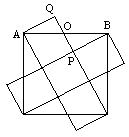
Lines from the vertices of a square to the midpoints of the sides are drawn, as shown above. Prove the surprising result that the area of the smaller square this produces is 1/5 the given square.
R.Honsberger, Mathematical Morsels
MAA, 1978
Proof
All it takes is to show that the two triangles AQO and BPO are equal. How to complete the proof should be obvious from the diagram.
I want to make just one additional remark. Let's return to the original picture of a square with four lines drawn inside it. We may think of identifying opposite sides of the square to obtain a torus. The lines shown will then form a 5 country map, each country being an image of a square. Of course, areas of the countries will by no means be equal.
Mathematics and Puzzles
As children, we all loved mathematics and working out puzzles. Mathematics was an all-important tool to answer questions, like "How many," "Who is older," "Which is larger." And puzzles were of course everywhere. We did not stop to check a dictionary to ascertain that a puzzle is something, such as a toy or game, that tests one's ingenuity. We did not care about our ingenuity a little bit, but just thrived on learning new things and skills that the nature made us curious about. Growing up was a great fun.
Time brought a change. In school we were made to realize that learning is a serious business, and for many of us much of it has ceased to be entertaining. Although not for all. Some could not give up their erstwhile pursuits of mental entertainment. There are enough of puzzle lovers to provide a living for the selected few who invent and publish puzzles - in accordance with the dictionary definition to challenge one's ingenuity, puzzles old and new. The luckiest of the breed grew to become scientists, mathematicians in particular. Mathematicians solve puzzles as a matter of vocation. Puzzlists seek puzzles in newspapers, books, and now on the Web.
There are many kinds of puzzles - jigsaw puzzles, slider puzzles, sliding blocks puzzles, logic puzzles, mazes, cryptarithms, crosswords, strategy games, dissections, magic squares - it's hard to enumerate all known kinds. Puzzlists and mathematicians have their preferences. Most of mathematicians will probably deem classification of their occupation as puzzle solving a misnomer. (Due to their mindset they will likely to inquire as to the definition of puzzle solving - just in case.) Mathematicians call their puzzles problems. Solved problems become lemmas, theorems, propositions. Why would they object to being categorized as puzzlists?
Solving both puzzles and mathematical problems require perseverance and ingenuity. However, there is a profound difference between solving puzzles and what mathematicians do for a living. The difference is mainly that of the attitude towards either activity. For puzzlist, solving a puzzle is a goal in itself. For mathematician, solving a problem is an enjoyable and a desirable occupation but is seldom (with the exception, for instance, of great problems of a long standing, like Fermat's Last Theorem) a satisfactory achievement in itself. In most cases after solving a problem mathematician will try something else: modify or generalize the solved problem, seek another proof - perhaps simpler or more enlightening than the original one, attempt to understand what made the proof work, etc., which will lead him to another problem and so on. Whatever he does, he eventually gets a hierarchical network of interrelated solved problems - a theory. Why does mathematician seek new problems?
The reason is in that mathematics, even if perceived by many as a not very meaningful manipulation of abstract symbols, embodies in its abstractedness a rare power of explanation. Some mathematics directly explains natural phenomena, some sheds light on other portions of mathematics or other sciences. (A famous Russian mathematician V.I. Arnold even categorized mathematics as that part of physics in which experiments are inexpensive.)
Understanding in mathematics is born not only from formulas, definitions and theorems but, and even more so, from those networks of related problems. The process is very much like distilling the many meanings of a word in Thesaurus into a unique shade of the concept that it represents. Mathematics - the most exact science of all - is least of all a dictionary of term definitions. Mathematicians seek knowledge. In search of knowledge, they enjoy themselves tremendously inventing and solving new problems.
The site - Le Monkey Puzzle - makes an attempt to present mathematics as an evolving and entertaining subject in which an unsuspecting visitor may take an active part.