![[Complex!]](abacus.gif) Complex
Problems
Complex
Problems
![[Queen!]](queen.gif)
i. 8 Queens
This is a commonly known chess problem...
The Question: In how many ways can you arrange
8 queens on a standard chessboard in such a way that none of them is
attacking any other?
![[Names &emp; Numbers]](namenumber.gif)
ii. Names & Numbers
Thanks to Mike and Ruth VanderMeer from Canada, Le Monkey can present you the following names and numbers puzzle:
Four words add up to a fifth word numerically: mars
venus
uranus
saturn
-------- +
neptune
Each of the ten letters (m, a, r, s,
v, e, n, u, t, and p) represent a unique
number from the range 0 .. 9. Furthermore, numbers 1 and 6 are being used most frequently.
The Question: What numbers does neptune equal?
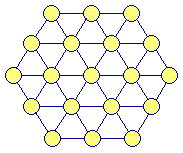
iii. Nineteen Numbers
Net
This is the toughest number net on our site! It has nineteen
circles that have to be filled with the numbers 1 upto (and including) 19. These
numbers have to be placed in such a way that all numbers on any horizontal row
and any diagonal line add up to the same sum.
Warning: there are many horizontal and diagonal lines, which have a different number
of circles (3, 4, or 5), nevertheless all these sums have to be equal!
The Question: How should the nineteen numbers be placed in the net?
iv. Roulette
A well known roulette trick is doubling the bet if
one loses. But consider this roulette problem to be limited to a maximal
number of consecutive bets.
The Question: What is the behavior of the
expectation (E(n)) for a limited roulette problem?
v. Cash for a Car
Thanks to Lucas Jones Le Monkey can present you the following puzzle:
A man is going to an Antique Car auction. All purchases
must be paid for in cash. He goes to the bank and draws out $25,000.
Since the man does not want to be seen carrying that much
money, he places it in 15 evelopes numbered 1 through 15. Each envelope contains
the least number of bills possible of any available US currency (i.e. no
two tens in place of a twenty).
At the auction he makes a successful bid of $8322 for a car.
He hands the auctioneer envelopes number(s) 2, 8, and 14. After opening the
envelopes the auctioneer finds exactly the right amount.
The Question: How many ones did the auctioneer
find in the envelopes?
![[Ladder]](ladder.gif)
vi. Ladder
Alley
In an alley two ladders are placed cross-wise.
The lengths of these ladders are resp. 2 and 3 meters. They cross
one another at one meter above the ground.
The Question: What is the width of the alley?
![[Cat & Mouse!]](catmouse.gif)
vii. Cat &
Mouse
Four white pieces are placed on one side of a chess
board, and one black piece is placed at the opposite site. The game is
played by the following rules:
 Black wins if it reaches the opposite side.
- White wins if it blocks black in such a way
that black can not do any legal move anymore.
- Only diagonal moves (of length 1)
are allowed.
- White only moves forward.
- Black can move backward and
forward.
- Black may make the first move, then white make a move, and so on...
The Question: Is this game computable (i.e. is
it possible to decide beforehand who wins the game, no matter how hard his
opponent tries to avoid this)?

viii. Car
Parking
A street of length L is randomly
filled with cars (one by one), where the length of a car is the unity of
L (i.e. 1).
The Question: What is the expectation for
the number of cars that can be parked until the street is filled?