|
The Gandan Monastery
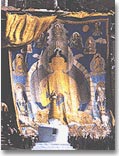 The
Gandan Monastery, 60 km east of Lhasa, lies atop
Mount Wanrigu, at an altitude of 3800 m. Tsong
Khapa, founder of the Gelukpa, or the Yellow Hat
Sect, established this monastery in 1409. It is
one of the three principal Gelukpa monasteries in
the Lhasa district. Gandan consists of many
temples and buildings. The "Cuoqin Vihara" has 108
pillars and can house 3,500 monks at one time. It
contains the beautiful and skillfully carved
bronze statues of Maitreya and Tsong Khapa. The
throne of Tsong Khapa and his collection of
Tibetan status can also be found here. Gandan is
one of Tibet's most important cultural relics. The
Gandan Monastery, 60 km east of Lhasa, lies atop
Mount Wanrigu, at an altitude of 3800 m. Tsong
Khapa, founder of the Gelukpa, or the Yellow Hat
Sect, established this monastery in 1409. It is
one of the three principal Gelukpa monasteries in
the Lhasa district. Gandan consists of many
temples and buildings. The "Cuoqin Vihara" has 108
pillars and can house 3,500 monks at one time. It
contains the beautiful and skillfully carved
bronze statues of Maitreya and Tsong Khapa. The
throne of Tsong Khapa and his collection of
Tibetan status can also be found here. Gandan is
one of Tibet's most important cultural relics.
Sera Monastery
 Sera means
"Hailstone" in Tibetan language. Legend has it
that it hailed while the foundation of this famous
monastery was being laid. Sera was the last of the
three principal Yellow Hat Sect monasteries to be
built in Lhasa. Unlike Drepung and Gandan, it was
not built upon a mountain, but rather, at the foot
of the "Wudu Hill" to the North of Lhasa City. It
was completed in 1419. Sera houses a great sutra
chanting hall, a college, and 32 sections. It once
housed nearly 10,000 monks and is proud of its
glorious history during the Ming Dynasty. Many
precious gifts were sent to Sera by the Chinese
Emperors of the time, several of which are well
preserved and may be viewed on location. Sera means
"Hailstone" in Tibetan language. Legend has it
that it hailed while the foundation of this famous
monastery was being laid. Sera was the last of the
three principal Yellow Hat Sect monasteries to be
built in Lhasa. Unlike Drepung and Gandan, it was
not built upon a mountain, but rather, at the foot
of the "Wudu Hill" to the North of Lhasa City. It
was completed in 1419. Sera houses a great sutra
chanting hall, a college, and 32 sections. It once
housed nearly 10,000 monks and is proud of its
glorious history during the Ming Dynasty. Many
precious gifts were sent to Sera by the Chinese
Emperors of the time, several of which are well
preserved and may be viewed on location.
The Norbulingka Park: "the Royal Park of
Dalai Lamas"
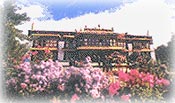 Norbulingka, or
"Jeweled Garden", is the site of the Dalai Lamas'
Summer Palace, while the Potala is the Winter
Palace. According to the Tibetan, it is the
residence of the Buddha. Willow trees, lush green
vegetation, colorful flowers, and large groups of
birds have made their home here. The palaces,
towers and pavilions are decorated with murals
depicting religious and historical stories. Norbulingka, or
"Jeweled Garden", is the site of the Dalai Lamas'
Summer Palace, while the Potala is the Winter
Palace. According to the Tibetan, it is the
residence of the Buddha. Willow trees, lush green
vegetation, colorful flowers, and large groups of
birds have made their home here. The palaces,
towers and pavilions are decorated with murals
depicting religious and historical stories.
 |