Religion
Nearly all Tibetans follow Tibetan Buddhism,
known as Lamaism, with the exception of
approximately 2,000 followers of Islam and 600 of
Catholicism.
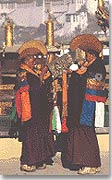 Tibetan Buddhism
is a branch of Chinese Buddhism. In the seventh
century AD, Buddhism was introduced into Tibet
from China and Nepal. It first gained acceptance
amongst the nobility, and was gradually embraced
by the common people. Tibetan Buddhism
is a branch of Chinese Buddhism. In the seventh
century AD, Buddhism was introduced into Tibet
from China and Nepal. It first gained acceptance
amongst the nobility, and was gradually embraced
by the common people.
Tibetan Buddhism was greatly influenced by
Indian Buddhism during its development. From the
seventh century to the middle of the present
century, a constant stream of eminent Buddhist
monks and scholars came from India, bringing with
them the dharma, or faith. An indigenous religion,
Bon, influenced the development of the Buddhist
religion, and the combination of the two religions
came to be known as Tibetan Buddhism.
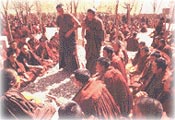 After years of
evolution, Tibetan Buddhism has developed its own
distinctive qualities and practices. A well-known
example is the belief that there is a Living
Buddha, who is the reincarnation of the first, a
belief alien to Chinese Buddhism. After years of
evolution, Tibetan Buddhism has developed its own
distinctive qualities and practices. A well-known
example is the belief that there is a Living
Buddha, who is the reincarnation of the first, a
belief alien to Chinese Buddhism.
Buddhism reaches every corner of Tibetan life.
Monasteries are the most conspicuous buildings in
every village, town and city, and the locals
gather and live near these buildings.
 |