Introduction
Tibet is located on the Southwest border of
China and covers an area of 1,200,000 square
kilometers. Its population of 2.3 million people
come from a variety of ethnic groups including
Tibetan, Han, Monba and Lhota. Although a part of
China, they have a unique culture, all their own.
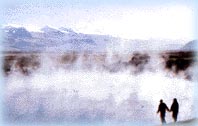 A wide
network of 5000 rivers crisscrosses the landscape
of Tibet, forming some of the most amazing scenery
ever seen. All the mountains in Tibet are perched
on the Qing-Zang plateau. Mount Everest,
Namjagbarwo, Gangdis, Hongduan and Kunlun are some
of the most impressive peaks in the region. A wide
network of 5000 rivers crisscrosses the landscape
of Tibet, forming some of the most amazing scenery
ever seen. All the mountains in Tibet are perched
on the Qing-Zang plateau. Mount Everest,
Namjagbarwo, Gangdis, Hongduan and Kunlun are some
of the most impressive peaks in the region.
Across the northern expanse of Tibet lie the
vast grasslands where horses, cattle and sheep
roam freely. The wilderness of Northwestern Tibet
is home to a variety of unusual and unique species
of animals.
Buddhism (or Lamaism, as it is known locally)
forms the very heart of Tibet. Nearly all Tibetan
are followers of Sakyamuni. Countless monasteries,
adorned by shining golden roofs, dot the entire
countryside and their beauty and serenity are an
inspiration to all.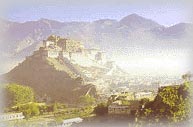
Tibet is an extraordinary and mysterious place.
Here, one finds not only the world's highest
mountain, Mount Everest, but also the world's
lowest valley, the Grand Yarlun-tzanpo River
Valley. It is a magical land filled with beautiful
surprises for those who venture into its embrace.
 |