Great Wall
Badaling Great Wall
This section of the Great Wall is often the first stop for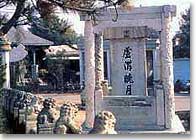 tourists into Beijing. It was built on the ridges of the mountains rising up and down according to the terrain. On the top of the wall is a road paved with square bricks, wide enough for six horses, abreast. Along the wall there are many beacon towers, which were once used as a means of communication to warn of an enemy's advance (with smoke during the day and fire at night). tourists into Beijing. It was built on the ridges of the mountains rising up and down according to the terrain. On the top of the wall is a road paved with square bricks, wide enough for six horses, abreast. Along the wall there are many beacon towers, which were once used as a means of communication to warn of an enemy's advance (with smoke during the day and fire at night).
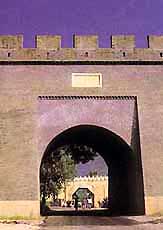 Juyongguan Pass Juyongguan Pass
Near Badaling Great Wall is Juyongguan Pass, one of the most important fortifications of ancient China. From here, you have command of the narrow valley that gives access through the mountains to Beijing. Historical records show that Juyongguan Pass was not only a strategic pass but also a trading place that flourished hundreds of years ago.
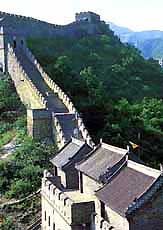 Mutianyu Great Wall
The wall, at this point, northeast of Beijing's Huairou County, becomes very steep. Built in the mid-6th century and rebuilt in the 14th century in the Ming Dynasty, it is older than Badaling Great Wall, but newly opened to tourists. Those who have been to the Badaling Great Wall may be interested in seeing the difference in this part of the Great Wall.
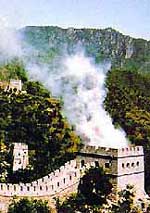 Simatai Great Wall Simatai Great Wall
Simatai Great Wall lies at the northern border of Beijing, about 120 kilometers from the city. Built on steep mountain slopes, it rises and falls sharply but has every essential structure a barrier needs - walls, watch-towers and parapets. In some extremely steep places, the structure is nothing more than a single wall with firing holes. At the foot of Simatai is a reservoir that is fed by two springs - one hot and one cold. In winter, the reservoir is usually shrouded in mist because of the hot spring.

|