|
|
Resources
 Rich with
water resources, its rivers total to a length of
692.57 kilometers and have an annual flow of
16.921 billion cubic meters. Subtropical Guilin
has a mild climate and abundant rainfall (1,900
millimeters per annum). It is neither freezing in
winter nor sweltering in summer, and enjoys
approximately 309 days without frost. It also
boasts over 1,533 hours of sunshine each year. The
average annual temperature is 19 degrees
centigrade. Over 1,000 types of plants can be
found in here, including such rare trees as
cathsya argurophylla and ginkgo biloba. The masson
pine is the most abundant natural plant; the
osmanthus is the main urban plant; and the
osmanthus flower is the official flower of Guilin.
Guilin also presents the world with many varieties
of animals, with over 400 species of terrestrial
vertebrates including the clouded leopard, the
yellow-bellied tragopan, the pangolin and the
masked civet. There are approximately 144 species
of aquatic animals such as salamander, mandarin
fishes, and eels. Guilin's major mineral resources
are hematite, pyrite, lead, zinc, steatite, and
marble.
Rich with
water resources, its rivers total to a length of
692.57 kilometers and have an annual flow of
16.921 billion cubic meters. Subtropical Guilin
has a mild climate and abundant rainfall (1,900
millimeters per annum). It is neither freezing in
winter nor sweltering in summer, and enjoys
approximately 309 days without frost. It also
boasts over 1,533 hours of sunshine each year. The
average annual temperature is 19 degrees
centigrade. Over 1,000 types of plants can be
found in here, including such rare trees as
cathsya argurophylla and ginkgo biloba. The masson
pine is the most abundant natural plant; the
osmanthus is the main urban plant; and the
osmanthus flower is the official flower of Guilin.
Guilin also presents the world with many varieties
of animals, with over 400 species of terrestrial
vertebrates including the clouded leopard, the
yellow-bellied tragopan, the pangolin and the
masked civet. There are approximately 144 species
of aquatic animals such as salamander, mandarin
fishes, and eels. Guilin's major mineral resources
are hematite, pyrite, lead, zinc, steatite, and
marble.
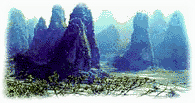
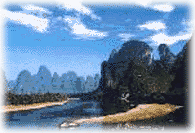 The typical,
Karst topography adds to the city's breathtaking
landscape. A myriad of hills and winding rivers
lend to its beauty. One of the most important
rivers, the Li River (Lijiang), cuts through the
city of Guilin. It twists around the peaks,
through small villages and rice fields, in and
around bridges, exhibiting the charm of rural
life, especially on a spring morning under the
rising sun, or on an autumn night under the moon
light. There are also spectacular caves and rocks
which were formed through aeons of weathering and
water erosion. In addition, scenic Guilin has a
plethora of historical and cultural relics in its
possession.
The typical,
Karst topography adds to the city's breathtaking
landscape. A myriad of hills and winding rivers
lend to its beauty. One of the most important
rivers, the Li River (Lijiang), cuts through the
city of Guilin. It twists around the peaks,
through small villages and rice fields, in and
around bridges, exhibiting the charm of rural
life, especially on a spring morning under the
rising sun, or on an autumn night under the moon
light. There are also spectacular caves and rocks
which were formed through aeons of weathering and
water erosion. In addition, scenic Guilin has a
plethora of historical and cultural relics in its
possession.

|
|
|