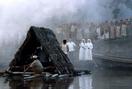
Although cinema
arrived at Cuba
at the beginning of the 20th
century and the island arrived early to the television
phenomena and cinematographic production, before the triumph of the Cuban Revolution around 80 full-length
films were produced, most of them were melodramas which did not say much about the
reality of the country.
IT'S NOT SO DIFFERENT THERE...
 Than here.
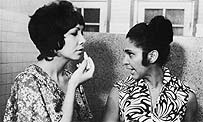
De
Cierta Manera (One
Way or Another) is a 1974
feature film from Cuba, in Spanish with English subtitles. Sara Gómez directed this
cinematic mix of documentary and fiction that looks at the marginal
neighborhoods of Havana shortly after the Cuban Revolution of 1959. Gómez
completed work on the film with Mario Balmaseda and Yolanda Cuellar
just before her death.
The film illustrates the history before the background of the
development process in Cuba. It demonstrates how tearing down slums
and building modern settlements does not change the thoughts and
behavior of the inhabitants, even over time. Yolanda, a female teacher,
cannot find the best methods to teach the marginalized children of the
slums because of their different origin. Mario, a worker in a bus
factory and a typical macho man, is confronted by Yolanda's instinct
for emancipation. The two nonetheless become involved. Their
relationship
portrays the idea that racism, sexism,
and class-based prejudices
must be demolished in order to succeed. The film does not contain
action in the traditional sense--but it portrays, through an unusual
mixture of documentary film modules and fiction, the conflicts in Cuban
society
that remain unsolved today.
As De Cierta Manera reveals, Gómez was a
revolutionary filmmaker with intersecting concerns: the Afro-Cuban
community and the value of its cultural traditions, women's issues, the
treatment of marginalized sectors of society, and the role of family
within the context of the revolution and workers' rights. For its time,
the film was extremely [radical]] both in form and content. Hence, Sara
Gómez remains one of the most significant filmmakers from Latin
America.
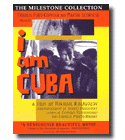
i am
Cuba
The
Cuban revolution is at the center of Mikhail Kalatazov's strange,
poetic film from 1964 which unites four stories.
Originally
controversial
because of a
uniquely Russian view of
Cuba, it was not
widely seen. In the
years since its original release, the film, which
features a poem by Yevgeni
Yevtushenko,has achieved international
critical acclaim. It offers a uniquely
earthy view of
Cuba in the early 1960's.
|
 |
 |
Strawberry & Chocolate
A sensation from Cuba
in which a chance encounter over ice cream
between a
middle-aged gay man and a young, fervent believer in
contemporary Cuban
Marxism sets the stage for a funny but seriousfilm
about difference and acceptance.
Their friendship develops
despite
official intolerance of homosexuality and it soon
withstands that
short-sighted policy.
|