 |
|
|
|
|
|
|
|
|
|
|
|
|
|
|
|
|
|
|
|
|
|
|
|
|
|
|
|
|
|
|
|
|
|
|
|
|
|
|
|
|
|
|
|
|
|
Through My Parents' Eyes |
|
|
|
David Goeckeler |
|
|
| The world was dramatic during the early lives of my parents, Carl and Nancy Goeckeler. The Cuban Missile Crisis, wars, musical revolutions, tragedies and great triumphs took place during Mom's and Dad's adolescent years, teen years and early adulthood. The media was constantly able to report an event that affected millions of people. John F. Kennedy was assassinated in 1963, as was Martin Luther King Jr. in 1968. The first moon landing happened a year after King passed. Olympians were murdered in the 1972 Munich Games. In the early 70's Nixon rocked the nation when he became the first president to resign. My parents' early years were full of shocking news. |
|
|
| Kennedy Assassination |
|
|
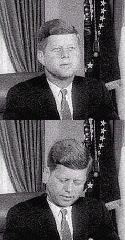
| November 22, 1963, John F. Kennedy was assassinated in Dallas, Texas. The day started off fairly normal for the president. First he was scheduled to eat breakfast in Fort Worth with the Chamber of Commerce. Then he was to fly to Dallas where he would be the focal point of a motorcade through downtown. Earlier that morning Kennedy said to his wife, "We're entering nut country today. But Jackie, if somebody wants to shoot me from a window with a rifle, nobody can stop it, so why worry about it?" (Mahoney 290). Eerily this is exactly how the president died. The Kennedys rode with Governor Connely and his wife in a car that had a retractable glass bubble ("The Assassination"). |
|
|
|
They chose, however, to ride with the glass protection down. Behind the presidential limo was a sedan with secret service agents in it and behind that were the Vice President Lyndon B. Johnson, Senator Ralph Yarborough, and their wives. At 12:30 the president's vehicle slowed to 11.2 mph and three shots were fired all of which struck the president with one hitting his head (Mahoney 291). One of the bullets went through Kennedy and injured Connely in the back, lungs, ribs, wrist and thigh. The crowd of thousands watched in horror as Jackie held her husband's head in her lap while is blood and brains seeped out onto her. |
|
|
|
The car sped off as a secret service agent leaped into the car. They along with the vice president and other escorts drove to Parkland Hospital where a team of doctors looked him over and tried to revive him. Dr. Tom Shires who was the head surgeon of the hospital stated, " Medically it was apparent the president was not alive when he was brought in [to the hospital]. There was no spontaneous respiration...technically, however, by using vigorous resuscitation instruments, tubes, and all the supportive measures we were able to raise a semblance of a heartbeat" ("The Assassination"). The president's death was listed at 1:00pm. However the doctors were unable to pinpoint exactly when his death occurred. |
|
|
|
Dad remembers hearing the news over the school intercom and later that day going to the circus with his class who had dampened spirits (Goeckeler). Mom also heard at school and had an "empty" feeling when she walked home for lunch. It also reminded her of when she saw the president when he visited Billings, Montana (Goeckeler). Lee Harvey Oswald, an ex-marine, was charged with the assassination of one of America's most beloved and charismatic Presidents of the 20th century. |
|
|
|
King Assassination |
|
|
|
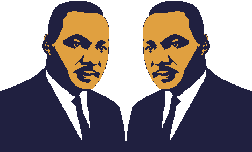
Five years after the murder of JFK, Martin Luther King Jr. was shot and killed too. The assassination took place April 4th 1968 in Memphis, Tennessee. Dr. King was in Memphis in support of a march that black sanitation workers who wanted a better benefits package were to take part in. He also planned on having thousands of "out of towners" join the demonstration that was scheduled for Monday, April 8th. This was the second march in Memphis in support of these city workers. The first ended in violence, which embarrassed King and went against his mentality of civil disobedience (Siebold 154). He basically wanted the march to go just like the first but without any outbreaks of hateful acts. |
|
|
|
The Memphis courts ordered King not to march on the following Monday, but King planned on assembling anyway.� On the evening of April 3rd King spoke to a group of 2000 people about threats he received when flying into Memphis from Atlanta. "...We've got difficult days ahead. But it doesn't really matter with me now...Like anybody I'd like to live a long life...[b]ut I'm not concerned about that now...I've seen the promised land. I may not get there with you but...we as a people will get to the promised land. So I'm happy tonight. I'm not worried about anything. I'm not fearing any man. Mine eyes have seen the glory of the coming of the Lord." (Siebold 154). |
|
|
|
On the evening of April 4th, Martin Luther King Jr. stood by the second floor railing of the Lorraine Motel. He leaned over to chat with Reverend Jesse Jackson and Ben Branch, a musician who was scheduled to play at a rally later that night. All of a sudden a shot was fired and King fell pounding the second floor concrete walkway. He was shot between the right side of his jaw and neck, and his tie was torn off in the blast (Siebold 160). He passed away at 7:05 in Saint Joseph's Hospital, with millions of Americans mourning his death. |
|
|
|
Dad was shocked by the assassination and remembers tension in the country at the time. He also said that a curfew was put into effect in Kansas City (Goeckeler). Mom was surprised too, but was not as effected since Montana had a very small black population. |
|
|
|
Moon Landing |
|
|
|
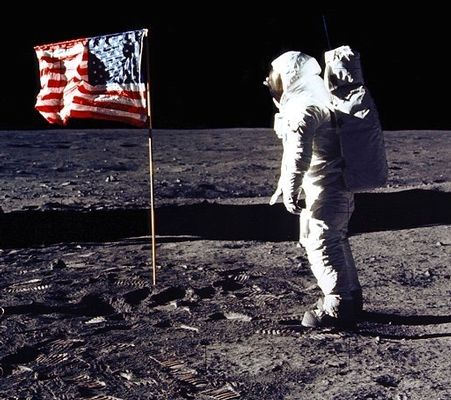
Just a year after Dr. King's tragedy, one of America's greatest accomplishments up to that point took place. The lunar landing was undoubtedly America's biggest event of the late 60's. The Apollo lunar module, Eagle, touched down on the surface of the moon at 4:17 eastern on July 20th, 1969. Neil Armstrong and Edwin Aldrin landed while Michael Collins piloted the command ship orbiting the moon. Six hours later Neil Armstrong stepped on the powdery surface of the moon saying, "That's one small step for man, one giant leap for mankind." (Clifton). Nineteen minutes later Aldrin stepped out and the two astronauts set up a television camera so the earth could watch. |
|
|
| It is estimated that 1/5th of the earth's population tuned into watch NASA's landing and to watch the men gather moon rocks and walk around (Clifton). The landing brought a sense of unity between nations and was looked upon as favorable by a number of unfriendly nations. The landing wasn't that easy though. The computer guidance system had the Eagle landing in a boulder filled crater. Armstrong manually steered the ship a couple hundred miles away to a safe and gentle landing (Clifton). |
|
|
| Mom recalls watching the landing at her cousin's birthday party and said it seemed surreal. Dad also thought it was exciting and remembers feeling pride when the American flag was placed on the moon. Both of my parents enjoyed watching the astronauts jump and walk with less gravity (Goeckeler). |
|
|
|
Nixon and Watergate |
|
|
| Shortly after America's great space triumph, scandal hit the Whitehouse. June 17th, 1972, five men broke into offices at the Watergate Office Complex in the capital. They were "fine-tuning eavesdropping equipment" installed in the Democratic Party's headquarters when a security guard noticed the break in and called the police at 1:47 A.M. (Murrin 1033). When investigators questioned the five men who were arrested, they found that the men were linked to a committee to re-elect President Nixon (also known as CREEP). The five burglars were paid to stay quiet and the CIA was instructed to lie to the FBI saying that further investigation could endanger national security (Murrin 1033). |
|
|
|
Eventually one of the five men caught, who had previously worked for the CIA, broke the silence. He and others testified about illegal activities involving CREEP and the president's aides. Soon the president himself was linked to covering up the Watergate Affair. Shortly after, it was discovered that Nixon had recorded all of his conversations in the Oval Office and 60 hours of tape were released to the public. After more and more testimony the president's approval rating dropped 39 points to the lowest public support for a president ever recorded (Matthews 336). Under the threat of impeachment, Richard Nixon resigned from his presidency August 9th, 1974. |
|
|
|
Dad was disappointed that America's highest officials acted in this way. He feared that international view of the office of president, the presidency itself, would be tainted and less respected. Mom liked Nixon and during the scandal she hoped he was not linked to the Watergate cover up.� Mom and Dad both remember that it drug on forever (Goeckeler). |
|
|
|
Munich Olympics |
|
|
|
The 1972 Munich Olympics were also very memorable, but not only for positive reasons. During the Olympics, terrorists murdered 11 members of the Israeli national Olympic team. Dad recalls the entire situation being portrayed in epic fashion by Olympic News Anchor Jim McKay.� On August 5th members of the Black September Movement, who had previously highjacked a Belgian commercial airliner, broke into the Israeli quarters at night and killed two athletes. They took nine other athletes hostage, and demanded the release of 200 Palestinians jailed in Israeli prisons, and a free escape (Chester 195). |
|
|
|
Israel refused to comply but the terrorists and hostages were flown to the Munich Airport by helicopter where they were told they would be flown to Cairo, Egypt. Soon after the helicopter landed, German Sharpshooters opened fire and were met with gunfire from the terrorist group. The helicopter was blown up by Black September members and all nine hostages along with the five terrorists were killed. A German police officer also died from gun wounds. Dad recalled that the Olympic spirit was seriously tested and broke in some people after the massacre (Goeckeler). |
|
|
|
It was a sad and tragic event, but Avery Brundage, the president of the International Olympic Committee, declared, "The games must go on." (Laing 131). The American swimmer, Mark Spitz, answered by winning an astounding and record setting seven gold medals. |
|
|
|
Although the 1972 Summer Olympics brought shocking news, it did not stand alone in that department. Within a decade, two of the nation's most influential leaders had been killed, a president resigned, and the U.S. put a man on the Moon. Along with these stunning events, the Vietnam War claimed thousands and thousands of U.S. lives. "I was right on the border age,"Dad said. If Dad went, it is possible that neither he nor his children would be living. |
|
|
|
 |
|
 |
|
|
 |
|
|
|
|
Photos |
|
|
|
|
Family Tree |
|
|
|
|
|
|
|
|
|
|
 |
|
|
 |
|
|
|
|
 |
|
|
|
|