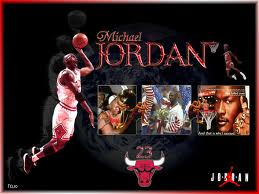
By acclamation, Michael Jordan is the greatest basketball player of all time. Although, a summary of his basketball career and influence on the game inevitably fails to do it justice, as a phenomenal athlete with a unique combination of fundamental soundness, grace, speed, power, artistry, improvisational ability and an unquenchable competitive desire, Jordan single-handedly redefined the NBA superstar. Even contemporaneous superstars recognized the unparalleled position of Jordan. Magic Johnson said, "There's Michael Jordan and then there is the rest of us." Larry Bird, following a playoff game where Jordan dropped 63 points on the Boston Celtics in just his second season, appraisal of the young player was: "God disguised as Michael Jordan. A brief listing of his top accomplishments would include the following: Rookie of the Year; Five-time NBA MVP; Six-time NBA champion; Six-time NBA Finals MVP; Ten-time All-NBA First Team; Nine time NBA All-Defensive First Team; Defensive Player of the Year; 14-time NBA All-Star; Three-time NBA All-Star MVP; 50th Anniversary All-Time Team; Ten scoring titles -- an NBA record and seven consecutive matching Wilt Chamberlain; Retired with the NBA's highest scoring average of 30.1ppg. A Tar Heel at heart, the high school All-American attended the University of North Carolina. As a freshman, he played somewhat in the shadows of upperclassmen James Worthy and Sam Perkins. However, he shone in the spotlight of the NCAA Championship game against Georgetown and another great freshman Patrick Ewing, whom he would foil future NBA championships for as well. Jordan scored 16 points, grabbed nine rebounds and made the winning basket on a 16-foot jumper with 18 seconds in the game for the 63-62 victory. As a sophomore, he was named College Player of the Year by The Sporting News. As a junior, he received that award again as well as the Naismith and Wooden Awards. After his junior year he was chosen with the third overall pick in the 1984 NBA Draft by the Chicago Bulls. The Houston Rockets selected 7-0 center Hakeem Olajuwon form the University of Houston with the No.1 pick, which most expected. The Portland Trail Blazers, however, with the No. 2 pick chose 7-1 center Sam Bowie from Kentucky, which was not as anticipated. Bowie had suffered several injuries while in college but the Blazers bypassed Jordan because just the year before the team selected another exciting shooting guard in Clyde Drexler. Although Drexler went onto to be a star, Bowie was an injury prone player with a journeyman pro career However, Jordan, coming off a gold medal performance at the 1984 Olympics prospered in the pro game with a fabulous first season, earning the NBA Rookie of the Year Award. He averaged 28.2 ppg, (third behind Bernard King and Bird) 6.5 rpg and 5.9 apg. He also was selected to the All-NBA Second Team. Perhaps more important, the Bulls improved to win 11 more games than in the season prior to his arrival and made it to the playoffs. Jordan averaged 29.3 ppg in the first round series, but the Bulls lost in four games to the Milwaukee Bucks. In his first season, he did not have outstanding shooting range and was thought to roam to often on defense resulting from playing trapping defenses in college according to his first NBA coach, Kevin Loughery. Yet, his medium game -- eight to 15-feet from the basket was impressive as evidenced by his .515 field-goal shooting percentage and his steals tended to compensate for his less than stellar straight-up defense. Improvement in both areas would come and he would ultimately be regarded as threat from anywhere on the floor and one of the best ever one-on-one defenders. He was a competent if unspectacular performer. But Jordan's hope of reaching the big leagues seemed dim, and with Major League Baseball embroiled in a labor dispute as the 1995 season neared, he focused his competitive fire back on the NBA. Late in the 1994-95 NBA season, he came out of retirement with the succinct statement of "I'm Back." He was back, albeit with the unorthodox No. 45 as he wanted to leave No. 23 behind, and attempted to carry the Bulls to another title. Jordan averaged 26.9 points in 17 regular-season games, which the Bulls played to a record of 13-4. The most memorable game of the initial comeback occurred six games in when he scored 55 points against the Knicks in the Garden. That game, dubbed "Double Nickel," was extraordinary in that a new Jordan emerged. Robbed of his youthful bounce at age 32, he turned primarily to fade-away jump shots and spinning layups. And in the waning moments of a tie game, he drew attention as he dribbled around the perimeter then passed to a wide-open Bill Wennington under the basket for the winning points in a 113-111 victory. His coach, Jackson, in the aftermath said, "It's rare that players can live quite up to New York. I've seen a lot of them fall flat on their faces because of the pressure to perform there. But he had the whole evening in the palm of his hand. Sometimes the game just seems to gravitate into his grasp." In the playoffs, he poured in 31.5 ppg. But despite Jordan's presence in the lineup, the Bulls didn't have quite enough to get past the Orlando Magic in the conference semifinals. Chicago lost to the Shaquille O'Neal-led Magic in six games. Jordan's championship quest was fulfilled the following season with almost a whole new band of players than in his first title runs. He began the season with his old No. 23 uniform but only his sidekick Pippen remaining from the first three championship teams. The Bulls added Dennis Rodman, an enigmatic player but a rebounding and defensive phenom. The team enjoyed one of the most remarkable years ever posted by any club. Jordan led the NBA with 30.4 ppg as the Bulls charged to a record 72 victories during the regular season, then stormed through the playoffs with a 15-3 record ending in a six game series win over the Sonics. Poignantly, Jordan recaptured the title on Father's Day and cradled the ball after the decisive game in a heap on the floor of the United Center, which replaced Chicago Stadium during his retirement, unabashedly crying. The emotional impact of the moment was overwhelming. Along the way, Jordan captured the MVP awards for the regular season, All-Star Game and Finals, joining Willis Reed (1970) as the only men to win all three honors in the same season. Although he had relinquished the MVP award to Karl Malone in 1996-97, Jordan was awarded MVP in 1997-98 and again led the Bulls to the NBA Championship with a satisfying six-game victory over Malone's Utah Jazz. Despite a horrible case of stomach flu in a critical Game Five, he would not let his team lose. He scored 38 points and the Bulls won the game and then the title at home in Game Six. He was also named the NBA Finals MVP for the fifth time. The Bulls duplicated the three-peat in 1998-99 with another six game series win over the Jazz. Jordan with his team down three points at the close of Game Six, scored on driving move to the basket. And on the next Jazz possession, he stole the ball from Malone in the post to set-up his game winning jump shot. The shot over Bryon Russell with 6.6 seconds left on the clock is etched in many fans mind and photographic history. After labor negotiations were resolved leaving a shortened season in 1999; Jordan left the game saying, "Right now I don't have the mental challenges that I have had in the past to proceed as a basketball player." Despite not playing for three seasons during his second retirement, Jordan was still probably the most recognizable athlete in the world. However, after assuming an ownership and team executive role with the Washington Wizards in 2000, he returned to play the game he loves, after being visibly frustrated in the owners' box with the team's performance. On Sept. 25, 2001, he signed a two-year contract with the Wizards for the veteran's minimum. Jordan brought in his old Bulls' coach Doug Collins and tried mightily to revive a once accomplished franchise that had sunken to moribund levels. But the Wizards, although an attendance draw around the league, failed to make the playoffs in Jordan's two years. However, moments of the great Jordan were apparent such as scoring 40 points a few days after his 40th birthday in the 2002-03 season. He left as a player to return to an ownership and executive role with the belief that with the cluster of young stars, the NBA was in fine shape. Above all, Jordan recognized his place in the game. In his book, For The Love of The Game: My Story, Jordan wrote: "There is no such thing as a perfect basketball player, and I don't believe there is only one greatest player either. Everyone plays in different eras. I built my talents on the shoulders of someone else's talent. I believe greatness is an evolutionary process that changes and evolves era to era. Without Julius Erving, David Thompson, Walter Davis, and Elgin Baylor there would never have been a Michael Jordan. I evolved from them." At the turn of the 21st century, ESPN, the preeminent all-sports network, conducted an expansive survey of media members, athletes and others associated with the sports world to rank the 20th century's greatest athletes. Jordan topped the list above Babe Ruth and Muhammad Ali -- substantiating his link to those earlier cultural icons.