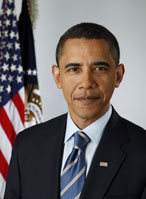
Barack Obama was born August 4, 1961 in Honolulu, Hawaii, to Ann Dunham, a White American from Wichita, Kansas. Obama's father was Barack Obama, Sr., a Luo from Nyang'oma Kogelo, Nyanza Province, Kenya. His parents met in 1960 while attending the University of Hawaii at Manoa, where his father was a foreign student. The couple married on February 2, 1961; they separated when Obama was two years old and divorced in 1964. Obama's father returned to Kenya and saw his son only once more before dying in an automobile accident in 1982.
After her divorce, Dunham married Indonesian student Lolo Soetoro, who was attending college in Hawaii. When Soetoro, a military leader in Soetoro's home country, came to power in 1967, all students studying abroad were recalled and the family moved to Indonesia. There Obama attended local schools in Jakarta, such as Besuki Public School and St. Francis of Assisi School, until he was ten years old.
He then returned to Honolulu to live with his maternal grandparents, Madelyn and Stanley Armour Dunham, while attending Punahou School from the fifth grade in 1971 until his graduation from high school in 1979. Obama's mother returned to Hawaii in 1972 for five years, and then in 1977 went back to Indonesia, where she worked as an anthropological field worker. She stayed there most of the rest of her life, returning to Hawaii in 1994. She died of ovarian cancer in 1995.
Of his early childhood, Obama has recalled, "That my father looked nothing like the people around me - that he was black as pitch, my mother white as milk - barely registered in my mind." In his 1995 memoir, he described his struggles as a young adult to reconcile social perceptions of his multiracial heritage. He wrote that he used alcohol, marijuana, and cocaine during his teenage years to "push questions of who I was out of my mind." At the 2008 Civil Forum on the Presidency, Obama identified his high-school drug use as his "greatest moral failure."
Some of his fellow students at Punahou School later told the Honolulu Star-Bulletin that Obama was mature for his age, and that he sometimes attended college parties and other events in order to associate with African American students and military service people. Reflecting later on his formative years in Honolulu, Obama wrote: "The opportunity that Hawaii offered - to experience a variety of cultures in a climate of mutual respect - became an integral part of my world view, and a basis for the values that I hold most dear."
Following high school, Obama moved to Los Angeles, where he studied at Occidental College for two years. He then transferred to Columbia University in New York City, where he majored in political science with a specialization in international relations. Obama graduated with a B.A. from Columbia in 1983. He worked for a year at the Business International Corporation and then at the New York Public Interest Research Group.
After four years in New York City, Obama moved to Chicago, where he was hired as director of the Developing Communities Project (DCP), a church-based community organization originally comprising eight Catholic parishes in Greater Roseland (Roseland, West Pullman, and Riverdale) on Chicago's far South Side. He worked there for three years from June 1985 to May 1988. During his three years as the DCP's director, its staff grew from one to thirteen and its annual budget grew from $70,000 to $400,000. His achievements included helping set up a job training program, a college preparatory tutoring program, and a tenants' rights organization in Altgeld Gardens. Obama also worked as a consultant and instructor for the Gamaliel Foundation, a community organizing institute. In mid-1988, he traveled for the first time to Europe for three weeks and then for five weeks in Kenya, where he met many of his paternal relatives for the first time.
Obama entered Harvard Law School in late 1988. He was selected as an editor of the Harvard Law Review at the end of his first year, and president of the journal in his second year. During his summers, he returned to Chicago where he worked as a summer associate at the law firms of Sidley & Austin in 1989 and Hopkins & Sutter in 1990. After graduating with a Juris Doctor (J.D.) magna cum laude from Harvard in 1991, he returned to Chicago.
Obama's election as the first black president of the Harvard Law Review gained national media attention and led to a publishing contract and advance for a book about race relations. In an effort to recruit him to their faculty, the University of Chicago Law School provided Obama with a fellowship and an office to work on his book. He originally planned to finish the book in one year, but it took much longer as the book evolved into a personal memoir. In order to work without interruptions, Obama and his wife, Michelle, traveled to Bali where he wrote for several months. The manuscript was finally published in mid-1995 as Dreams from My Father.
From April to October 1992, Obama directed Illinois's Project Vote, a voter registration drive with a staff of ten and seven hundred volunteers; it achieved its goal of registering 150,000 of 400,000 unregistered African Americans in the state, and led to Crain's Chicago Business naming Obama to its 1993 list of "40 under Forty" powers to be.
For twelve years, Obama served as a professor at the University of Chicago Law School teaching Constitutional Law. He was first classified as a Lecturer from 1992 to 1996, and then as a Senior Lecturer from 1996 to 2004. He also joined Davis, Miner, Barnhill & Galland, a twelve-attorney law firm specializing in civil rights litigation and neighborhood economic development, where he was an associate for three years from 1993 to 1996, then of counsel from 1996 to 2004, with his law license becoming inactive in 2002.
Obama was a founding member of the board of directors of Public Allies in 1992, resigning before his wife, Michelle, became the founding executive director of Public Allies Chicago in early 1993. He served from 1994 to 2002 on the board of directors of the Woods Fund of Chicago, which in 1985 had been the first foundation to fund the Developing Communities Project, and also from 1994 to 2002 on the board of directors of the Joyce Foundation. Obama served on the board of directors of the Chicago Annenberg Challenge from 1995 to 2002, as founding president and chairman of the board of directors from 1995 to 1999. He also served on the board of directors of the Chicago Lawyers' Committee for Civil Rights Under Law, the Center for Neighborhood Technology, and the Lugenia Burns Hope Center.
State legislator: 1997-2004
Obama was elected to the Illinois Senate in 1996, succeeding State Senator Alice Palmer as Senator from Illinois's 13th District, which then spanned Chicago South Side neighborhoods from Hyde Park-Kenwood south to South Shore and west to Chicago Lawn. Once elected, Obama gained bipartisan support for legislation reforming ethics and health care laws. He sponsored a law increasing tax credits for low-income workers, negotiated welfare reform, and promoted increased subsidies for childcare. In 2001, as co-chairman of the bipartisan Joint Committee on Administrative Rules, Obama supported Republican Governor Ryan's payday loan regulations and predatory mortgage lending regulations aimed at averting home foreclosures.
Obama was reelected to the Illinois Senate in 1998, defeating Republican Yesse Yehudah in the General Election, and reelected again in 2002. In 2000, he lost a Democratic primary run for the U.S. House of Representatives to four-term incumbent Bobby Rush by a margin of two to one.
In January 2003, Obama became chairman of the Illinois Senate's Health and Human Services Committee when Democrats, after a decade in the minority, regained a majority. He sponsored and led unanimous, bipartisan passage of legislation to monitor racial profiling by requiring police to record the race of drivers they detained and legislation making Illinois the first state to mandate videotaping of homicide interrogations. During his 2004 general election campaign for U.S. Senate, police representatives credited Obama for his active engagement with police organizations in enacting death penalty reforms. Obama resigned from the Illinois Senate in November 2004 following his election to the U.S. Senate.
2004 U.S. Senate campaign
In mid-2002, Obama began considering a run for the U.S. Senate; he enlisted political strategist David Axelrod that fall and formally announced his candidacy in January 2003. Decisions by Republican incumbent Peter Fitzgerald and his Democratic predecessor Carol Moseley Braun not to contest the race launched wide-open Democratic and Republican primary contests involving fifteen candidates. Obama's candidacy was boosted by Axelrod's advertising campaign featuring images of the late Chicago Mayor Harold Washington and an endorsement by the daughter of the late Paul Simon, former U.S. Senator for Illinois. He received over 52% of the vote in the March 2004 primary, emerging 29% ahead of his nearest Democratic rival.
In July 2004, Obama wrote and delivered the keynote address at the 2004 Democratic National Convention in Boston, Massachusetts. After describing his maternal grandfather's experiences as a World War II veteran and a beneficiary of the New Deal's FHA and G.I. Bill programs, Obama spoke about changing the U.S. government's economic and social priorities. He questioned the Bush administration's management of the Iraq War and highlighted America's obligations to its soldiers. Drawing examples from U.S. history, he criticized heavily partisan views of the electorate and asked Americans to find unity in diversity, saying, "There is not a liberal America and a conservative America; there's the United States of America." Though it was not televised by the three major broadcast news networks, a combined 9.1 million viewers watching on PBS, CNN, MSNBC, Fox News and C-SPAN saw Obama's speech, which was a highlight of the convention and confirmed his status as the Democratic Party's brightest new star.
Obama's expected opponent in the general election, Republican primary winner Jack Ryan, withdrew from the race in June 2004. Two months later and less than three months before Election Day, Alan Keyes accepted the Illinois Republican Party's nomination to replace Ryan. A long-time resident of Maryland, Keyes established legal residency in Illinois with the nomination. In the November 2004 general election, Obama received 70% of the vote to Keyes's 27%, the largest victory margin for a statewide race in Illinois history.
U.S. Senator: 2005 - 2008
Obama was sworn in as a senator on January 4, 2005. Obama was the fifth African-American Senator in U.S. history, and the third to have been popularly elected (See Seventeenth Amendment to the United States Constitution). He was the only Senate member of the Congressional Black Caucus. CQ Weekly, a nonpartisan publication, characterized him as a "loyal Democrat" based on analysis of all Senate votes in 2005�2007. The National Journal ranked him as the "most liberal" senator based on an assessment of selected votes during 2007; in 2005 he was ranked sixteenth most liberal, and in 2006 he was ranked tenth. In 2008, Congress.org ranked him as the eleventh most powerful Senator. Obama announced on November 13, 2008 that he would resign his senate seat on November 16, 2008, before the start of the lame-duck session, to focus on his transition period for the presidency. This enabled him to avoid the conflict of dual roles as President-elect and Senator in the lame duck session of Congress, which no sitting member of Congress had faced since Warren Harding.
Religion:Secretary of the Treasury
Timothy F. Geithner (2009 -
Secretary of Defense
Robert M. Gates (2006 - )
Attorney General
Eric H. Holder (2009 - )
Secretary of the Interior
Ken L. Salazar (2009 - )
Secretary of Agriculture
Tom J. Vilsack(2009 - )
Secretary of Commerce
No one appointed yet
Secretary of Labor
Secretary-designate: Hilda L. Solis
Secretary of Health and Human Services
No one appointed yet
Secretary of Housing and Urban Development
Shaun Donovan (2009 - )
Secretary of Transportation
Ray H. LaHood (2009 - )
Secretary of Energy
Steven Chu (2009 - )
Secretary of Education
Arne Duncan (2009 - )
Secretary of Veterans Affairs
Eric K. Shinseki (2009 - )
Secretary of Homeland Security
Janet Napolitano (2009 - )
My fellow citizens: I stand here today humbled by the task before us, grateful for the trust you've bestowed, mindful of the sacrifices borne by our ancestors.
I thank President Bush for his service to our nation as well as the generosity and cooperation he has shown throughout this transition.
Forty-four Americans have now taken the presidential oath. The words have been spoken during rising tides of prosperity and the still waters of peace. Yet, every so often, the oath is taken amidst gathering clouds and raging storms. At these moments, America has carried on not simply because of the skill or vision of those in high office, but because we, the people, have remained faithful to the ideals of our forebears and true to our founding documents.
So it has been; so it must be with this generation of Americans.
That we are in the midst of crisis is now well understood. Our nation is at war against a far-reaching network of violence and hatred. Our economy is badly weakened, a consequence of greed and irresponsibility on the part of some, but also our collective failure to make hard choices and prepare the nation for a new age. Homes have been lost, jobs shed, businesses shuttered. Our health care is too costly, our schools fail too many -- and each day brings further evidence that the ways we use energy strengthen our adversaries and threaten our planet.
These are the indicators of crisis, subject to data and statistics. Less measurable, but no less profound, is a sapping of confidence across our land; a nagging fear that America's decline is inevitable, that the next generation must lower its sights.
Today I say to you that the challenges we face are real. They are serious and they are many. They will not be met easily or in a short span of time. But know this America: They will be met.
On this day, we gather because we have chosen hope over fear, unity of purpose over conflict and discord. On this day, we come to proclaim an end to the petty grievances and false promises, the recriminations and worn-out dogmas that for far too long have strangled our politics. We remain a young nation. But in the words of Scripture, the time has come to set aside childish things. The time has come to reaffirm our enduring spirit; to choose our better history; to carry forward that precious gift, that noble idea passed on from generation to generation: the God-given promise that all are equal, all are free, and all deserve a chance to pursue their full measure of happiness.
In reaffirming the greatness of our nation we understand that greatness is never a given. It must be earned. Our journey has never been one of short-cuts or settling for less. It has not been the path for the faint-hearted, for those that prefer leisure over work, or seek only the pleasures of riches and fame. Rather, it has been the risk-takers, the doers, the makers of things -- some celebrated, but more often men and women obscure in their labor -- who have carried us up the long rugged path towards prosperity and freedom.
For us, they packed up their few worldly possessions and traveled across oceans in search of a new life. For us, they toiled in sweatshops, and settled the West, endured the lash of the whip, and plowed the hard earth. For us, they fought and died in places like Concord and Gettysburg, Normandy and Khe Sahn.
Time and again these men and women struggled and sacrificed and worked till their hands were raw so that we might live a better life. They saw America as bigger than the sum of our individual ambitions, greater than all the differences of birth or wealth or faction.
This is the journey we continue today. We remain the most prosperous, powerful nation on Earth. Our workers are no less productive than when this crisis began. Our minds are no less inventive, our goods and services no less needed than they were last week, or last month, or last year. Our capacity remains undiminished. But our time of standing pat, of protecting narrow interests and putting off unpleasant decisions -- that time has surely passed. Starting today, we must pick ourselves up, dust ourselves off, and begin again the work of remaking America.
For everywhere we look, there is work to be done. The state of our economy calls for action, bold and swift. And we will act, not only to create new jobs, but to lay a new foundation for growth. We will build the roads and bridges, the electric grids and digital lines that feed our commerce and bind us together. We'll restore science to its rightful place, and wield technology's wonders to raise health care's quality and lower its cost. We will harness the sun and the winds and the soil to fuel our cars and run our factories. And we will transform our schools and colleges and universities to meet the demands of a new age. All this we can do. All this we will do.
Now, there are some who question the scale of our ambitions, who suggest that our system cannot tolerate too many big plans. Their memories are short, for they have forgotten what this country has already done, what free men and women can achieve when imagination is joined to common purpose, and necessity to courage. What the cynics fail to understand is that the ground has shifted beneath them, that the stale political arguments that have consumed us for so long no longer apply.
The question we ask today is not whether our government is too big or too small, but whether it works -- whether it helps families find jobs at a decent wage, care they can afford, a retirement that is dignified. Where the answer is yes, we intend to move forward. Where the answer is no, programs will end. And those of us who manage the public's dollars will be held to account, to spend wisely, reform bad habits, and do our business in the light of day, because only then can we restore the vital trust between a people and their government.
Nor is the question before us whether the market is a force for good or ill. Its power to generate wealth and expand freedom is unmatched. But this crisis has reminded us that without a watchful eye, the market can spin out of control. The nation cannot prosper long when it favors only the prosperous. The success of our economy has always depended not just on the size of our gross domestic product, but on the reach of our prosperity, on the ability to extend opportunity to every willing heart -- not out of charity, but because it is the surest route to our common good.
As for our common defense, we reject as false the choice between our safety and our ideals. Our Founding Fathers our Founding Fathers, faced with perils that we can scarcely imagine, drafted a charter to assure the rule of law and the rights of man -- a charter expanded by the blood of generations. Those ideals still light the world, and we will not give them up for expedience sake.
And so, to all the other peoples and governments who are watching today, from the grandest capitals to the small village where my father was born, know that America is a friend of each nation, and every man, woman and child who seeks a future of peace and dignity. And we are ready to lead once more.
Recall that earlier generations faced down fascism and communism not just with missiles and tanks, but with the sturdy alliances and enduring convictions. They understood that our power alone cannot protect us, nor does it entitle us to do as we please. Instead they knew that our power grows through its prudent use; our security emanates from the justness of our cause, the force of our example, the tempering qualities of humility and restraint.
We are the keepers of this legacy. Guided by these principles once more we can meet those new threats that demand even greater effort, even greater cooperation and understanding between nations. We will begin to responsibly leave Iraq to its people and forge a hard-earned peace in Afghanistan. With old friends and former foes, we'll work tirelessly to lessen the nuclear threat, and roll back the specter of a warming planet.
We will not apologize for our way of life, nor will we waver in its defense. And for those who seek to advance their aims by inducing terror and slaughtering innocents, we say to you now that our spirit is stronger and cannot be broken -- you cannot outlast us, and we will defeat you.
For we know that our patchwork heritage is a strength, not a weakness. We are a nation of Christians and Muslims, Jews and Hindus, and non-believers. We are shaped by every language and culture, drawn from every end of this Earth; and because we have tasted the bitter swill of civil war and segregation, and emerged from that dark chapter stronger and more united, we cannot help but believe that the old hatred's shall someday pass; that the lines of tribe shall soon dissolve; that as the world grows smaller, our common humanity shall reveal itself; and that America must play its role in ushering in a new era of peace.
To the Muslim world, we seek a new way forward, based on mutual interest and mutual respect. To those leaders around the globe who seek to sow conflict, or blame their society's ills on the West, know that your people will judge you on what you can build, not what you destroy.
To those who cling to power through corruption and deceit and the silencing of dissent, know that you are on the wrong side of history, but that we will extend a hand if you are willing to unclench your fist.
To the people of poor nations, we pledge to work alongside you to make your farms flourish and let clean waters flow; to nourish starved bodies and feed hungry minds. And to those nations like ours that enjoy relative plenty, we say we can no longer afford indifference to the suffering outside our borders, nor can we consume the world's resources without regard to effect. For the world has changed, and we must change with it.
As we consider the role that unfolds before us, we remember with humble gratitude those brave Americans who at this very hour patrol far-off deserts and distant mountains. They have something to tell us, just as the fallen heroes who lie in Arlington whisper through the ages.
We honor them not only because they are the guardians of our liberty, but because they embody the spirit of service -- a willingness to find meaning in something greater than themselves.
And yet at this moment, a moment that will define a generation, it is precisely this spirit that must inhabit us all. For as much as government can do, and must do, it is ultimately the faith and determination of the American people upon which this nation relies. It is the kindness to take in a stranger when the levees break, the selflessness of workers who would rather cut their hours than see a friend lose their job which sees us through our darkest hours. It is the fire fighter's courage to storm a stairway filled with smoke, but also a parent's willingness to nurture a child that finally decides our fate.
Our challenges may be new. The instruments with which we meet them may be new. But those values upon which our success depends -- honesty and hard work, courage and fair play, tolerance and curiosity, loyalty and patriotism -- these things are old. These things are true. They have been the quiet force of progress throughout our history.
What is demanded, then, is a return to these truths. What is required of us now is a new era of responsibility -- a recognition on the part of every American that we have duties to ourselves, our nation and the world; duties that we do not grudgingly accept, but rather seize gladly, firm in the knowledge that there is nothing so satisfying to the spirit, so defining of our character than giving our all to a difficult task.
This is the price and the promise of citizenship. This is the source of our confidence -- the knowledge that God calls on us to shape an uncertain destiny. This is the meaning of our liberty and our creed, why men and women and children of every race and every faith can join in celebration across this magnificent mall; and why a man whose father less than 60 years ago might not have been served in a local restaurant can now stand before you to take a most sacred oath.
So let us mark this day with remembrance of who we are and how far we have traveled. In the year of America's birth, in the coldest of months, a small band of patriots huddled by dying campfires on the shores of an icy river. The capital was abandoned. The enemy was advancing. The snow was stained with blood. At the moment when the outcome of our revolution was most in doubt, the father of our nation ordered these words to be read to the people:
"Let it be told to the future world...that in the depth of winter, when nothing but hope and virtue could survive... that the city and the country, alarmed at one common danger, came forth to meet [it]."
America: In the face of our common dangers, in this winter of our hardship, let us remember these timeless words. With hope and virtue, let us brave once more the icy currents, and endure what storms may come. Let it be said by our children's children that when we were tested we refused to let this journey end, that we did not turn back nor did we falter; and with eyes fixed on the horizon and God's grace upon us, we carried forth that great gift of freedom and delivered it safely to future generations.
Thank you. God bless you. And God bless the United States of America.