
|
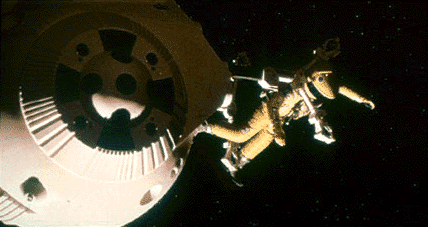
a rectangular monolith, impassive, enigmatic, black: The central image of "2001: A Space Odyssey" is a symbol chosen to be evocative but reticent. Biblical tablet? Giant microchip? Interdimensional gateway? Whatever it is, you will talk about it as you leave the theater. "2001" is beloved for many different reasons, including its scrupulous scientific accuracy, its vast reach from "The Dawn of Man" to the next stage of human evolution, its unrivaled integration of musical and visual composition, its daring paucity of dialogue and washes of silence, its astonishingly creative psychedelic sequence and its still-gorgeous pre-digital special effects. As predictive futurism, to be sure, "2001" is pretty spotty. Attention has been focused this year on the film's vision of the HAL 9000 computer; HAL supposedly went online in January 1997, and that has been enough, in this computer-obsessed era, to inspire magazine covers and scholarly conferences noting how little "2001" got "right." As our calendars race toward the film's date, we also note that our steps into outer space have been far more timid than "2001" imagined. At best, the film's predictions remind us that the future never unfolds as we dream it. Predictions, fortunately, are the least interesting and most disposable aspect of "2001." The chief reason the movie still holds -- no, demands -- our attention, long after a million bad science-fiction epics have deservedly faded from memory, is its respect for its own mystery. Its vision of what science-fiction authors call "first contact," the first brush of Homo sapiens with some other intelligent species, remains disturbingly and enticingly spectral. There are no bug-eyed monsters here, just profound questions to ponder. "2001's" ambiguities are not, as is so often the case today, a by-product of sloppiness or last-minute editing-by-committee; they are a deliberate choice, a preference for open-ended speculation over the pat satisfactions of tying up loose ends. Do the monoliths actually spark the stages of human evolution, or simply witness them or beam information about them back to its alien creators? Why does the supercomputer HAL turn on its human companions? What exactly happens to astronaut Dave Bowman on Jupiter? And what does the apparition of the fetal "Star Child," floating in space at the film's finale, portend? "2001" is stubbornly -- and, to some, distressingly -- unwilling to spell out its secrets. |
