1.1 A common definition of "dialect"
1.2 History and concepts
1.3 Gathering language data
1.3.1 Selecting informants
1.3.2 Receiving language samples from the informants
1.4 The graphical representation of fieldwork data
2. The development of the dialects of American English
2.1 The history of American English
2.2 Influences that form a regional dialect
2.3 The uniformity of American English
2.4 Major divisions of American English
2.4.1 The East-West division
2.4.2 The North-South division
2.5 The relation between linguistic and settlement patterns in the U.S.
3. Northern dialects
3.1 General northern features
3.2 New England
3.2.1 Settlement and history
3.2.2 Features
3.3 New York and the Hudson Valley
3.3.1 Settlement and history
3.3.2 Features
3.4 Inland Northern
3.4.1 Settlement and history
3.4.2 Features
3.5 North Midland
3.5.1 Settlement and history
3.5.2 Features
4. Southern dialects
4.1 Characteristics of Southern speech
4.2 South Midland
4.2.1 Settlement and history
4.2.2 Features
4.3 Southern
4.3.1 Settlement and history
4.3.2 Features
4.4 Black English
5. The future of American regional dialects
Appendix A: Bibliography
Appendix B: Maps
1.1 A common definition of "dialect"
The "Oxford Advanced Learner’s Dictionary" defines "dialect" as follows:
"The form of a language used in a part of a country or by a class
of people with grammar, words and pronunciation, that may be
different from other forms of the same language."
This definition already contains a basic description of a dialect in terms of its features (i.e. characteristics like grammar and vocabulary) and is obviously sufficient for a common, non-scientific use, but for the scientific treatment of language varieties some elements of this definition need to be considered in greater detail.
Raven I. McDavid, Jr. presents a definition of "dialect" which basically goes along with Crowther’s definition but points out some important details more precisely: according to McDavid a dialect is "a variety of language, regional or social, set off (...) from other varieties by (...) features of pronunciation, grammar, or vocabulary". This definition stresses the difference between regional and social dialects which is crucial for the choice of the techniques that are used to determine the distribution of a dialect. Dialectology is therefore the practical implementation of the implications of this definition, as it deals with techniques to determine the regional or social distribution of a certain variety of a language. The section of dialectology which deals with regional dialects is called linguistic geography. Despite that it remains difficult to determine the difference between language and dialect: "it is often a debatable point as to where one should draw the line between dialect differences and language differences"
The roots of linguistic geography reach back to the end of the 19th century when this new technique was created by German linguists as a consequence of the innovations in Linguistics. Linguistic geography is therefore based on the assumption that, as Craig M. Carver puts it, "language is a material phenomenon (...) that can be observed and even collected". Its goal is to "determin(e) the regional (...) distribution of (...) differences" in grammar, pronunciation and vocabulary and to seek "historical and cultural explanations" for them.
Though McDavid considers phonetic geography a part of linguistic geography Carver states that "(t)he relationship between word and phonectic geography has never been fully explored" and that "this important question is left for future studies to answer". In fact, modern linguistic geography often combines research on vocabulary, grammar and pronounciation (see below) as there seems to be a relation between word and phonetic geography because lexical and phonetical regions coincide very well at least in the U.S.
The most important results of American dialectology are Hans Kurath’s research on the dialects of New England and the middle and south Atlantic states as well as the "Dictionary of American Regional English" (DARE). In 1929 the American Council of Learned Societies chose Hans Kurath to implement the concept of an "American Linguistic Atlas" which intended to provide maps covering all the dialects of the U.S. But due to fincancial limits this project was never completed, in some regions (like e.g. the north central states or the upper Midwest), however, linguistic research has been conducted by different investigators in basically the same way, so its results were comparable. Only in 1970 the DARE-crew managed to create a complete investigation of the American dialects which also had the advantage of utilizing the advances of dialectology that had been made since Kurath edited his works.
The DARE research delivered basically the same results as Kurath’s, even though some of the dialects had changed in the meantime (e.g. the Hudson Valley / Upstate New York dialect, see below), whereby the DARE data enables a much more precise coverage of the American dialects.
The basis of any research on dialects is the so called fieldwork, i.e. the gathering of language samples from the required area. Practically, this means finding an informant, i.e. someone, who gives information about his vocabulary, grammar, pronunciation, etc. and confronting him with a scheme which has been composed in order to figure out patterns of language that are peculiar to the particular region. Basically, fieldwork consists of the following two steps:
In this step a sufficient number of informants is selected. To make sure, that the selected informants reflect the population, great attention is paid to the well-balanced distribution of factors like sex, age, cultural and ethnic background, education etc. among the informants. Furthermore it is important that the informants are spread more or less even in the required area which implies the consideration of the population density. Apart from these factors the social, economic and political history of the informants’ home-region is also taken into account in order to provide a equal representation of all kinds of settlements.
A special problem of linguistic geography in the U.S. is the size of the country and the necessarily huge number of informants. This problem was also the main obstacle for Kurath’s works whereas the DARE research team could use computers to evaluate their data.
1.3.2 Receiving language samples from the informants
The most common method is sending a trained investigator or fieldworker to the informant. The fieldworker works on the basis of a prepared set of questions and tasks like e.g. giving synonyms for standard expressions or filling gaps in texts which are designed to deliver an image of the particular language of a region. The further part of this method has undergone significant changes during the last few decades. In the 1930s Kurath applied a non-fixed scheme whose implementation was left to the fieldworker whereas the DARE investigators used a well-elaborated questionnaire which had to be completed by the informant.
In addition to that often research on phonology and grammar is conducted, so the fieldworker tries to receive language samples which derive from a situation similar to a conversation. For Kurath’s team this invoked problems in noting the results, because at that time no tape recorders were available, so the fieldworker had to write down his impressions in a special phonetic alphabet.
1.4 The graphical representation of fieldwork data
The basic assumption behind drawing dialect-maps is that a dialect region shares a certain set of features, especially a lexicon, i.e. a particular vocabulary. The basic concept of mapping dialects is to draw an isogloss, i.e. a line around an area where a certain feature appears more often than in its adjacent areas. Therefore the number of encounters of all the features given by the informants are charted on a map of the investigated area. When the isoglosses of a certain set of features coincide this area can be confined by a boundary or dialect boundary. According to McDavid, a dialect area includes different types of isoglosses:
phonemic system; differences in the incidence of the phonemes; differences
in the incidence of allomorphs (...); differences in the pronounciation of the
phonemes; differences in the morphemic system (...) and differences in the
incidence of particular vocabulary items"
Carver, however, points out some shortcomings of this technique, he particularly stresses that is not suitable for showing the fading change of a dialect because it relies on sharp lines. Instead he suggests two rather complicated techniques which focus on the participation of a certain area in a dialect. In addition to that Carver invents the term dialect layer for a lexical subregion of a dialect which is characterized by a certain set of lexical isoglosses and as a consequence of that he defines a dialect region as a composite of dialect layers. The traditional method (the so called bundle-method) is, however, still widespread and can also be found in Kurath’s standard works.
2. The development of the dialects of American English
Before examining the American dialects in detail it seems useful to take a closer look at the conditions for the spread of dialects in the U.S. as well as the influences that form a dialect should be considered. So the following parts present a brief overview of the history of American English and a theory about the roots of a regional dialect. In addition to that some major divisions of American English will be outlined.
2.1 The history of American English
From today’s point of view there are some obvious differences between American and British English which have been invoked by different factors. The first differences (chiefly in the vocabulary) appeared already before the Declaration of Independence when the first English settlers invented new words for things that were unknown to them, like e.g. animals that cannot be found in England. An important contribution to this process came from the languages of the Indians which already contained words for these new objects.
The most important period for the English language in America began after the American Revolution. The Americans then got aware of their new identity and, as Albert C. Baugh / Thomas Cable put it, an "ardent, sometimes belligerent patriotism sprang up, and (...) it became order of the day to demand an American civilization". The purpose of this movement was the separation from England in all parts of life, but especially in culture and language. There was in fact a strong desire to change the language and some people even thought about replacing English with another language, but due to the fact that in 1790 90 per cent of the Americans were descendants of English settlers English was maintained. As the language could not be replaced, people tried to modify it, the most important of them being Noah Webster (1758 - 1843). His first works were books on spelling, pronunciation and grammar, whereby the spelling book became a best-seller which temporarily was the second best-sold book in the U.S. His most important work which, however, gained less attention during his lifetime was "An American Dictionary of the English language" (1828). In this book he suggested a partially reformed ortography (e.g. dropping the u in words like honour). Besides that Webster is also said to have influenced the American pronunciation by introducing modified pronunciation rules which e.g. intended to give "fuller value to the unaccented syllables". So a major part of today’s differences between American and British English is owed to Webster’s work.
An important effect also shows as far as pronunciation is concerned. Examples are the so called "broad a" which was only maintained in New England and the South and was characteristic for South England dialects in the 18th century. Besides that the omission of the r which also derives from southern England has survived only in roughly the same parts of the U.S. As a result of close connections between the northeast and southeast of the U.S. and England the speech of these regions is traditionally closer to British English than the rest of the U.S.
2.2 Influences that form a regional dialect
There are some factors that decisevely determine the evolution of a regional dialect: McDavid e.g. mentions as the most prominent of them the settlement patterns in a certain region. Baugh / Cable also support this idea and consider it therefore "the most plausible attempt" to study "the districts in England from where the earliest settlers came" in order to figure out the origins of the American regional dialects. Carver mentions this point as well, calling it "relocation diffusion", i.e. people bring their culture (or language resp.) from a center to its adjacent areas. Moreover he employs a rather complex model of settlement to figure out the importance of pioneering.
In addition to that the routes of migrations and settler-trails play an important role. As different groups of settlers moved westward, they brought their forms of speech with them and depending on their numeric importance their dialect had a more or less important influence on the language of the new colony. McDavid presents the example of the Great Lakes-states where a difference between the areas settled from Pennsylvania and those settled from New York can be perceived. Also Baugh / Cable go along with this idea by emphasizing the value of the "spread of the early form of Virginia speech in the southern states" and the Scotch-Irish form of English which crucially determined the speech of the of the West.
As another crucial aspect McDavid explains the importance of geographical shapes by stressing the lack of communication and interaction which appears when towns or villages have to cope with physical barriers like e.g. mountains or deserts. So due to the reduced interchange different forms of culture and also language arise. Also in Carver’s view the physiography of a region determines settlement patterns as well as the settlers’ habits and creates therefore different economies and societies which develop their own variations of language. This becomes particularly obvious in the South of the U.S. which is divided in a coastal and a mountain part (see below).
Moreover, McDavid writes that cultural centers significantly influence the speech of their surrounding areas by having a dominant political, social or economical position. Carver fits close to this by presenting the concept of a nodal or functional region, i.e. a region "based (...) on the interaction between a centre (...) and a surrounding hinterland". As examples he mentions the "five coastal centers from which most American dialects developed": Boston, Philadelphia, Virginia, Charleston, New Orleans (see below).
2.3 The uniformity of American English
As McDavid states, "dialect differences in American English are relatively small" compared to those in European countries like e.g. Italy or France. Also Robert McCrum / William Cran / Robert MacNeil write that "(n)o one disputes (...) the remarkable uniformity of much American speech" and add that "there (is) nothing like the patchwork of local variations known in Britain". There are different reasons for this phenomenon: Baugh / Cable argue that when North America was settled there was "a constant mingling of settlers from one part with settlers from other parts". As settlement is one of the most important factors in the history of a dialect (cf. 2.2), it is evident that as a consequence of this circumstance no sharp language differences could emerge because a more or less standardized English was necessary to enable a working communication between the settlers who came from all over Europe and all parts of Great Britain resp. According to Baugh / Cable even nowadays mobility is a characteristic of the American society: "(t)he merging of regional differences (...) has been promoted (...) by a certain mobility that characterizes the American people". In addition to that there have been some, partially peculiarly American, factors that prevented a situation like in Europe. As the most prominent of these influences Baugh / Cable mention Noah Websters work on a standardized American variation of the English language (cf. 2.1) and what they call the "American instinct of conformity" i.e. the constant attempt to standardize great parts of public life.
Baugh / Cable in fact also concede some minor exceptions to this uniformity in New England and the South (cf. 2.1), but they are not really significant so they call them "variations" of American English instead of "defections from the general standard".
2.4 Major divisions of American English
As far as dialects are concerned, the whole area west of the Mississippi Valley states is actually the most faint and unexplored part of the U.S. There are several reasons for this, the most important being settlement: in contrast to the eastern states, settlement in the West is not yet concluded but still in progress and as a consequence of that western dialects (as far as they can be perceived) are not yet as well-developed as eastern speech is but still emerging and intervening. In addition to that there have been strikingly different settlement patterns in the West: due to the rugged terrain and the many desert-like areas settlement was not cohesive as in the east but little "islands", usually without hinterland emerged. Besides that the streams of settlers did not follow clear ways, but, as McDavid writes, "(t)he streams of Yankee and South Midland migration crossed and recrossed". This circumstance furtherly blured western dialect boundaries. As a consequence of the fact that settlers from the Inland Northern and North Midland areas dominated among the western settlers a general preponderance of northern features can, however, be assumed.
Another problem for linguistic geography in the West is that there are only few surveys covering Western speech. Even the DARE-research was sporadic, investigating only very few communities in some of the western states.
Despite that, a fundamental division is, however, possible whereby this distinction is mostly based on relatively few lexical features since pronunciation and grammar are practically equal in the whole West. According to Carver, the West can be divided in three major subareas: the Northwest including mainly Oregon and Washington, northern California and the Southwest reaching from southern California to Texas. The northwest is actually the most distinct western region because its was mostly settled by colonists from the Great Lakes region as well as it is connected to the Midwest by strong Scandinavian immigration. The Southwest is unified chiefly by the strong influence of Spanish rule which left a lot of traces in the region’s speech, e.g words like buckaroo (ranch, Spanish vaquero), wrangler (cowboy, Spanish caballerango) or lasso (Spanish lazo) remained though many of them are receding nowadays. In contrast to that, northern California received a great mixture of settlers during the Gold Rush which helped to establish two major factors dividing northern from southern California: there are two different lexicons, probably as a result of the various settlement of the north, and in addition to that almost no Spanish influence can be found in northern California.
There have been several attempts to deal with the dialects of the West, one of them being the idea of a so called "General American" speech. This idea which is suggested by Baugh / Cable and McCrum / Cran / MacNeil is based on the almost equal pronunciation all over the West but ignores lexical differences that, as shown above, exist. Therefore this concept seems to be only little plausible and needs to be replaced by a more precise investigation of the Western dialects which remains to be conducted.
As a result of the circumstances described above, in the following chapters most effort will be put in describing the settlement of the American east coast because, according to McDavid, "(t)he dialect areas (...) are most sharply defined along the Atlantic Coast, where settlement was earliest and patterns have had longest to become stabilized".
2.4.2 The North-South division
The result of Kurath’s work was the division of the U.S. in five major dialect areas: Inland Northern, Eastern New England, North Midland, South Midland and Southern (cf. map 1) whereby he assumed a general threefold division in Northern, Midland and Southern dialects. As a consequence of that there was a discussion among dialectologists whether the Midland dialect which was assumed by Kurath as he introduced the names North and South Midland really exists, after the opinion appeared that North Midland should be regarded as a relative of the northern dialects whereas South Midland rather belongs to the southern dialect region. In contrast to Kurath who assumed a well-defined and distinct Midland Dialect, Carver prefers the division in a northern and a southern half, regarding the Midland dialect only a faintly defined layer. Carver’s most important argument is a general split of the streams of settlers in the early history of the U.S.: "To a great extent, the linguistic divide is a result of two broad streams of migration during the westward expansion of the United States". In contrast to that Kurath was of the opinion, that "(t)he common notion of a linguistic (boundary) separating ‘Northern’ from ‘Southern’ speech is simply due to an erroneous inference from an oversimplified version of the political history of the nineteenth century". As Kurath mainly refers to a political division, Carver’s assumption seems more elaborate, because he furthermore mentions an ethnic division which ocurred after the South received only few new settlers after the pioneer-time. In addition to that he points out the different economic development which was mainly invoked by the southern tendency to agriculture. As a result of that Carver points out that the South is clearly distinguished from the North by two major layers which partially overlap each other and whose outer boundaries confine the southern dialects. Practically, Carver’s boundary of the South coin cides very well with the northern and western boundary of Kurath’s South Midland dialect, i.e. it does not extend to the Far West but ends somewhere in central Texas.
But even though the are different opinions as far as the names are concerned, no one really doubts that the North and South Midland (or Lower North and Upper South, as Carver calls them) dialects exist and have their own characteristic set of features. So the discussion was mainly about the origin of the features and the general cultural classification but did never question the existence of two separate dialects.
Here the names which Kurath introduced will be used, because they are more common and used more often in literature.
2.5 The relation between linguistic and settlement patterns in the U.S.
According to Baugh / Cable, the first period of immigration to the U.S is commonly regarded as the most important, because it shaped the cultural and linguistic patterns that later arriving settlers had to assimilate to, or as Carver puts it, after the arrival of the first settlers "(t)he basic cultural features were in place and would persist unaltered by the arrival of newcomers" At the east coast where the earliest settlements were made this period ended, according to Baugh / Cable, approximately in 1790. As chapter 2.2 showed the most important force that forms the dialect of a certain area is its settlement which is again influenced by the region’s physiography. Therefore the follwing chapters will present a brief overview of the history and settlement of the American dialect regions as well as an outline of the typical features of their speech.
According to McDavid there is a basic set of features, which is applies to all Nothern dialects, i.e. Eastern New England, New York and Inland Northern. They are not all distributed homogeneously, but apart from a few exceptions in the Inland Northern dialect where some of these features are disappearing or at least receding all of them can be found in the northern dialects.
According to McDavid and Carroll E. Reed, a general feature of Northern dialects is the different pronunciation of single vowels like o and diphtongs like ou, e.g in words like morning and mourning or fourteen and forty which are therefore phonetically distinguished. Another northern peculiarity is the conversion of e in unaccented syllables to some kind of i, which makes stretched sound like stretchid or useless like useliss. These features go along with the pronunciation of a unvoiced s in words like cease or ease. In addition to that because is quite often pronounced like becuhse.
According to Reed there is also a set of typical northern grammar, e.g are irregular preterits like dove (dive), see (saw), clim (climbed) or begin (began) quite common. Another peculiarity is the use of to be as a finite verb: in northern dialects phrases like "How be you?" (How are you) or "Be I going to?" (Am I going to) are no exception, since (to) be can be used as a synonym for some of its forms.
3.2.1 Settlement and history
The first settlers came to New England in the first half of the 17th century and founded the first colonies around the Massachusetts Bay area and in the Connecticut River Valley. Settlement in the Massachusetts Bay area mainly gravitated to Boston whereas the Connecticut River Valley colony had no clear center. In the latter half of the 17th century these two colonies expanded northward and intermingled as the streams of settlers crossed in the northern section of New England. In contrast to that Rhode Island was settled chiefly by English dissenters and was therefore no source for the setlement of other areas.
According to Baugh / Cable "practically all of the early colonists came from England", particularly from the southeastern counties of England. These settlers brought the language of their home-region to the colonies and therefore New England speech was shaped by the English spoken in southeastern England at that time. The settlers also brought a lot of farming, fishing and shippping expressions, which influenced the New England dialect, since these branches played an important role in southeastern England.
3.2.2 Features
A typical peculiarity of new England speech is that words like new or due are pronounced like noo and doo, resp., instead of nyu and dyu, resp. In addition to that Reed states that in New England there is a special pronounciation of words like moral or forest which are pronounced with some kind of uh diphtong, i.e. moral would be pronounced like muhral whereas forest would sound like fuhrest. According to Baugh / Cable and McDavid New England speakers furthermore pronounce a short o in words like hot or top, i.e. these words actually sound as they are spelled whereas other Americans would pronounce uh, i.e. top would sound like tuhp. Besides that people from New England still use the archaic broad a in contrast to the flat a which is usual in the rest of the U.S. (cf. 2.2), i.e. words like path or fast sound like puth or fuhst. This is due to the fact that colonists from the southern counties of England were preponderant among the settlers of New England, because the broad a is a feature from southern England. The probably best known New England feature is, however, the pronunciation of r: before consonants and at the end of words it is omited, e.g. in words like car, four or park, on the other hand the so called linking or intrusive r is added in order to link vowels together, e.g. in terms like "an idear of it".
As mentioned in 3.2.1 the New England dialect contains a lot of shipping expressions, e.g. bulkhead, which was originally a word for a door that separates compartments on a ship but is meanwhile used for a door in the basement. Another example of this kind is the term open day for a cloudless day, which derives from the shiping language where it meant a day without storms. Examples for farming words are e.g. pung (a sleigh which was used for transport), webbing (rein), top cow (bull) or witch grass (weed). Another very common expression in New England is vum for yes, which probably derives from "I vow".
3.3 New York and the Hudson Valley
The first Dutch settlers came to New York which was originally a Dutch colony approximately in 1614, but they were soon outnumbered by colonists from New England, after the English had seized the colony in 1664. The first settlers from New England arrived at Long Island in 1640, in the 1740s they had settled the area east of the Hudson River. At the same time there were also important Dutch, German and Ulster-Scots colonies. After the war with the French in 1763 northern New York was opened up and settlers settlers chiefly from Vermont and Massachusetts arrived there. In the latter half of the 18th century there were two main streams of settlers from New England: the first one followed the Hudson Valley northward to the area of Albany, whereas the second one moved westward to the mostly unsettled Genesee Valley in the Great Lakes region. So one can presume that this great variety of settlement influences invoked a speech, which was, despite the large number of settlers from New England different from the New England dialect, or as Carver puts it, "(e)ach of these broad colonial cultural regions left its imprint (...) on the linguistic regions of New York".
3.3.2 Features
At Kurath’s time there was a discussion whether the state of New York was a separate dialect area, today, however, most of the dialectologists agree, that at least at that time it was, or as Carver writes, "(t)hat the region (...) exists seems assured" even though it has undergone significant changes since Kurath conducted his research in the latter half of the 1940s. It is therefore first of all important to distinguish New York from New England as far as its dialect is concerned. Even though the state of New York was settled chiefly from New England it has in fact a considerable set of shared features but on the other hand some peculiarites emerged which justify the treatment as a separate dialect. According to McDavid the region’s features can, however, be perceived most clearly in New York City and its surroundings.
Two features which definetely hint to the New England origin are the omission of r before consonants, e.g. in words like card or park and the pronunciation of words carry or dairy which are sound like cehry and dehry, resp. In contrast to that the predominance of unrounded vowels in words like hot, top or borrow which makes them sound like huht, tuhp or buhrrow is a clear difference since these words would be pronounced with a short o in New England.
The best-known feature of New York speech is probably the pronunciation of vowels before r which makes words like third or curl sound like thoid and coil resp. Another feature is the lengthened flat a in words like can as well as a lengthened o occurs in words like lawn which makes it sound like lohn. Furthermore words like morning and mourning or horse and hoarse are homonymes in New York speech which sets it in contrast to most of the northern dialects.
The settlement of the Inland Northern area began in the 1660s with a few settlers from New England arriving in northern New Jersey, in the first half of the 19th century New Englanders and New Yorkers settled the northernmost strip of Pennsylvania. After the living conditions in New England had worsened at the end of the 18th century, some New Englanders went westward to northeastern Ohio. Avoiding great parts of Indiana because of its bad soil and high land prices, the settlers later moved to Michigan and northern Illinois. In the 1830s a wave of migration started in New England, but in contrast to the past settlers now bulked in Michigan and northern Illinois, because the way there had become much easier by the opening of the Erie Canal in 1825. So Michigan was settled densly until 1850 and northern Illinois received a great influx of settlers from New England who arrived via Michigan. In the middle of the 19th century a wave of New Englanders moved to Wisconsin from northern Illinois. Minnesota, however, was only sparsely settled before 1850 and during the 1850s many New Englanders moved to its eastern section from Wisconsin and Illinois. During the 1850s a few settlers from Minnesota and Nebraska came to the Daktotas, but only in the 1870s a larger number of settlers arrived from the western South Midland area and therefore brought South Midland influence to these states.
As a result of the large number of New Englanders particularly in the eastern parts of the Inland Northern area a preliminary preponderance of New Englanders emerged, or as McDavid puts it, "by and large, the earliest settlements in Michigan and Wisconsin and the northernmost strip of Ohio, Indiana, and Illinois was Yankee". This dominance receded in the middle of the 19th century when a huge number of Germans (according to Baugh / Cable approximately one and a half million) and Scandinavians came to the area between Wisconsin in the east and Oregon and Washington in the West, whereby German immigration was particularly stimulated by the failure of revolution in Germany in 1848. According to McDavid, these settlers came to this region mainly because of the climate and the prohibition of slavery which corresponeded with their moral ideas. This wave of migration had a significant influence on the structure of the population of this area since afterwards partially more than half of the population of a state was of German or Scandinavian origin (mainly in Wisconsin, Minnesota and the Dakotas).
3.4.2 Features
Carver figures out a layer which basically corresponds with Kurath’s results as shown in Baugh / Cable whereby Carver’s and Kurath’s results both exclude New England. This is in fact surprising, since New Englanders were one of the major groups among the early settlers of this region. To explain this, Carver stresses that the two dialects developed independently and therefore some features which have disappeared in New England are still current in Inland Northern and vice versa.
Carver’s Inland Northern again contains three sublayers, one in the east of the Inland Northern area as shown in map 1, which roughly corresponds with the Great Lakes region, a second one around Minnesota and a third one at the Pacific coast, including mainly Washington and Oregon (see also 2.4.1). Carver states, that this region, in contrast to the other dialect areas, becomes more distinct in the West: "lines of isogloss difference are clearer the farther West one goes. The (...) boundary is especially strong through Iowa, southern South Dakota, Montana, central Idaho and Oregon".
The Inland Northern dialect is, however, also characterized by a set of pronunciation features. A very important feature which, together with the pronunciation of r, clearly distinguishes the Inland Northern dialect from the New England dialect is the flat a in words like ask or path which would be pronounced with a broad a in New England. Besides that the r is, as mentioned above, not omitted, but fully pronounced even after vowels, e.g. in words like card or park. In addition to that "short o words" like hot or top are pronounced like huht or tuhp, which is also a significant difference between Inland Northern and New England. There is on the other hand a rather strange peculiarity, which, however, indicates New England influence: according to McDavid fog is pronounced like fuhg, whereas dog or log are pronounced with a short o like in New England. McDavid does, however, not offer any explanation or scheme for the distribution and cause of this feature.
In contrast to other American dialects Inland Northern contains relatively few grammar features, only the use of into and onto as synonymes for in and on, resp. seems to be a particular Inland Northern feature. On the other hand, some lexical evidence from Carver’s Inland Northern area can be given: pickle (cucumber), to run (to get hurt with something sharp), semi (a large trailer truck), skiff (slight snowfall), going down (decreasing wind) or pit (core of a fruit).
Since Pennsylvania was the most important hearth, i.e. origin, for the North Midland area as well as for the South Midland area, it seems useful to examine the history of its settlement in greater detail. Settlement in Pennsylvania actually spread from the southeast after the colony was founded at the end of the 17th century. There were three main groups of settlers in Pennsylvania, the earliest being English Quakers and others from northern England. From the first half of the 18th century on large numbers of Germans and Scotch-Irish arrived, whereby Germans and Scotch-Irish soon retired to the hinterland. As the Scotch-Irish who arrived one decade or so after the Germans found their desired territories occupied, they moved further west to the eastern edge of the Appalachians which obstructed further expansion. From approximately 1760 on the western part of Pennsylvania was settled mainly by Scotch-Irish, after 1790 southeastern and southwestern settlers moved to the northern part. Already in the 1740s Scotch-Irish had moved particularly to Virginia and North Carolina after these states had declared religious freedom (see below), after 1785, when the territory south of the Ohio River was opened by a treaty, many of them went to the South Midland area.
The early settlements in the rest of the North Midland area were established mainly by colonists from Kentucky, Tennesee, Virginia and North Carolina after the war of 1812, when the Indians had been defeated. After traffic ways had been improved in the first half of the 19th century, more settlers from Pennsylvania, particularly from the western counties, arrived. The settlement of Iowa began in the 1830s, when the settlers pushed westward into newly opened territories, whereas Missouri was also settled after the war of 1812, mainly from Kentucky, Tennessee and Illinois.
3.5.2 Features
Considering the lexical evidence, the North Midland dialect seems to be highly complex, since it was settled by three main groups of settlers. In fact it represents a mixture of northern and southern lexical features, whereby some kind of internal north-south boundary seems to appear, because southern features are particularly spread in the southern portions of Ohio, Indiana and Illinois. Since settlement from Pennsylvania almost outweighed other influences, northern features are, however, dominant. Due to the immigration from the South Midland area, South and North Midland share a considerable set of features which will be described in 4.2.2. On the other hand, the dialect becomes rapidly less distinct the further west on goes, i.e. west of Missouri and Iowa, where the features are already very faint, no clear perception is possible anymore.
As a result of the settlement from the Pennsylvania hearth, of course many traces of German and Scotch-Irish can be found in the dialect’s lexicon. In fact, there are many Germanisms, particularly in southeastern Pennsylvania: e.g. words like toot (sack), spook (ghost) or snits (dried fruit), but there are also German grammar features like something is all (gone). Examples for Scotch-Irish relics are e.g. piece (snack) or to redd up (to clean up), which is also common in the South.
As far as pronunciation is concerned, the great variety of this dialect becomes evident once more. McDavid even suggests separate pronunciation features for eastern and western Pennsylvania, which goes along with Carver, who refers to cultural subregions in Pennsylvania, but these differences are relatively small and besides that these subregions also share the general North Midland features. A typical North Midland pronunciation feature, which is also common in New England, is the pronunciation of new like noo or due like doo, furthermore no distinction is made between morning and mourning or horse and hoarse. Besides that one of the most prominent features of the North Midland dialect is the "American r, which is probably a result of the Scotch-Irish settlement since the Scotch-Irish are said to have brought this feature to the U.S. Another important feature is the flat a which appears most often in North Midland.
4.1 Characteristics of Southern speech
There are several factors, which make southern speech (i.e. the South Midland and Southern) which is, together with the New England dialect, the best-explored in the U.S. unique. The most important cause for this was definetely the relatively high degree of isolation in the southern states: as a result of the badly developed economy and traffic system and few urbanization the South, particularly the Southern Highlands (i.e. the South Midland area), received almost no new settlers after the pioneer-time, or as Carver puts it "(a)fter the first effective settlements, the South received very few foreign immigrants". This promoted the conservation of archaic features as well as close relations to England, particularly in the Coastal South, made, like in New England, typical south English features (e.g. the omitted r) survive. In fact lexical evidence that reaches back to the Elizabethan age can be found, showing the lack of innovation in this region. Basically, most of these (particularly lexical) features were common in the whole country when the early settlers arrived, but nowadays most of these features have disappeared in the rest of the U.S., except the South: "Generally speaking, then, the lexicon (...) tends to be old (...) and maintaining many terms that (...) were once widely used but have died out everywhere but in the South". As a result of this isolation, settlers from the Coastal South participated relatively few in the westward movement whereas South Midland settlers were more flexible.
There is, however, also a set of pronunciation and grammar features which applies to the whole southern speech region, as Carver defines it (cf. 2.4.2): one of the most significant features of southern dialects is the pronunciation of ue and uw like yoo, i.e. new becomes nyoo and due is pronounced like dyoo. Furthermore oa and ou are phonetically distinguished from a single o, e.g. are morning and mourning as well as horse and hoarse are pronounced differently. The pronunciation of the diphtong ou before voiced consonants is somewhat different since it is in this case rather pronounced like uh, i.e. out becomes uht or mountain is pronounced like muhntain. Additionally a stressed i is pronounced like uh, e.g. in words like five or my which therefore would sound like fuhve or muh. On the other hand o is pronounced if the following consonant is unstressed, e.g. poor is pronounced like pohr or your like yohr.
In contrast to the northern dialects, which contain relatively few grammar features, southern dialects are full of grammatical peculiarities. So a very common feature is the replacement of you (second person plural) by you all. This is one of the best-knwon features of southern speech, which northerners often make fun of. In addition to that the southern dialects are to a even larger extent than the New England dialect full of irregular verb forms, like e.g. seed (saw), holp (helped), riz (rose) or mought (might). Carver explains this with the generally low education and the rural structure of the South. Furthermore sentences like I’ve done told you or Germanisms like I might could can be found in the South.
Since Scotch-Irish, Germans and the settlers from Virginia and North Carolina who were, according to Baugh / Cable, mainly of south English origin were the largest groups of settlers (see below), they have of course left traces in southern speech. The Scotch-Irish shaped particularly the farming related speech of the South, because they were the majority among the southern farmers, in fact a lot of lexical traces of Scotch-Irish and English dialects as well as German words can be found in southern speech: "the (southern) lexicon (...) is replete with words of Scotch-Irish and English dialect origin". Examples for Scotch-Irish terms referring to rural life are e.g. poor (weak, when referring to animals), to back (to adress a letter) or hant (ghost). Besides that some general relics of Scotch-Irish dialect can be found, particularly in the South Midland dialect, e.g. fornent (near to), scoot (to move sth.) or redd (to clean up). Traces of English dialect are e.g. gozzle (throat) or shackly (unsteady). Besides that also some German expressions, like e.g. hot potato salad or spatzie (sparrow) can be found, particularly in the South Midland dialect. Typical examples for archaic expressions are e.g free-hearted (generous) or kin(s)folk, which still have the meaning they had 500 years ago.
The hearths of the South Midland area were mainly Pennsylvania and Virginia, from where most of the settlers of this region came. Before 1730 a few settlers from Virginia and North Carolina moved westward to the eastern edge of the southern Appalachians, because the soil of their plantations got exhausted and they were looking for new farming land. From 1730 to 1740 two other groups of settlers arrived: the first group were Germans from eastern Pennsylvania who moved to the valleys in the south of the Appalachians, the other group were Scotch-Irish who also came from Pennsylvania and moved to the south Appalachian valleys of Virginia and North Carolina as well as to the eastern edge of the Appalachians in the Carolinas. By 1760 the southern Appalachains were profoundly settled mainly by Germans and Scotch-Irish when settlers from Virginia and North Carolina who were looking for new land poured into Kentucky and eastern Tennessee. In 1790 great parts of the south bank of the Ohio River, Kentucky and Tennessee were settled. Arkansas and the Ozark Highlands were settled mostly by settlers from Tennessee, from there settlers continued to move to Oklahoma and central Texas.
4.2.2 Features
In general, the South Midland dialect is more homogenous and unified than the speech of the Coastal South, because it originated mainly from one hearth region in Pennsylvania and Virginia. Another difference is the preponderance of Scotch-Irish settlers in the South-Midland area, which made their influence even stronger there. But besides these obvious reasons, there are some other aspects, which distinguish the Mountain South from the Coastal South: as a consequence of the bad soil and the analogously different economy the Mountain South attracted even fewer new settlers than the Coastal South and became therefore isolated in the South itself. This can particularly be seen in the lexicon of this region since it contains a lot of expressions from Pennsylvania and Virginia, which have died out even in the Southern dialect. Besides that the Mountain has practically no features of British English which brought some differences, e.g. in the pronunciation of the r, which resembles rather to North Midland, whereas the coastal pronunciation is quite different.
Due to the fact that Texas and Oklahoma were settled late and settlers from the South Midland area intermingled with others from the Southern states, the features of South Midland can in fact be perceived there, but they are not as distinct and clear as in Kentucky, Tennessee or West Virginia.
There is, however, an important set of features, which South Midland shares with North Midland, the most prominent of them being the pronunciation of the r. In the North and South Midland dialect the r is fully pronounced, whereas it is often omitted in the Coastal South. There were probably two main forces that formed this feature: on the one hand Scotch-Irish were dominant in the Mountain South, on the other hand the speech of the Coastal South was influenced by southern English dialects, which treated the r differently (see above). Besides that o and a are in both South and North Midland almost equally pronounced like oh or o resp.: e.g. wash sounds like wosh whereas fog is actually pronounced as it is spelled. Another coincidence with North Midland which, however, creates a sharp contrast between South Midland and Southern is the absence of the "Southern drawl" (see below) in the South Midland dialect, i.e. Mary sounds like Mehry or dairy is pronounced like dehry. Furthermore unstressed final syllables like -ed or -ess, e.g. in words like stretched, haunted or useless are, as in North Midland, basically pronounced as they are spelled.
There are, however, relatively few grammar features which are peculiar to the South Midland dialect, the most prominent of them being irregular possesives like ourn (ours) or yourn (yours) and the widespread irregular preterites, as mentioned in 4.1.
In addition to that there are relatively few lexical features which separate South Midland from Southern. There are in fact layers distinguishing South Midland from Southern which are, however, relatively faint and receding, but despite that clear enough to figure out boundaries. Typical South Midland expressions are e.g. hidy (hello), to feel (to examine sth. by touching it), cuss-fight (argument) or the universal use of ever, e.g. in everwhere, everway etc.
Since there was, as mentioned above, practically no slavery in this area except a small strip along the Mississippi River, there were almost no blacks and Black English had only few influence on South Midland speech, which clearly distinguishes it from the Southern dialect: "the fact that the (South Midland area) has always had a very small black population, sets it in contrast perhaps more than any other factor" to the Coastal South.
The area of today’s Southern dialect had three hearths: the tidewater district of Virginia with its center Jamestown, the adjacent areas of Charleston, South Carolina and the vicinities of New Orleans, Louisiana, whereby the latter one contributed least to the settlement of this area. Since the population of the Southern dialect area therefore consists of a lot of different groups of settlers, Carver calls the Southern dialect "a patchwork of dialects".
The settlement in the Virginia tidewater district began in 1607 with the founding of Jamestown, Virginia. Soon this area was peopled by a "miscellanious group of adventurers from all parts of England", i.e. settlers from all social levels with different religious attitudes, whereby, according to Baugh / Cable, a majority of them came from the eastern counties of England. Later these settlements extended southward to North Carolina, whereby all these colonies remained close to the coast. As mentioned above there were also German and Scotch-Irish settlers from Pennsylvania in Virginia and North Carolina.
The second important hearth, the area of Charleston, South Carolina, was founded approximately in 1670 and soon became the economic and cultural center of the costal area from North Carolina to Georgia. The population of this area was much more heterogeneous since it consisted of French who fled from their country because of religious persecution, English dissenters, some Dutch from the New York area and the Netherlands as well as Baptists from Massachusetts. After the Indians had been dispossessed, the settlers moved to eastern Georgia and some years later to Alabama.
The third nucleus, New Orleans, which was founded in 1717 by the French, had only few influence on the Southern dialect. Before the Spanish seized the colony in 1766 it was only sparsely settled, after the seizure, however, many settlers from Nova Scotia and the English colonies joined the colony as well as many blacks were imported. Eventually, many angloamericans poured into the area after the Louisiana Purchase in 1803.
Soon after the arrival of the first settlers the South was dependent on agriculture since the climate was quite suitable for growing crops. This plantation-system later promoted the development of slavery and invoked the import of large numbers of black slaves from Africa. This aspect played an important role for the South since the importation of blacks invoked the spread of Black English mainly along the southern seaboard.
4.3.2 Features
Since the Southern dialect is besides North Midland the least homgeneous and most complex dialect, it consists of a set of general features as well as some major sub-regions. Carver actually figured out four major layers whose composite fits close to Kurath’s Southern dialect. One of these layers which is, however, of minor importance, is situated in Louisiana, the more important so called Atlantic South region surrounding the settlement hearths of Jamestown and Charleston. The speech of this portion of the South shares a lot of features with New England since the early American colonies which were presumably linguistically homogenous were later divided by the strong foreign immigration to the eastern North Midland states. This relation is, however, getting more faint, because New England turned out to be more innovative whereas the South remained mostly conservative (cf. 4.1). As a consequence of that and the close contact between the South and England (cf. 2.1, 4.1), some English features persisted in the Southern dialect. A typical example is the treatment of the r: as in New England, it is usually omitted before consonants, i.e. park is pronounced like pahk or card like cahd. There is also the pronunciation of haunted like hauntid, which can be found in the north as well. Analogous to that syllables like el or ain are pronounced like il or in resp., which makes towel sound like towil and mountain like mountin, a feature which can also be found in New England.
Besides that there is also a certain relation to Pennsylvania which becomes particularly evident by some Germanisms which were brought to the South by Germans settlers: e.g. the southern term outen derives probably from German ausmachen as well as stump (cigar butt) is of German origin.
Despite these peculiarities there is also a set of features which applies to the whole Southern dialect: e.g. the pronunciation of the diphtong ea since words like seat or beat are pronounced like seyt or beyt resp. But the probably most prominent feature of southern dialects is the so called "Southern drawl", which means the addition of i or y where it does not belong. So words like to dare are pronounced like daire and as a consequence of that there and their become actually homonymes.
According to McDavid and Carver, this Atlantic South region can again be split in two major subregions, the Virginia piedmont and eastern North Carolina subdialects, whereby the eastern North Carolina subdialect includes the southeastern portion of Virginia, eastern North Carolina and northeastern South Carolina whereas the Virginia piedmont dialect is confined to northeastern Virginia. The Virginia piedmont subdialect is mainly characterized by two distinctions as far as the pronunciation of vowels is concerned, so the diphtong ou is pronounced like aw before voiceless consonants, e.g. out sounds like awt, whereas o before voiced consonants is pronounced like ah, e.g. down sounds like duhn or proud like pruhd. The second important pronunciation feature is the distinction of i: before voiceless consonants it is pronounced like ay, e.g. twice sounds like twayce, whereas before voiced consonants it is pronounced like ey, e.g. time sounds like teyme which comes close to the standard pronunciation. Besides that there are no particular grammar or vocabulary features, which would differ from the general features of the Southern dialect.
The most prominent feature of the eastern Carolina subdialect is the pronunciation of i before voiced vowels like oih, so e.g. bird sounds like boihd. Besides that the o in words like top or hot is usually pronounced like in the o in morning. This feauture can also be found in New England and indicates the south English influence on southern language. Another peculiarity is the pronunciation of the th in with or similar words like the th in both as well as the pronunciation of a like eh, e.g in calm.
Besides that the Southern dialect contains some more subialects which are, however, less important. Examples are e.g. the subdialects in Alabama or Florida. These differences are commonly the result of different settlement patterns, e.g. Alabama remained for a long time unsettled because hostile Indians threatended the settlers.
A very important factor which shaped southern speech was definetely Black English (cf. 4.4), or as Carver puts it "(i)ts impact on the distinctiveness of (southern) speech is considerable". As a result of the slave importation there was a considerable number of them in the Coastal South and therefore there was always close contact between the slaves and the white population. Today southern speech contains many traces of Black English, e.g. words like pinder (peanut), cooter (turtle) or tote (to carry).
In contrast to the dialects mentioned so far, Black English is no regional, but a social dialect (cf. 1.2) which is, however, mostly confined to the Coastal South as a result of the strong slave importation which was a consequence of the southern economy (cf. 4.3.1). In the latter half of the 20th century Black English has spread to some major northern cities, as many blacks from the South moved there.
Black English developed from the so called Pidgin English, a simplified form of English with many West African features. Pidgin English developed as a way of communication between the slave-holders and the slaves but also spread among the slaves themselves since they came from different African regions with different languages. Later so called creole dialects developed from Pidgin English, the most prominent of them being the still existing Gullah dialect in South Carolina and Georgia. Eventually, the development of Black English was supported by the social isolation of the blacks but despite that the creole dialects are constantly assimilating to standard English.
Baugh / Cable mention a set of features which underline the differences between standard English and Black English:
"the absence of the copula, the use of the auxiliary be for expressing
durative aspect, the absence of infliction for the possessive, and the
failure of agreement (...) of verbs in the present tense third person singular."
5. The future of American regional dialects
Considering the high degree of moblity of the American society and the generally less idstinct dialect areas in the U.S. one might tend to presume that the American regional dialects will sooner or later disappear or at least become relics limited to small reservations. Furthermore, an increasing importance of social dialects seems to be unevitable, since the the importance of the the home-region is decreasing compared to the social group (be it ethnic or income-based) someone belongs to.
In this context D.W. Meinig’s theory of cultural geography is an interesting point. This theory explains the emergence of regional cultures in four steps, the fourth (after first settlement, political unity and economic growth) being the "metropolitanization". This period is characterized by the "dissolution of historic regional cultures", implying the disappearance of regional dialects.
As this phenomenon has not been observed yet, Carver suggests another interpretation of this idea:
"It also happens in the fourth phase of this (i.e. Meinig’s) model that new
innovative centers emerge with a new awareness of the values of local
culture and environment. These may be the future nodes for linguistic
innovation, from which new regional dialects will develop"
This interpretation seems, however, more likely since dialects and regional speech are changing things which reflect the circumstances and innovations of their environment. In fact, one can conclude that regional dialects are likely to change and maybe reorder but not to disappear.
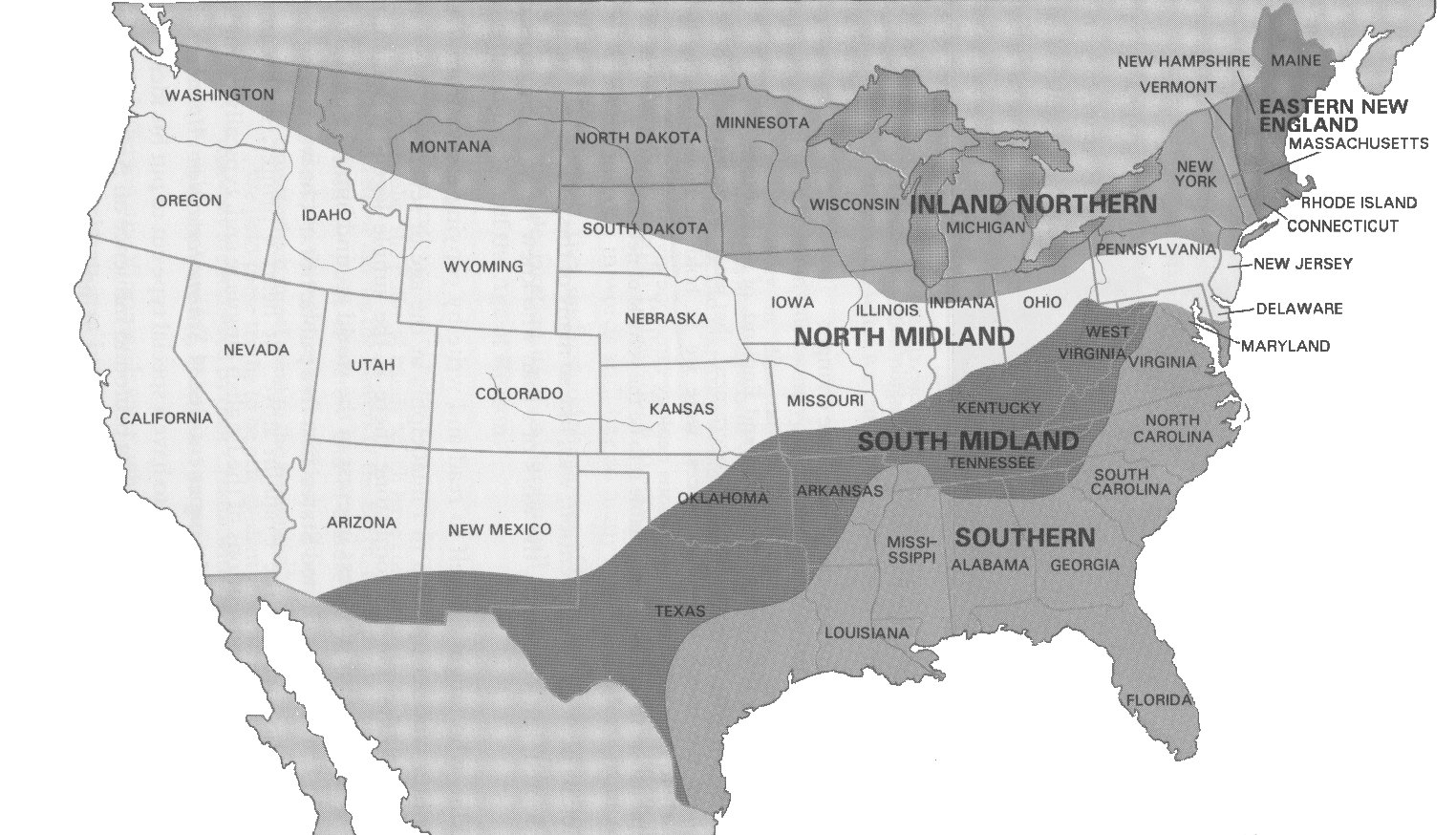
Map 1: The dialect areas of the U.S.
The western part of the map should actually be more faint since western
dialects are not as distinct as this map indicates
(Source: McCrum / Cran / MacNeil, ibid., p. 238; slightly modified)
Ich erkläre hiermit, daß ich die Facharbeit ohne fremde Hilfe angefertigt und nur die im Literaturverzeichnis angeführten Quellen und Hilfsmittel benützt habe.
leFlex