



Transport & Infrastructure
______________________________________________
Hypersonic airliners:
Hypersonic airliners are already being researched and developed, and could enter commercial service within the next 25 years.
These aircraft would have a cruising speed of Mach 5 - or 3,800 mph - allowing them to fly from Europe to Australia in less than four hours. With a range of more than 20,000 km (12,000 miles) they could perform this journey without refueling. They would have excellent subsonic and supersonic fuel efficiency, avoiding the problems inherent in earlier supersonic aircraft. Furthermore, and perhaps more importantly, hypersonic airliners will be environmentally friendly. Powered by liquid hydrogen, their only waste products will be water vapor and small levels of nitrous oxide.
Another advantage is that, while the 150m-long designs will be larger than previous jets, they will actually be lighter than Boeing 747s and could utilize conventional airport runways. They will have moderate take-off noise, too.
In many ways, they will be the spiritual successor of Concorde.
The craft will likely be windowless, however. The heat generated by traveling so fast will make it difficult to install windows that are not too heavy. One solution to this problem might be the installation of flat screen displays projecting images of the scene outside.
______________________________________________________________________________
Solar hybrid vessels:
In the near future, the availability of cheap energy is likely to become a major issue as fossil fuels begin to decline. Ship transport will be among the sectors most directly affected. Even if peak oil lies further into the future than currently predicted, another trend coming into play is the need to drastically reduce CO2 emissions. A recent study by the International Maritime Organization (IMO) claims that emissions from the shipping industry now stand at roughly 1 billion metric tons per year. This is nearly 3% of global anthropogenic CO2 emissions, or eight times the total CO2 released by all volcanoes on Earth. If shipping were ranked as a country, it would be equivalent to the 6th largest greenhouse gas emitter in the world.
Both peak oil and global warming have spurred efforts to create new and more efficient ship transport systems. There are many technical and operational means by which this is being achieved. These include new propeller and rudder designs, more flexible use of engines, waste heat recovery, better route planning, improved weather routing systems and autopilots, speed optimization and improved slot time and turn-around systems in ports and canals.
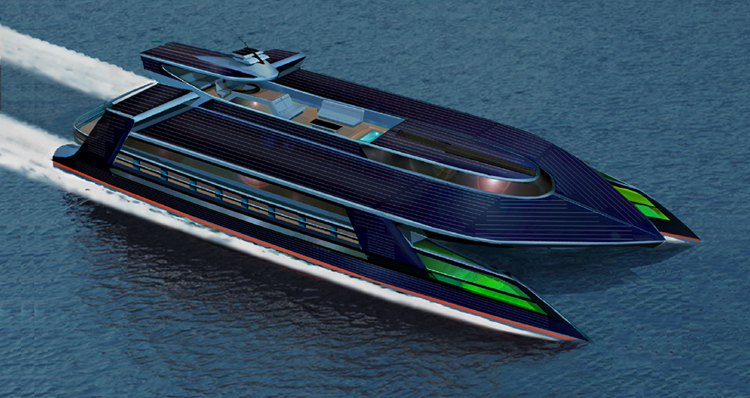
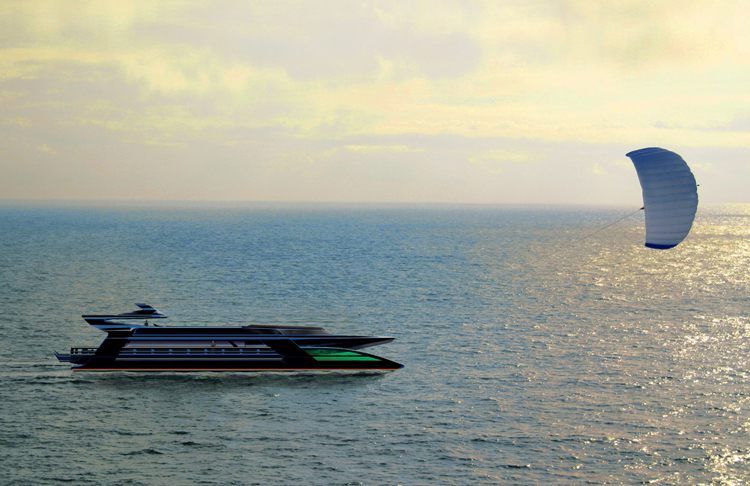
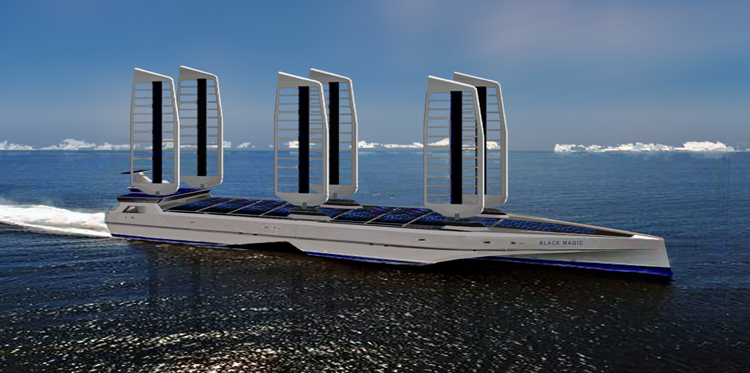
A more exciting, innovative and longer-term solution is the use of solar and hybrid technologies. The car industry is already beginning to go electric, with a majority of new vehicles predicted to be electric or hybrid-electric by 2030. Eventually, the shipping industry could see widespread adoption of electric too.