Project Information
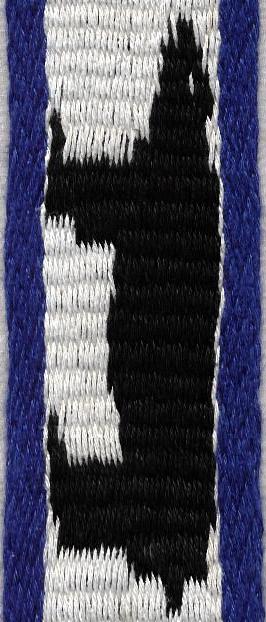
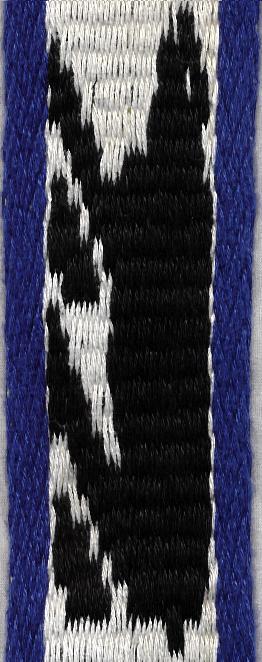
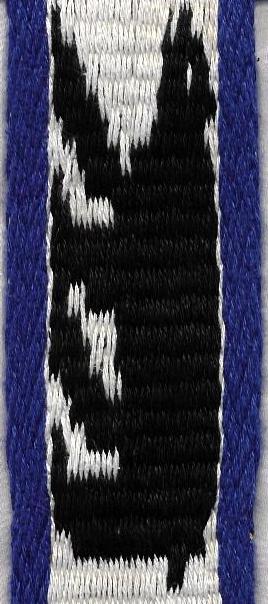
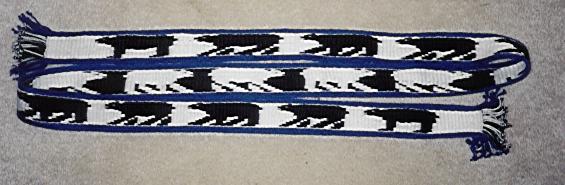
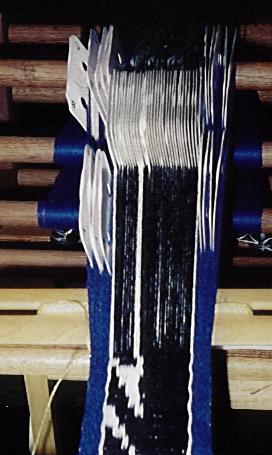
This project was done for Baron Tirloch of Tallaght as commissioned by his lady wife Mistress Anne of Carthew. This is a project based on what might have been called a girdle. A girdle is a belt, cord, sash, or the like, worn about the waist (1). There are surviving examples of tablet woven girdles made for priests around 800-900(2). This belt was made using double-faced weave and 3/1 broken twill. The side panels are done of broken twill and warped half S twill and half Z twill for a chevron appearance to the twill. The main design is of regular double-faced weave that�s warped all S direction. The motif of this belt is Baron Tirloch�s heraldry of azure, on a bend argent between two harps or, a bear passant sable. When I drafted the pattern for this project, I had to try to graph a bear with one paw in the air. I decided instead to try to graph the pattern so the bear looks like it�s actually walking to the left. I started and ended with the bear standing still, but in the middle is repeated, alternating motifs of a walking bear showing the left and then the right legs forward. I used two different techniques in this project because I wish to learn how to use 3/1 broken twill as it is more challenging, but I didn�t want to try to do double-faced 3/1 broken twill yet. From experiments I�ve done, double-faced 3/1 broken twill can be difficult to master and it also doesn�t lend itself well to motifs that have straight lines that run from side to side. Because the weaving of 3/1 broken twill results in offset lines then any straight line that runs from side to side ends up looking jagged. I finished the ends of this project by taking each group of warp threads from each card, using three threads for the core and the fourth wrapped around them. I then tied big knots at the bottom to keep the wraps from sliding down the cores. This results in a look similar the girdle of Witgarius. For this weaving I�m using linen thread made for weaving projects instead of silk or wool. I used linen because I found the colors available from Earth Guild more pleasing to the mundane eye then their wool and because the cost for enough silk to do this project would have run into the hundreds of dollars. From the examples I have seen pictures of most woven girdles were meant to tie around the waist in the middle of the belt with the two ends hanging down from the knot. I used an inkle loom that Sir Janos made for me for my project, for three reasons. One, as of yet I haven�t had a chance to build a middle-to-late period loom for my work. Two, back strap looms can cause a lot of low back pain and you might not be around a solid object to tie it to. In addition, an inkle loom is very portable and can be taken to where ever one is going, which the middle to late period looms were not. But during medieval times the majority of the populace didn�t travel much so they wouldn�t have needed a portable loom. The cards I�m using are made from card stock. Card stock is, for the modern weaver is less stressful on the warp threads as the constant turning of the cards can cause wear on the threads. Card stock is weak enough that any friction caused by the turning will destroy the card, not the warp thread. This took two months spaced out on one to two hours a day during the week and from eight to twelve hours on the weekends; start to finish to weave, due to having to unweave several sections when I had incorrectly woven part of the pattern.
1. Random House Webster�s Unabridged Dictionary, CD-ROM Version 3.0
2. The Techniques of Tablet Weaving, Peter Collingwood 1982, Chap 12, p.332-333