|
|
|
logout (you are login)
|
|||
|
|
|
||||
|
|
|||||
|
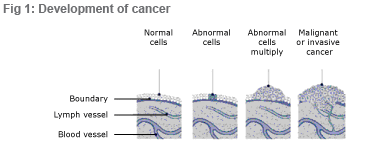
What is Cancer? Cancer is a class of diseases characterized by out-of-control cell growth and form a tumor. The cancer is very serious if the tumor begins to spread throughout the body. When a tumor successfully spreads to other parts of the body and grows, invading and destroying other healthy tissues, the result is a serious condition that is very difficult to treat. Not all tumors are cancerous, there are two classification of tumors : 1. Benign tumors: generally cancerous and do not spread to other parts of the body. However, some could be precancerous and may progress to cancer if untreated. 2. Malignant tumors: cancerous and if not treated early, may spread and affect other parts of the body, becoming invasive cancer.
What causes cancer? There are no definite answers on what causes most cancers. Lifestyle habits and recreation or substances in our environment affecting the body are commonly identified as highly possible risk factors. Other identified high risk factors for cancer include smoking, diet, chemicals and asbestos. Cancer is not contagious; you will not catch it by coming into contact with someone who has it. Cancer in Malaysia
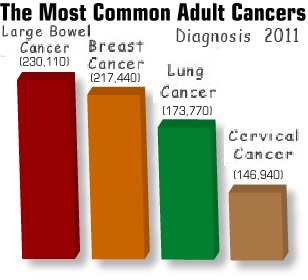
The top 4 cancers affecting both male and female in Malaysia are: Colorectal (bowel) Cancer Colorectal is cancer of the large intestine (colon), the lower part of your digestive system. Colorectal cancer also known as colon cancer or large bowel cancer. Most colorectal cancers develop first as colorectal polyps, which are growths inside the colon or rectum that may later become cancerous. Colorectal cancer affects both men and women , and is most often found in people aged 50 years or older. Some factors that increase a person's risk of colorectal cancer such as:
Breast Cancer Breast cancer is a kind of cancer that develops from breast cells. Breast cancer usually begins in the cell of the lobules, which are the inner lining of the milk ducts that supply them with milk. A malignant tumor is a group of cancer cells that can then invade surrounding tissues or spread to other areas of the body. The majority of breast cancer occurs almost entirely in women, but men can get it too. Many risk factors can increase your chance of developing breast cancer such as:
Lung Cancer Lung cancer is an uncontrolled growth of abnormal cells that start off in in one or both of the lungs. The abnormal cells do not develop into healthy lung tissue, they divide rapidly and form tumor. Lung cancer occurs when a tumor forms in the tissue of the lung. There are two major types of lung cancer:
Some factors increase lung cancer risk :
Cervical Cancer Cervical cancer forms in the tissues of the cervix, which is the muscular opening of the uterus into the vagina. Cervical cancer occurs most commonly in women over the age of 30. Cervical cancer can often be successfully treated when it's found early by taking Pap tests (a procedure in which cells are scraped from the cervix and looked at under a microscope). Cervical cancer risk factors include :
DID YOU KNOW...? Loving, Caring , Sharing received the HAP (Humanitarian Accountability Partnership) certification in 2006 and subsequently revamped or introduced methods and processes in order to be truly accountable to donors, partners and beneficiaries. Your support inspires us to continue our humanitarian work. Help us to do more.
|
|||||