- This book is meant as a guide to advanced course work at Lincoln College Preparatory Academy. When you decide to enroll in advanced courses in either the IB or the AP program of study you are joining a community of thousands of students across the nation and the world in advanced study.
- These advanced programs of study will help you meet standards of excellence in breadth and depth of knowledge, communication skills and higher order thinking skills. They can lead to college credit, advanced college standing or higher competitive college scholarships and WILL prepare you to excel in college. These courses of study will not just present information but will encourage you to think deeply about issues and problems --and even about thinking itself!
- When you begin an advanced study program at Lincoln you will embark on an adventure in learning, stretching and growing. The faculty and staff of Lincoln Prep. believe in you and your abilities, and we're proud to be able to offer you this program that fulfills so well our college preparatory theme and our school's motto:
Excellence Through High Expectations. - The International Baccalaureate is both truly "international" (offered in over 70 countries) and "Baccalaureate" (designed for the advanced university bound high school student). A comprehensive and rigorous two-year college preparatory curriculum, IB is offered in the junior and senior year at LCPA and hundreds of other high schools around the world. Based on the pattern of no single country, IB seeks to provide students of diverse linguistic, cultural and education backgrounds with a shared academic experience of the first rate that may be taken in any country and is recognized in any country.
- Students study an integrated group of courses designed by the International Baccalaureate Organization, culminating in extensive examinations that are evaluated by IB trained teachers internationally. In scope and content the IB program provides a curriculum similar to the freshmen year of liberal arts study in college -- but with the sort of integration of courses few colleges are able to offer.
The official objectives of the International Baccalaureate program are :
- to provide a balanced education with both breadth and depth of knowledge, in which �learning how to learn� is as important as learning the disciplines themselves
- to facilitate geographic and cultural mobility
- to promote international understanding through a shared academic experience
- LCPA students may elect to take one or more IB courses (certificate program) or the full six-field curriculum (Diploma program). Each IB course is designed and reviewed by IB teachers around the world.
- The same international standards of excellence in course content and student learning are applied in all schools. Thus, Ib students develop skills, knowledge, study habits, and self-discipline that will enable them to excel with confidence in the �global village� in which they will live and work.
- The IB is widely recognized at most colleges and universities for college credit, advance course placement, and scholarships. Significant numbers of IB Diploma graduates have gained admission to the most selective universities in the world.
- Students who complete the full IB Diploma program will have a wider perspective and greater understanding of their academic work than they would have gained from isolated advanced studies classes.
- The educational philosophy of the organization is found in the mission statement adopted in 1996:
- Through comprehensive and balanced curricula coupled with challenging assessments, the International Baccalaureate Organization aims to assist schools in their endeavors to develop the individual talents of young people and teach them to relate the experience of the classroom to the realities of the world outside. Beyond intellectual rigor and high academic standards, strong emphasis is placed on the ideals of international understanding and responsible citizenship, to the end that IB students may become critical and compassionate thinkers, lifelong learners and informed participants in local and world affairs, conscious of the shared humanity that binds all people together while respecting the variety of cultures and attitudes that makes for the richness of life.
Program Administration: The IBO - Policies, curriculum, standards and guidelines are coordinated by the International Baccalaureate Organization, a non-governmental office with headquarters in Geneva, Switzerland and regional offices in Cardiff, Singapore, Buenos Aires, Stockholm, Sydney, Yokohama, Mumbai, Amman, Moscow, Nairobi, Mexico City and New York City. The IB program was first offered in 1970.
- Committees and working groups of IB teachers from all over the world continually review and up-date the program, with input from all IB schools. IB policies are communicated to each IB school through regular meetings, mailings and surveys. The master guide for all IB procedures for school coordinators is the Vade Mecum (Latin for "go with me") which is updated annually.
- Only schools extensively reviewed by the IB Organization are authorized to offer the curriculum and present candidates for examination. Lincoln Prep., one of the first high schools in the Kansas City metro area to offer the program, underwent an extensive review by IBO in 1987 and, like all IB schools, has received on-going focused reviews each year since.
- All IB teachers receive special training from the IBO in their teaching and evaluation of their courses and students. Thus, although each IB school has a certain freedom to adapt the IB curriculum to its individual circumstances, the curriculum and standards are consistent in all schools offering the IB program.
Program Administration: LCPA - IB at LCPA is a central part of our total academic program. All principals, counselors, and teachers provide program support. Teachers of IB courses administer the IB policies concerning their courses. Most overall administrative tasks, such as registering students for exams are assigned to a school-appointed IB Coordinator.
- To meet its goals of breadth and depth of learning, the IBO has designed and refined a course of study in six broad subject groups. The IBO requires all IB schools to offer IB-designed courses in each of the six subject groups.
- Courses are offered at either the High Level (HL) or the Standard Level (SL) or both. Levels are distinguished by the number of hours of course work involved.
- Diploma candidates must take at least 3 and not more than 4 subjects at the High Level (HL), requiring two full years of study. The remaining courses are generally Standard Level (SL), which requires only one year of advanced study by IB guidelines. However, due to LCPA graduation requirements and/or the fact that American students often need two years of advanced study in certain fields in order to be adequately prepared for the exams, most SL courses at Lincoln also follow a two year sequence.
- Students may register for no more than two SL exams during their junior year. Most exams (all HL exams) must be taken at the end of the senior year.
(Specific LCPA course offerings for each subject group are given in parentheses; see the LCPA Student Planning Guide for course descriptions.)
Language A: a study of national and world literature and advanced writing skills in the student's first language
- (language A1, I & II, taught in English - HL only)
Language B: a second language
- (French or Spanish two years, levels 4 - 6 --SL only
Latin two years, level 5 - 6 -- will be available in 2003)Individuals and Societies:Social/cultural studies or the history of a major world region such as the Americas, East Asia, Africa, Europe
- (IB history of the Americas I 7 II -- HL only,
IB Psychology -- SL only, as an optional sixth course)Experimental Sciences: advanced laboratory sciences
- (IB Biology 2 & 3 -- HL, IB Physics 1 & 2 -- HL or SL
IB/AP Chemistry 2 & 3 -- HL or SL)Mathematics: advanced math such as Math Methods or Math Studies
- (IB/AP Calculus -- normally SL only, IB Math -- SL only)
Arts and Electives: an elective of the students choice
- (an additional Language B, IB Psychology, Art/Design,
IB Music, IB Theater Arts, a second science)
Unique Characteristics of the Program - The program offers special features in addition to the traditional strengths of a liberal arts curriculum.
- Theory of Knowledge (ToK) is a required interdisciplinary course intended to stimulate critical reflection upon the knowledge and experience gained inside and outside the classroom. ToK challenges students to question the bases of knowledge, to be aware of subjective and ideological biases, and to develop a personal mode of thought based on analysis of evidence expressed in rational argument. The key element in the IBO's educational philosophy, Theory of Knowledge seeks to develop a coherent approach to learning which transcends and unifies the academic subjects and encourages appreciation of other cultural perspectives.
- Creativity, action, service is known by its acronym CAS and is a fundamental part of the diploma curriculum. The CAS requirement lakes seriously the importance of life outside the world of scholarship, providing a refreshing counterbalance to the academic self-absorption some may feel within a demanding school program. Participation in theater productions, sports, and community service activities encourages young people to share their energies and special talents while developing awareness, concern and the ability to work cooperatively with others. The goal of educating the whole person and fostering a more compassionate citizenry comes alive in an immediate way when students reach beyond themselves and their books.
- Diploma candidates are also required to undertake original research and write an extended essay of some 4000 words. This project offers the opportunity to investigate a topic of special interest and acquaints students with the kind of independent research and writing skills expected at university. There are currently 60 subjects, including more than 35 languages, in which the essay may be written.
Registration for Exams - Registration takes place in October for exams in May. A student becomes an IB candidate only when he or she officially registers for the exams. The registration process is administered by the IB coordinator.
- Students are registered in one of the following categories:
Certificate - the candidate plans to sit for exams in one or more IB courses, but not the full Diploma program
Anticipated Diploma - junior candidates "anticipating" completion of the entire Diploma program
Diploma - senior candidates in the full Diploma program
Resit - the candidate is retesting for a higher score
Curriculum Integration - Qualities that set the IB program apart from other advanced studies programs are its emphasis on the interrelationships among courses and its comprehensive nature, as illustrated below.
The International Baccalaureate
Curriculum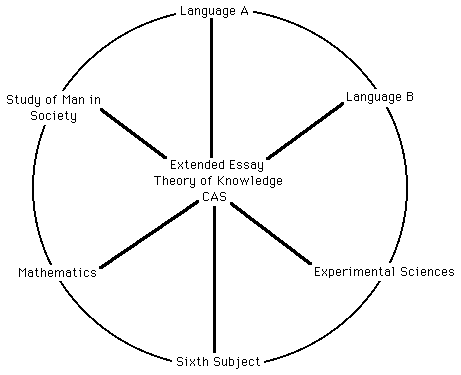
LCPA Four-Year Sequence of Pre-IB and IB Courses Language A, HL
Literature & Composition... American Literature... IB Language A1... IB Language A2Individuals and Societies, HL
World Cultures... U.S. History or Government & Economics... IB History of the Americas I... IB History of the Americas IIExperimental Sciences, HL or SL
Biology... Chemistry... IB Chemistry 2... IB Chemistry 3
Biology... Chemistry... IB Biology 2... IB Biology 3 (HL only)
or Biology... Chemistry... IB Physics I... IB Advanced PhysicsLanguage B, SL
French 2... French 3... French 4... French 5*
Spanish 2... Spanish 3... Spanish 4... Spanish 5*
Latin 3... Latin 4... Latin 5... Latin 6
(*IB Second Language exam may be taken at the 4th - 6th level, depending on the individual student's preparation)Mathematics, SL
Geometry... Algebra II/Trig... Pre-Calculus... Calculus
Geometry... Algebra II/Trig... Pre-Calculus... IB MathSixth Subject Area, HL or SL
One of these sequences:
IB Psychology (SL only)
Foundations of Art... Studio Drawing II... IB Portfolio Art I (SL)... IB Portfolio Art II (HL)
Drama I... Drama II... IB Theater (SL or HL)
IB Music (SL only)
an additional Language B or Experimental Science, Following the above sequencesTheory of Knowledge
Usually taken as an elective in the senior year, this course is a
requirement to receiving the IB Diploma. Though the course has no
IB exam, internal course work is moderated by the IB Organization and will
be assessed along with the Extended Essay in determining the total points
Received by IB Diploma candidates.(exceptions may be made to suggested sequences based on student preparation)
Assessment - One of the strongest features of the International Baccalaureate program is its multiple assessment approach. IB recognizes that a single exam is not a very complete indication of student achievement, so they include other measures as well. In all aspects of IB assessment, student work is rated according to how well it meets published performance criteria; it is not rated in comparison to other candidates work. Although the means of assessment vary from course to course, certain general features should be noted:
Internal Assessment: In most IB courses, the teacher submits an evaluation of each student's learning in the course according to clear criteria contained in the IB teacher's guide for that course. The teacher assesses learning in either the course as a whole or a specific project. This internal assessment (within the school) often counts for as much as 30% of the students final IB score.
- To insure consistency in how all IB teachers around the world internally assess their students, they are required to send samples of student work and their assessment of that work to an outside IB Scholar, who reviews their grading and adjusts it if it is deemed too high or too low. This process is known as 'External Moderation�.
External Assessment: In most IB courses, students write essays or perform projects on either prescribed topics or topics of their choice. These are then sent to an evaluator designated by IB (usually in another country) to be evaluated, again according to clear IB criteria.
Oral Examination: Some courses, especially language courses, have an oral component. Students demonstrate their knowledge of the subject by speaking about a topic in a formal, timed setting, either into a tape recorder or before the teacher or an external examiner designated by IB.
The Written Examination - This is the most heavily weighted aspect of assessment in almost all IB subjects. Every May, IB sets dates for testing in almost all IB subjects for candidates who have registered for these exams the previous October. Exams are scheduled in morning and afternoon sessions during the first three weeks of May. All IB schools across the northern hemisphere follow the same schedule and the same strict exam procedures (southern hemisphere schools test in November).
- The typical IB exam is divided into two or three sets of questions, called papers. Most exams are completely essay or written problems; only a few (such as the experimental sciences and math methods) have a multiple choice question (MCQ) paper. Each exam is timed, but the time allotment is ample for most students to plan and write the exam without feeling rushed. The total amount of time for all papers in a subject ranges from two to four hours, sometimes spread over two exam sessions or two days.
- After examination, student responses are sent immediately to a designated examiner for scoring, following clear IB criteria.
The Final Score: The IB Grade - Upon completion of the examinations, the IB Examinations Office (IBEX) in Cardiff, Wales, Compiles all assessment measures described above for all IB candidates. Final scores are then calculated for each course, according to the following grading scheme:
1 = very poor 4 = satisfactory 2 = poor 5 = good 3 = mediocre 6 = very good 7 = excellent - Scores are reported to the IB high schools, who then report the scores to individual students in mid- to late June. Alternatively, students may access their scores via the IB Web Site and their individual candidate code number as early as late June.
IB Diploma Requirements The Diploma is awarded to candidates who successfully complete all the following:
-
-the full, six-subject IB curriculum, with a total score of 24 or better
-a course in the Theory of Knowledge (ToK)
-an extended Essay in an IB subject area
-at least 150 hours of CAS (creativity, action, service)
- If any one component is not completed, the Diploma will not be awarded. These components are central to the IB Programs goal of integrating the IB curriculum. Indeed, this full set of integrated requirements is what sets the IB program apart from other advanced study programs.
- Internationally, about 70% of all Diploma candidates successfully earn the Diploma. It doesn't take genius to earn the diploma.
It does take:
-
-an inquiring intellect
-strong skills in reading, writing, problem-solving
-a willingness to set high goals for yourself
-a determination to succeed
-self-discipline, self-motivation and self-confidence
-high goals for your college education and career- These are the characteristics that make the IB Diploma so highly valued to university scholarship committees, graduate schools and many employers. The Diploma does not certify that you are smarter than similar non-IB students. It does certify that you have attained a superior college preparatory education that is unique in its conformity to international standards of excellence. It certifies that you have an advanced level of maturity and self-discipline, that you like to challenge yourself, that you work hard and manage time well, and that you are highly motivated to attain excellence.
- In the tremendous competition for admission to highly competitive colleges, for scholarships, and for professional career positions, an IB Diploma graduate definitely stands out from the crowd.
Theory of Knowledge (ToK) - Normally taken in the senior year, ToK is central to the IB Diploma program. ToK is a seminar class in which the distinct forms of knowledge in the IB subject groups can be critically evaluated, compared, contrasted and integrated. The course draws from philosophy but is not an introduction to philosophy. Primarily it is intended to stimulate students thinking about their own learning experiences -- to acquire critical awareness of what it means to know. It is a course in which students are encouraged to think about thinking itself!
IB assigns a grade for each ToK Diploma candidate based on these two assignments:
- 1) A 1200 - 1500 word essay on a prescribed topic dealing with problems of knowledge. The essay is externally assessed and counts for two-thirds of the students ToK score.
- 2) An oral class presentation of approximately 10 minutes, creatively exploring a specific knowledge issue. The presentation is internally assessed and counts for one-third of the students ToK score.
- There is no IB written examination for ToK. Student performance is rated as either Excellent, Good, Satisfactory, Mediocre, or Elementary. If the candidates rating is high in both ToK and the Extended Essay, up to three bonus points are added to the candidates overall score. If the rating is Elementary in both, the Diploma is not awarded.
Extended Essay - This diploma requirement is an opportunity for students to pursue independent study, research and reflection on a topic of interest to them. The only requirements concerning topic selection are that it be limited in scope (for example the Impact of Social Darwinism on the Ambitions of Cecil Rhodes but NOT The Life of Cecil Rhodes) and that it be related to an IB subject (except ToK). If the topic is in a Language B course, it must be written in that language; otherwise, the working language must be English. The same paper cannot be submitted to meet the requirement of both the Extended Essay and any other assessment component in an IB course.
- Each candidate chooses a supervising teacher in the subject in which the paper is written and the supervisor then assists the candidate in topic selection, research, specific requirements and meeting deadlines. The final product, however, must be the candidates own work; the supervisor cannot grade or correct it. The essay must include reasonable analysis, interpretation, synthesis or evaluation of the topic, its importance, or its relationship to a large topic.
- The paper must contain an abstract, a table of contents, a standard bibliography and must be typed according to standard research paper format. The current requirement is for a paper of approximately 4000 words.
- IB estimates that candidates will spend approximately 40 hours on the Extended Essay. Two identical copies of the essay must be submitted in final form to the IB coordinator by March 1 of the senior year. If that paper is not completed on time, the Diploma will not be awarded.
- The un-graded final draft is sent to an IB designated reader for external assessment. The reader will evaluate the essay, based on clear IB criteria assessing the quality of the research question, supporting facts, analysis and evaluation of the topic, discussion and argument, conclusion, abstract, length, and overall presentation in addition to the specific criteria for papers in the subject area in which the paper was written.
- The Extended Essay will be assigned a "grade" of Excellent, Good, Satisfactory, Mediocre, or Elementary, the same grades used for ToK. If the candidate's rating is high both ToK and the Extended Essay, up to three bonus points are added to the candidate's overall score. If the rating is Elementary in both, the Diploma is not awarded.
Creativity, Action & Service (CAS) - This component of the Diploma program recognizes that a person does not learn "by head alone". Involvement in extracurriculur activities the enhance the student's creativity, physical activity, and service to others are forms of experimental learning vital to the full development of the person.
- Aminimum of 150 hours of CAS activities are required during the two years of the Diploma program, either spread out or in concentrated projects. Activities must develop the candidate's creativity, action and service. They must be voluntary activities for which the candidate receives neither pay nor academic credit and are not to be solely political or religious in nature.
- Creativity includes a wide range of involvement in the arts or production; even the creative design or the implementation of a service project can qualify
- Action includes a wide range of physical activities and training for service, including activity involved in service projects
- Service includes activities benefiting the school, neighborhood, community, nation, world, and the environment.
- All CAS activities must be completed and documented by April 1 of the Senior year. Self-Evaluation and Supervisor's Evaluation forms are supplied by the IB Coordinator.
Self-Evaluation: For each CAS activity, The candidate should address the following:
-
-a log, listing dates, hours per day and time spent
-the ways in which the activity fulfills one or more components of CAS
-the extent to which the candidate has developed personally
-the understanding, skills and values gained or strengthened
-the benefit of the activity to others
-ways in which the activity enhances the student's classroom learningSupervisor's Evaluation: For each CAS activity, the adult supervisor should address the following, where applicable:
- -student's reliability, punctuality and total time spent
-evidence of initiative, planning and organization
-amount of effort and commitment
-student's personal development and achievement, taking into account their skills and attitudes at the start of the activity
Overview of the AP Program - The Advanced Placement program offered by the College Board is a rigorous course of study made up of individual exams in certain subject areas. Students may take the exams whether or not they have taken a course labeled "AP". At Lincoln, we have identified certain courses to be of the appropriate content material as to prepare students to excel on Advanced Placement Exams.
- The official objective of the Advanced Placement program is to provide highly motivated students an opportunity to take college-level courses and exams while still in high school.
- There are approximately 14,000 high schools which offer students the opportunity to enroll in AP courses and sit for the exams. In 1998, AP reached a milestone -- more than a million exams were taken by about half a million students!
- Advanced Placement is a program for everyone: students say that they enjoy the challenge of taking AP courses with classmates and AP teachers who are just as enthusiastic as they are; high school faculty find that AP courses enhance their students' confidence and academic interest; college faculty report that these students are better prepared for serious academic work than students who do not choose an advanced program of study.
- Compared with regular college prep high school courses, AP courses are usually more demanding. Students will typically read and write more, analyze material, synthesize ideas, solve problems, and evaluate. Most AP classes are comparable to sophisticated college courses, so they aren't easy, but they're not impossibly difficult either. The intellectual skills and interests developed in AP courses -- critical reading, analyzing data sets, synthesizing evidence to develop new insights, ect. -- will equip students for lifelong learning. The courses require a commitment to participating actively in class and doing the out-of-class assignments. "Keeping up" is a basic practice for any college-level course. These courses move rapidly and cover a lot of ground. Successful students are those who keep up or, better, stay a little ahead of the required reading.
LCPA Sequence of AP Courses English
Literature & Composition... American Literature... IB Language A 1... AP EnglishSocial Studies
World Cultures... Economics/Government... AP US History... Psychology/Sociology or Theory of KnowledgeScience
Biology... Chemistry... IB/AP Chemistry 2*... IB/AP Chemistry 3
Biology... Chemistry... any junior level science... AP Environmental Science(*the highly motivated student could succeed on the AP exam following Chemistry 2, alternatively, students may choose two years of advanced chemistry before testing)
Foreign Languages
Latin 2... Latin 3... IB/AP Latin 4*... IB/AP Latin 5(*The highly motivated studcent could succeed on the AP Vergil exam following Latin 4, however, students are strongly recommended to complete Latin 5 before the exam)
Mathematics
Algebra II/Trig... Pre-Calculus... IB/AP Calculus i*... IB/AP Calculus II*(*there are two separate AP exams in Calculus, the AB exam may be taken after Calculus I, the BC exam after Calculus II)
The AP Assessment Process - AP Exams in each subject area consist of multiple choice and essay sections. The exams are timed, with the time allotment such that most students will have time to finish the entire exam without feeling rushed.
- Once exams are taken at Lincoln, they are sent to the college board where they are scored according to criteria set by AP subject area scorers. Scores are based solely on the student's performance on the written exam.
- The chief faculty consultants who score the AP Exams apply high standards to the process. The multiple-choice questions are used to provide both high reliability (the likelyhood that a candidate repeating the exam would receive the same grade) and continuity. They ensure that a candidate who earns an AP grade of 3 on one year's exam is at the same level of competence as candidates who earned the same grade in previous years.
- The stability of AP grades is maintained in two ways:
- 1. Direct comparisons are made between the performance of the current year's candidates and that of former candidates on a set of identical multiple-choice questions. Psychometricians can then determine the relative difficulty of the essay questions and calibrate them with a high degree of accuracy, thereby minimizing the effects on candidates' grades of different free-response questions from one year to the next.
2. The chief faculty consultants compare the general distributions of scores in their subject areas to those of the past several years and consider other pertinent data (such as validity studies and table leader reports) to arive at decisions on grades.
- The questions on the multiple-choice sections are scored with a correction factor to compensate for random guessing, and they are deliberately set at such a level of difficulty that students who perform acceptably on the free-response section generally need to answer about 50-60 percent of the multiple-choice questions correctly to obtain a total grade of 3.
The Final Score: The AP "Grade" - The faculty consultants' judgements on the free-response questions are combined with the results of scoring the multiple-choice questions, and the total raw scores are converted by the chief faculty consultants to a 5-point scale:
- 5 = Extremely Well Qualified
4 = Well qualified
3 = Qualified
2 = Possibly Qualified
1 = No Recommendation- Scores are reported to the AP high schools, who then report the scores to individual students in mid- to late July.
Student Preparation for Assessment - IB and AP - None of the assessment components of IB or AP courses are ment to be surprises. It is the duty of the teacher to assign papers and activities in each course that will give students practice and prepare them for all assessment components of the course. Students should take ALL assignments in advanced courses seriously; they are carefully designed to prepare students to excel in all areas of assessment.
- Disciplined preparation for the comprehensive written exams is critical for high scores in either the IB or AP program.
Some suggestions:
- Attend any special tutorial or review sessions a teacher offers, or work independently with the teacher.
- Establish a study schedule for independent review of course content. LCPA advanced study teachers want our students to excel and will give extra time to help make that possible. Ultimately, however, each candidate's performance on the exam will depend on his or her own self-discipline and study.
- Review any previous exam materials that are available. Teachers commonly use previous exams in class to expose students to the nature of the written exams. IB exams are released 24 hours after administration and AP exams are released on a five year schedule, so in both cases students have access to previous exams for study and review.
Test Taking Skills - Preparation does not end when the student enters the examination room for a scheduled exam. Because the exams measure more than just content knowledge, careful thought, planning and time management during the exam are crucial. Test-taking skills here are no different from those in any other setting: students who "tackle" any advanced program exam will be far ahead of their peers in college testing situations.
- 1) Follow the regulations for the conduct of the examination.
- 2) Listen carefully to the test instructions, asking questions about any area of uncertainty in test procedures.
- 3) Read or skim the entire test before writing. ON IB exams, students will have choices of questions and by over viewing the exam, students can select the questions they will write on and begin to plan how they will respond.
- 4) Don't be overly pressured by the time limit, but work to finish the exam. Most students will have ample time to finish the exams without pressure.
- 5) Read and analyze a question thoroughly, then reread the question one or two more times. Know what the question is asking: underline the parts or jot down its key parts on the test paper itself. As you plan your answer, make certain the points you raise respond clearly and directly to the question. No matter how much you know on some other topic, you will be graded only on how fully and clearly you respond to the question given. Throughout your writing process, keep asking yourself if each part of your answer clearly and logically addresses the question.
- 6) Plan your answer. First, informally outline your answer -- perhaps first jot down random ideas and topics you might cover; then put them in a logical order that addresses all parts of the question. Clear, sophisticated organization of the answer is a key quality for a high score. Begin with a brief introductory statement, followed by well-organized paragraphs that guide the reader through your answer.
- 7) Draw conclusions. Your answer should be a balance of specific, accurate facts and your analysis. Look for key words in the question such as analyze, explain, compare, assess, evaluate, interpret. The best responses give accurate, relevant facts and then comment thoughtfully on their significance or their meaning. The examiners will rate both what/how much you know, AND how well you understand and interpret it.
- 8) Proofread. Read the question and your answer. Check for spelling, grammar and correct sentence structure. Verify that you have provided ample, specific evidence for the interpretations you made. Make sure you answered the question completely and make neat changes as necessary.
- 9) Write neatly. Take the time to use your most legible handwriting, however do not value neatness so much that you will not make corrections to improve your answer.
- 10) Be confident. IB and AP exams are stressful for all students, and you will probably be very conscious during the exam of how much you don't know about the subject. Realize that every student feels this way, and focus with confidence on what you do know. Believe in yourself and your abilities. As in everything else in life, your attitude is a key component of your success.
Preparing for Advanced Courses
Advice for Grades 6 - 10- The high standards in both the IB and AP programs assume high levels of achievement or preparation at the middle school and high school years. The LCPA program at the middle school and the first two years of high school is designed to prepare all highly motivated students for success. All courses at these levels are considered IB/AP prep courses.
- All LCPA students should focus in the early years on developing their critical reading and writing, mathematics, science, and problem-solving skills. They should strive to develop good habits of self-motivation, time management and always doing their best (going far beyond the minimum) on all assignments. They should also develop independent reading habits by reading for enjoyment during their school year and especially the summer.
Curriculum Planning - Students can begin in Middle School to plan their courses so they are fully prepared to enter the IB program as juniors. To have the easiest entry into the IB Diploma program, students should begin a Language B (Spanish, French, or Latin) in Middle School or by the ninth grade at the latest, and continue that same language each year. Students should take as many of their graduation requirement courses as possible in the freshman and sophomore years: Speech, Word Processing, Practical Arts, Fine Arts, African-American History, Physical Education. And students should also look into the "sixth subject" courses and should take the necessary prerequisites in the freshman and sophomore years.
Frequently Asked Questions Is there a cost to the student for IB or AP exams?
- Yes. Though the school does underwrite most of the cost, the students are expected to pay a portion of the exam fees. Please recognize that with proper preparation and study, students can earn college credit for high scores and the test fees are indeed a great college savings.
These courses sound demanding. Will I still have a life?
- Of course. The programs are not intended to occupy every waking moment. However, preparation for IB or AP exams is a major commitment and must be a top priority. You will have to weigh your commitments to extracurricular activities, work, leisure time, and all else and budget your time accordingly. Students worldwide who have earned the IB Diploma overwhelmingly insist that the benefits were well worth the sacrifices in the highly competitive college and career world.
I'm interested in University X. How do I find out its policies on accepting these test scores?
- College and university acceptance policies very with each institution. IB has published a guidebook listing many U.S. College acceptance policies, however the most accurate information will be obtained from the university you are interested in. Talk to the Admissions Officers to determine their policies concerning admissions, advanced placement in college courses, scholarship opportunities, etc. The IB website www.ibo.org has links to colleges and universities so you can see their policies regarding IB exam scores.
What if I don't do well on the exam -- won't that hurt my chances for college admissions or scholarships?
- No. For one thing, you do not have to send your scores to any college. Even if you do send a low score it should not affect your admission or scholarships. A low score will only mean that you will not be given credit, or most likely, advanced placement, in that particular course. The fact that you chose to challenge yourself in a demanding program will still impress your college advisor.
Do the advanced courses have weighted grades?
- Yes. The IB and AP scores are totally separate from the final semester grade recorded on the LCPA transcript. In recognition of the greater challenges of the advanced courses, LCPA has a policy of assigning "weighted" grades to IB and other advanced study courses.
There are a LOT of regulations -- are exceptions ever made?
- Sometimes. Though to ensure consistent standards, IB and AP are both very clear in their policies. However, there can sometimes be allowances for individual circumstances. See the Advanced Studies coordinator about your specific concerns.
- These advanced programs of study will help you meet standards of excellence in breadth and depth of knowledge, communication skills and higher order thinking skills. They can lead to college credit, advanced college standing or higher competitive college scholarships and WILL prepare you to excel in college. These courses of study will not just present information but will encourage you to think deeply about issues and problems --and even about thinking itself!
I. International Baccalaureate
Overview of the IB Program
Mission of the IBO
Program Administration
IBO Subject Groups
Unique Characteristics of IB
Registration for Exams
Curriculum Integration
Course Sequence at LCPA
Assessment
The Written Exam
The IB "Grade"
Diploma Requirements
Theory of Knowledge
Extended Essay
Creativity, Action, Service
II. Advanced Placement
Overview of the AP Program
Course Sequence at LCPA
Assessment
The AP "Grade"
III. Testing-IB and AP
Student Preparation
Test Taking Skills
IV. Preparing for Advanced Courses
Advice for Grades 6 - 10
Curriculum Planning
International Baccalaureate and
Advanced Placement at
LCPA
An introduction: