
The-Planet-Pluto!
The ICE Planet!
Pluto's Long Page
Have A Far-Out Time On PLUTO!
If You Want To See Pluto in SPANISH!
Click Here for Sarah's Sundials!
Click here for the LC JUNIORS HOMEPAGE!
Pluto, the ninth and last planet (usually) was discovered on February 18, 1930. It is the only planet to be discovered by an American. This special American�s name is Clyde W. Tombaugh, although Percival Lowell had previously funded three unsuccessful searches for the �Planet X.�
Pluto was named for the Roman god of the underworld, Pluto, and for Percival Lowell�s initials, PL. The same year that it was discovered, Pluto was officially labeled the ninth planet by the International Astronomical Union. Then, in 1997, a random woman by the name of Christine Lavin wrote a song about the small, far away, mysterious planet.
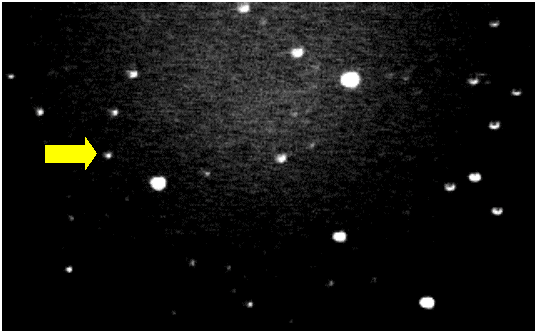
Pluto is the only planet that has not been visited by a spacecraft (that we know of here on Earth). It is also the only planet that cannot be seen with binoculars. You must use a telescope (usually a high powered one) to view Pluto from the earth.
Pluto is approximately five billion, nine hundred thirteen million, five hundred and twenty thousand kilometers from the sun, except for the twenty out of two hundred forty nine years of its orbit when it�s closer to the sun than Neptune. Wow! Twenty whole years! The planets rotation period is every 6.387 days, which is the same, as it�s only known moon, Charon�s, rotation. Pluto is the only planet that rotates synchronously with its moon, or orbit of satellite, and they are constantly facing each other.
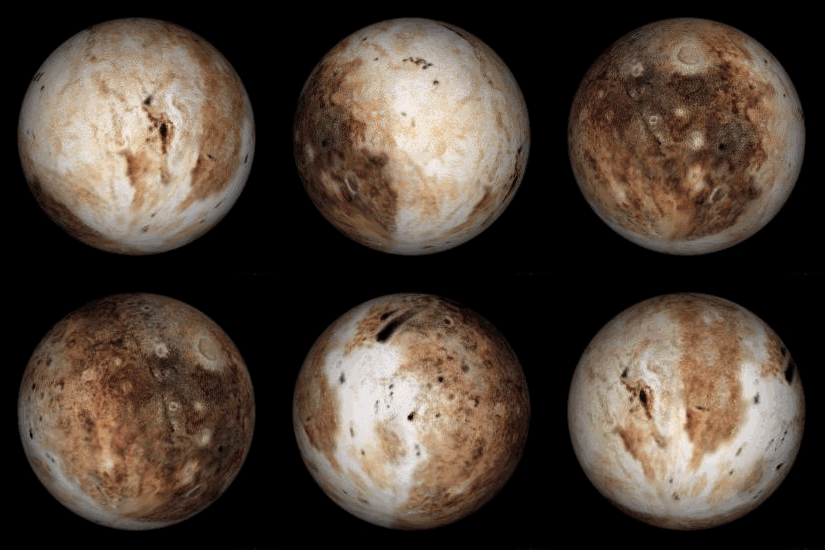
Pluto�s mass is approximately 6.4*10 to the �9, which is calculated at .0021 of the Earth�s mass. Pluto�s average density is 1.8-2.1 grams per cubic centimeter, and is 50%-70% rock mixed with ices. It is smaller than seven of the solar systems moons (Moon, Io, Europa, Ganymede, Callisto, Titan, and Triton). It is also the second contrastiest body, just following Lapetus. Pluto�s surface pressure is also one hundred thousand times less than the Earths surface pressure.
Pluto rotates the opposite direction from most planets, and is colder than seventy degrees Kelvin. Although it is made of mostly rock and ice, Pluto also contains small traces of solid methane, ethane, carbon monoxide, and nitrogen. Its surface pressure is also one hundred thousand times less than the Earth�s. Whoa!
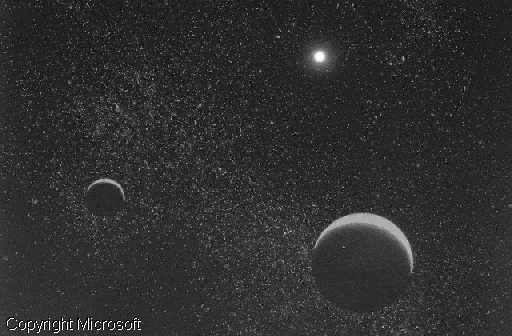
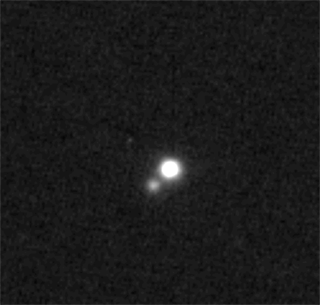
As mentioned before, Charon is Pluto�s only known moon. It was not seen from the Earth until 1978. Where was it before then? Who knows! Anyway, another quick fact that is associated with Charon and Pluto, is that Charon is located twelve thousand and two hundred miles from Pluto. That sure is a lot of space! Maybe they think that long distance relationships are the best way to go�
That�s all that this site can tell you about Pluto. If it�s your hearts desire to know more (I feel sorry for you!), go to one of my PLUTO links!