Survey of Western Art (Art 202) Monument List
A Monument List is a group of art works that art historians regard as signal works of their ages. You will need to be able to identify these works on quizzes and exams.
Classical Greek Period, c. 480 B.C. - c. 330 B.C.
Kritios Boy, Kritios, c. 480 B.C.

The Parthenon, 438 B.C., Athens

Hellenistic Period, c. 350 - c. 100 B.C.
Laocoön and his Sons, c. 150 BC

Venus di Milo, 1st century B.C

Roman Period, c. 150 B.C. - c. 280 A.D.
Agusutus of the Prima Porta, 29 AD

The Pantheon, 125 A.D, Rome

Late Antique Period c. 280 A.D. - c.600 A.D.
Christ as Redeemer golden mosaic, 432-40

Celtic/Germanic Arts of North Europe, 4th Century A.D. to 8th Century A.D.
Sutton Hoo Purse cover, c. 655

The Middle Ages in North Europe, c. 700 - c. 1300
Book of Kells page, c. 795

Chartres Cathedral, begun 1194, France

Proto-Renaissance in Italy, c. 1230 - c.1400
Lamentation over Christ, Giotto, c. 1305

Early Renaissance in Italy, c. 1400 - c. 1480
Tribute Money, Masaccio, 1420s

Early Renaissance in North Europe, c. 1400 - 1500
Arnolfini Wedding, Jan van Eyck, 1434

High Renaissance in Italy, c. 1480 - c. 1520s
David, Michelangelo, 1504

16th Century in Italy, c. 1520s - c. 1600
Venus of Urbino, Titian, 1538

Baroque Period, c. 1600 - c. 1700
The Entombment of Christ, Caravaggio, 1603

Baroque Period in Holland, c. 1600 - c. 1700
Rembrandt Self Portrait, 1658

Rococo Arts, Early to mid-18th century
Departure from the Island of Cythera, Watteau, 1717

18th Century Middle Class Life, c. 1730 - c. 1780
The Rakes Progress, The Heir, Hogarth, 1732-33

Neo-Classical Period, c. 1760s - Early 1800s
Oath of the Horatii, David, 1784

Romanticism, Late 18th century to mid 19th century
The Third of May 1808, Goya, 1814

Realism, Mid-19th Century
The Stonebreakers, Courbet, 1849

Impressionism, Mid 1870s into the Early 20th Century
Le Moulin de la Galette, Renoir, 1881

Baroque Painting in Italy and France
c. 1600 - c. 1700
Map of Europe in 1648 Wikipedia

Maps of 17th century Europe were very different from what we see today. Only Spain, Portugal, France, and England are the countries we recognize today.
Ever thing red on the map belonged to Spain. All the pink and gray spotted areas, Austria, and all the little purple, green, and tan duchies and principalities straggling down into Italy started out the 17th century as part of the Holy Roman Empire
The 17th Century, Beginning of the Modern Era
The Baroque period, c. 1600 - c. 1700, was the beginning of the modern era. This was when the Western World as we know it today began to take shape. In the Renaissance respect for human intellect had been reasserted; and between the 15th and 17th centuries humanist attitudes (that is emphasizing matters concerning mankind, secular knowledge, and the importance of the individual) grew increasingly consequential. It was in the Baroque period that modern attitudes about political systems and cultural practices based on those principles began to take shape and the modern nation states began to take form.
The Baroque period was an age of extremes. There were extremes in religion, politics, and the arts. For over thousand years western European Christians had been united under the Roman Catholic Church. Unity ended in mid-1500's with the advent of religious protests that led to schism (split) between Protestants and Catholics. In the 1600's the continent was plunged into a series incredibly bloody and destructive religious wars between these two religious groups ( The Thirty Year's War,1618-1648 is one example) as a result of their un-reconcilable differences. There were extremes in political views also. Monarchs and princes of the Catholic Church sought to extend their powers while their subjects were beginning to think about personal rights and the importance of the people having a say in government.
Politics and arts merged. On the one hand monarchs and princes of the Catholic Church used art as propaganda to promote their superiority over their subjects. At the other extreme of the political spectrum citizens of the tiny Protestant Dutch Republic asserted that neither Church nor monarch had the right to manage their and demanded paintings that depicted the every day lives of ordinary citizens.
Baroque arts are notable for extremes in style and subject matter. Renaissance arts had been unified by a love of beauty, idealization, and centrally placed figures in quiet restrained poses. Baroque arts were all over the map. Strong contrasts of all kinds show up in Baroque painting and sculpture. Compositions filled with from side to side with active writing twisting figures. The desire for extreme naturalism brought about an explosion of unidealized figures and faces. There's even strong contrast between light and dark.
The Baroque period was the last age of great religious art. Fittingly some of the most movingly effective religious images of all time come from the 17th century. By the 18th century secular culture displaced religion from the central position it had occupied in the West for 1500 years and the arts become primarily secular.
|
- To see paintings of Caravaggio and other artists in this lecture click on the highlighted name of the artist.
|
Caravaggio (Michelangelo Merisi da Caravaggio), 1573 - 1610
Deeply Moving Religious Painting Addressed to Ordinary Sinners and Reprobates
It is appropriate to begin this period with the Italian painter Caravaggio. He was very much a man of extremes: his life was squalid and his mature work, mostly religious subjects, was exceptionally powerful, moving, and expressive.
He abandoned Renaissance idealization and its emphasis on beauty. Caravaggio's models had coarse work worn hands, knobby knees, and gaunt weather worn faces. These highly unidealized people with all the irregularities of the human form were washerwomen, prostitutes, shop girls, and aged household servants, common manual laborers, scoundrels, and con men rather than the elegant athletic youths, graceful beauties, or dignified old men that show up in the works of Masaccio, Michelangelo, and Raphael.
In Caravaggio's time one of the things the Catholic Church wanted was religious paintings that were meaningful and accessible to every worshipper, even the poorest of the poor. The Church wanted every one to feel they had as much access to God as did the rich. Caravaggio's moving and effective religious paintings allowed ordinary un-remarkable everyday people, especially sinners and reprobates, to see themselves in scenes with Christ and the saints. In the Renaissance only aristocrats (people with inherited social position) and wealthy merchants could expect to have themselves depicted worshipping in the very presence of Christ, the Madonna, or the saints—see Titian's Pesaro Altarpiece and van der Wydens's Descent from the Cross. Now, with Caravaggio working classes and even the poorest of the poor could see themselves involved the most sacred events. They too could participate in sacred moments.
 REQUIRED VIEWING: Simon Schama's Power of Art: Caravaggio 1/4. Please watch all four parts of the video. 1 hour
Please look at enlarged version in this link.
The Entombment of Christ, 1603 is a monumental moving work depicting the burial of Christ. In this life-size work Christ's most humble followers are the ones who mourn his death.The life-size work hangs about five feet above the floor which makes the viewer feel as if he is present at this sacred event. It seems as if we (the viewers) are standing in the tomb and Christ's body is being lowered into our waiting arms. The stone tomb cover they stand on juts out outward adding to the sense of physical presence of the painted figures.
Caravaggio used a highly dramatic style of very strong light dark contrasts. In The Entombment a brilliant spotlight shines on the figures leaving the rest of the composition in inky darkness. This very high contrast light-dark focuses our attention on the drama and emotional intensity of the event which makes the picture so movingly effective.
High light dark contrast also makes the life-size figures seem to pop right out of the canvas into our space thereby increasing the reality of the event.
In this picture Caravaggio has made the people look so real, so believable, so physically present, so three dimensional, that they seem to reach right into the viewer's space. It seems we should be able to reach out and touch them. It seems as if the men are lowering Christ's body into our arms.
Caravaggio's theatrical lighting (it's called that because it's just like a brilliant spot light that leaves the rest of a theater's stage in darkness.) was quickly taken up by other Baroque painters all over Europe.
Illusion and Subjectivity in Baroque Arts
The 17th century was an age of extremes in styles and subject matter as well as extremes of passion. The time is also notable for questioning what is reality and what is illusion. 17th century painters were masters at creating visual illusions to fool the mind and delight the eyes.
One thing that Baroque artists excelled at creating exceptionally good illusions of things that can't really be—and doing it such a realistic naturalistic fashion that the images seem very real to the viewer. Pictures of this sort are said to be highly subjective. That is they show us things that for all their apparent realism and seeming physicality cannot really happen, cannot really be.. (Subjective means affected by, or produced by the mind or feelings; it refers to experiences that are not externally verifiable;they can't be proven, they are affected/produced by the mind or feelings.) In this conntext, subjective paintings depicts experiences that are imagined, cannot be proven. You could not have see the object or event.
depicted if you had been present at the event.
Subjective images depict everything from pure fantasy (dragons, fairy princesses, pigs building houses of straw, or space aliens) to interior visions and dream experiences. Baroque arts of Italy, Spain, and France were particularly subjective; particularly committed to trying to convince viewers of the reality of things that do not actually happen.
For your information: La Pittura Barocca
The 17th century was an age of extremes in styles and subject matter as well as extremes of passion. Caravaggio's paintings represent one end of the spectrum; he depicted the most ordinary people, even the very poor, in stark simple settings. Other painters were producing over-the-top fanciful, extravaganzas intended to stun and over awe viewers. These works were made for the richest and most powerful, and were intended to enhance the perception of power and authority. As with Caravaggio these works were convincing illusions that played with the viewer's perception of reality. But these were used for the purpose of political propaganda.
Royalty and Propaganda Painting
Catholicism was still the faith of most European rulers... The artists who worked for them were expected to use their talents to express the grandeur of the Church, the supremacy of faith, or the majesty and absolute, God-given power of the monarch. Architecture, sculpture, and painting were the means by which the greater glory of religion and monarchy could be made visible.
Painting and sculpture was intended to be "celebration of a particular man—the king, the ruler, the pope, or nobleman (a person born into a high class). The seventeenth century became the age of the royal portrait. On horseback, or seated, kings, queens, princes, and nobles saw themselves mare more magnificent, more graceful, more exalted than ordinary mortals.
pp 159 and 160, Wood, Cole, Gealt, Art of the Western World
Baroque Apotheosis
The word apotheosis means elevation to a preeminent or transcendent position; glorification. In the Baroque period the word tended to be used very literally; Baroque apotheoses tended to depict monarchs, churchmen or members of the nobility floating up into the heavens in the company of Christ, the saints, or gods and goddesses of classical mythology. Others had earthbound settings, but included cloud borne pagan gods and goddesses who fluttered around kings, princes of the church, or aristocrats. All Baroque apotheoses were intended to glorify the person depicted, to make them seem so superior, so elite, that they schmoozed only with gods.
Baroque apotheoses were political propaganda. As the paragraph above says the idea of was to "express the grandeur of the Church, the supremacy of faith, or the majesty and absolute, God-given power of the monarch... (it was a) means by which the greater glory of religion and monarchy could be made visible." The goal was to insure that ordinary folks would believe they were inherently inferior and submit themselves to the will of their betters. All this was done in a supremely realistic, naturalistic, and highly illusionistic way that helped to make the scenes very convincing.
Below are two spectacular colossally conceived Baroque apotheoses, both ceiling paintings, by Pietro da Cortona and Andrea Pozzo. Italian Baroque painters carried Michelangelo's idea to even greater extremes. Be sure to click on the enlarged views of The Apotheosis of St. Ignatius and try to figure out where reality stops and illusion begins.
The first, Pietro da Cortona's, Triumph of Divine Providence is in the Barberini Palace, family home of Pope Urban III in Rome. It's an expression of over the top family pride. Pope Urban was so proud of his family's position in Italian history that he had Pietro paint a ceiling in which bees representing the initial of Urban's family name, Barberini, fly up into the heavens to be with Divine Providence. In the second, princes of the Catholic Church depict themselves mounted on the tops of pillars and lauching themselves into the clouds in order to adore the sainted priest Ignatius Loyola. People who can praise their family to the sky are certainly must be much superior to ordinary folk.
Telling what is real and what is illusion in these colossal paintings is difficult. You really have to look at the enlarged versions of both to see the wonderful details and effects. Where does the real architectural structure and sculptural molding stop and painting begin. This kind of painting is called trompe l'oeil (pronounced tromp cloy—which means 'to fool the eye'. Trompe l'oeil creates an optical illusion that makes painted objects seem to be so real, so three dimensional, that they seem to extend into the viewer's space. Trompe l'oeil paintings make it hard for a viewer to tell what is real and what is painted. It is a common feature of Baroque painting; and it's another example of going to extremes to achieve an effect.
One place to see a trompe l'oeil painting is in Portland on the wall next to the Oregon Historical Society Building. The Historical Society is on the Park Blocks opposite the Portland Art Museum.
>
Peter Paul Rubens, 1577 - 1640
Rubens' Presentation of the Portrait of Marie de'Medici to Henry IV depicts the king of France rapturously receiving a portrait of his soon-to-be bride, Marie de-Medici. Actually, what is going on here is an arranged political marriage. Henry IV of France desperately needed money for his wars so he contracted to marry the Italian princess Marie de'Medici sight unseen. Her phenomenally wealthy family was eager to fork over huge amounts of money in return for making Marie the queen (she was avidly for it by the way). Rubens turned a calculated and cynical political union into a stirring scene that makes it look like monarchs' marriages are arranged by the gods. Jupiter and Juno, husband and wife king and queen of the Roman gods float regally overhead as they present a portrait of the bride-to-be to the king. Behind Henry stands an allegorical figure representing the Kingdom of France telling him to go for it.
Rubens, like Pietro da Cortona and Andrea Pozzo, was an master of the florid over the top energized Baroque painting style. His works are enlivened by bulging, billowing, fluttering, clouds and fabric. His scenery pulses with life. Few of his figures are in quiet poses, most twist and gesture dramatically. They are often viewed from unusual angles. Rubens also is particularly notable for pearly fleshed full-figured women. He was one of the many painters who picked up Titan's use of unified color; The Presentation of the Portrait of Marie de' Medici to Henry IV for example, is unified by the repetition of red and gold tones throughout the work.
In the picture below, Marie de'Medici Landing at Marseilles, we see Marie herself arriving in France.The queen isn't just met by photographers and notable dignitaries the way ordinary human beings would be. She is greeted by the allegorical figure of France while 'Fame' floats above her announcing her arrival by blowing his horn. Nereids and tritons, also beings from classical mythology, rise out of the sea around her feet.
It was Marie herself who commissioned Rubens to paint the series of 21 huge paintings commemorating her life as the queen of France.
Baroque Painting in Holland
c. 1600 - c. 1700
Joannes Janssonius, Map of Dutch Republic in 1658, Wikipedia

The Baroque Period in Holland, c. 1600 - c. 1700
So far we have been talking about Catholic religious arts and images intended to add to the prestige of royalty. But there was another major player in the arts of the Baroque period and that was Holland. Citizens of the Dutch Republic asserted that neither Church nor monarch had the right to manage them and demanded paintings that depicted the lives and interests of ordinary people. The Republic was a largely Protestant nation and a potent sea power; it had successfully expelled its former Spanish rulers and was now vying successfully for world markets and colonies with much bigger rivals England and Spain. Trade and manufacture and enriched them.
The Dutch had made themselves into a prosperous middle-class nation without kings or church hierarchy. Bakers and butchers, as well as mayors, and merchants were proud of their accomplishments and wanted to see themselves and their values reflected in painting. These people respected realism, and for the most part, wanted to see real life objectively depicted; they expected honest truthful unidealized objective images of themselves, their land and their possessions. Objective refers to that which is real, actual, externally verifiable. Basically objective images show you what you, and every one else. could actually see.
Painters produced portraits, scenes of everyday life, landscapes, still-lifes, Bible scenes, and mythological subjects for their clients. Everyday life was an especially popular subject.
Genre Scenes (pronounced john-ra)
Genre scenes were hugely popular subjects for Dutch painting in the 17th century Holland. Genre scenes show ordinary people engaged in activities of everyday life. They are the antitheses (opposites) of apotheoses; we don't see aristocrats and monarchs trying to make themselves look superior to every one else here.V
Dutch genre scenes were typically moralizing and could be bawdy and humorous. They depicted ordinary people at leisure, in their homes, and at work. Faces and figures were typically unidealized, irregular and ordinary in keeping with the appearance of the people they depicted.
Still-Life Painting
As well as pictures of themselves, the Dutch wanted to see their possessions. They were particularly found of still-lifes (the plural of still-life is still-lifes). Still-lifes depict inanimate objects, usually everyday things like wine glasses, dishes, food, flowers, and books. Baroque artists all over Europe painted still-lifes but those in Holland were the most lush and elegant.
Willem De Kalf is "one of the most celebrated of all still-life painters. His early works were modest kitchen and courtyard scenes, but he soon became the outstanding exponent of a type of still-life in which fruit and precious objects - porcelain, oriental rugs, Venetian glass - are arranged in grand Baroque displays." Web Gallery of Art, Biography of Willem de Kalf
Landscape Painting
In the Renaissance landscape settings had been used as background for figures. In the Baroque period landscape became an important subject of painting in its own right. Landscapes are paintings in which scenery is the major subject of the work; they may include city scenes, ocean views, figures or other evidence of human activity, but the emphasis is on the scenery.
The Dutch were particularly fond of landscape painting. They had largely created their own country by reclaiming it from the sea (that by the way is what most windmills were for, to pump out sea water). So it gave them pleasure to see street scenes, cityscapes, views of fields, farms, and ports.
Recommended Viewing : Simon Schama's Power of Art: Rembrandt , 60 minutes.
Rembrandt van Rijn is recognized as the greatest of the Dutch Baroque painters because of his great sensitivity to the human condition. He painted genre scenes, landscapes, portraits, Biblical scenes, and mythology. In all these categories he presented his ordinary, un-idealized, believable, subjects without moralizing or making judgments.
 |
| Rembrandt, Danaë, c. 1636, The Hermitage, St. Petersburg |
Danaë was a beauty from Greek mythology. A mortal woman and one of Zeus' lovers, she was a popular female nude subject for Renaissance and Baroque painting. See Titan's Danaë, she's one of his typical luscious flawless beauties, a goddess of a woman. Rembrandt on the other hand represented Danaë as a real women whose body yields to gravity. Rembrandt considered her humanity not imaginary perfection.
 |
| Rembrandt, The Night Watch, 1642, Oil on canvas. 12' x 14' 4", Rijksmuseum, Amsterdam |
Because of Dutch fascination with the interests of ordinary people, group portraits were very popular subjects for painting. The Night Watch —depicting a citizen militia reunion—demonstrates Rembrandt's compositional mastery of a very difficult subject. Group portraits can be deadly dull; think about high school football team and debate team shots you have seen. In this work lively, life-size figures mill around preening, gesturing, and posing as they get read for a parade. Rembrandt keeps it interesting by arranging the crowd in several overlapping groups. Our eyes are drawn across the composition by bobbing heads and variations in head height.
Rembrandt was only one of many painters influenced by Caravaggio's style. Artists always borrow from each other, but they do not copy exactly.
 |
| Rembrandt, Self-Portrait, 1658, oil on canvas, 4'3" x 3'3", Frick Collection, New York |
REQUIRED VIEWING: Rembrandt's Self-Portraits 3, minutes 26 seconds
Artists depicting themselves was a new thing in the 17th century, and many artists recorded their own appearance. But Rembrandt outdid them all by painting and drawing a remarkable series of self-portraits over a period of 30 years. The early ones present a self-confident young man preening, showing off his fine clothes, and his good life with his wife; but as Rembrandt matured his portraits became more reflective, more critical and introspective.
This late Self Portrait from 1658, is an honest self appraisal of an older man contemplating his own mortality and reflecting on a life full of tragedy. He has added psychological depth to the work by keeping the eyes in shadow to suggests an introspective mind and complex personality that is holding something in reserve from the viewer. Rembrandt faces the world soberly and with great dignity, sitting regally holding a painters stick like a scepter. There is much more here than the typography of a face.
Rembrandt took advantage of the new observations on the way people see and used loose, impressionistic brushwork, knowing that the mind only pays attention to these effects when the viewer stands close to the painting. When the viewer moves back away from the picture his mind smoothes out all the irregularities and makes make sense of the scene.
Required Reading The Bible story of the Prodigal Son
As Rembrandt grew older, his work became ... "increasingly concerned with fundamental human emotions and relationships. He found material for his study of the human condition in the Old Testament, a text he knew well...The humanity that reverberates through his work, the great themes of compassion, love, and reconciliation on which he meditated are a high point in the history of Western art." pp 191-193, Wood, Cole, Gealt, Art of the Western World
The Return of the Prodigal Son, like all his religious images is pervaded with a sense of quietness and a soul-searching belief in intimate forgiveness. Like the portrait above, this painting is about humanity, compassion and love.
Baroque Painting in Holland
c. 1600 - c. 1700
Joannes Janssonius, Map of Dutch Republic in 1658, Wikipedia
The Baroque Period in Holland, c. 1600 - c. 1700
So far we have been talking about Catholic religious arts and images intended to add to the prestige of royalty. But there was another major player in the arts of the Baroque period and that was Holland. Citizens of the Dutch Republic asserted that neither Church nor monarch had the right to manage them and demanded paintings that depicted the lives and interests of ordinary people. The Republic was a largely Protestant nation and a potent sea power; it had successfully expelled its former Spanish rulers and was now vying successfully for world markets and colonies with much bigger rivals England and Spain. Trade and manufacture and enriched them.
The Dutch had made themselves into a prosperous middle-class nation without kings or church hierarchy. Bakers and butchers, as well as mayors, and merchants were proud of their accomplishments and wanted to see themselves and their values reflected in painting. These people respected realism, and for the most part, wanted to see real life objectively depicted; they expected honest truthful unidealized objective images of themselves, their land and their possessions. Objective refers to that which is real, actual, externally verifiable. Basically objective images show you what you, and every one else. could actually see.
Painters produced portraits, scenes of everyday life, landscapes, still-lifes, Bible scenes, and mythological subjects for their clients. Everyday life was an especially popular subject.
Genre Scenes (pronounced john-ra)
Genre scenes were hugely popular subjects for Dutch painting in the 17th century Holland. Genre scenes show ordinary people engaged in activities of everyday life. They are the antitheses (opposites) of apotheoses; we don't see aristocrats and monarchs trying to make themselves look superior to every one else here.V
Dutch genre scenes were typically moralizing and could be bawdy and humorous. They depicted ordinary people at leisure, in their homes, and at work. Faces and figures were typically unidealized, irregular and ordinary in keeping with the appearance of the people they depicted.
Still-Life Painting
As well as pictures of themselves, the Dutch wanted to see their possessions. They were particularly found of still-lifes (the plural of still-life is still-lifes). Still-lifes depict inanimate objects, usually everyday things like wine glasses, dishes, food, flowers, and books. Baroque artists all over Europe painted still-lifes but those in Holland were the most lush and elegant.
Willem De Kalf is "one of the most celebrated of all still-life painters. His early works were modest kitchen and courtyard scenes, but he soon became the outstanding exponent of a type of still-life in which fruit and precious objects - porcelain, oriental rugs, Venetian glass - are arranged in grand Baroque displays." Web Gallery of Art, Biography of Willem de Kalf
Landscape Painting
In the Renaissance landscape settings had been used as background for figures. In the Baroque period landscape became an important subject of painting in its own right. Landscapes are paintings in which scenery is the major subject of the work; they may include city scenes, ocean views, figures or other evidence of human activity, but the emphasis is on the scenery.
The Dutch were particularly fond of landscape painting. They had largely created their own country by reclaiming it from the sea (that by the way is what most windmills were for, to pump out sea water). So it gave them pleasure to see street scenes, cityscapes, views of fields, farms, and ports.
Recommended Viewing : Simon Schama's Power of Art: Rembrandt , 60 minutes.
Rembrandt van Rijn is recognized as the greatest of the Dutch Baroque painters because of his great sensitivity to the human condition. He painted genre scenes, landscapes, portraits, Biblical scenes, and mythology. In all these categories he presented his ordinary, un-idealized, believable, subjects without moralizing or making judgments.
|
| Rembrandt, Danaë, c. 1636, The Hermitage, St. Petersburg |
Danaë was a beauty from Greek mythology. A mortal woman and one of Zeus' lovers, she was a popular female nude subject for Renaissance and Baroque painting. See Titan's Danaë, she's one of his typical luscious flawless beauties, a goddess of a woman. Rembrandt on the other hand represented Danaë as a real women whose body yields to gravity. Rembrandt considered her humanity not imaginary perfection.
|
| Rembrandt, The Night Watch, 1642, Oil on canvas. 12' x 14' 4", Rijksmuseum, Amsterdam |
Because of Dutch fascination with the interests of ordinary people, group portraits were very popular subjects for painting. The Night Watch —depicting a citizen militia reunion—demonstrates Rembrandt's compositional mastery of a very difficult subject. Group portraits can be deadly dull; think about high school football team and debate team shots you have seen. In this work lively, life-size figures mill around preening, gesturing, and posing as they get read for a parade. Rembrandt keeps it interesting by arranging the crowd in several overlapping groups. Our eyes are drawn across the composition by bobbing heads and variations in head height.
Rembrandt was only one of many painters influenced by Caravaggio's style. Artists always borrow from each other, but they do not copy exactly.
|
| Rembrandt, Self-Portrait, 1658, oil on canvas, 4'3" x 3'3", Frick Collection, New York |
REQUIRED VIEWING: Rembrandt's Self-Portraits 3, minutes 26 seconds
Artists depicting themselves was a new thing in the 17th century, and many artists recorded their own appearance. But Rembrandt outdid them all by painting and drawing a remarkable series of self-portraits over a period of 30 years. The early ones present a self-confident young man preening, showing off his fine clothes, and his good life with his wife; but as Rembrandt matured his portraits became more reflective, more critical and introspective.
This late Self Portrait from 1658, is an honest self appraisal of an older man contemplating his own mortality and reflecting on a life full of tragedy. He has added psychological depth to the work by keeping the eyes in shadow to suggests an introspective mind and complex personality that is holding something in reserve from the viewer. Rembrandt faces the world soberly and with great dignity, sitting regally holding a painters stick like a scepter. There is much more here than the typography of a face.
Rembrandt took advantage of the new observations on the way people see and used loose, impressionistic brushwork, knowing that the mind only pays attention to these effects when the viewer stands close to the painting. When the viewer moves back away from the picture his mind smoothes out all the irregularities and makes make sense of the scene.
Required Reading The Bible story of the Prodigal Son
As Rembrandt grew older, his work became ... "increasingly concerned with fundamental human emotions and relationships. He found material for his study of the human condition in the Old Testament, a text he knew well...The humanity that reverberates through his work, the great themes of compassion, love, and reconciliation on which he meditated are a high point in the history of Western art." pp 191-193, Wood, Cole, Gealt, Art of the Western World
The Return of the Prodigal Son, like all his religious images is pervaded with a sense of quietness and a soul-searching belief in intimate forgiveness. Like the portrait above, this painting is about humanity, compassion and love.
Introduction to the 18th Century and its Major Styles
c. 1700 - 1800
and
Rococo Painting and Architecture
Early to mid-18th century
Overview of the 18th Century
This is the first of three lectures on the painting of the 18th century. They are Rococo Style, 18th Century Middle Class Life, and Neoclassicism. Each period is brief but notable since each had very distinctively different styles and subject matter. Even their audiences tended to be different.
The 18th century is often called the Age of Enlightenment because it was
"...a period of optimism, tempered by the realistic recognition of the sad state of the human condition and the need for major reforms...The era is marked by such political changes as governmental consolidation, nation-creation, greater rights for common people, and a decline in the influence of authoritarian institutions such as the nobility and Church." Wikipedia-Age of Enlightenment
Secular Art Now the More Important Than Religious Art
Secular art took the foreground in this century; the great age of religious painting and sculpture ended with the Baroque period. The 18th century started out confident that the power of human intellect could explain everything, that rationality and order would dominate society. The century ended in revolution, continent wide war, and political upheaval.
18th Century Movements Reflect Interests of Different Social Classes
Rococo, 18th Century-Middle-Class-Life, and Neoclassical styles overlapped each other in time; each getting underway while the previous was still going strong. These movements represented interests and aspirations of different social classes and signaled great political and social changes that the century witnessed. At the outset of the century monarchs and aristocrats were still very much in power and the arts still catered to them. (Aristocrats are people of the highest social class who have wealth, land, and power through inheritance. Their family titles ( count, lord, lady ) and wealth were given to their ancestors by kings and are passed down through the generations) However by this time the middle-class was much more prosperous, numerous, and influential, in every European country not just Holland. Its members wanted images that reflected their life style and interests. As the century moved on their political power grew; by the end of the century the middle and working class populace were able to unseat the king of France and gain political recognition in other countries..
The Importance of France in the 18th Century
Since the Early Renaissance Italy had been the unquestioned cultural center of Europe. In the 18th century France took over that position. Philosophy, science, political thinking, fashions, and painting styles nurtured in France spread all over the continent. In France painting and sculpture became subjects of intense public interest. The Palace of the Louvre in Paris became the first public musuem in the world. Great crowds made up of people from all classes flocked the Louvre to see annual exhibitions of new French works. Toward the end of the century painting was sufficiently important to the French public that it was co-opted by the liberal press to encourage support of revolution.
Classicism
Classical Greco-Roman influence had remained very important in areas of taste and learning all over Europe ever since the Renaissance. People were familiar with stories from classical mythology. Ancient Greek and Latin languages, Greek and Roman history, and poetry, were important subjects of study by scholars. Sculptors and painters (Michelangelo, Titian, Caravaggio, Rubens, and many others) paid homage to classical figural arts and as well as depicting classical history and mythology. This tradtion contiued to flourish in the 18th century.
Rococo Painting and Architecture
Early to mid-18th century
Rococo style began as elegantly delicate architectural decoration for the luxurious Paris mansions of the supremely confidant pleasure seeking aristocrats of France. Rococo interiors were light colored, delicate, graceful, and full of elegant curves. The grace of the architecture was complemented by equally elegant Rococo paintings.
Here the supremely wealthy and still hugely powerful aristocrats passed the days in idleness and luxury, participating in sophisticated intellectual games and complex love affairs like those described in the novel and movies Dangerous Liaisons. They were completely insulated from and indifferent to the economic hardships and political subjugation of their less fortunate countrymen.
Rococo Painting
Rococo palaces were filled with paintings that complemented their elegant settings. In style Rococo painting are light, delicate, and soft in color. They are very different from the heavy solid figures and dramatically darker 17th century Baroque works. Rococo subject matter is typically trivial, mostly having to do with romantic love, sexual innuendo, and frivolous pastimes. Scenes are filled with references to classical mythology. Along with aristocratic lovers, mythical gods and goddesses are the major subjects..Cupids abound.
|
- To see paintings of Watteau and other artists in this lecture click on the highlighted name of the artist.
|
Antoine Watteau (Va-toe), 1684 - 1721
Watteau was the most subtle and complex of Rococo painters. In typically small intimate pictures, he depicted the vagaries and melancholy uncertainties of romantic love. His settings are almost always gardens or landscapes of great beauty peopled with fragile elegantly dressed couples. One of his best know works is the The Departure from the Island of Cythera painted in 1717.
This scene of gilded lovers in a landscape shows the mingling of intellectual, emotional and carnal content that distinguishes Watteau as the exemplar of the age. The painting depicts mythological subjects in modern dress; the protagonists are wealthy, beautiful, and elegant, and the mood is sophisticated, transient, and tinged with sadness. ...it is indebted to the sort of luscious oil painting best exemplified by the great Venetians of the sixteenth century and by Rubens and van Dyck. Yet its dream vision, its emotional delicacy, and its subtle mingling of philosophical and sensual ideas mark this work as a product of its own time.p. 197, Wood, Cole, Gealt, Art of the Western World
Contemporary (18th century) lovers dally on Cythera, mythological island home of the love goddess Venus. (Her statue stands in the shade of the trees at the right of the scene while flights of her cupid attendants flutter on the other side.) Even though all are surrounded by great beauty, there is a touch of wistfulness or sadness here. Some lovers chatter gaily but some look back as if longing for more time in this mythical setting. In general Watteau's paintings give a sense that passion will not survive the day—that one will seek a new lover tomorrow.
Watteau got the idea for this energized setting from Reubens, but in his hands it becomes much more delicate than anything Reubens ever did. The scene filled with gentle graceful curves that undulate sensually. Hills, silhouettes of the trees, and clouds all wave languidly. Even lovers and cupids array themselves in swaying waves across the scene. There practically no straight lines in the composition.
His subject matter is designed to appeal to the aristocratic preference for pleasure and romantic dalliance.
 |
| Jean-Antoine Watteau, Departure from the Island of Cythera, c. 1717, Musée du Louvre, Paris |
Francois Boucher (Boo-shay), 1703 - 1770
Boucher was another French Rococo style painter. His pictures are much more directly carnal; they have none of Watteau's subtlety. Lovers and mythological gods and goddesses are also his subjects; but he uses them for depicting very obviously erotic themes and sometimes titillating sexual ambiguity. In Jupiter in the Guise of Diana Seducing Callisto, Jupiter (Roman name for Zeus) has turned himself into a woman so he can seduce the nymph Callisto.
Boucher's pictures are beautifully executed and very pleasing to the eye with luscious female nudes, sensual curves, and pastel colors, all dished it up with whipped cream and froth. Boucher's compositions are filled with frothy feathery vegetation and pastel colors—delicate violets, rosy pinks, pale greens and soft blues.
Jean-Honore Fragonard, 1732 - 1806
Fragonard's Rococo paintings carry on Watteau's theme of mythological subjects in modern dress—frolicking aristocratic lovers surrounded by sculpture representing classical gods. Like Boucher, his work is more sexually obvious. In The Swing, a hopeful young lover gazes amorously up the dress of his beloved and points directly at the object of his desire. This one also has an element of humor; in the background the young woman's middle-aged sugar daddy pushes the swing unaware the seduction of his mistress is going on right before his eyes. Mythological references are really common in Rococo works; this one has a statue of the cupid Eros presiding over the scene.
 |
| Fragonard, The Swing, 1767, 81 x 64 cm, Wallace Collection, London |
18th Century Middle Class Life - Painting and Prints
c. 1730 - c. 1780
18th Century Middle-Class Life was a movement that arose before mid-century and overlaps with Rococo and Neo-Classicism. It is radically different from Rococo arts in that it depicts ordinary subject matter, tending toward everyday experience of ordinary people rather than sensual fantasies. It was an outgrowth of the Enlightenment, the 18th century philosophy that envisioned the superiority of rationality, order, and objective experience, as well as the idea that human behavior could be reformed through moral models. The Middle-Class Life movement responded to the interests of intellectuals and a growing, prosperous, educated middle-class—both groups were beginning to challenge the excesses of aristocratic life styles.
The title, 18th Century Middle-Class Life refers to a desire among middle class patrons (patrons are the people who buy the paintings) for representation of something that more closely approximated real life and ordinary experiences. It was greatly influenced by Dutch Baroque genre paintings. Subjects included portraits, landscapes, moralizing genre scenes, and still-lifes. We will discuss only the genre scenes and still-lifes.
Beginning about 1730, English painter and printmaker William Hogarth employed broad satire and humor to convey moral lessons to his middle-class English audience. In France, Jean-Baptiste Chardin was injecting a sense of rationality, order, and simplicity into his works which depicted the virtues and sober reality of middle-class life.
William Hogarth, 1697 - 1764
In England the middle class was a growing social force in the 18th century and Hogarth was the man to produce the moralizing middle-class genre scenes they wanted. He painted several series of narrative (story telling) genre scenes in which we see prosperous members of the middle-class learning the lessons of morality. He used elements of Rococo style, but the themes were not Rococo; his protagonists don't escape into a fantasy world, instead they learn they have to live with the consequences of their behavior. Hogarth was inspired by Dutch Baroque genre scenes, and like them, made his satires appealing by presenting them with humor and bawdiness.
For your information: The Rake's Progress an overview of each of the paintings in the series.6:06 minutes
The Rake's Progress is a series of eight paintings that warn the viewer that money does not buy character or happiness—there are perils associated with immorality, greed, betrayal, and stupidity. We see young Rakewell come into money and then, scene by scene, waste it in drunkenness and debauchery, and ultimately after being thrown in prison for non payment of debts, he dies in an insane asylum.
In the first painting The Heir Rakwell tries on new clothes and kicks out his inconveniently pregnant girl friend. Meanwhile his servants are shamelessly robbing him. His family steward sneaks money from his purse while another servant looks for hidden treasure behind the wall paper. In the next scene,The Orgy, we see the drunken Rakwell in a bordello having his pockets picked by the women he hired to entertain him. Hogarth's humorous and bawdy references are there to keep his work from being preachy.
REQUIRED VIEWING: Printmaking Processes: Intaglio. Watch the first two segments.
Hogarth painted The Rake's Progress with the intention of having the pictures reproduced as prints. Prints are multiple copies of this same image. They are made using several techniques; the one Hogarth used was engraving. To make engravings pictures are carefully copied onto copper plates by carving the metal surface with a sharp tool called a burin. To make the finished print
...the engraved plate is inked all over, the ink is then wiped off the surface leaving ink only in the engraved lines. The craftsman lays a sheet of paper over the plate and puts them through a high-pressure printing press. The paper picks up ink from the engraved lines, thereby making an engraved print. The process can be repeated many times; typically several hundred impressions (copies) could be printed ..." Printmaking, Wikipedia
When you compare the paintings with their prints you will notice the prints are mirror images of the originals.
Reproduction of paintings as prints made Hogarth's work widely accessible to his middle-class and even working class audiences because they were inexpensive. Hogarth did several series including A Harlot's Progress and Marriage à la Mode.
 |
 |
| Hogarth, The Heir , 1735, 14" x 16 1/4" engraved print, Soane Museum, London |
Hogarth, The Orgy, 1732-33, 14" x 16 1/4" engraved print, Soane Museum, London |
Jean-Baptiste Chardin, 1699 - 1769
French artist Jean-Baptiste Chardin is a universally admired painter of still-lifes. He depicted everyday items, including kettles, vegetables, and earthenware pots—the kinds of things and types of setting that one would expect to find in middle-class households of the period. All of his paintings are sober, quiet and reserved. They employ classical economy, simplicity, and clarity This shows up in calm, stability, and overall harmonious balance that comes from arranging objects with mathematical precision and emphasizing texture, color, and shape.
Chardin also did quiet scenes showing families and domestic life. In general, he injects a subtle sense of morality, rationality, and order into his work as in Girl Peeling Vegetables which suggests that there is virtue in ordinary household duties.
Neoclassical Painting
c. 1760s - Early 1800s
What Makes a Painting Neoclassical Style
The Kinds of Subjects Depicted in Neoclassical Style
There were a number of things that stimulated the development of Neoclassical style painting, sculpture, and architecture in the late 18th century.
- Neoclassicism paid homage (honor or respect shown publicly) to "classic" models. That is, Neoclassical artists often drew on poses, gestures, and settings used in classical antiquity and in works of great European masters of the Renaissance and the Baroque period.
- People wanted a change from Rococo frivolity and from ordinary domestic scenes. They still wanted moralizing, but moralizing presented in more dignified and substantial subjects like scenes from history.
- In the Late 18th century the public also expected to see depictions of personal integrity, nobility of character and high minded ideals, as well as gestures of selflessness and honor.
- Sociopolitical changes of the time made the selfishness and insensitivity of monarchy and aristocratic privilege less and less acceptable.
We are going to concentrate on models strongly influenced by sculpture of classical antiquity (Greeks and Romans). Mid-century discovery and excavation of the buried Roman cities Herculaneum and Pompeii had stirred up great interest in classical antiquity. It aroused a continent wide fad for everything Greco-Roman—travel to Italy and Greece exploded. People wanted classical style dishes, wallpaper, dresses, and hair styles, furniture, architecture—and paintings. Compare the fashionable Mme. Recamier with figures from Boscoreale: Frescoes from the Villa of P. Fannius Synistor.
Contemporary Heroes
Even though Neoclassical artists employed "classical" models they could and often did show 18th century people in contemporary clothing and settings. Gilbert Stuart's Lansdowne Portrait of George Washington, 1796 (below) is a portrait that pays homage to the ancient Greco-Roman sculptural tradition by giving the president a pose and oratorical gesture common in sculpture of the Roman Republic (oratory refers to public speaking). Like Aulus Metellus, a Roman elected official, Washington's gesture is intended to emphasize his personal integrity and nobility of character and suggests that he leads by persuasion, not by command. Washington also carries a sheathed sword that is to be drawn only in defense of the country, not used against its citizens. As president Washington stands in front of a chair of state (rather than sitting on it—kings often are shown seated on thrones) to emphasize American democratic ideals. Architecture and furniture in the painting are 18th century retro-classical in style.
Nobility of character and dedication to public duty were thought to be major features of ancient leaders and heroes. People wanted to see these values in contemporary life, and looked for them in personal and political behavior.
How David Used Neoclassicism
|
- To see paintings of David and other artists in this lecture, click on the highlighted name of the artist.
|
Jacques-Louis David (pronounced Dah-veed), 1748 - 1835
The French painter David is the best known master of Neoclassical style; he illustrated Greek and Roman history and literature as well as applying Neoclassical style to contemporary 18th century subjects. His figures are supremely realistic and naturalistic. He had studied in Italy and was very familiar with Greek, Hellenistic, and Roman sculpture. His settings are spare and simple in keeping with classical principles of design.
David realized that he had to do something new and radical with the required homage to "classic" models and moralizing themes if he wanted to be really famous.
His first major work, and most famous painting, was The Oath of the Horatii. David wanted the story of three heroic brothers to be seen as an uplifting patriotic and historical subject. Their story comes from the history of the early Roman republic, telling of a time when the city state of Rome was at war with a neighboring city. The two sides agreed the outcome would be decided by hand-to-hand combat between a set of brothers from each city. The three Horatii brothers were chosen to fight for Rome. The painting depicts the moment when their father presented their swords and received their oaths to fight to the death. Since ancient Roman times their deeds have been regarded as acts of highest moral virtue and nobility of character. "These are men willing to lay down their lives out of patriotic duty. In this patriarchal society, the steely men, with their resolute gaze and taut, outstretched limbs are citadels of republican patriotism."Oath of the Horatii
David intended the figures to recall ancient Greco-Roman sculpture. The male figures do look very realistic, naturalistic, and very sculptural, with their clearly defined musculature. But unlike ancient athlete and hero figures, they are frozen, rigid, stiffly posed. There is no sense of the dynamic elasticity and imminent movement of Classical Greek or Hellenistic figures (which are intended to look alive and breathing) these guys are never going to move. They are painted figures trying to look like stone statues.
There is great drama in this scene. The triangular stance and rigidity of forms speaks to the intensity of the brothers' commitment to duty. While across the room mother and sisters swoon and weep over the inevitable suffering and loss the contest will bring. David is saying that there is no great gesture, no fulfillment of higher duty, that is without its consequent hardship—but heroes will make the sacrifice without regret.
The Oath of the Horatii was exhibited in the Louvre Palace in Paris for the 1784 annual exhibition of new artworks. These shows were very popular and everyone in Paris went to see them. 1784 was a time of growing political tension in France; left leaning newspaper articles of the time praised David's work for the sense of public duty it promoted. The writers made it into a parable about patriotism and duty to the nation of France and contrasted it the with empty useless loyalty to the French king who did nothing to deserve anyone's respect. Since it was viewed by so many people, The Oath of the Horatii, became one of the touchstones in the political debate that eventually lead to the French Revolution in 1789. This Revolution, after many detours, led to the overthrow of the monarchy and establishment of a republic in France.
The Death of Marat, below, is another example of David's use of Neoclassical style. It's a contemporary subject in a contemporary setting; but its classical nude male figure, its theme of noble sacrifice, and its rigorous simplicity and clarity of style make it fit with Neoclassical expectations. Jean-Paul Marat, one of the leaders of the French Revolution had an extremely painful skin disease so he spent a lot of time in the bathtub; he even worked there and received visitors. That's where he was when he was stabbed to death by a visitor. Since Marat was murdered in the bath, David took the opportunity to depict him as a male nude in the classical tradition.
David regarded Marat as a hero, a martyr of the French Revolution, (a martyr is a person who dies for a great cause). He showed Marat as a secular (not religious) martyr, choosing for him one of the iconographic poses that since the Early Renaissance had been used to depict Christian martyrs.
 |
| David, Death of Marat, 1793, Oil on canvas, 162 x 128 cm, Musées Royaux des Beaux-Arts, Brussels |
The French Revolution broke out in 1789. It led to years of civil war, attacks upon France by foreign nations, and eventually to the rise of Napoleon Bonaparte. Bonaparte ended the civil war, united France, and then set out to conquer all of Europe. It was over 25 years after the outbreak of the French Revolution before peace was restored to the continent. All this upheaval resulted in a political sea change, that in the course of the 19th century, led to more democratic governments.
Politics and Neoclassical Architecture
Art and politics were perhaps never combined so closely as in the Neoclassical period. Both painting and architecture reflected its uplifting ideals. In the late 18th century architecture that looked directly back to the original Greek and Roman models was all the rage in Europe as well as in the a new United States.
In the United States Neoclassical influence architecture was associated with the virtues of Greek democracy and the Roman republic. As a result it became the favorite style for both American public and domestic buildings well into the 19th century—long after interest in Neoclassical painting had waned. Columns, triangular pediments, and rounded Roman domes abounded. Americans even painted their houses white to emulate the way they thought the marble of Greek temples was supposed to look.
 |
 |
| Greenwood Plantation, St. Francisville, Louisiana |
Thomas Jefferson's University of Virginia Rotunda |
Virginia State CapitolBuilding, Richmond Virginia, 1865 photo.
One of the major American architects working in American Neoclassical style was Thomas Jefferson. This statesman, architect, and president of the United States planned the campus and designed the Rotunda Building for the University of Virginia. The Rotunda was a scaled down version of the Pantheon in Rome. His Virginia State House was based on a Roman version of Greek temple style.
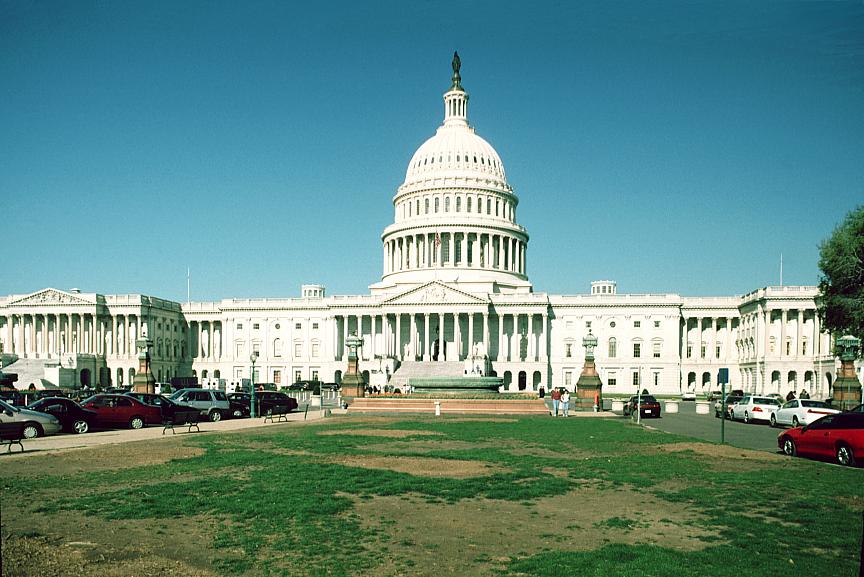
East Face, United States Capitol Building
The United States Capitol Building borrowed architectural elements from both Greeks and Romans. It was constructed of white marble, and has graceful columns and triangular pediments in emulation of Greek temples and in honor of Greek democracy. As a reminder of the ideals of Roman republicanism, it has a number of domed chambers that create un-encumbered interior spaces. The major dome retains a sense of classical simplicity, and clarity, but because it needed to be higher and more imposing than a round dome, it was built in the pointed ribbed vault style of Brunnelleschi's Early Renaissance Duomo.
Painting of the Romantic Period
The Art of Emotion
Late 18th century to mid 19th century
Introduction to the 19th Century
Well before the 18th century painters and sculptors had realistic naturalism nailed. They had developed ways to represent the full range of human appearance from idealized classical beauty to that of ordinary unidealized people. They could indicate psychological states, suggest the complex personality and the life of the mind that lay behind a face. All understood mathematical perspective and used it to generate highly believable interior scenes and landscapes. So what now?
Fortunately human inventiveness continued to flourish. Each new era's social, political, and technological changes spurred painters and sculptors to view the world in new ways. In keeping with the modern age and its penchant for change, the 19th century's new subject matter and styles came along more speedily than before. The first thing was Romanticism, the art of emotion.
Introduction to the Art of Emotion
Romanticism has very little to do with things popularly thought of as "romantic," although love may occasionally be the subject of Romantic art. Rather, it is an international artistic and philosophical movement that redefined the fundamental ways in which people in Western cultures thought about themselves and about their world. Introduction to Romanticism Lila Melani
The terms Romanticism and Romantic was an artistic movement that dominated visual arts, literature, and music by satisfying the craving of people to experience every kind of emotion and complex inner psychological state. Romantic paintings dealt with every human emotion and psychological state—romantic love, sentimentality, happiness, nostalgia, and humor, but also obsessive love, sadness, terror, and hideous brutality and mental instability. The darkest aspects of human psyche from madness to man's inhumanity to man were represented. As everyone knows human beings find the grim unpleasant side of human character to be especially fascinating.
Romanticism was at its high point from the late 18th century to mid-19th century. The French Revolution (1789-1799) and the Napoleonic Wars (1803-1815) brought about two-and-a-half decades of continent wide war that swept away all thoughts of the superiority of rationality and reason. The arts shifted away from Neoclassical rationality, clarity, and restraint, towards works that expressed an overwhelming outpouring of passion.
Expressionism and Romantic Compositional Effects
Arts of the Romantic period are highly expressive in style; artists trotted out every compositional effect that would intensify the emotional impact of the scenes they depicted. It was their goal to arouse an intense emotional response in the viewer and to convey their own feelings.
Expressive effects are of course not limited to the Romantic period—but in this time they were heaped on by the shovelfuls to intensify the mood.
- Remember that expressive images stress strongly emotional or deeply psychological states.
- They often use distorted shapes and exaggerated poses.
- They can have clashing and dynamic lines and shapes.
- Color is bold or strident.
Romantic paintings take advantage of all the expressive effects and the dramatic compositional and lighting effects developed in earlier periods to ramp up tension and/or heighten mood.
Drama
In Romantic paintings there are often dramatic storm clouds; scenes may be set at dramatic times of day, or in particularly poignant (causing a sharp sense of sadness, pity, or regret) and evocative (prompting vivid memories of things from the past) seasons of the year. For example, sunsets become reminders of life's end, storms may suggest inner turmoil. Figural compositions may be filled with writhing bodies, suggesting tension and struggle—or sometimes sensuality ( sensual suggests something sexually exciting or arousing passions of the body).
Color
Color always has expressive potential. Strong reds evoke strong emotions. The color is often associated with violence and blood; but at the same time, rich saturated reds impart an intense lush visual quality that can be very appealing to the eye. In some paintings this may induce us to be horrified and drawn in at the same time. Any juxtaposition of strong colors heightens emotions. Light soft pleasing colors (blues, grays, and greens for example) on the other hand suggest pleasant sensations like nostalgia for happy times.
Lines and Shapes Influence Mood
In compositions strong horizontal and vertical emphasis tend to suggest stability, permanence, or quiet. This simply means that when major elements of the composition run horizontally (from side to side) of the picture, and/or vertically (straight up and down), the overall effect will be one of quiet. Compositions in which figures or objects are organized the shape of a wide based triangle have the same effect (see Leonardo's Madonna of the Rocks, 1483-86). Horizon lines are good examples of horizontal emphasis. We have seen a number of images from other periods that illustrate these principles: Masaccio's Tribute Money and Chardin's Glass of Water and Coffee Pot for example.
On the other had if figures or objects in the composition are tipped up, tilted, or sloped at uncomfortable angles, the viewer will be aware of discomfort or tension in the subject represented. A predominance of wavy sinuous lines or shapes may impart a sense of sensuality; but may also suggest the eerie, or unexplained.
Crowded forms and lines all tumbled together at odd angles, especially there are short insistently repeated jagged zigzags tend to make the work edgy and agitated and impart a sense of uncertainty and apprehension.
REQUIRED VIEWING: The Style of Francisco Goya
How to Stir Passion about Insanity and Mans' Inhumanity to Man
The Spanish painter and printmaker Goya "was one of the earliest artists to see beneath the facade of rationality and expose the mind as the seat of irrationality." Madness and man's inhumanity to man were often his themes. Madness is the inner torment that our own mind's so cruelly inflict upon us. Man's inhumanity to man reflects the hideous sufferings we inflict upon others as a result of irrational beliefs in national superiority and religious righteousness. p. 214, Cole, Gealt, and Wood, Art of the Western World
Goya's very overt expression of his own strong feelings makes his work quintessentially Romantic. The Third of May 1808, 1814 was a response to the invasion of Spain by Napoleon in 1808. Nine brutal years of French occupation and consequent guerilla warfare brought hideous suffering and incomprehensible atrocities upon the Spanish populace.
The Third of May 1808 is Goya's own anguished outcry against man's inhumanity to man. It depicts a brutal execution of Spanish loyalists by Napoleon's troops. He intensified the drama of the event by depicting the massacre against the inky darkness of night. Faceless executioners mow down the patriotic martyrs including the central figure who flings out his arms in a crucifixion pose.
Goya treated greater horrors than straight forward murder. His prints from the Disasters of War speak for themselves as revelations of the artist's own deeply felt pessimism and profound despair about the darkest aspects of human psyche. The print this is worse, number 37, is from a series depicting war time brutality.
 |
| Goya, This is worse, #37, 1810-1820, The Disasters of War Art AstStor |
Goya also concerned himself with the mental instability. Insanity had not been a subject of art before this. In the Incantation, a print from Los Caprichos series we see a "...diabolical world of witchcraft and demons that tortures and confuses the mind. Dark and hideous, the conjurers loom over their victim. Are they a frightening hallucination, part of the midnight of the soul to which humankind is vulnerable, or are they real? For Goya, the two realities were the same: the deranged mind could victimize the body that it inhabited as easily as real witches could." Humanities Web
This fascination with madness and emotions pushing people over the edge was also a new subject of literature—think about the stories and poems of Edgar Allan Poe.
 |
| Géricault, Raft of the Medusa, 1819, oil on canvas, 16' x 23', Musée du Louvre, Paris Wikipedia |
The Raft of the Medusa was painted to record Gericault's anger about what happened to victims of the wreck of the ship Medusa in 1816. As a result of political incompetence and callousness, 149 people were abandoned on a flimsy raft that drifted undiscovered for two weeks. Only 15 survived. Géricault intended viewers to have visceral responses the horror, desperation, and cannibalism the survivors experienced. The painter, like all other Romantic artists, heightened the drama and emotional intensity of this colossal work. He ennobled the suffering with Michelangelo-like male nudes and dramatic poses rather than make it as squalid and direct as it must have really been.
Subjects of Romantic literature showed the contemporary passion for things foreign, exotic, supernatural, and from ancient times—think Mary Shelly's Frankenstein, Walter Scott's Ivanhoe, and poetry of Edgar Allen Poe.
Painters did it too. Delacroix depicted the foreign, exotic, and ancient times in works that titillate us with a dramatic juxtaposition of sensuality (see meaning of sensuality above) and horror. In this scene the ancient Persian king Sardanapalus prepares to commit suicide after a defeat in battle. The king (in white) reclines on a funeral pyre (pile wood used to burn dead bodies) covered with rich silk fabric, heaps of golden treasure, and the bodies of his favorite horses and concubines.
Romantic Landscapes
In the early 19th century, landscapes were a major venue for Romantic sentiments. Landscapes were not just objective representations of a particular location, but manifestations of the artist's own longing for times past, (nostalgia is always a dead give away of Romantic sentiment), heart swelling national pride, profound spiritual reflections, or some other strong emotion.
German painter Friedrich painted moody melancholy landscapes filled imaginative imagery. His Gothic ruins suggest his loneliness, sadness and sense of longing for the distant past.
Salisbury Cathedral from the Bishop's Grounds, 1825, is one of English painter John Constable's nostalgic views of the countryside around his home. His highly believable landscapes are Romantic because they express his own personal experience—his love of familiar places and memories of times past and loved ones now dead. In his case the memories are happy ones. These paintings are homage to a happy, and greatly missed, past.
 |
| Turner, The Slave Ship, 1840, oil on canvas, 35 3/4 x 48 1/4 in. Museum of Fine Arts, Boston
Wikipedia
|
Turner was another major English Romantic landscape painter. He wanted to capture atmospheric effects and fleeting optical sensations rather than describing objects exactly which gives his work an abstract impressionistic quality. Much of his work is abstract in that his pictures have a simplified unfocused quality. The way he uses color and his very noticeable brush marks makes his work very expressive. Turner did much of his landscape painting out of doors while actually looking at the scenery. He was the first major painter to do this.
This dramatic highly expressive landscape called The Slave Ship depicts dead and dying slaves being cast into the ocean. He makes the ship barely visible; instead he suggests that nature itself rises in revulsion at the event by the turmoil of sea and sky.
Turner was a master of achingly beautiful landscapes that feature lots of dramatic sky as well as spectacularly expressive use of color. He was equally entranced by contemporary events and nostalgia for the past. The Téméraire was sailing ship that had valiantly defended Britain against the French in the Napoleonic Wars. By 1838 this noble vessel was no more than a rotting hulk to be towed to the wrecking yards; a sad end for an historic and noble craft.
Humor in Romantic Painting
Romantic art may also be full of mock horror and leg pulling humor; they are also very much part of human emotions.
The American Romantic author Washington Irving made his readers alternately laugh and shiver. His short story The Legend of Sleepy Hollow tells of how Icabod Crane, an unpopular school teacher, was made a figure of fun. Brom Bones, Crane's rival for the local beauty, scared Crane out of town by pretending to be the legendary ghost of the Headless Horseman.
John Quidor, an American Romantic painter depicts Brom Bones in the roll of the Headless Horseman flinging a pumpkin at Icabod Crane. Crane believing it is the real head of the local ghost flees in terror.
Painting of the Realist Movement
Mid-19th Century
REQUIRED VIEWING: Information about the Revenge of the Nice is at the end of this lecture. Read the Realism and Impressionism Lectures before you watch the video.
Realism (spelled with a capital R) was the next major movement to develop after Romanticism. Starting about mid-century in France, Realism depicted common place and often gritty themes. It presented everyday situations and dilemmas that were true reflections of the lives of craftsmen, urban laborers and peasants (rural laborers), and the very poor without any of Romanticism's drama, theatricality, or classical forms in order to accurately show the reality of life.
In this case 'Realism' and 'Realist' refer to a specific major historic art movement, as such these words should be capitalized.
French Realists tended to be revolutionaries with socialist tendencies who responded to the failure of European governments to deal with pressing social needs. They promoted social consciousness with strong gritty themes that were often shocking to middle-class viewers. Realist style was shocking too; artists were not concerned with conventional standards of beauty and their painting techniques were sometimes crude by contemporary standards.
Gericault's Raft of the Medusa had been an outcry against the insensitivity of government to the plight of its least influential citizens. But it is not 'Realist' in style, because it ennobles the suffering with classical poses and dramatic gestures. It is the same with Goya's Third of May, 1808. Goya referred to his about-to-be massacred Spanish patriot in terms of Christian religious iconography of past ages. Realists thought the suffering of the working class and poor should be presented in its unvarnished state. They wanted to rub the noses of the middle and upper class viewers in the suffering of the less fortunate. (Middle class referred to merchants, businessmen, prosperous farmers, professional people.)
By mid 19th century great art was no longer used to aggrandize monarchy, aristocracy, or religion. Subject matter was irrevocably directed toward modern experience and lives of ordinary people, even the desperately poor.
Daumier's Third Class Carriage depicts worn hardworking French peasant women being ignored by the other more prosperous travelers in a crowded railway car.
Daumier was not, strictly speaking, a Realist painter. He is best known as a caricaturist, and sculptor, and a political and social satirist. Most of his work was anti-government political cartoons.
Gustave Courbet (pronounce Core-bay), 1819 - 1877
 |
| Courbet, Stonebreakers, 1849, 1.6x2.6m, [formerly Gemaldegalerie, Dresden; destroyed in 1945] |
Courbet is the most famous French Realist; he even coined the term Realism. "Courbet believed the realist artist's mission was the pursuit of truth which would help erase social contradictions and imbalances." Courbet, Wikipedia
One notable Realist work is the Stonebreakers. The figures in this five- foot-by-eight-foot painting are life-size and shoved right up to the picture plane (surface of the canvas) because Courbet wanted viewing it to be very much an 'in your face' experience. He wanted the well-fed and well-to-do middle-class viewer to be unable to avoid noticing the squalor and futility of peasant labor depicted here. This is gritty unpleasant Realism.
There is no way anybody could make any where near an adequate a living crushing stones by hand. There is no drama, no theatricality here, only desperate hardship. Like Goya, Courbet makes the point that art is not always about beauty; it may be confrontational as well as intellectually and emotionally demanding.
Courbet, and his Realist contemporary, Millet, made his subjects universal by making them anonymous; that is, figures are faceless. They represent the vast army of nameless wretchedly poor people who struggle to make the barest living by doing backbreaking work.
Jean-Francois Millet (pronounced Mill-ay)
 |
| Millet, The Gleaners, 1857, oil on canvas, 83.7 x 111 cm, Musée d'Orsay, Paris |
Millet's Gleaners follow the reapers through the fields gathering fallen grain by hand. Gleaning was a traditional right of the very poor.
REQUIRED VIEWING: Matthew Collings: Impressionism, Revenge of the Nice . 1 hour 40 minutes
Impressionism, Revenge of the Nice is about Gustave Courbet, Edouard Manet, and Claude Monet and their roles in late 19th century painting. It puts the artists and their work in an historical context; and by talking about life in France it reminds us how life and contemporary circumstances can affect the development of the arts.It sums up late 19th century painting and shows ways it relates to the seemingly very different arts of the 20th century.
Read the lectures on Realism and Impressionism before you watch this video. You will understand the material much better if you have already read the lectures. It is about 1 hour and 30 minutes viewing time.
The video discusses the lives and works of
- Gustave Courbet (Pronounced Core-bay) 1819-1877
- Edouard Manet (Pronounced Man-ay) 1832-1883,
- Claude Monet (Pronounced Mowm-ay) 1840-1926
Impressionism
Mid 1870s into the Early 20th Century
Impressionism, the next a major French movement to affect Western art, flourished from the 1870s into the early 20th century. Impressionists carried on the Realist interest in representing real contemporary life and being "true to nature," but their subject matter was not gritty or confronting. Impressionists chose to depict middle-class leisure pursuits and sunny landscapes.
Impressionists were going for the appearance of spontaneity; they tended to use light bright colors and attempted to capture fleeting effects of sunlight by applying paint with quick, short, choppy brush strokes. Paintings tended to be highly textured, that means the pigment was applied in thick easily visible strokes. Figures were often caught in spontaneous movement and seen from unusual vantage points.
Impressionism and the Outdoors
Impressionists were the first group of artists to actually go outside to paint landscapes on site. Like Turner, Impressionists were committed to capturing fleeting optical sensations and atmospheric effects that you could only get by being outside in the elements and working fast. They were especially concerned with the constantly changing play of sunlight on vegetation and water. Their intention was to capture the impression of an experience rather than all the details.
The very first painting to be called 'Impressionist' was Monet's Impression Sunrise, 1873 that captures the impression of an urban river scene in the very early, very misty morning.
|
- To see paintings of Monet and other artists in this lecture click on the highlighted name of the artist.
|
Claude Monet (pronounced mown-ay), 1840 - 1926
 |
| Monet, Impression Sunrise, 1873, oil on canvas, 48 x 63 cm, Musée Marmottan, Paris Artstor |
Impressionists were going for the appearance of spontaneity; they tended to use light bright colors and attempted to capture fleeting effects of sunlight by applying paint with quick, short, choppy brush strokes. Their brush strokes are easily visible.
 |
| Monet, The Cliffs at Etretat, 1885, Oil on canvas, 65 x 81.1 cm, Clark Art Institute, Williamstown, MA Wikipedia |
By the 19th century new styles and movements were coming along every decade or so. It became common for a painter to work in several styles in the course of a life time. All the Impressionists had established careers working in other styles long before they took up Impressionism. Some later abandoned Impressionism for other new styles.
Renoir's paintings (above and below) depict the second major theme of Impressionists, middle class leisure. Renoir's appealing casual scenes of outdoor luncheon parties on the river and dances in the public parks of Paris are typical of this kind of work. In these scenes figures are caught in spontaneous movement and seen from unusual vantage points.
Even though these are figure paintings, the preference for light sunny settings is still there. In Dance at the Moulin de la Galette there is clear evidence of the dappled effects of sunlight filtered through the trees.
Impressionist paintings have an abstract, unfocused quality, and are lacking in detail. They and are intended to be quick impressions of a scene. No effort is made to hide brush marks, it is intended that you notice the blobs and dashes of pigment on canvas that seem to radiate and vibrate in the sunlight.
Edgar Degas (pronounced day-gah), 1834 - 1917
 |
 |
| Degas, Musicians in the Orchestra, 1872, Oil on canvas. 69 x 49 c, Städelsches Kunstinstitut, Frankfurt am Main Wikipedia |
Degas, The Ballet Lesson, 1872, Oil on canvas, 69 x 49 cm, Stadelsches Kunstinstitut, Frankfurt am Main Wikipedia |
New Technology and Impressionism
Modern technology was a boon to Impressionists. For one thing it was now easy to paint outdoors (plein air painting) because paints were now commercially available in tubes. Also by this time painters were using photography as a tool. From photography Degas and other Impressionists adopted informal, casual, snapshot-like compositions. Also from photography they got the idea of viewing figures from unusual vantage points. In Musicians in the Orchestra, Degas gives us a view of the stage over the shoulders of the musicians. In La Repetition Degas left the center of the picture empty and casually cropped the right side of the picture thereby cutting the dancers in half—a common characteristic of casual photographs. In The Ballet Lesson dancers and ballet master straggle diagonally across the composition paying no attention to the viewer, not posing formally, but just going about their practice as they would if Degas had been snapping pictures of them.