|
No
Technology For ME
Stephanie Hoke
Assistant Editor
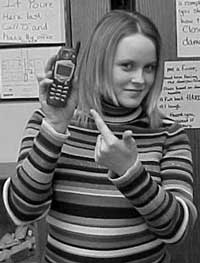
Lately, I feel like I live in a technologically stunted bubble.
Everywhere I look, people are talking on their cell phones or checking
their pagers. And a lot of the people are answering pages on their cell
phone. I ask, why do they need both? Actually, I wonder why they need
any of it.
I understand the need for technology for emergency reasons, hence the
phones. But I feel that pagers do not serve as an acceptable mode for
communication, because you must still find a phone to contact the people
who were trying to contact you in the first place. In the end this
method ends up costing people more money than it is worth. After having
a pager for a month, I quickly realized the huge downfall to the device.
I have been told that I need a cell phone so I can be more accessible to
people. That sounds reasonable, but who says that I want to be
accessible all of the time? If there is something that I feel cannot
wait until I get home, then I can use a pay phone. I have never found
this to be a problem.
It also seems that this modern “convenient” technology leads to a lot
more stress and problems than necessary. Having a cell phone means
receiving calls from people that you have no interest in talking to. So
calls are ignored, and lies are told about a “problem” with the phone.
Or, ringers are turned off, leading to a call being missed that
otherwise would not have been.
Do not get me wrong; I think some of the phones out now are really cute,
but very expensive. Most of the time, it seems like what one person has
is not as good
as what someone else has. There also seems to be so many accessories for
what I thought was supposed to be simple and convenient. I thought it
was really funny when I saw an emergency power source for cell phones.
Aren’t the cell phones supposed to be for emergencies? Or at least it
seemed to start that way.
As of now, I still see no real need buy a phone to carry around. I have
come to this conclusion because I know that my bill would be through the
roof, and I am financially strapped as it is. No, for now, I will
continue to make and receive calls from the comfort of my home.
May I also mention that since I still live with my parents, I have the
added bonus having a of mother who doubles as my voicemail. So if you
need me, leave a message after her greeting.
Top
Place Your Advertisement Here
|
|
|
A Compromise to
Censorship
Amy Porter
EDITOR
“In the preliminaries to the 1996 presidential campaign,
Senate majority leader Bob Dole, a presidential hopeful, attacked
record-makers in a bid to rally support. In his early posturing, Dole said,
“We must hold Hollywood and the entire entertainment industry responsible
for putting profit before common decency.”(John Vivian, The Media of Mass
Communication, Allyn and Bacon)”
And how does one define common decency? And if a simple, concise and specific definition could be reached
would all interested parties share that definition? The conclusion I draw
from this conundrum is: absolutely not.
decency? And if a simple, concise and specific definition could be reached
would all interested parties share that definition? The conclusion I draw
from this conundrum is: absolutely not.
First, I do not believe it is possible to create a definition of common
decency that would 1.) totally encompass all forms of media and 2.) give the
appropriate amount of credit due to those pieces of art, literature, film,
music, etc. that uses amoral subject matter to show a distinctly moral
lesson.
Second, what a person decides within himself or herself to be appropriate or
inappropriate is completely subjective to that person. It had to do with
that person’s background, lifestyle, family, religion or lack thereof,
experiences and any number of other circumstances. The level of
appropriateness may also be subject to the special circumstance in which the
potentially offensive subject matter is presented. For example, a film that
is appropriate for a college-level film-appreciation class may not be
appropriate for a third grader’s birthday party.
Third, as a “free, white and 21” member of society with my own morals, ideas
and intellect, who has the right to tell me what I can and cannot see, hear,
read or listen to? All of the movies in my personal library are rated R, if
they are rated at all. This is not due to a specific enjoyment to four
letter words, sex, violence, explicit drug use or any other of the reasons
for these rating, but I still believe them all to be great movies. A perfect
example is “Requiem for a Dream,” which outlines the gory details of four
drug addicts. The overall message is perfectly clear: a life of drugs will
end in nothing but death and despair. In getting to that point, the movie
outlines a great number of horrible, if not offensive scenes. I find this
film to show a very hard lesson that is important for today’s youth to be
aware of, but I wouldn’t let my baby sister watch it until she was mature
enough, in my mind, to handle all of it.
Censorship oversteps boundaries that parents should be setting. If the Harry
Potter Series inspires my ten-year-old cousin to read something more
literately appealing than the instructions to a Playstation 2 game, then so
be it. I’m not so concerned that this exposure is going to send him straight
into a coven that I feel the need to speak out against this series, which I
enjoy. And if it did, once he was mature enough to make such a decision, I
would support that whole-heartedly.
What one generation sees as “the thing to do,” the next generation sees as
the work of the devil. Classical and Jazz music were both seen as heresy in
their day. Huckleberry Finn has been ripped from shelves all over the
country for the dreaded “N” word. As if ignoring the fact that at one point
such as word was an unfortunate yet acceptable part of American culture will
do anything to its history. That book is not about four letter words, but it
uses them. Does it thereby lose its validity?
The biggest issue is to determine what is appropriate. This should be done
on a case-by-case basis, rather than a grand, impersonal, sweeping decision.
The best person to determine whether or not something is appropriate for a
child is the parent of that child. For the unfortunate masses of children
with parents that are tuned out to begin with, a “may not by suitable”
sticker isn’t going to have any effect, as the child can just as easily
download the album off the Internet as they could buy it, to begin with.
Lyrics are the least of the problems this child may face.
Unfortunately, there will never be a perfect system. There is a time and a
place for nearly everything, and it is my hope that those things should stay
at those times in those places and nowhere else. But who is to say where
that place and time exist?
Top
|